Quick Answer
German etiquette is built around respect for personal space, clear communication, and reliability: greet properly, use Sie until invited to switch, be punctual, keep noise down in shared spaces, and follow simple table and workplace norms. These customs are consistent across German-speaking Europe, with small regional differences in formality and directness.
German etiquette and customs mostly come down to predictability and respect: greet people clearly, use Sie until you are invited to switch to du, be punctual, keep noise down in shared spaces, and follow straightforward dining and workplace norms.
If you want the language side to match the social rules, pair this with how to say hello in German and how to say goodbye in German.
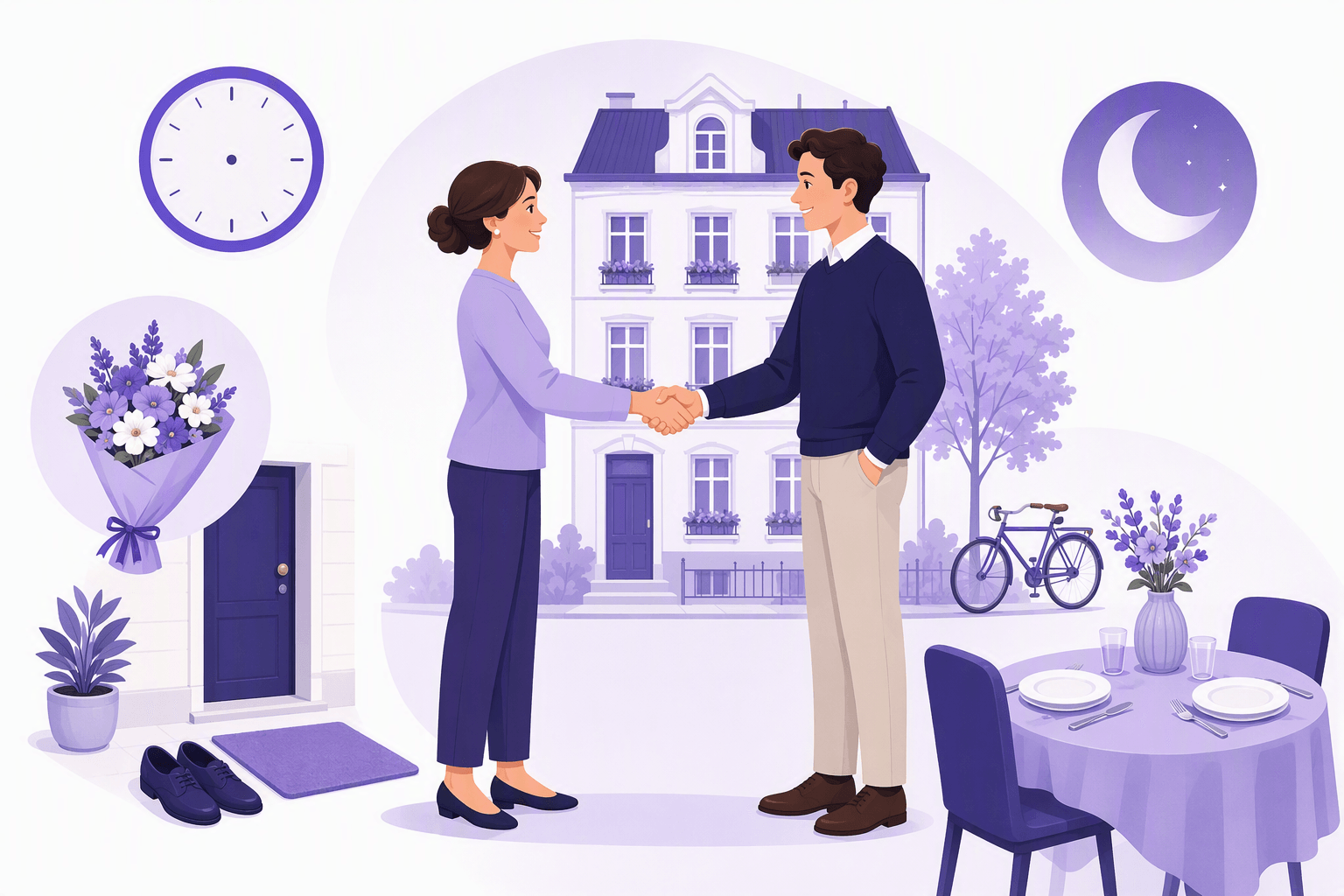
Why German etiquette feels different (and why it is consistent)
A lot of what visitors call "German manners" is really a shared preference for clear boundaries and reliability.
Deborah Tannen’s work on conversational style is useful context: cultures differ in how much they value explicitness vs indirectness, and German interaction often rewards clarity over hinting. That can feel blunt if you come from a more indirect norm, even when nobody is upset.
There is also a scale factor. Germany has about 84 million residents, and German is used across multiple countries and regions. Ethnologue estimates roughly 90 million native speakers of German worldwide (Ethnologue, 27th ed., 2024), so stable norms help interactions run smoothly across dialects and borders.
Greetings: what matters more than the exact words
In Germany, greetings are less about warmth and more about acknowledging the other person properly.
You do not need big small talk. You do need eye contact, a clear greeting, and the right level of formality.
Handshakes, personal space, and eye contact
A brief handshake is still common in professional contexts and first introductions. It is typically firm, not crushing, and short.
Personal space is respected. Standing very close, touching someone’s arm repeatedly, or hugging on first meeting can feel intrusive.
💡 A safe default
Say "Guten Tag" (GOO-ten TAHK), make eye contact, and keep your distance. If the other person offers a handshake, mirror it.
Titles and last names
In formal situations, last names and titles matter more than many visitors expect.
"Herr" (hehr) and "Frau" (frow) plus the last name is common in emails, appointments, and when speaking to officials. Academic titles can be used if you know them, especially "Herr Doktor" or "Frau Doktor".
Sie vs du: the rule that controls everything
If you learn one etiquette rule for German-speaking contexts, learn this: start with Sie unless you have a clear reason not to.
- Sie (ZEE) is the polite, formal "you".
- du (doo) is the informal "you".
Using du too early can feel pushy or overly familiar. Using Sie too long is rarely offensive, it can just feel distant.
How the switch happens
Often, the older person, higher-status person, or host initiates the switch.
A common explicit line is Wollen wir du sagen? (VOLL-en veer doo ZAH-gen), literally "Do we want to say du?"
In many modern workplaces, colleagues use du quickly. With clients, government offices, healthcare, and older strangers, Sie is still the safer choice.
The "first name but Sie" combination
German has a combination that surprises learners: first name plus Sie can happen in some workplaces or service settings. It signals friendliness without full informality.
If someone signs an email "Viele Grüße, Anna" but still writes Sie, mirror their level until they clearly invite du.
Punctuality: what "on time" really means
Punctuality is one of the most stable expectations in German-speaking contexts.
For appointments, arriving exactly on time is fine, and arriving a few minutes early is often better. Arriving late without notice can be read as disrespectful because it wastes the other person’s planned time.
For private invitations, the rule is softer. Still, showing up very late can create stress for the host, especially if food is timed.
🌍 Why punctuality carries social meaning
In many German contexts, punctuality is treated as a sign of reliability, not enthusiasm. It is less about impressing people and more about showing you can be counted on.
Quiet hours (Ruhezeiten) and shared-space etiquette
Germany has a strong culture of respecting neighbors, especially in apartment buildings.
"Ruhe" (ROO-uh) means quiet. You will hear "Ruhezeiten" used for building rules, local regulations, or everyday expectations.
What people expect you not to do
Exact rules vary by region and building, but the expectations are consistent:
- Avoid loud music late at night.
- Avoid drilling, hammering, or vacuuming during posted quiet times.
- Keep stairwell conversations short and quiet.
- Do not slam doors, especially in shared hallways.
If you live in an apartment, ask for the Hausordnung (HOWSS-OR-doong), the house rules. It often lists quiet times, recycling rules, and what belongs where.
⚠️ The fastest way to annoy neighbors
Noise complaints are one of the most common sources of conflict in apartment living. If you are unsure, assume your neighbors can hear more than you think, especially in older buildings.
Sundays and holidays
Many people treat Sundays and public holidays as rest days. Even where the law is not the point, the social expectation can be.
If you want to do something noisy, ask first. A quick "Passt es, wenn ich kurz bohre?" (PAHST ess, venn ish koortz BOH-ruh), meaning "Is it OK if I drill briefly?", goes a long way.
Public behavior: queues, transit, and "don’t block the way"
German public-space etiquette is practical. The goal is to keep things moving.
If you follow one principle, make it this: do not create friction for other people.

Queuing and turn-taking
People queue in a fairly strict way, even when the line is not marked.
Cutting in line is noticed. If you are unsure who is next, ask "Wer ist der Letzte?" (vehr ist dehr LETS-tuh), meaning "Who is last?"
Escalators and sidewalks
In many cities, the norm is stand on the right, pass on the left on escalators. The same logic often applies on sidewalks and in station corridors.
If you stop to check your phone, step aside. Blocking the flow reads as inconsiderate.
Public transport volume
Phone calls on trains happen, but loud calls are frowned on. Keep your voice low.
If you are watching something, use headphones. This is especially important on regional trains and long-distance trains where people work or rest.
Dining etiquette: simple rules that matter
German table manners are not complicated, but they are consistent.
If you are used to very informal dining, the biggest change is pacing and structure.
Seating, starting, and "Guten Appetit"
In many settings, you wait until everyone has food before starting. Someone often says Guten Appetit (GOO-ten ah-peh-TEET) before the first bite.
If you are a guest, wait for the host to signal the start. If you are unsure, follow the slowest person at the table.
Cutlery and hands
Keep your hands visible, not in your lap. In more traditional settings, elbows off the table is still a norm.
Knife and fork use is common even for foods that might be finger food elsewhere. If you are not sure, mirror what others do.
Paying and splitting
In casual restaurants, splitting the bill is common, and servers often ask individually. You can say "Getrennt, bitte" (geh-TRENT, BIT-tuh), meaning "Separate, please."
Do not assume one person will automatically pay for everyone, unless it is clearly an invitation.
For more language you can use at the table, see German travel phrases.
Visiting someone’s home: gifts, shoes, and the doorbell moment
Home etiquette is where small details matter most.
The good news is that Germans usually appreciate straightforward, low-drama politeness.
Bringing something
If you are invited for dinner, bring something small: flowers, chocolates, or a bottle of wine (if you know they drink). Avoid very expensive gifts, which can feel awkward.
If you bring flowers, many people avoid giving an even number in some contexts, but this is not universal. The safer move is simply to bring a modest bouquet and a friendly note.
Shoes
Many households prefer shoes off indoors, especially in apartments. Watch what the host does and follow.
If you want to be polite, you can ask: "Soll ich die Schuhe ausziehen?" (zoll ish dee SHOO-uh OWS-tseen), meaning "Should I take my shoes off?"
Leaving
Goodbyes can be brief. A clear thanks is valued more than a long emotional exit.
A simple "Danke für die Einladung" (DAHN-kuh fuer dee IN-lah-doong), meaning "Thanks for the invitation," is perfect.
Workplace etiquette: meetings, emails, and feedback
German workplace culture varies by industry and company, but some patterns are common.
Directness and planning tend to be rewarded. Vagueness tends to create friction.
Meetings and preparation
Meetings often have an agenda, explicit decisions, and follow-ups. If you have a point, say it clearly and early.
If you are late, acknowledge it briefly and move on. Long excuses can feel like wasting more time.
Email tone and structure
German business emails can be more formal than English ones, especially outside startups.
Common openings include "Guten Tag" (GOO-ten TAHK) or "Sehr geehrte(r) ..." (zehr guh-EHR-tuh), meaning "Dear ...", for more formal contexts. Closings like "Mit freundlichen Grüßen" are standard.
If you want a broader language overview that explains why formality shows up in grammar and pronouns, see German language overview.
Feedback style
Feedback can be straightforward. Many Germans prefer to name the problem clearly, then fix it.
This aligns with what intercultural communication research often highlights: different cultures distribute "softening" differently. If you are used to more cushioning, focus on content, not perceived tone.
💡 A practical response to direct feedback
Repeat the point back, confirm the next step, and ask one clarifying question. This reads as competent and cooperative, even if the delivery felt blunt.
Regional differences: Germany, Austria, Switzerland
Etiquette norms are broadly similar across German-speaking Europe, but there are differences in rhythm and formality.
Austria can feel a bit more formal in service encounters, and Switzerland can feel more reserved in public spaces. Dialect also changes how "polite" something sounds, even when the words are equivalent.
If you are traveling across regions, the safest approach is to start slightly more formal, then adjust.
For language differences that go beyond etiquette, the German pronunciation guide helps you hear what is accent vs what is a different word choice.
Common mistakes visitors make (and how to fix them fast)
Most etiquette problems are not moral failures, they are mismatched expectations.
Here are the ones that cause the most friction, and the simplest fixes.
Switching to du too early
Fix: use Sie until invited, and do not pressure the switch. If you accidentally use du, you can correct yourself and move on.
Being "friendly loud" in quiet spaces
Fix: lower your voice on trains, in stairwells, and late at night. If you are with friends, move the conversation outside.
Treating rules as optional suggestions
Fix: if there is a posted rule, follow it. This includes recycling rules, quiet times, and building signage.
Over-apologizing
Fix: one clear apology plus a solution is better than repeated apologies. If you bump someone, "Entschuldigung" (ent-SHOOL-dee-goong) is enough.
If you want more everyday phrases that match polite behavior, German idioms and expressions is a good next step.
How to learn etiquette from movies and TV (without copying the wrong stuff)
Movies and shows are great for etiquette because you can see timing, distance, and tone, not just words.
The trick is to watch for repeated patterns: how people greet in offices, how they open emails on screen, how they complain to neighbors, and what they say when they leave.
Also watch genre. A crime show will exaggerate confrontation, and a comedy will exaggerate awkwardness.
For a practical method, use the clip-first approach described in how to learn a language with movies: pick short scenes, replay them, and copy the exact phrasing and intonation for that situation.
A simple "do this, avoid that" checklist
If you want a quick mental model:
- Do: greet clearly, make eye contact, keep a bit of distance.
- Do: use Sie by default, and wait for du to be offered.
- Do: arrive on time, or message early if you will be late.
- Do: respect quiet times and shared spaces.
- Avoid: loud calls on transit, blocking walkways, and casual du with strangers.
Once you have these basics, German etiquette stops feeling strict and starts feeling predictable.
If you want to practice the phrases that show politeness in real scenes, Wordy’s German clips make it easy to hear how natives actually say "bitte", "danke", and "Entschuldigung" in context.
Frequently Asked Questions
Are Germans really that strict about punctuality?
When should I use Sie vs du in German?
Is it rude to be direct in Germany?
What are German quiet hours (Ruhezeiten)?
What is the most polite way to greet someone in German?
Sources & References
- Goethe-Institut, culture and daily-life resources, accessed 2026
- Duden, online dictionary and usage notes (Sie/du, greetings), accessed 2026
- Auswärtiges Amt (Federal Foreign Office), travel and country information, accessed 2026
- Ethnologue, 27th edition, 2024
- Institut für Deutsche Sprache (IDS), language information resources, accessed 2026
Start learning with Wordy
Watch real movie clips and build your vocabulary as you go. Free to download.


