German Idioms and Expressions: 35 Sayings You’ll Actually Hear (With Pronunciation)
Quick Answer
German idioms are fixed expressions that rarely translate word-for-word. If you learn the most common ones, like 'Ich verstehe nur Bahnhof' and 'Daumen drücken', you will understand everyday conversations faster and sound more natural in German-speaking countries.
German idioms and expressions are fixed phrases Germans use to react fast, add humor, and signal social closeness, and learning a core set of them helps you understand real conversations far more than literal translation ever will.
German is also a high-value language to learn: Ethnologue estimates about 90 million native speakers and roughly 130 million total speakers worldwide, spread across Germany, Austria, Switzerland, and other communities. If you already have basics like greetings and farewells, idioms are one of the quickest ways to sound less textbook and more human, especially in TV and movie dialogue.
If you want a warm-up first, review how to say hello in German and how to say goodbye in German. Then come back here and start noticing how often native speakers lean on set phrases.
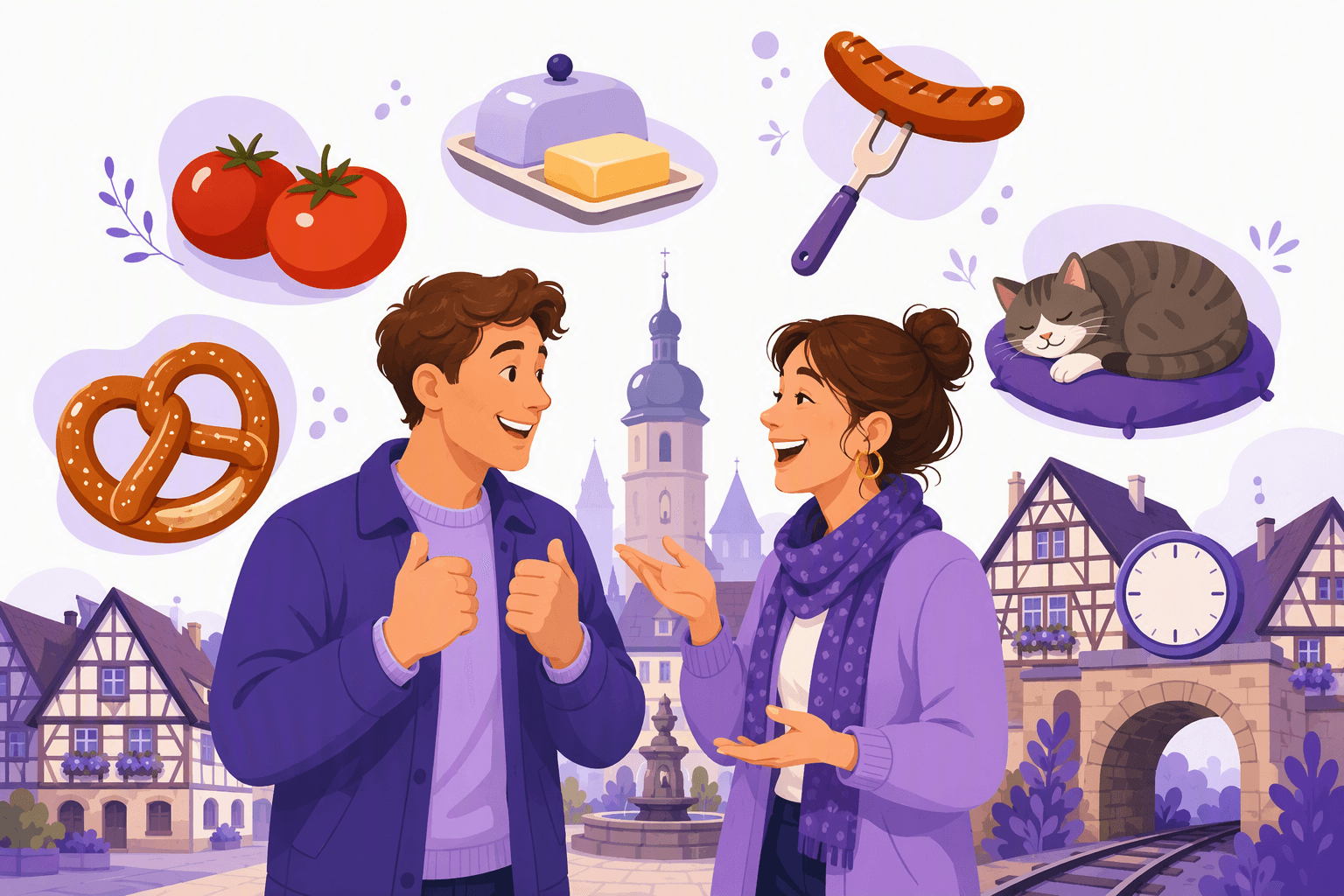
What counts as an idiom in German (and why it matters)
An idiom (Redewendung) is a conventional expression whose meaning is not fully predictable from the individual words. Duden’s Redewendungen entries are a good reality check: if a phrase is listed there, it is usually common enough to be worth learning.
Idioms matter because they are processing shortcuts. In conversation, people do not build every sentence from scratch, they reuse chunks, which is a core idea in phraseology research associated with scholars like Alison Wray (work on formulaic language) and Harald Burger (work on German phraseology).
How to learn idioms without memorizing 1,000 random sayings
Focus on high-frequency situations: confusion, encouragement, annoyance, surprise, and reassurance. Those show up constantly in dialogue, especially in workplace scenes, family arguments, and comedy.
Also learn the “frame” around the idiom. Many idioms prefer certain verbs or pronouns, and if you copy the whole pattern, you will sound natural faster.
💡 A practical rule
If you cannot imagine yourself saying it out loud this week, skip it for now. Idioms work best when they match your real life: exams, work deadlines, dating, travel, and friendships.
35 German idioms and expressions you will actually hear
Below are idioms that are widely understood in Standard German. A few have light regional flavor, and I call that out when it matters.
Daumen drücken
Pronunciation: DOW-men DRUEK-en
Meaning: To keep your fingers crossed for someone.
Use it when someone has an exam, interview, date, or medical appointment. Germans literally “press thumbs” for luck.
/DOW-men DRUEK-en/
Literal meaning: To press thumbs
“Ich drücke dir die Daumen für das Vorstellungsgespräch.”
I'm keeping my fingers crossed for your interview.
Very common and friendly. You can say it to friends, coworkers, and family. With strangers, add a polite tone: 'Ich drücke Ihnen die Daumen'.
Ich verstehe nur Bahnhof
Pronunciation: ikh fer-SHTEH-uh noor BAHN-hohf
Meaning: I do not understand anything.
It is stronger than “Wie bitte?” and often used when someone explains something too fast or too technically.
/ikh fer-SHTEH-uh noor BAHN-hohf/
Literal meaning: I only understand train station
“Kannst du das nochmal erklären? Ich verstehe nur Bahnhof.”
Can you explain that again? I don't understand a thing.
Often said with a half-laugh to soften the confession of confusion. In formal settings, you can switch to 'Ich habe das nicht ganz verstanden'.
Alles in Butter
Pronunciation: AH-less in BOO-ter
Meaning: Everything is fine.
It is a reassuring phrase, used after a small problem or when someone worries.
Jetzt geht’s um die Wurst
Pronunciation: yetst GAYTS oom dee VOORST
Meaning: Now it is crunch time, now it really matters.
You hear it in sports, exams, negotiations, and deadlines. It is informal but not rude.
Das ist nicht mein Bier
Pronunciation: dahss ist nikht mine BEER
Meaning: Not my problem, not my responsibility.
This can sound dismissive, so use it carefully. It is fine among friends, risky at work.
Tomaten auf den Augen haben
Pronunciation: toh-MAH-ten owf den OW-gen HAH-ben
Meaning: To miss something obvious.
Use it when someone cannot find the keys that are right in front of them.
Jemandem einen Korb geben
Pronunciation: YEH-man-dem EYE-nen korp GAY-ben
Meaning: To reject someone romantically.
It is common in dating talk, but it can feel blunt if said directly to the person.
Ich bin fix und fertig
Pronunciation: ikh bin fiks oont FEHR-tikh
Meaning: I am exhausted.
This is everyday spoken German. You will hear it after work, travel, or stressful days.
Das ist mir Wurst
Pronunciation: dahss ist meer VOORST
Meaning: I do not care either way.
It can sound indifferent. If you want softer, say “Mir ist das egal” in a neutral tone.
Das ist mir schnuppe
Pronunciation: dahss ist meer SHNOO-peh
Meaning: I do not care.
Similar to “Das ist mir Wurst”, often a bit playful.
Da liegt der Hund begraben
Pronunciation: dah leekt der hoont beh-GRAH-ben
Meaning: That is the real issue, that is the core of the problem.
This is useful in meetings when you want to point to the underlying cause.
Ich glaub, es hackt
Pronunciation: ikh glowp ess hahkt
Meaning: You have got to be kidding.
It expresses annoyance or disbelief. Keep it for informal contexts.
Das kann doch nicht wahr sein
Pronunciation: dahss kahn dokh nikht vahr zine
Meaning: That cannot be true.
Common reaction to bad luck, bureaucracy, or surprising news.
Das ist der Hammer
Pronunciation: dahss ist der HAH-mer
Meaning: That is amazing, that is wild.
Tone decides whether it is positive or sarcastic. In comedy, sarcasm is common.
Auf keinen Fall
Pronunciation: owf KINE-en fahl
Meaning: No way.
Very common and safe. For extra emphasis: “Auf gar keinen Fall.”
Das ist nicht ohne
Pronunciation: dahss ist nikht OH-neh
Meaning: That is not easy, that is serious.
People use it for difficult tasks, intense situations, or surprisingly strong effects.
Ich bin dabei
Pronunciation: ikh bin dah-BYE
Meaning: I am in, I will join.
Great for plans and invitations. It is casual but normal at work too.
Ich bin raus
Pronunciation: ikh bin rows
Meaning: I am out.
You hear it in group chats, plans, or when someone quits a discussion.
Das ist nicht mein Ding
Pronunciation: dahss ist nikht mine DING
Meaning: That is not my thing.
A polite way to decline activities without sounding judgmental.
Das ist nicht so mein Fall
Pronunciation: dahss ist nikht zoh mine fahl
Meaning: I am not really into it.
Slightly softer than “nicht mein Ding”, often used about movies, music, or food.
Da steppt der Bär
Pronunciation: dah shtaypt der BEHR
Meaning: That place is going to be lively.
You might hear it about parties, festivals, or busy bars. It can sound a bit old-fashioned, but still recognizable.
Ich mach mir keinen Kopf
Pronunciation: ikh mahkh meer KINE-en kopf
Meaning: I am not stressing about it.
Useful when reassuring someone. It signals calm, sometimes stubborn calm.
Das ist mir durchgerutscht
Pronunciation: dahss ist meer DOORKH-geh-rootsht
Meaning: That slipped my mind.
A common excuse for forgetting an email or task. It is more natural than a direct “Ich habe es vergessen.”
Ich habe die Nase voll
Pronunciation: ikh HAH-beh dee NAH-zeh fohl
Meaning: I am fed up.
Strong emotion, but not obscene. If you want a milder version: “Ich habe genug.”
Das geht mir auf die Nerven
Pronunciation: dahss gayt meer owf dee NEHR-ven
Meaning: That is getting on my nerves.
Very common. At work, consider softer: “Das ist etwas nervig.”
Das ist ein alter Hut
Pronunciation: dahss ist ine AHL-ter hoot
Meaning: That is old news.
Good for repeated topics or ideas that are no longer exciting.
Das ist Schnee von gestern
Pronunciation: dahss ist shnay fon GES-tern
Meaning: That is yesterday’s news, it is in the past.
It can be dismissive, but it is common in relationship talk and arguments.
Jemandem auf den Keks gehen
Pronunciation: YEH-man-dem owf den keks GAY-en
Meaning: To annoy someone.
It is informal and often used with humor. “Keks” makes it sound less aggressive.
Ich habe einen Kater
Pronunciation: ikh HAH-beh EYE-nen KAH-ter
Meaning: I have a hangover.
Literally “tomcat”. Very common after parties.
🌍 A small cultural trap
In German, Kater is a hangover. In English, “cat” does not mean hangover. If you translate literally, you will confuse people. This is exactly why idioms are best learned as whole units.
Ich bin auf dem Holzweg
Pronunciation: ikh bin owf dem HOLTS-vayk
Meaning: I am on the wrong track.
Useful when you realize your assumption was wrong. It is a nice self-correction phrase.
Das ist ein Kinderspiel
Pronunciation: dahss ist ine KIN-der-shpeel
Meaning: That is child’s play, very easy.
It is casual, and can sound arrogant if used about someone else’s task.
Übung macht den Meister
Pronunciation: UEH-boong mahkht den MY-ster
Meaning: Practice makes perfect.
This is a proverb, not just an idiom. It is common in learning contexts, sports, and crafts.
Ende gut, alles gut
Pronunciation: EN-deh goot AH-less goot
Meaning: All’s well that ends well.
Often said after a stressful story resolves. It can also be used ironically.
Ich hau mich aufs Ohr
Pronunciation: ikh how meekh owfs ohr
Meaning: I am going to sleep.
Very casual, often used at night when leaving a chat or party.
Ich bin platt
Pronunciation: ikh bin plaht
Meaning: I am wiped out.
Short, spoken, and common. Great for everyday fatigue.
Das ist nicht die feine Art
Pronunciation: dahss ist nikht dee FY-neh ahrt
Meaning: That is not classy, that is not the proper way.
This is a social judgment phrase. It can be mild scolding, often used by older speakers.
When idioms sound natural vs when they sound weird
Idioms are social signals. Used well, they show you “belong” in the conversation, used badly, they can sound like you are performing.
Linguist Deborah Tannen’s work on conversational style is a useful lens here: people use formulaic language to manage rapport, involvement, and distance. In German, that often means using short idiomatic reactions instead of long explanations.
Match the register
Some idioms are neutral, like “Auf keinen Fall”. Others carry attitude, like “Das ist nicht mein Bier”.
If you are unsure, choose the neutral option first. You can always get more colorful later.
⚠️ Workplace caution
At work, avoid idioms that sound dismissive or emotional until you know the team culture. 'Nicht mein Bier' and 'Ich glaub, es hackt' can come off as disrespectful in a meeting, even if they are normal among friends.

Watch for regional and generational flavor
German is pluricentric: Germany, Austria, and Switzerland each have their own standard varieties. The Institut für Deutsche Sprache (IDS) discusses how usage differs across regions, and you will feel that in idioms too.
Swiss German dialects add another layer. Most Swiss people understand Standard German idioms, but everyday speech in Zürich or Basel can be dialect-heavy.
If you are learning for travel, pair this article with German travel phrases so you have both the practical basics and the natural reactions.
Idioms in movies and TV: why you hear them so often
Scriptwriters use idioms because they compress meaning. “Ich bin raus” instantly signals withdrawal, “Da liegt der Hund begraben” signals analysis, and “Ich habe die Nase voll” signals emotional escalation.
That is why learning through clips works well: you hear the idiom with facial expression, timing, and the exact situation. If you are building a study routine, combine idioms with core vocabulary like the 100 most common German words so you can understand the surrounding sentence.
Mini patterns that make these idioms easier
You can recycle parts of idioms to build new sentences.
Mir ist das ...
“Mir ist das egal”, “Mir ist das zu viel”, “Mir ist das peinlich” are not idioms, but they are idiom-like frames that show up constantly. They help you express stance quickly.
Das geht mir auf ...
“Das geht mir auf die Nerven” is the classic, but you will also hear “Das geht mir auf den Geist”. Learn one, recognize both.
Ich bin ...
“Ich bin platt”, “Ich bin dabei”, “Ich bin raus” are short and powerful. They are also easy to pronounce and hard to mess up grammatically.
What about rude expressions?
German has a rich set of rude idioms too, but they are socially risky. If you are curious, keep them separate from your everyday toolkit and learn them with context and severity.
For that, use our guide to German swear words. It will help you recognize what you hear without accidentally escalating a situation.
A simple 7-day practice plan (no cramming)
Pick 5 idioms from the list that match your life right now. Write one short sentence for each, and say it out loud.
Then, for a week, do this:
- Day 1: Listen for them in a show or podcast, do not speak them yet.
- Day 2: Shadow one clip line-by-line, copying rhythm.
- Day 3: Use one idiom in a text message.
- Day 4: Use one idiom in a low-stakes spoken moment.
- Day 5: Swap in a neutral alternative and compare tone.
- Day 6: Review, then drop the ones that feel unnatural.
- Day 7: Add 2 new idioms.
If you also want romantic language, idioms are not always the best tool. Start with direct phrases from how to say I love you in German, then add playful idioms once your relationship German feels comfortable.
Use idioms to sound natural, not to show off
The goal is not to sprinkle every sentence with sayings. The goal is to understand what people mean, respond quickly, and keep the conversation flowing.
If you learn even 10 of these well, you will notice a real jump in listening comprehension and confidence. For more learning ideas and clip-based practice, browse the Wordy blog and build a small, repeatable routine around what you actually hear in real dialogue.
Frequently Asked Questions
What are the most common German idioms?
Do German idioms translate literally into English?
Are these idioms used in Austria and Switzerland too?
How can I practice German idioms without sounding forced?
What is the difference between an idiom and a proverb in German?
Sources & References
- Ethnologue, Ethnologue: Languages of the World, 27th edition, 2024
- Duden, Redewendungen (online dictionary), accessed 2026
- Institut für Deutsche Sprache (IDS), resources on German usage and phraseology, accessed 2026
- Goethe-Institut, Deutsch lernen resources, accessed 2026
Start learning with Wordy
Watch real movie clips and build your vocabulary as you go. Free to download.


