German Language Overview: Where It's Spoken, How It Works, and How to Learn It
Quick Answer
German is a major world language spoken across Central Europe and far beyond, with around 90 million native speakers and well over 100 million total speakers worldwide. This overview explains where German is used, what makes its grammar and pronunciation unique, and how to learn it efficiently using real native input like TV and movie clips.
German is a major European language with around 90 million native speakers and well over 100 million total speakers worldwide, and it is the main language of Germany and Austria plus a national language in Switzerland. If you want a practical German language overview, the essentials are: where it is spoken, how its pronunciation works, what the grammar is really doing (cases and word order), and how to learn it efficiently with real native input.
| English | German | Pronunciation | Formality |
|---|---|---|---|
| Hello | Hallo | HAH-loh | casual |
| Good day (polite hello) | Guten Tag | GOO-ten tahk | polite |
| How are you? (informal) | Wie geht's? | vee GAYTS | casual |
| Please | Bitte | BIT-uh | polite |
| Thank you | Danke | DAHN-kuh | polite |
| Excuse me / sorry | Entschuldigung | ent-SHOOL-dee-goong | polite |
| Goodbye | Tschüss | chooss | casual |
| Goodbye (formal) | Auf Wiedersehen | owf VEE-der-zayn | formal |
Where German is spoken (and why it matters for learners)
German is not just "Germany’s language". It is a pluricentric language, meaning it has multiple standard varieties used in different countries, with shared core grammar and vocabulary.
According to Ethnologue (27th ed., 2024), German has roughly 90 million L1 speakers, making it one of Europe’s largest native languages. It is also one of the most learned foreign languages in Europe, supported by a large testing and teaching ecosystem (Goethe-Institut).
Official-language countries and regions
German is an official language in six countries: Germany, Austria, Switzerland, Liechtenstein, Luxembourg, and Belgium. In Switzerland and Belgium, it is one of several official languages, so you will hear it alongside French, Italian, Romansh, or Dutch depending on the region.
German also has protected regional status in places like South Tyrol (Italy), where everyday life can be bilingual. For learners, this means German media, signage, and education are not limited to one country.
Dialects vs Standard German
You will often hear "Hochdeutsch" (HOHK-doytch), meaning Standard German, especially in news, school, and most national media. But in daily life, dialects can be strong, particularly in Switzerland (Swiss German), parts of Austria, and southern Germany.
A useful mental model is: learn Standard German first, then learn to recognize dialect features later. You can still become fluent without speaking a dialect, but you should expect to hear them.
💡 A learner-friendly strategy
Aim for Standard German pronunciation and grammar, then build "dialect tolerance" through exposure. Watching clips from different regions trains your ear without forcing you to copy every local feature.
What German sounds like (pronunciation you can actually use)
German spelling is more consistent than English spelling, but it has a few sounds that deserve focused practice. If you get these right, your accent becomes clearer fast.
If you want a deeper sound-by-sound walkthrough, use our German pronunciation guide alongside this overview.
ch
The letter combination ch has two common pronunciations.
After front vowels (i, e, ä, ö, ü), it is usually the "ich-sound", a soft hiss: ich (ikh, like "h" mixed with "sh"). After back vowels (a, o, u, au), it is often the "ach-sound": Bach (bahkh), a rougher throat sound.
r
German r varies by region, but in most standard accents it is a throat sound, not the rolled Spanish-style r. In rot (roht) or Brot (broht), you can aim for a light gargle-like sound, and you will be understood.
At the end of syllables, -er often becomes a relaxed "uh": besser (BESS-uh). This is one reason German speech can sound smoother than the spelling suggests.
ä, ö, ü
Umlauts are not decoration, they change meaning.
- ä is like "eh": Mädchen (MED-khen)
- ö is like "ur" with rounded lips: schön (shurn)
- ü is like "ee" with rounded lips: müde (MUE-duh)
A practical trick: say "ee" for ü, then keep the tongue position and round your lips.
Word stress and sentence melody
German stress often falls early in the word, especially in native German words: WÓhnung (VOH-noong). Many loanwords keep their original stress patterns, which is why Hotel is hoh-TELL.
Sentence melody is typically flatter than English, but questions still rise at the end. If you copy rhythm from real dialogue, your German will sound more natural than if you only read textbooks.
How German grammar works (without the panic)
German grammar looks intimidating mainly because learners meet several systems at once: gender, cases, and word order. The good news is that it is rule-driven, and the rules pay off quickly (Duden Band 4; IDS resources).
"Languages differ not so much in what they can express, but in what they must express."
Stephen C. Levinson, linguist, in Pragmatics (Cambridge University Press)
German "must express" certain relationships, especially through case marking. Once you see that, the system becomes less mysterious.
Gender: der, die, das
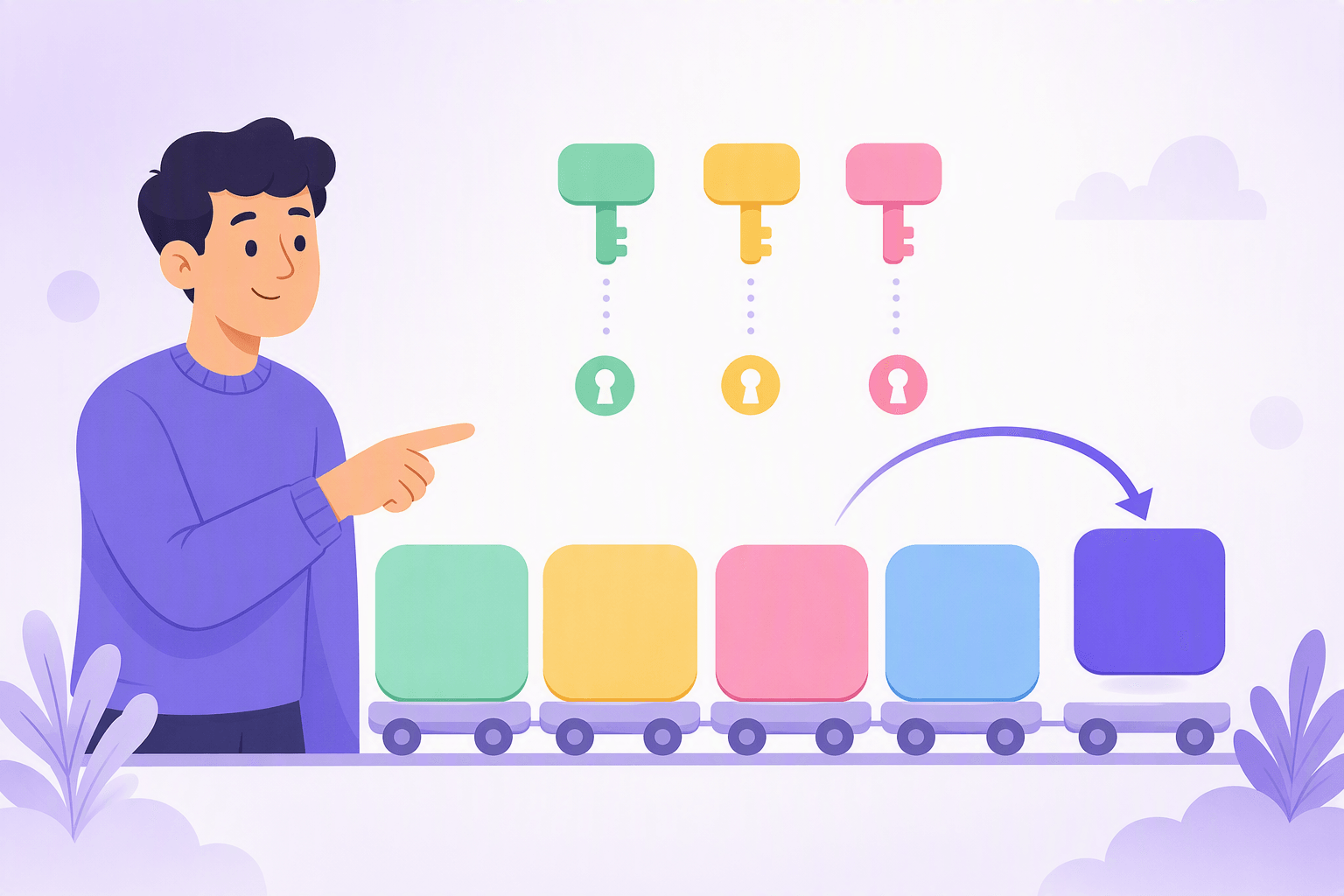
German has three grammatical genders: masculine (der), feminine (die), and neuter (das). Gender is a property of the noun, not the person.
You cannot reliably guess gender from meaning, so learn nouns with their article: der Tisch (dair TISH), die Tür (dee TOOR), das Buch (dahs BOOKH). This is not optional, because articles change with case.
Cases: why endings change
German has four cases: nominative, accusative, dative, genitive. In everyday conversation, the first three matter most, and genitive is often replaced by other structures in speech.
Cases answer "who is doing what to whom" and "to/for whom". English uses word order and prepositions for this, but German uses endings too.
Here is a minimal, high-utility snapshot:
| Function | Case | Typical question | Example |
|---|---|---|---|
| Subject | Nominative | who/what? | Der Mann kommt. (dair mahn kohmt) |
| Direct object | Accusative | whom/what? | Ich sehe den Mann. (ikh ZAY-uh dain mahn) |
| Indirect object | Dative | to/for whom? | Ich gebe dem Mann das Buch. (ikh GAY-buh dame mahn dahs bookh) |
If you learn common verb patterns (like "geben" often takes dative plus accusative), cases become predictable.
Verb position: the real "German feeling"
German word order is famous for sending the verb to the end, but that is only in certain structures.
-
Main clause: verb is usually second position
Ich gehe heute ins Kino. (ikh GAY-uh HOY-tuh ins KEE-noh) -
Yes/no question: verb first
Gehst du heute ins Kino? (GAYST doo HOY-tuh ins KEE-noh) -
Subordinate clause: conjugated verb at the end
Ich glaube, dass er heute ins Kino geht. (ikh GLOW-buh dahs air HOY-tuh ins KEE-noh gate)
This is the single most important grammar pattern to notice in real dialogue. Once your brain expects the final verb, listening becomes easier.
Separable verbs: the "split" you keep hearing
Many common verbs split in main clauses.
- ankommen (AHN-koh-men) becomes:
Er kommt um acht Uhr an. (air kohmt oom ahkt oor ahn)
In subordinate clauses, it stays together:
..., weil er um acht Uhr ankommt. (vyle air oom ahkt oor AHN-kohmt)
Separable verbs are not rare, they are everyday German. Treat them as one vocabulary item, not two.
Compounds: German’s superpower
German builds long nouns by combining smaller words, and the last part is the "head" that tells you what it is.
- Handschuh (HAHNT-shoo) = glove (hand + shoe)
- Krankenhaus (KRAHN-ken-hows) = hospital (sick + house)
Compounds look scary, but they are often easier than memorizing unrelated words. If you can parse them, your vocabulary grows faster.
German in real life: politeness, directness, and "small talk"
Learners often describe German as "direct". What is really happening is that German-speaking cultures tend to value clarity and efficiency in certain contexts, especially in workplaces and public services.
That does not mean people are rude. It means politeness is often expressed through structure (formal address, modal verbs, softeners) rather than lots of extra friendliness.
du vs Sie (and how to avoid awkwardness)
German has two common "you" forms:
- du (doo): informal, friends, family, many peers
- Sie (zee): formal, strangers, many professional settings
If you are unsure, use Sie. Switching to du is often explicit: "Wollen wir du sagen?" (VOLL-en veer doo ZAH-gen), meaning "Shall we use du?"
For a focused breakdown, see our guide to saying hello in German, where formality choices show up immediately.
The role of "bitte" and modal softeners
Bitte (BIT-uh) can mean "please", "here you go", and "you’re welcome" depending on context. German also uses modal verbs to soften requests:
- Könnten Sie... (KURN-ten zee): "Could you..."
- Würden Sie... (VUR-den zee): "Would you..."
These patterns are a big part of sounding polite without sounding overly formal.
Swearing and intensity (a cultural note)
German has a rich range of mild-to-strong swear words, but what counts as "too much" depends on setting and region. If you are curious, read our guide to German swear words, but treat it as comprehension-first, not a starter kit.
🌍 A practical media tip
In German TV and film, you will hear more casual address, contractions, and particles than in textbooks. That gap is normal. Learning from short scenes helps you map "classroom German" to "street German" without guessing.
How to learn German efficiently (a plan that works)
German is widely taught, but many learners plateau because they do not get enough high-quality listening. Research on language acquisition consistently supports the value of comprehensible input, meaning language you mostly understand with a bit of stretch.
A practical approach is to combine structure (a course or textbook) with authentic media. If you are choosing tools, start with our comparison of the best language learning apps, then build a routine.
Step 1: Build a pronunciation base in one week
Spend 10 to 15 minutes a day on:
- Umlauts ä/ö/ü
- ch in ich vs Bach
- The German r
- Sentence stress imitation
Record yourself reading one short line, then compare it to native audio. This is faster than trying to "fix accent" later.
Step 2: Learn high-frequency grammar patterns, not grammar trivia
Prioritize:
- Verb-second in main clauses
- Verb-final in subordinate clauses
- Dative after common prepositions (mit, nach, bei, zu)
- Separable verbs
Use a notebook for patterns you keep hearing. The goal is recognition first, production second.
Step 3: Use clips to train listening and word order
Full movies are great, but they are long and dense. Short clips let you repeat the same sentence until your brain stops translating.
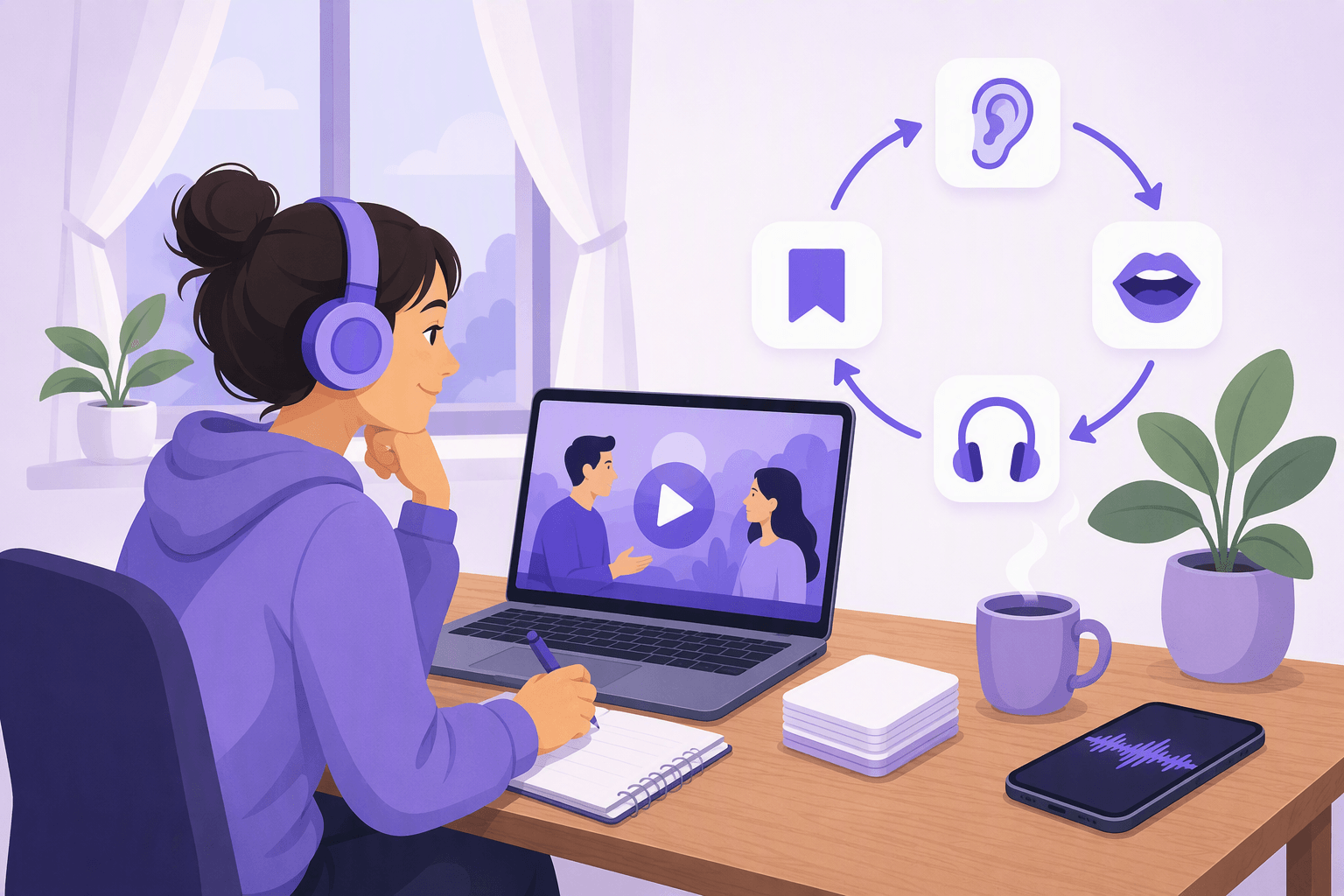
A strong clip routine looks like this:
- Watch with subtitles in German.
- Rewatch and shadow (repeat out loud).
- Save 5 to 10 useful lines as flashcards.
- Rewatch two days later.
This is exactly why Wordy focuses on real movie and TV clips: you get natural speed, real intonation, and repeatable context.
Step 4: Speak earlier than you feel ready
Speaking does not require perfect grammar, it requires automaticity.
Start with "chunks" you can reuse:
- Ich hätte gern... (ikh HET-uh gairn): "I’d like..."
- Können Sie mir helfen? (KURN-en zee meer HELF-en): "Can you help me?"
- Ich glaube, dass... (ikh GLOW-buh dahs): "I think that..."
If you can say these smoothly, you can function in real situations while your grammar catches up.
Step 5: Track vocabulary by themes and situations
German vocabulary grows faster when you learn it in clusters: travel, work, relationships, daily routines. If you want quick wins, start with greetings and farewells, then expand.
Useful next reads:
What makes German valuable (career, study, and access)
German matters because it is a major language of education, research, and industry in Europe. Germany is also one of the largest economies in the world, and German is a working language in many companies across the DACH region (Germany, Austria, Switzerland).
German is also a high-utility travel language in Central Europe. Even when locals speak English, German often unlocks warmer interactions and more detailed help.
A realistic expectation for progress
German is learnable for English speakers because it is a fellow Germanic language, sharing many cognates (Haus/house, Wasser/water). But it still takes time to internalize cases and word order.
If you study consistently, many learners reach basic conversational ability (A2) in a few months, and independent functioning (B1) in a year or so. Your timeline depends on hours, not talent.
⚠️ Avoid the most common trap
Do not wait to "finish grammar" before listening to real German. If you only read and do exercises, your first real conversation will feel like a different language. Start with slow, repeatable audio early, then increase difficulty.
Quick cultural insights you will notice in German media
German dialogue has a few recurring features that textbooks underteach. Recognizing them improves comprehension immediately.
Particles that change tone
Words like doch (dokh), mal (mahl), and ja (yah) often do not translate cleanly. They manage tone, emphasis, and shared assumptions.
- Komm mal her. (kohm mahl hair) feels like "come here for a second"
- Das ist ja unglaublich. (dahs ist yah OON-glowp-likh) adds "as you can see" emphasis
These are not advanced, they are everyday.
The "phone voice" and formal routines
In professional calls, you will hear structured openings and closings, often more formal than casual chat. This is why learning set phrases is useful, even if you prefer relaxed speech.
Humor and understatement
German humor in film often leans on understatement, awkwardness, and deadpan delivery, especially in workplace or family scenes. If a line sounds "too plain" to be funny, the delivery is usually the joke.
A simple next step
If your goal is to understand real German quickly, combine a small grammar backbone with daily listening. Start with greetings and everyday exchanges, then build into longer scenes.
For a structured clip-based path, visit Learn German and use short dialogues as your daily practice material.
Frequently Asked Questions
How many people speak German worldwide?
Where is German an official language?
Is German grammar really hard?
What level of German do I need to understand movies and TV?
What is the best way to learn German pronunciation?
Sources & References
- Ethnologue. German (deu), Ethnologue: Languages of the World, 27th edition, 2024
- Goethe-Institut. Deutsch lernen: Informationen zu Kursen und Prüfungen, 2023-2025
- Institut für Deutsche Sprache (IDS). Grammatik und Sprachgebrauch: Ressourcen zur deutschen Gegenwartssprache, 2020-2024
- Duden. Die Grammatik (Duden Band 4), 10. Auflage, 2022
- Organisation for Economic Co-operation and Development (OECD). Education at a Glance, 2023
Start learning with Wordy
Watch real movie clips and build your vocabulary as you go. Free to download.


