Quick Answer
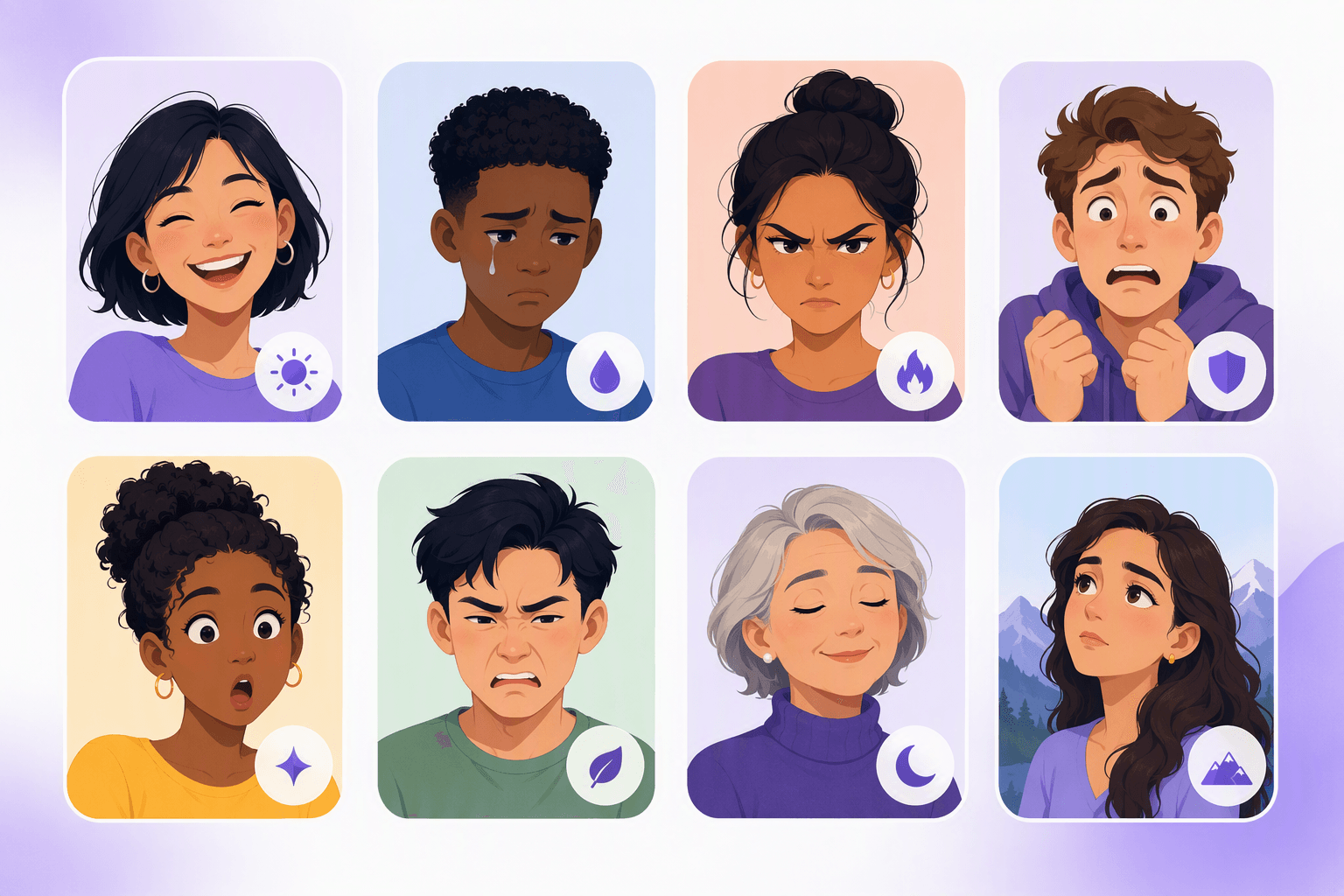
The basic emotions in German are glücklich (happy), traurig (sad), wütend (angry), ängstlich (afraid), überrascht (surprised), and angewidert (disgusted). German is world-famous for its compound emotion words. Schadenfreude (pleasure at others' misfortune), Weltschmerz (world-weariness), Sehnsucht (deep longing), and Torschlusspanik (fear of diminishing opportunities), words so precise that English borrows them directly.
The most essential emotion words in German are glücklich (happy), traurig (sad), wütend (angry), ängstlich (afraid), überrascht (surprised), and angewidert (disgusted). With these six words and a handful of compound forms, you can express nearly any emotional state in everyday conversation across Germany, Austria, and Switzerland.
German is spoken by approximately 130 million people worldwide according to Ethnologue's 2024 data, making it the most widely spoken native language in the European Union. But what makes German truly remarkable for emotion vocabulary is its compound-word system. While English struggles to describe the pleasure you feel at someone else's misfortune, German simply fuses Schaden (damage) and Freude (joy) into Schadenfreude, a single, elegant word that the entire world now borrows. This productivity is not limited to famous examples. German speakers routinely coin new compound emotions, making the language a uniquely precise instrument for the inner life.
"German compound words for emotions reveal a culture that takes the naming of inner states seriously. Words like Weltschmerz, Sehnsucht, and Torschlusspanik encode complex psychological experiences that most languages need entire sentences to describe." (Institut für Deutsche Sprache (IDS), Mannheim)
This guide covers 40+ German emotion words with pronunciation, grammar patterns, the world-famous untranslatable compounds, and cultural context for using feelings vocabulary naturally.

Basic Emotions at a Glance
Psychologist Paul Ekman's research identified six universal emotions recognized across all human cultures. Here are their German equivalents.
| English | German | Pronunciation |
|---|---|---|
| Happy | Glücklich | GLEWK-likh |
| Sad | Traurig | TRAU-rikh |
| Angry | Wütend | VEW-tent |
| Afraid / Anxious | Ängstlich | ENGST-likh |
| Surprised | Überrascht | ew-ber-RASHT |
| Disgusted | Angewidert | AHN-geh-vee-dert |
A pronunciation note: the ü in glücklich and wütend has no English equivalent. Round your lips as if saying "oo" but try to say "ee." The ä in ängstlich sounds like the "e" in English "bed." These umlauted vowels are essential to being understood, so practice them carefully.
Positive Emotions
Beyond basic happiness, German offers a rich vocabulary for the many shades of feeling good.
| English | German | Pronunciation |
|---|---|---|
| Enthusiastic / Thrilled | Begeistert | beh-GUY-stert |
| Grateful | Dankbar | DAHNK-bar |
| Proud | Stolz | shtolts |
| Calm / Peaceful | Ruhig | ROO-ikh |
| Content / Satisfied | Zufrieden | tsoo-FREE-den |
| Relieved | Erleichtert | ehr-LYEKH-tert |
| Overjoyed | Überglücklich | EW-ber-glewk-likh |
| Hopeful | Hoffnungsvoll | HOF-noonks-fol |
| Excited | Aufgeregt | OWF-geh-raykt |
| Amused | Amüsiert | ah-mew-ZEERT |
Begeistert
Begeistert (beh-GUY-stert) is one of the most expressive positive words in German. It comes from Geist (spirit/mind), so being begeistert literally means being "spirited" or "inspired." It conveys a stronger, more active enthusiasm than glücklich: the difference between contentment and genuine excitement.
Zufrieden
Zufrieden (tsoo-FREE-den) describes a quiet, deep satisfaction. It comes from Frieden (peace), so being zufrieden means being "at peace" with something. Germans value Zufriedenheit (contentment) as a life goal, perhaps more than the pursuit of dramatic happiness. A common phrase is Ich bin zufrieden mit meinem Leben (I am content with my life).
Überglücklich
Überglücklich (EW-ber-glewk-likh) demonstrates the compound system perfectly. The prefix über- (over/beyond) intensifies glücklich (happy) into "overjoyed." German uses über- freely to amplify emotions: überrascht (over-surprised), überwältigt (overwhelmed).
Negative Emotions
German is equally precise when describing difficult feelings.
| English | German | Pronunciation |
|---|---|---|
| Afraid / Fearful | Ängstlich | ENGST-likh |
| Frustrated | Frustriert | froo-STREERT |
| Jealous | Eifersüchtig | EYE-fer-zewkh-tikh |
| Lonely | Einsam | EYE-zahm |
| Ashamed | Beschämt | beh-SHAYMT |
| Disappointed | Enttäuscht | ent-TOYSHT |
| Nervous | Nervös | nehr-VEUS |
| Bored | Gelangweilt | geh-LAHNG-vylt |
| Guilty | Schuldig | SHOOL-dikh |
| Overwhelmed | Überwältigt | ew-ber-VEL-tikht |
Eifersüchtig
Eifersüchtig (EYE-fer-zewkh-tikh) is a compound of Eifer (zeal/eagerness) and Sucht (addiction/craving), literally meaning "zeal-addicted." The word captures the obsessive quality of jealousy better than most languages. The related noun Eifersucht (jealousy) appears frequently in German literature, from Goethe's Die Leiden des jungen Werthers to modern fiction.
Enttäuscht
Enttäuscht (ent-TOYSHT) means "disappointed" and has a fascinating etymology. Täuschung means "deception" or "illusion," and the prefix ent- means "un-" or "de-." So enttäuscht literally means "de-illusioned": the feeling when reality strips away a pleasant fantasy. This etymology gives the word a philosophical weight that English "disappointed" lacks.
Einsam
Einsam (EYE-zahm) means "lonely" and comes from ein (one) plus the suffix -sam, literally "one-some." The word is cognate with English "lonesome." Sociological research from the Goethe-Institut notes that Einsamkeit (loneliness) has become a growing topic in German public health discourse, particularly among elderly populations in urban areas.
Famous German Compound Emotion Words
This is where German truly shines. These words are so culturally specific and precisely descriptive that many have been borrowed directly into English. According to research by linguist Anna Wierzbicka, such "untranslatable" emotion words reveal deep cultural values about what a society considers important enough to name.
| English | German | Pronunciation | Note |
|---|---|---|---|
| Pleasure at others' misfortune | Schadenfreude | SHAH-den-froy-duh | Schaden (damage) + Freude (joy) |
| World-weariness / Existential melancholy | Weltschmerz | VELT-shmehrts | Welt (world) + Schmerz (pain) |
| Longing for distant places | Wanderlust | VAHN-der-loost | Wandern (to hike) + Lust (desire) |
| Intense, bittersweet longing | Sehnsucht | ZAYN-zookht | Sehnen (to yearn) + Sucht (craving) |
| Fear of diminishing opportunities | Torschlusspanik | TOR-shloos-pah-nik | Tor (gate) + Schluss (closing) + Panik (panic) |
| Longing for far-away places | Fernweh | FEHRN-vay | Fern (far) + Weh (ache), opposite of Heimweh |
| Secondhand embarrassment | Fremdschämen | FREMT-shay-men | Fremd (foreign/other) + schämen (to be ashamed) |
| Emotional eating weight gain | Kummerspeck | KOO-mer-shpek | Kummer (grief) + Speck (bacon) |
Schadenfreude
Schadenfreude (SHAH-den-froy-duh) is perhaps the most internationally recognized German emotion word. It fuses Schaden (damage, harm) and Freude (joy) into a single concept: the guilty pleasure you feel when someone else fails. English adopted this word because no native equivalent exists. Research by Ekman and others confirms that Schadenfreude represents a genuine, cross-culturally recognized emotional response, but German is one of the few languages to give it a dedicated name.
Weltschmerz
Weltschmerz (VELT-shmehrts) translates literally as "world pain." Coined by the German Romantic author Jean Paul in 1827, it describes a deep, existential sadness at the gap between the ideal world and reality. The Sturm und Drang (Storm and Stress) literary movement of the late 18th century cultivated this sensibility, and it became a defining characteristic of German Romanticism. Today, the word is used more casually to describe a general weariness with the state of the world.
Sehnsucht
Sehnsucht (ZAYN-zookht) describes an intense, often bittersweet longing for something absent: a person, a place, a time, or even an undefined ideal. C.S. Lewis famously discussed this concept in English, but could only describe it; German names it directly. Psychologists at the Max Planck Institute have studied Sehnsucht as a distinct psychological construct, finding it is most pronounced in adolescents and older adults.
Torschlusspanik
Torschlusspanik (TOR-shloos-pah-nik) literally means "gate-closing panic," the anxiety that time is running out and opportunities are disappearing. The word originates from medieval cities, where residents had to rush through the city gates before they closed at nightfall. Today it is most often used to describe the pressure people feel about life milestones: finding a partner, having children, or changing careers before it feels "too late."
Fernweh
Fernweh (FEHRN-vay) is the elegant opposite of Heimweh (homesickness). Where Heimweh is the ache (Weh) for home (Heim), Fernweh is the ache for the faraway (Fern). It describes the restless longing for distant places you have never visited. The word captures a uniquely German travel culture; Germany consistently ranks among the world's top-spending tourist nations.
Kummerspeck
Kummerspeck (KOO-mer-shpek) is one of the most endearingly specific German compounds. It literally means "grief bacon," the weight you gain from emotional overeating during difficult times. The word is humorous but widely understood, and it demonstrates how German compound-word formation can turn an entire behavioral pattern into a single, vivid noun.
🌍 German Emotional Restraint and Precision
German culture has a reputation for emotional restraint in public settings, but this does not mean a lack of emotional depth. Rather, the language's extraordinary compound-word system suggests the opposite: Germans value naming emotions with precision over displaying them outwardly. Having a single word for "the panic that life's opportunities are closing" (Torschlusspanik) or "grief bacon" (Kummerspeck) reflects a culture that processes feelings through linguistic exactness. This precision is also visible in the philosophical tradition: German is the language of Freud's Angst, Heidegger's Sorge (care/concern), and Nietzsche's Ressentiment.
Grammar: Expressing Emotions in German
German uses three main grammatical patterns for expressing feelings, and mastering all three is essential for natural conversation.
Sein + Adjective
The simplest pattern mirrors English "I am + adjective":
- Ich bin glücklich. (I am happy.)
- Sie ist traurig. (She is sad.)
- Wir sind überrascht. (We are surprised.)
The adjective takes no ending in this predicative position; it stays in its base form. This is the easiest pattern for beginners.
Reflexive Verbs
Many German emotions use reflexive verbs, which require a reflexive pronoun (mich, dich, sich, uns, euch, sich). This is a key difference from English.
| English | German | Pronunciation | Note |
|---|---|---|---|
| To be happy / glad | Sich freuen | zikh FROY-en | Ich freue mich |
| To be angry | Sich ärgern | zikh EHR-gern | Ich ärgere mich |
| To be ashamed | Sich schämen | zikh SHAY-men | Ich schäme mich |
| To be bored | Sich langweilen | zikh LAHNG-vy-len | Ich langweile mich |
| To worry | Sich sorgen | zikh ZOR-gen | Ich sorge mich |
| To be excited | Sich aufregen | zikh OWF-ray-gen | Ich rege mich auf (separable) |
Note that sich aufregen is a separable-prefix verb: the auf- detaches and moves to the end of the clause. Ich rege mich über die Verspätung auf (I am getting upset about the delay). Separable verbs are common in German emotion vocabulary and require practice to use naturally.
Dative Constructions
Some emotional states use the dative case, putting the person experiencing the emotion in the indirect object position:
- Mir ist langweilig. (I am bored. Literally: "To me it is boring.")
- Mir ist schlecht. (I feel nauseous/unwell.)
- Mir ist unwohl. (I feel uneasy.)
This construction is impersonal: the subject is the implied es (it), and the person feeling the emotion appears in the dative. It takes practice for English speakers because the grammatical subject and the experiencer are reversed.
💡 Adjective Endings With Emotions
When emotion adjectives appear before a noun, they take standard German adjective endings: ein trauriges Kind (a sad child), der wütende Mann (the angry man), eine glückliche Frau (a happy woman). The endings follow the same declension rules as any other adjective, determined by gender, case, and article type. In predicative position after sein (Ich bin traurig), no ending is needed.
The Philosophical Tradition: Angst, Zeitgeist, and Sturm und Drang
German's influence on the vocabulary of emotions extends far beyond everyday conversation. The language has shaped how the entire Western world talks about inner life through its philosophical and literary traditions.
Angst (ahngst) in everyday German simply means "fear" or "anxiety": Ich habe Angst vor Spinnen (I am afraid of spiders). But through the works of Kierkegaard (who wrote in Danish but drew on German philosophy), Heidegger, and later the existentialists, Angst entered English as a term for existential dread, the anxiety of confronting human freedom and mortality. The Duden recognizes both the everyday and philosophical senses.
Zeitgeist (TSYTE-guyst) combines Zeit (time) and Geist (spirit/mind) to describe the intellectual and cultural climate of an era. The word was popularized by Hegel in the early 19th century and is now used internationally in journalism, art criticism, and cultural commentary.
The literary movement Sturm und Drang (Storm and Stress, 1760s-1780s) gave emotional intensity a central place in German culture. Young Goethe, Schiller, and their contemporaries rejected Enlightenment rationalism in favor of raw emotional expression. This tradition established that feelings deserve precise, serious language, a cultural attitude that still shapes German emotion vocabulary today.
Practice With German Films and Media
Emotions are among the most frequently expressed concepts in film dialogue, making movies and TV series an ideal way to internalize this vocabulary. German cinema has a long tradition of exploring complex emotional states, from the Expressionist anxiety of Fritz Lang's Metropolis to the quiet grief of Das Leben der Anderen (The Lives of Others) to the Wanderlust of modern German travel films.
Check out our guide to the best movies for learning German for recommendations that will expose you to emotion vocabulary in authentic contexts and at every difficulty level.
Wordy lets you practice German vocabulary in real context by watching German content with interactive subtitles. When an emotion word like Schadenfreude or Sehnsucht appears in dialogue, you can tap it to see its meaning, pronunciation, and grammatical details. Explore our blog for more German learning guides, or visit our German learning page to start building your emotion vocabulary today.
Frequently Asked Questions
What are the basic emotions in German?
What is Schadenfreude?
What German emotion words have no English equivalent?
How do you say 'I am happy' in German?
How does German grammar work with emotion words?
What is the difference between Angst and ängstlich?
Sources & References
- Duden, Die deutsche Rechtschreibung, 28th edition (2024)
- Ekman, P., Basic Emotions (chapter in Handbook of Cognition and Emotion, 1999)
- Wierzbicka, A., Emotions Across Languages and Cultures (Cambridge University Press, 1999)
- Goethe-Institut, German language and culture learning resources
- Institut für Deutsche Sprache (IDS), Mannheim, Deutsche Wortforschung
Start learning with Wordy
Watch real movie clips and build your vocabulary as you go. Free to download.


