German Two-Way Prepositions (Wechselpräpositionen): The Clear Guide With Examples
Quick Answer
German two-way prepositions (Wechselpräpositionen) take accusative when you describe movement toward a destination (wohin?), and dative when you describe location or position (wo?). The core set is an, auf, hinter, in, neben, über, unter, vor, zwischen. The reliable shortcut is: if the sentence answers 'where to?', use accusative, if it answers 'where?', use dative.
German two-way prepositions (Wechselpräpositionen) are the nine common German prepositions that take accusative when you talk about a destination (wohin?), and dative when you talk about a location (wo?): an, auf, hinter, in, neben, über, unter, vor, zwischen.
They matter because this is one of the fastest ways German signals meaning without extra words, and it shows up constantly in everyday scenes, from arriving somewhere to putting objects down.
💡 The one-line test
Ask a question: wohin? (where to?) means accusative, wo? (where?) means dative. If you can answer with a destination, use accusative. If you answer with a position, use dative.
German is also a high-impact language to learn: Ethnologue estimates around 90 million native speakers and roughly 130 million total speakers worldwide (Ethnologue, 27th edition, 2024). That means this grammar point pays off across Germany, Austria, Switzerland, and far beyond.
If you want more everyday German that pairs well with this grammar, start with how to say hello in German and how to say goodbye in German, then come back and notice how often prepositions appear in those same short lines.

What "two-way" actually means in German
Two-way prepositions are not random. They are a small, stable set where case encodes meaning.
In reference grammars like Duden and IDS grammis, the key idea is: these prepositions can describe either a static relationship (location) or a directional relationship (goal). German marks that difference with dative vs accusative.
The nine core Wechselpräpositionen
Memorize this list first, then learn the decision rule.
- an (ahn)
- auf (owf, rhymes with "cow" + f)
- hinter (HIN-ter)
- in (in)
- neben (NAY-ben)
- über (OO-ber)
- unter (OON-ter)
- vor (for)
- zwischen (TSVISH-en)
German spelling is consistent, but watch ü in über. Say it like "oo with a smile" (OO-ber), not "you-ber".
⚠️ Don't add 'gegenuber' to this list automatically
Learners often assume every location preposition is two-way. gegenüber usually takes dative in standard usage. Keep your focus on the nine above until they are automatic.
The rule that works: wohin? vs wo?
Most learners hear "movement equals accusative, location equals dative". That is close, but it can mislead you.
A better rule is goal vs position.
If the phrase answers wohin? you use accusative because you are expressing a target endpoint. If it answers wo? you use dative because you are describing where something is.
Accusative: destination or endpoint (wohin?)
Use accusative when something ends up somewhere new.
-
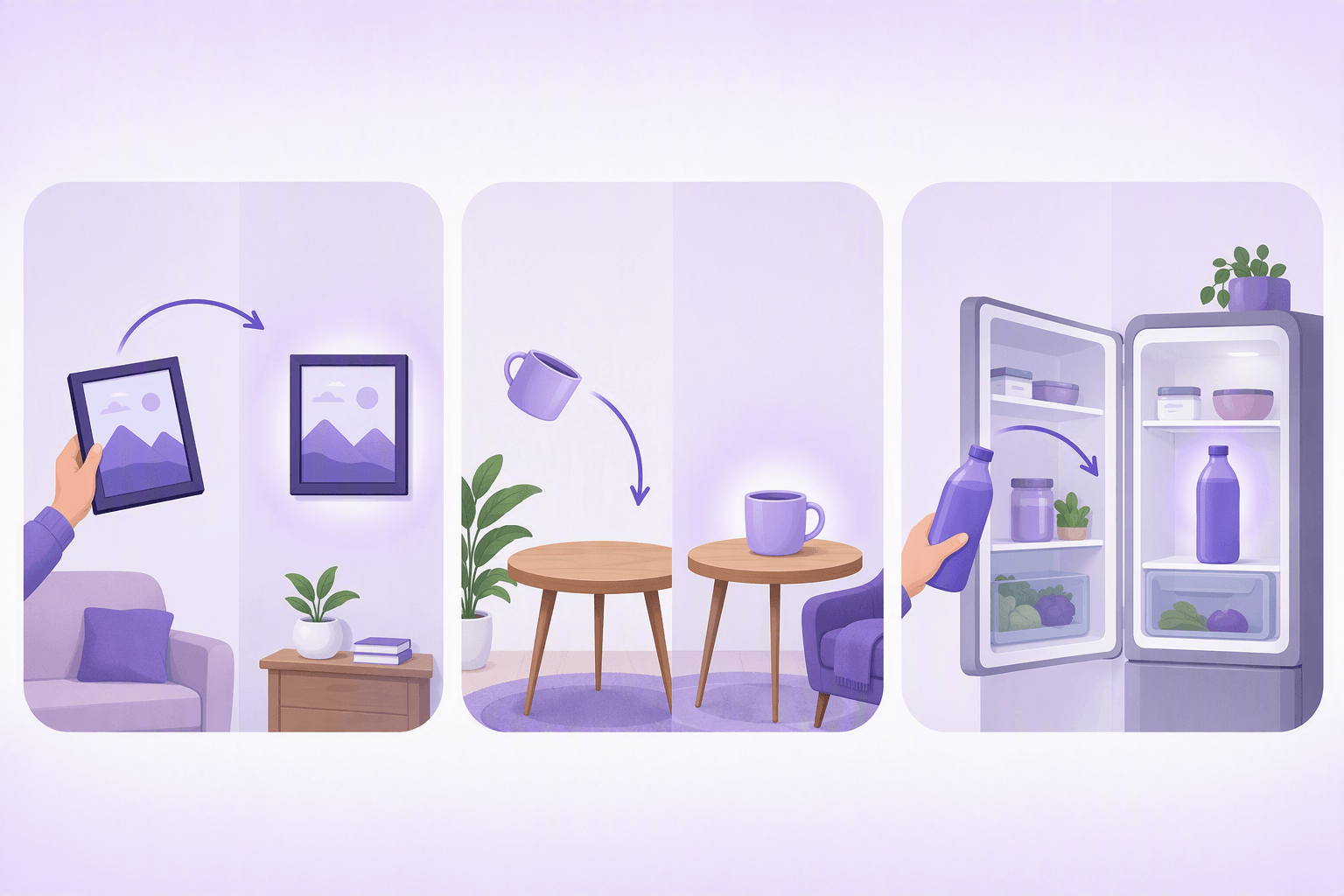
Ich gehe in die Küche.
I go into the kitchen. -
Ich stelle die Tasse auf den Tisch.
I put the cup onto the table. -
Wir hängen das Bild an die Wand.
We hang the picture onto the wall.
Dative: location or position (wo?)
Use dative when something is already positioned somewhere.
-
Ich bin in der Küche.
I am in the kitchen. -
Die Tasse steht auf dem Tisch.
The cup is on the table. -
Das Bild hängt an der Wand.
The picture is hanging on the wall.
In Hammer's German Grammar and Usage (Durrell), this contrast is treated as a meaning distinction, not a memorization trick. Once you treat it as meaning, the case choice stops feeling arbitrary.
The articles you must know (because case lives there)
With two-way prepositions, learners often know the rule but fail on the article endings.
Here are the minimum forms you need for singular nouns.
Accusative articles (destination)
- masculine: den
- feminine: die
- neuter: das
- plural: die
Dative articles (location)
- masculine: dem
- feminine: der
- neuter: dem
- plural: den (often with -n on the noun if possible)
So you get pairs like:
- in den Park (masc, acc) vs in dem Park (masc, dat)
- auf die Straße (fem, acc) vs auf der Straße (fem, dat)
- unter das Bett (neut, acc) vs unter dem Bett (neut, dat)
If you want a deeper refresher on cases, this topic connects directly to German cases explained and German dative case.
The contractions you will hear constantly: im, am, ins, ans
Native speakers rarely say in dem in casual speech. They contract.
These contractions are not slang, they are standard.
- in dem = im (im)
- an dem = am (ahm)
- in das = ins (ins)
- an das = ans (ahns)
Notice what happens: im/am are dative, ins/ans are accusative.
That means you can often hear the case instantly.
- Ich bin im Büro. (dative, location)
- Ich gehe ins Büro. (accusative, destination)
This is one reason two-way prepositions are so useful in real listening, especially in movies and TV where people speak quickly.
The most common prepositions, explained with real mental pictures
Below, each preposition has a practical meaning, then the accusative vs dative contrast with copyable examples.
an
an often means "at" a boundary, edge, or vertical surface.
Think: wall, window, door, riverbank, seaside.
- Ich hänge das Poster an die Wand. (destination, acc)
- Das Poster hängt an der Wand. (location, dat)
Also common: am Meer (at the sea), am Fenster (by the window).
auf
auf often means "on top of" a surface, or "onto" that surface.
- Ich lege das Buch auf den Tisch. (acc)
- Das Buch liegt auf dem Tisch. (dat)
It is also used with institutions in some fixed phrases, but keep the physical picture first.
hinter
hinter is "behind".
- Der Hund läuft hinter das Auto. (acc, ends up behind it)
- Der Hund sitzt hinter dem Auto. (dat, already behind it)
in
in is "in/into". It is the most frequent two-way preposition in daily German.
- Sie geht in die Schule. (acc, into school)
- Sie ist in der Schule. (dat, at school)
For learners, this pair is the clearest demonstration of how German uses case to encode meaning.
neben
neben is "next to".
- Stell den Stuhl neben den Tisch. (acc)
- Der Stuhl steht neben dem Tisch. (dat)
über
über is "over/above", sometimes "across" depending on the verb.
- Er hängt die Lampe über den Tisch. (acc, placing it above)
- Die Lampe hängt über dem Tisch. (dat, position)
unter
unter is "under/below".
- Ich schiebe die Tasche unter den Stuhl. (acc)
- Die Tasche ist unter dem Stuhl. (dat)
vor
vor is "in front of" and also used for time, but as a two-way preposition it is spatial.
- Stell dich vor den Spiegel. (acc)
- Du stehst vor dem Spiegel. (dat)
zwischen
zwischen is "between".
- Setz dich zwischen die beiden. (acc)
- Du sitzt zwischen den beiden. (dat)
Plural dative den is a common stumbling block here.
The verbs that trigger this grammar all the time
Two-way prepositions become easy when you associate them with common verbs.
Verbs that often create accusative (putting, moving to a place)
These verbs often imply a destination.
- stellen (SHTEL-en): to set upright, place
- legen (LAY-gen): to lay flat, put down
- setzen (ZET-sen): to set, seat
- hängen (HENG-en): to hang (transitive)
Examples:
- Ich stelle das Glas auf den Tisch.
- Ich lege das Handy neben das Bett.
- Ich setze mich auf den Stuhl.
- Ich hänge die Jacke an die Garderobe.
Verbs that often create dative (being, staying, lying)
These verbs describe position.
- sein (zine): to be
- bleiben (BLY-ben): to stay
- stehen (SHTAY-en): to stand
- liegen (LEE-gen): to lie
- sitzen (SIT-sen): to sit
- hängen (HENG-en): to hang (intransitive)
Examples:
- Das Glas steht auf dem Tisch.
- Ich bleibe im Zimmer.
- Die Jacke hängt an der Garderobe.
That last pair is important: hängen can be transitive or intransitive, and the meaning changes the case.
The biggest trap: movement without a destination
You can move and still use dative.
If you are moving around inside a location, not entering it as a goal, you answer wo?, not wohin?.
- Ich gehe im Park spazieren. (dative, location is the park)
- Ich gehe in den Park. (accusative, destination is the park)
This is why the "movement equals accusative" shortcut breaks. The question test stays reliable.
A fast decision checklist (what to ask yourself)
When you see a two-way preposition, do this in order:
- What is the verb doing: placing, going, entering, staying?
- Ask wohin? or wo?
- Choose case and article.
If you want a sentence that sounds natural, add a time phrase and keep the verb in second position, as explained in German word order.
Mini scene examples you can reuse in real life
These are the kinds of lines you actually hear in German dialogue.
At home
-
Kannst du das bitte in den Kühlschrank stellen?
-
Das ist schon im Kühlschrank.
-
Leg die Schlüssel auf den Tisch.
-
Die Schlüssel liegen auf dem Tisch.
In a cafe or restaurant
- Setzen Sie sich bitte an den Tisch am Fenster.
- Wir sitzen am Fenster.
If you are building polite requests, pair this grammar with how to say hello in German because greetings and polite framing often appear in the same interaction.
On the street
- Stell dich nicht vor den Eingang.
- Er steht vor dem Eingang.
Cultural usage notes that help you sound local
German speakers often prefer precise placement verbs where English uses "put".
That means two-way prepositions show up with stellen/legen/setzen more than learners expect.
A small but real cultural detail: in many German households, especially in apartments, you will hear practical, spatial instructions constantly, shoes by the door, bikes in the cellar, recycling in specific bins. The language follows that habit of precise organization.
Another everyday pattern is the use of contracted forms in speech. In fast dialogue, ins, ans, im, am are so common that they become listening anchors. Once you recognize them, your comprehension jumps.
Practice: convert location sentences into destination sentences
Take a dative sentence and change the verb to a placing or going verb. Then switch to accusative.
-
Das Buch liegt auf dem Tisch.
-> Ich lege das Buch auf den Tisch. -
Der Hund ist im Auto.
-> Der Hund springt ins Auto. -
Die Jacke hängt an der Tür.
-> Ich hänge die Jacke an die Tür.
This is also how you should practice with movie clips: pause, repeat, then swap the verb and case to train the contrast.
If you like learning with authentic dialogue, the method in how to learn a language with movies fits perfectly here because two-way prepositions are visible in subtitles and audible in short scenes.
Common mistakes (and how to fix them fast)
Mistake 1: Using dative after every two-way preposition
Learners do this because dative feels "more German" or because they memorize fixed phrases like im and overgeneralize.
Fix: force yourself to ask wohin? out loud. If you can answer with a destination, use accusative.
Mistake 2: Picking the right case but the wrong preposition
Example: saying auf der Wand when you mean a picture on the wall.
Fix: build a mental map.
- an der Wand: attached to the wall
- auf der Wand: on the wall surface, but not the usual phrasing for hanging objects
Duden and IDS grammis both emphasize that prepositions encode spatial relations, not just "location". Treat them as geometry.
Mistake 3: Forgetting plural dative "den"
- zwischen den Häusern (dat plural)
- unter den Leuten (dat plural)
Fix: when you see plural dative, expect den and often an extra -n on the noun where possible.
Why German uses case here (a meaning-based explanation)
German keeps a rich case system, and two-way prepositions are one place where it still carries a clear semantic load.
In cognitive linguistics, scholars like Leonard Talmy discuss how languages package motion events, such as path and manner, in different ways. German often makes the path explicit via prepositions and case, while the verb can focus on the action. You do not need the theory to use the grammar, but it explains why the distinction is so stable.
For a learner, the takeaway is simple: the case is not decoration. It is information.
A quick note on register and real-world German
This grammar applies across registers, from formal to casual.
Whether you are saying a polite goodbye like in how to say goodbye in German or joking with friends, the case choice still signals meaning. Even when German gets spicy, the structure stays, see German swear words for how grammar remains intact even in informal speech.
How to train this with clips (the Wordy method)
Pick short scenes that include physical movement: entering a room, putting a phone down, hanging a coat, sitting at a table.
Listen for the contraction first (im/ins, am/ans), then confirm the meaning by asking wo? or wohin? This is one of the fastest ways to make the rule automatic because you hear the contrast in realistic speed.
If you want romantic examples where placement and movement show up in everyday dialogue, how to say I love you in German is a surprisingly good companion, couples talk a lot about where to meet, where to sit, and where things are.
💡 One daily drill
Write 5 pairs: one sentence with wo? (dative) and one with wohin? (accusative). Use the same noun each time. After a week, your article endings start to come out automatically.
Summary you can keep in your head
Two-way prepositions are simple once you treat them as meaning.
- wohin? destination, endpoint, change of position: accusative
- wo? location, position, no endpoint: dative
Learn the nine prepositions, learn the article forms, and practice with verb pairs like legen/liegen and stellen/stehen. After that, this stops being a grammar topic and becomes a listening skill you use every day.
Frequently Asked Questions
What are German two-way prepositions (Wechselpräpositionen)?
Is the rule really 'movement = accusative, location = dative'?
Why is 'in die Schule' accusative but 'in der Schule' dative?
How do I know whether to use 'an' or 'auf'?
Do native speakers always follow the two-way preposition rule?
Sources & References
- Duden, 'Wechselpräpositionen' (accessed 2026)
- Institut für Deutsche Sprache (IDS), grammis: Präpositionen und Kasus (accessed 2026)
- Goethe-Institut, Deutsch lernen: Grammatik (accessed 2026)
- Ethnologue, 27th edition, 2024
Start learning with Wordy
Watch real movie clips and build your vocabulary as you go. Free to download.


