Quick Answer
The German dative case marks the indirect object (who receives something) and is also required after many common prepositions like mit, nach, and bei. In practice, you use dative articles like dem (masc/neut), der (fem/pl), and pronouns like mir/dir/ihm, plus dative endings on adjectives in certain patterns.
The German dative case is the form you use for the indirect object (the receiver) and after many everyday prepositions like mit and bei, which is why it shows up constantly in real conversations as dem, der, den, and pronouns like mir and dir.
German is spoken by roughly 90 million native speakers and used across multiple countries and regions, making it one of Europe’s most important languages for work and travel (Ethnologue, 27th edition, 2024). If you want to sound natural, dative is not an advanced extra, it is core grammar you meet in the first minutes of real listening.
If you also want everyday phrases that actually occur around dative structures, start with greetings like hello in German and farewells like goodbye in German, then come back here and you will notice dative everywhere.

What the dative case does (in plain English)
The dative marks the role “to/for whom” in many sentences.
In English, we often show this with word order or with “to”: “I give the book to him.” German can do the same idea, but it signals the role with case forms.
The core pattern: giver, thing, receiver
A very common German structure is:
- Nominative: the subject (who does it)
- Accusative: the direct object (what is given/done)
- Dative: the indirect object (who receives/benefits)
Example:
- Ich gebe dem Mann das Buch.
“I give the man the book.”
Here, das Buch is the thing (accusative), and dem Mann is the receiver (dative).
💡 Fast dative test with pronouns
If you can replace a noun phrase with mir (to me) or dir (to you) and the sentence still makes sense, you are probably looking at a dative role: Gibst du mir das Wasser? Schreibst du ihr? Hilfst du ihm?
The dative articles you must recognize
Dative is easiest when you stop thinking “grammar concept” and start thinking “these are the shapes German uses”.
Below are the most important definite and indefinite articles in the dative.
Definite articles (the)
- masculine: dem
- feminine: der
- neuter: dem
- plural: den (plus often -n on the noun)
Pronunciation reminders:
- dem: dehm
- der: dair (German r, but this approximation works)
- den: dehn
Indefinite articles (a/an)
- masculine: einem (EYE-nem)
- feminine: einer (EYE-ner)
- neuter: einem (EYE-nem)
- plural: no indefinite article, you use other words like keinen patterns or just plural without “a”
Example:
- Ich helfe einem Freund.
“I help a friend.”
Dative pronouns: the real high-frequency set
In real speech, dative shows up constantly as pronouns, especially in quick exchanges.
Here are the core ones you should automate:
- ich: mir (meer)
- du: dir (deer)
- er: ihm (eem)
- sie (she): ihr (eer)
- es: ihm (eem)
- wir: uns (oons)
- ihr: euch (oykh, throat ch)
- sie/Sie: ihnen/Ihnen (EE-nen)
Example mini-dialogue:
- Kannst du mir helfen?
“Can you help me?” - Klar, ich helfe dir.
“Sure, I’ll help you.”
David Crystal, in The Cambridge Encyclopedia of the English Language, highlights how English relies heavily on word order for roles like “who gets what.” German, by contrast, uses case marking to keep roles clear even when word order changes, which is one reason dative feels unfamiliar at first.
The dative in real German word order
German can move pieces around for emphasis, especially in speech.
These two can both be correct:
- Ich gebe dem Mann das Buch.
- Das Buch gebe ich dem Mann.
Because dem Mann is marked as dative, the listener still knows it is the receiver.
⚠️ Do not translate German word order too literally
English learners often assume the first noun is the receiver. In German, the case ending is the signal. Train your ear to hear dem/der/den and mir/dir first, then interpret the role.
Dative verbs: verbs that "want" mir/dir/ihm
Some verbs take a dative object even when there is no direct object.
You do not need a long list to start, you need the most common ones and a habit: learn them with a dative pronoun.
helfen
helfen (HEL-fen) = to help
- Kannst du mir helfen?
- Ich helfe dir.
danken
danken (DAHN-ken) = to thank
- Ich danke dir.
- Vielen Dank! (This is not dative itself, but it pairs naturally with danken.)
antworten
antworten (AHNT-vor-ten) = to answer
- Er antwortet mir nicht.
“He’s not answering me.”
gehören
gehören (geh-HUR-ren) = to belong to
- Das gehört mir.
“That belongs to me.”
passen
passen (PAHS-en) = to fit, to suit
- Das passt mir nicht.
“That doesn’t work for me / doesn’t suit me.”
These patterns are described consistently in major references like Duden and in teaching materials from the Goethe-Institut (Duden, accessed 2026; Goethe-Institut, accessed 2026). The key is that the verb’s argument structure includes a dative participant.
Dative after prepositions: the biggest daily trigger
If you only learn one dative rule, make it this one: some prepositions always force dative.
In everyday German, these are everywhere because they express location, company, origin, and topic.
aus
aus (ows) = out of, from (origin)
- Ich komme aus der Stadt.
“I come from the city.”
bei
bei (bye) = at, near, at someone’s place
- Ich bin bei meiner Freundin.
“I’m at my girlfriend’s place.”
mit
mit (mit) = with
- Ich gehe mit dem Hund.
“I’m going with the dog.”
nach
nach (nahkh, back-throat ch) = to (cities/countries), after
- Ich fahre nach Berlin.
- Nach der Arbeit bin ich müde.
“After work I’m tired.”
seit
seit (zyte) = since, for (time duration)
- Ich lerne seit einem Jahr Deutsch.
“I’ve been learning German for a year.”
von
von (fon) = from, of (very common in speech)
- Das ist von meinem Bruder.
“That’s from my brother.”
zu
zu (tsoo) = to (people, places with an article), too
- Ich gehe zu dem Arzt. (often contracted: zum Arzt)
- Ich gehe zu der Schule. (often: zur Schule)
The Institut für Deutsche Sprache (IDS) is a reliable reference point for how these prepositions behave in standard usage and how case marking supports comprehension in flexible word order (IDS, accessed 2026).
Two-way prepositions (Wechselpräpositionen): dative vs accusative
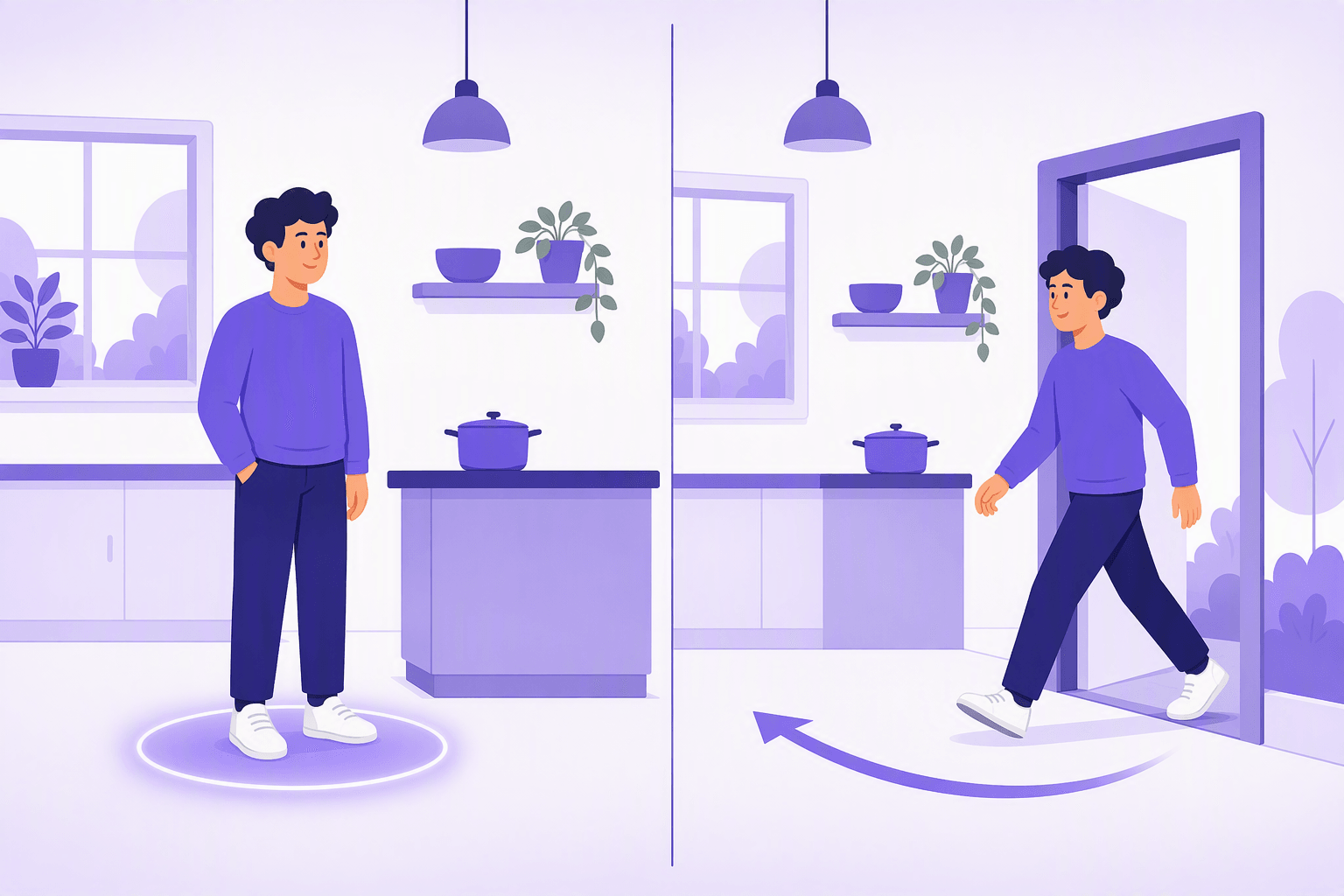
Some prepositions can take dative or accusative, depending on meaning.
The classic set includes: in, an, auf, unter, über, vor, hinter, neben, zwischen.
The practical rule:
- Dative: location, “where?” (WO?)
- Accusative: direction/change, “where to?” (WOHIN?)
in
in (in) can be dative or accusative:
- Ich bin in der Küche. (location, dative)
“I’m in the kitchen.” - Ich gehe in die Küche. (direction, accusative)
“I’m going into the kitchen.”
auf
auf (owf) = on, onto
- Das Buch liegt auf dem Tisch. (dative)
- Ich lege das Buch auf den Tisch. (accusative)
an
an (ahn) = at, on (vertical), to
- Das Bild hängt an der Wand. (dative)
- Ich hänge das Bild an die Wand. (accusative)
🌍 Why Germans care about 'where' vs 'where to'
In German-speaking countries, giving directions is a daily social skill, especially in dense cities with public transit. The WO vs WOHIN distinction is not academic, it is how you avoid misunderstandings like standing at the wrong platform or putting something in the wrong place. Case is part of that precision.
Dative plural: "den" plus the extra -n
Dative plural has a pattern that learners miss because it is two changes at once:
- the article becomes den
- many plural nouns add -n (or -en) if they can
Examples:
- mit den Kindern (not mit die Kinder)
- bei den Freunden
- von den Studenten
If the plural already ends in -n or -s, you usually do not add another -n:
- mit den Frauen (already ends in -n)
- mit den Autos (plural -s)
This is one of those “small” details that makes your German sound much more native-like, especially in fast speech where articles can be reduced.
Adjective endings in the dative (en is your friend)
Adjective endings can look intimidating, but for dative you can get very far with one high-frequency outcome: -en.
With "the" words (definite articles)
- mit dem guten Wein
- bei der neuen Arbeit
- von den kleinen Kindern
You see guten, neuen, kleinen: that -en ending is the common dative signal here.
With "a" words (indefinite articles)
Masculine/neuter dative often still uses -en:
- mit einem guten Freund
- bei einem alten Haus
Feminine dative with einer also commonly gives -en:
- mit einer guten Freundin
If you want the full system, Duden’s grammar reference lays out the adjective declension tables clearly (Duden, accessed 2026). For speaking, the goal is recognition and a few automated chunks.
💡 Chunking beats memorizing tables
Instead of memorizing every ending, memorize 6 to 10 dative phrases you will actually say: mit dem Handy, bei der Arbeit, nach dem Essen, seit einem Jahr, von meinem Chef, zu meiner Mutter. Then swap nouns.
Common contractions that hide the dative
German often contracts preposition + article, and dative is where you see this constantly.
These are not slang, they are standard:
- zu dem becomes zum
- zu der becomes zur
- bei dem becomes beim
- von dem becomes vom
Examples:
- Ich gehe zum Arzt.
- Ich bin beim Bäcker. (BAE-ker, with umlaut as "ae")
- Das ist vom Chef.
When you listen to native speech, these contractions are one reason dative can feel “invisible.” Train your ear for -m endings: zum, beim, vom.
Dative in everyday set phrases (what you actually hear)
Dative is not just “grammar sentences.” It is baked into common social language.
Mir geht's gut
Mir geht's gut. (meer GAYTS goot)
Literally: “To me it goes well.”
Meaning: “I’m doing well.”
This is a dative-first structure, and it is extremely common as an answer to greetings.
If you are practicing conversational openings, pair it with hello in German so the whole exchange feels natural.
Wie geht's dir?
Wie geht's dir? (vee GAYTS deer)
“How are you?” (to you)
Es tut mir leid
Es tut mir leid. (ess toot meer lाइट, approximate)
“I’m sorry.”
Literally: “It does me sorrow.”
You will also hear Tut mir leid alone.
Danke dir
Danke dir. (DAHN-kuh deer)
“Thanks.” (friendly)
This is a great example of how dative pronouns show closeness. It is not “more correct” than Danke, it is more personal.
Typical dative mistakes (and how to fix them fast)
Mistake 1: Using accusative after a dative preposition
Wrong:
- mit den Tisch
Right:
- mit dem Tisch
Fix: make a short list of “always dative” prepositions and drill them with one noun each.
Mistake 2: Forgetting dative plural -n
Wrong:
- mit den Kind
Right:
- mit den Kindern
Fix: whenever you learn a plural, learn it with mit den once.
Mistake 3: Mixing up "ihm" and "ihn"
Wrong:
- Ich gebe ihn das Buch.
Right:
- Ich gebe ihm das Buch.
Fix: say it as a rhythm: ihm is “to him,” ihn is “him.”
Mistake 4: Overusing "zu" for destinations
Learners often say zu Berlin.
In standard German:
- nach Berlin (cities, most countries)
- in die Schweiz (countries with an article or special patterns)
- zu meiner Freundin (people)
This is not purely dative, but it is where dative prepositions collide with travel logic, so it is worth cleaning up early.
A practical mini-drill (5 minutes) that builds dative automatically
Do this out loud, daily, for a week:
- Pick one dative preposition: mit
- Say 5 noun phrases: mit dem Handy, mit der Karte, mit den Freunden, mit einem Kaffee, mit meiner Schwester
- Put each into a full sentence:
- Ich bezahle mit der Karte.
- Ich rede mit den Freunden.
Then repeat with bei, von, zu, seit.
This kind of repetition aligns with what Paul Nation’s work on vocabulary learning emphasizes: high-frequency items need many meaningful encounters to become automatic. Here, the “item” is not just a word, it is a grammar chunk like mit dem.
Why dative matters for sounding natural (not just being correct)
In German-speaking cultures, clarity and precision are valued in everyday coordination: meeting times, directions, responsibilities, and polite requests. Case marking supports that clarity.
You hear it in small daily negotiations:
- Kannst du mir das schicken? (Can you send that to me?)
- Gib mir bitte Bescheid. (Let me know.)
- Das gehört dir. (That’s yours.)
Once you recognize dative forms, you will also understand more of what you hear in films and series, because pronouns like mir and dir are often unstressed and fast.
If you want a fun contrast between “polite everyday German” and language you should avoid in formal settings, see our guide to German swear words. Even there, you will spot dative patterns like mir in emotional outbursts.
Quick checklist: when to use dative
Use dative when:
- You mean “to/for someone” as the receiver: Ich gebe ihm das Buch.
- The verb requires it: helfen, danken, antworten, gehören, passen
- The preposition requires it: mit, bei, von, zu, aus, nach, seit
- A two-way preposition is about location (WO?): in der Küche, auf dem Tisch
Learn dative through real listening (the fastest path)
Textbook exercises help, but dative becomes natural when you hear it repeatedly in context: requests, favors, directions, and relationships. That is also why romantic lines like I love you in German stick, they are short, emotional, and repeated.
For structured listening practice with subtitles and replay, you can also try Wordy’s German clips on /learn/german. Focus on spotting mir/dir/ihm and mit/bei/von first, then expand.
dem
dem (dehm) is the dative definite article for masculine and neuter nouns.
Use it after dative triggers:
- mit dem Mann (with the man)
- bei dem Kind (at the child’s place, often: beim Kind)
- nach dem Essen (after the meal)
/ikh GAY-buh dehm MAHN dahss BOOKH/
Literal meaning: I give to-the man the book.
“Ich gebe dem Mann das Buch, weil er es braucht.”
I give the man the book because he needs it.
This is a standard dative pattern: the receiver is dative (dem Mann), the thing is accusative (das Buch). In conversation, the dative phrase can move earlier or later without changing the role.
der
der (dair) is the dative definite article for feminine nouns, and also the genitive feminine article in other contexts, so you must rely on the trigger.
Examples:
- mit der Frau (with the woman)
- in der Küche (in the kitchen, location)
- von der Schule (from the school)
/ikh bin in dair KUE-khuh/
Literal meaning: I am in the kitchen.
“Ich bin in der Küche, kannst du kurz warten?”
I'm in the kitchen, can you wait a moment?
With two-way prepositions like 'in', dative signals location (WO?). If you change it to direction (WOHIN?), it becomes accusative: Ich gehe in die Küche.
den
den (dehn) is the dative definite article for plural nouns, and it often forces an extra -n on the plural noun.
Examples:
- mit den Kindern
- bei den Freunden
- von den Leuten
/ikh bin mit dehn KIN-dern/
Literal meaning: I am with the children.
“Am Wochenende bin ich oft mit den Kindern im Park.”
On weekends I'm often with the kids in the park.
Dative plural is a high-frequency pattern in family and daily-life talk. Listen for 'den' and the extra -n on the noun, it is one of the clearest audible dative signals.
Frequently Asked Questions
What is the dative case in German used for?
How do I know if a German verb takes dative?
Is 'mit' always dative in German?
Why does dative plural use 'den' and add -n?
What is the difference between 'Ich gebe ihm das Buch' and 'Ich gebe ihn das Buch'?
Sources & References
- Duden, 'Die Grammatik' (online reference), accessed 2026
- Institut für Deutsche Sprache (IDS), Grammatik resources (online), accessed 2026
- Goethe-Institut, German grammar learning materials (online), accessed 2026
- Ethnologue, 27th edition, 2024
Start learning with Wordy
Watch real movie clips and build your vocabulary as you go. Free to download.


