Quick Answer
The best Japanese textbooks depend on your goal: Genki for beginner foundations, Tobira for the bridge to intermediate, and Shin Kanzen Master for JLPT-focused mastery. Pair any textbook with daily listening to real Japanese, because Japanese is a pitch-accent language and the sound system matters as much as grammar.
The best Japanese textbooks in 2026 are Genki for beginners who want a clear, balanced path, Tobira for the jump from basic to real intermediate reading, and Shin Kanzen Master for serious JLPT prep, especially N2 and N1. If you are self-studying, choose one main textbook series, then add daily listening to native Japanese so your pronunciation, rhythm, and pitch accent develop alongside grammar.
| English | Japanese | Pronunciation | Formality |
|---|---|---|---|
| Best beginner all-rounder | Genki I・II | GEN-kee | casual |
| Immersion-style classroom feel | みんなの日本語 | meen-NAH noh nee-HOHN-goh | casual |
| Bridge to intermediate | とびら | toh-BEE-rah | casual |
| JLPT intensive | 新完全マスター | sheen kahn-ZEN mah-SUH-tah | casual |
| Kanji building | Remembering the Kanji | ree-MEM-ber-ing thuh KAN-jee | casual |
Why Japanese textbooks still work in 2026
Textbooks are still the fastest way to get a coherent grammar sequence, especially for Japanese, where word order, particles, and politeness levels are tightly linked. A good series also controls vocabulary load, so you are not drowning in unknown words.
Japanese is spoken by about 123 million people worldwide (Ethnologue, 2024). That scale is exactly why publishers keep updating audio, workbooks, and digital supplements.
The Japan Foundation’s global survey counted Japanese-language learners across 140 plus countries and regions (Japan Foundation, 2021). When a series becomes a classroom standard at that scale, it usually means the sequencing has been stress-tested on real learners.
💡 A simple rule for choosing
Pick the textbook that matches your main output goal: conversation, reading, or JLPT. Then commit for 90 days before switching. Most "bad textbook" experiences are really "too many resources" problems.
What "best" means: match the book to your goal
A textbook is "best" when it matches your constraints: time, learning style, and what you need Japanese for. Use the sections below like a decision tree.
If you want to speak comfortably (daily life Japanese)
Choose a series with lots of dialogues, role-play prompts, and audio. You want repeated exposure to natural turns like あの (AH-noh, "um"), ちょっと (CHOHT-toh, "a bit"), and そうですね (SOH dehs-neh, "well, yeah").
You will also benefit from practicing greetings early. Pair your book with our clip-based guides to how to say hello in Japanese and how to say goodbye in Japanese.
If you want to read (anime, manga, news, novels)
Choose a book that introduces longer passages and teaches reading strategies, not just sentence-level grammar. You also need a kanji plan, because reading fluency is mostly kanji recognition plus vocabulary.
If anime is your main motivation, use a textbook for structure and then add targeted media study. Our Japanese anime learning guide helps you pick the right kind of shows and avoid "I can understand subtitles but not speech" traps.
If you want JLPT results (N5 to N1)
Choose a JLPT series that is explicit about test skills: grammar patterns, reading speed, and listening formats. You can still use a general textbook first, but at some point you need test-shaped practice.
A practical path is: general textbook to N4 or N3, then JLPT books for the level you are taking. That keeps your Japanese usable, not only testable.
The best Japanese textbooks by level (with honest pros and cons)
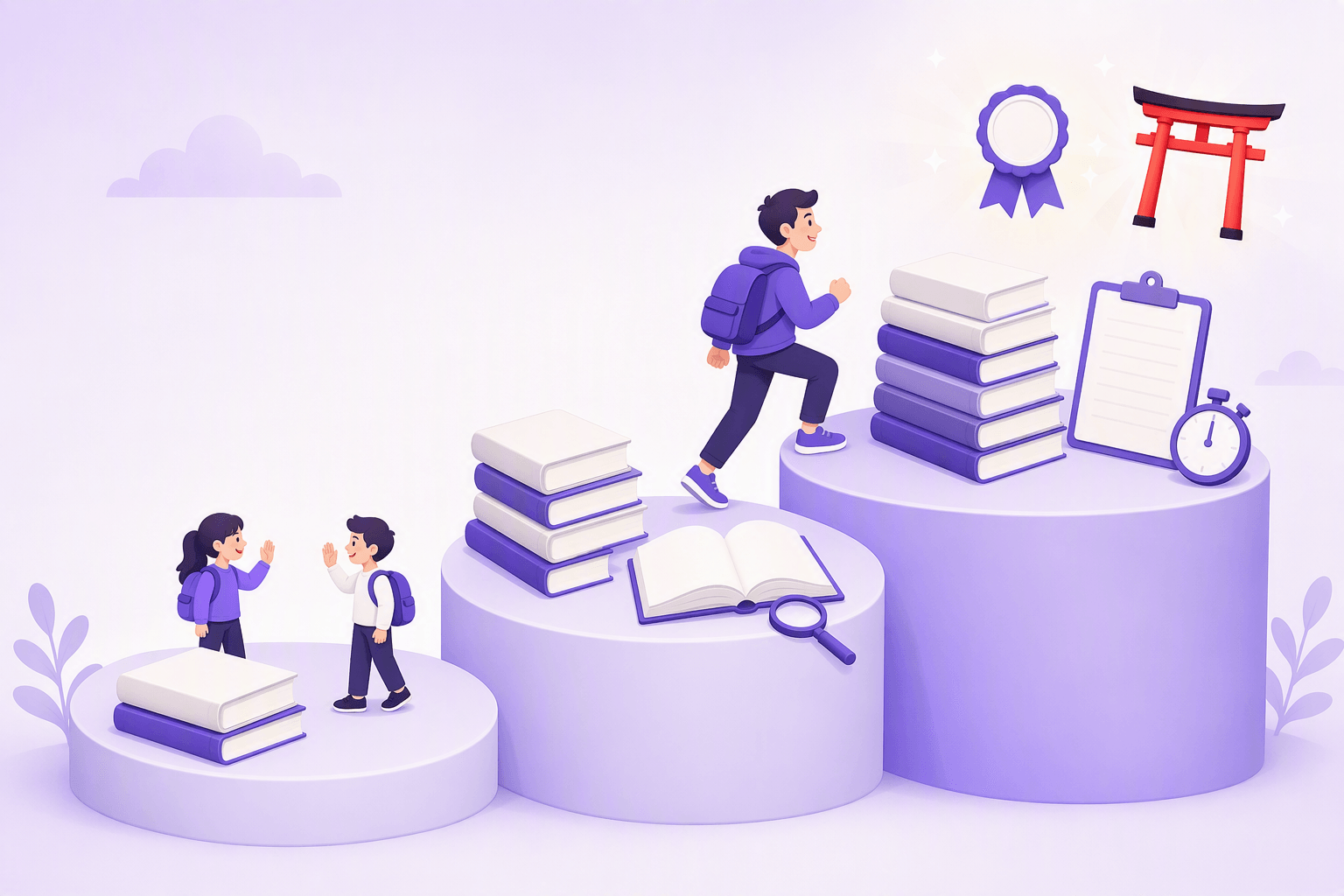
These picks are consistently reliable for self-learners in 2026. I am prioritizing books with strong sequencing, good audio availability, and a track record in classrooms.
Genki (I・II)
Genki is the default recommendation for a reason: it is structured, friendly, and balanced. The dialogues are practical, and the grammar explanations are clear enough to self-study.
Pronunciation note: "Genki" is げんき, often said like GEN-kee. Do not over-stress the first syllable, keep it light and even.
Best for:
- Complete beginners who want a guided path
- Learners who want speaking plus grammar
- People who need lots of exercises
Watch-outs:
- Some dialogues can feel overly "textbook polite" unless you supplement with real audio
- If you skip the audio, your listening lags behind fast
みんなの日本語 (Minna no Nihongo)
みんなの日本語 (meen-NAH noh nee-HOHN-goh) is extremely strong, especially if you like an immersion-style approach. The main text is mostly Japanese, and you use a separate translation and grammar notes book.
That structure can be powerful because it forces you to rely on Japanese cues early. It can also be frustrating if you want quick explanations in English.
Best for:
- Learners who like a classroom feel and repetition
- People who enjoy pattern drills and controlled practice
- Students who will work with a tutor or class
Watch-outs:
- You effectively need multiple books (main text plus translation/notes)
- Self-study is slower if you do not have someone to check your output
Japanese From Zero!
Japanese From Zero! is a gentle on-ramp for absolute beginners who feel intimidated by dense layouts. It is especially good at removing early friction and building confidence.
Pronunciation note: the series uses romaji early, so you must actively transition to kana. Otherwise, you risk building "English reading" habits that do not map to Japanese timing.
Best for:
- True beginners who want a slower pace
- Learners who need lots of hand-holding
- People returning after a long break
Watch-outs:
- Slower progression means you may outgrow it quickly if you study daily
- You still need a kana plan from week one
とびら (Tobira)
とびら (toh-BEE-rah) is the classic bridge from beginner to intermediate. It introduces longer readings, more realistic topics, and the kind of grammar you actually meet in essays, blogs, and interviews.
This is where Japanese starts to feel like Japanese, not like a sequence of isolated patterns. If Genki is "I can order food," Tobira is "I can read a short article and discuss it."
Best for:
- Learners moving from N4 to N3-ish content
- People who want reading plus discussion
- Students who want to transition into native materials
Watch-outs:
- It assumes you already have a base, do not start here from zero
- Vocabulary load is heavier, so you need spaced repetition
新完全マスター (Shin Kanzen Master)
新完全マスター (sheen kahn-ZEN mah-SUH-tah) is the most rigorous mainstream JLPT series. It is dense, test-shaped, and extremely effective when you already have some Japanese and need to close gaps.
It is not designed to be fun. It is designed to make you pass.
Best for:
- JLPT N3, N2, and N1 candidates who want depth
- Learners who like detailed explanations and lots of practice
- People who can handle a high workload
Watch-outs:
- Easy to burn out if you try to do everything at once
- Not ideal as your only Japanese input, you still need real listening
総まとめ (Sou Matome)
総まとめ (SOH mah-toh-meh) is the more schedule-friendly JLPT series. It breaks content into daily chunks, which makes it easier to build routine.
Many learners use it as a "first pass" and then use Shin Kanzen Master for weak points. That combination is efficient and realistic.
Best for:
- Learners who need structure and a calendar-like plan
- People who get overwhelmed by dense pages
- Anyone balancing study with work or school
Watch-outs:
- Less depth than Shin Kanzen Master
- You may need extra reading and listening practice for higher levels
Remembering the Kanji (Heisig)
Remembering the Kanji is a kanji memory system, not a full Japanese course. It teaches you to recognize and write characters using mnemonics, often before you learn readings.
Used correctly, it reduces the "kanji wall" by giving you a method. Used incorrectly, it becomes a time sink that delays real Japanese.
Best for:
- Learners who feel stuck on kanji recognition
- People who like systems and mnemonics
- Students who want a separate kanji track
Watch-outs:
- It does not teach vocabulary usage by itself
- You must pair it with words in context, not just isolated characters
🌍 Textbooks vs real Japanese: why both matter
Japanese politeness is not just vocabulary, it is social positioning. A textbook teaches the grammar of 丁寧語 (teh-NEH-go, polite speech) and 敬語 (KAY-go, honorific speech), but real clips teach when people actually switch registers, soften statements, or trail off to sound less direct.
Pronunciation and pitch accent: what textbooks miss
Most textbooks teach sounds, but they cannot fully teach timing, reduction, and pitch movement. Japanese is often described as a pitch-accent language, and NHK’s accent dictionary is one of the standard references used in broadcasting (NHK, 2016).
You do not need to obsess over pitch accent on day one. You do need to hear a lot of natural Japanese so your brain builds a reliable sound map.
"The more comprehensible input you have, the more language you acquire. The central idea is that we acquire language by understanding messages."
Stephen D. Krashen, linguist (Krashen, 1985)
Practical takeaway: treat your textbook as your grammar spine, and treat audio as your daily nutrition. Without audio, your Japanese stays "paper Japanese."
A simple study plan that actually works (textbook + media)
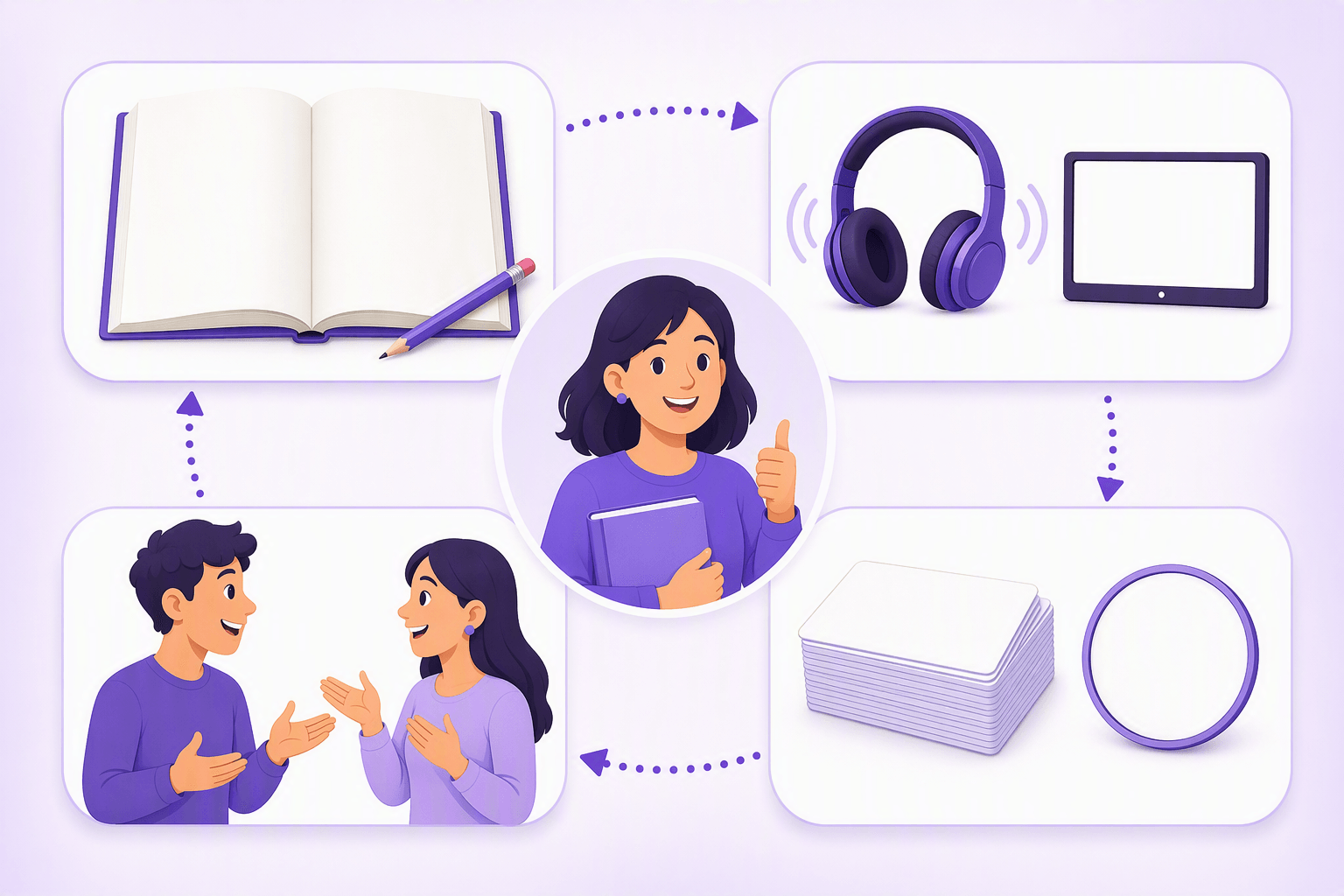
This plan is designed for self-learners who can study 30 to 60 minutes a day. The goal is steady progress without resource-hopping.
Step 1: Pick one "spine" book for 90 days
Choose Genki, Minna no Nihongo, or Japanese From Zero! and commit. Your job is not to find the perfect book, it is to finish chapters.
If you are unsure, Genki is the safest default for English-speaking self-learners. If you love structure and drills, Minna is excellent.
Step 2: Add daily listening, even if you understand little
Do 10 to 15 minutes a day of native audio. Use subtitles as support, not as a crutch.
Wordy’s approach is built for this: short clips, repeated listening, and vocabulary tracking. If you want a broader view of methods, start at the blog index and compare learning styles.
Step 3: Use spaced repetition for vocabulary, not willpower
Textbooks introduce vocabulary in batches. Your brain forgets it in batches too.
A simple rule: every new chapter gets its own deck or list, and you review it for 10 minutes a day. This is where most self-learners either accelerate or stall.
Step 4: Start speaking earlier than you feel ready
Speaking is not a reward for "finishing the book." It is part of learning the book.
Use short patterns from your chapter and say them out loud. Then recycle them in real situations, like greetings and introductions.
If you want ready-made patterns for first conversations, our guide to saying "I love you" in Japanese is a good example of how Japanese changes with context and relationship.
⚠️ The most common self-study mistake
Do not turn your textbook into a reading-only activity. If you are not listening and speaking, you are training recognition, not communication. That gap shows up fast when you try to understand real dialogue.
How to choose between Genki vs Minna no Nihongo (quick comparison)
Use this table when you are stuck between the two most common beginner paths.
| Feature | Genki | みんなの日本語 |
|---|---|---|
| Best for | Balanced self-study | Classroom-style immersion |
| Language of explanations | English | Separate translation/notes book |
| Audio importance | Essential | Essential |
| Pace | Moderate | Often faster, more drill-heavy |
| Self-study friction | Lower | Higher unless you buy the companion books |
If you want a third option, Japanese From Zero! is the "slow and steady" path. It is not weaker, it is just paced differently.
Where textbooks fit in a modern Japanese learning stack
In 2026, the most effective learners combine three things:
- A structured grammar path (textbook).
- High-volume listening (clips, shows, podcasts).
- Feedback (tutor, language exchange, or recording yourself).
If you want a broader comparison of tools, our best language learning apps guide helps you decide what to add around your textbook.
For learners who want to go deeper into cultural language, especially informal speech, it also helps to understand what not to copy from media. Our Japanese swear words guide is useful for recognizing strong language without accidentally using it.
Final recommendations (what to buy)
If you want one clear answer, here is the most reliable setup for most self-learners:
- Genki I and II as your beginner spine.
- Tobira as your bridge into intermediate reading.
- Shin Kanzen Master for the JLPT level you are taking.
Then add daily listening from day one. That combination is how you turn "I finished a book" into "I can understand people."
If you want to practice with real dialogue right away, start learning with clips on Japanese on Wordy.
Frequently Asked Questions
What is the best Japanese textbook for complete beginners?
Is it better to study Japanese with a textbook or an app?
Which textbooks are best for JLPT N3, N2, and N1?
How long does it take to finish Genki I and II?
Do I need to learn kana before starting a Japanese textbook?
Sources & References
- Ethnologue (SIL International). Ethnologue: Languages of the World, 27th edition, 2024.
- The Japan Foundation. Japanese-Language Education Overseas (Survey Report), 2021.
- NHK Broadcasting Culture Research Institute. NHK日本語発音アクセント新辞典 (NHK Japanese Pronunciation and Accent Dictionary), 2016.
- Krashen, S. The Input Hypothesis: Issues and Implications, 1985.
Start learning with Wordy
Watch real movie clips and build your vocabulary as you go. Free to download.


