Quick Answer
To write your name in Japanese, you usually use katakana to match the sounds of your name (not the spelling). Kanji name versions exist, but they are optional and can feel like a nickname. This guide shows practical rules, pronunciation approximations, and what Japanese people actually expect on forms, in emails, and in daily life.
To write your name in Japanese, the default and most correct option is katakana, a script designed to represent the sounds of non-Japanese words and many foreign names. You choose katakana based on how your name is pronounced, then adjust it to fit Japanese syllable patterns, often adding vowels or long vowel marks.

| English | Japanese | Pronunciation | Formality |
|---|---|---|---|
| My name is ... | 私の名前は…です | wah-TAH-shee noh nah-MAE-wah ... dess | polite |
| Please call me ... | …と呼んでください | ... toh YOHN-deh koo-DAH-sai | polite |
| How do you write your name? | お名前はどう書きますか | oh-NAH-mae-wah doh KAH-kee-mass-kah | polite |
| It's written like this | こう書きます | koh KAH-kee-mass | polite |
| In katakana | カタカナで | kah-tah-KAH-nah deh | casual |
| In romaji | ローマ字で | ROH-mah-jee deh | casual |
Why katakana is the standard for your name
Japanese is spoken by about 123 million people worldwide, mostly in Japan (Ethnologue 2024). In daily life, Japanese writing uses three scripts together: hiragana, katakana, and kanji.
Katakana is the workhorse for loanwords (外来語, gai-rai-go, "guy-RYE-goh") and for many non-Japanese names. That is why your name on a package label, a reservation list, or a school roster is typically written in katakana.
"Writing systems are social technologies: they do not just represent language, they organize identity and belonging."
Professor David Crystal, linguist (Crystal, The Cambridge Encyclopedia of Language)
That principle shows up clearly in Japan: katakana signals "this is a foreign-origin name," without implying you have a Japanese legal name.
💡 A practical rule
If you are unsure which script to use, use katakana for your name, and romaji (Latin letters) when a form explicitly asks for it. A kanji version is optional and should be treated as a nickname unless you have official documentation that uses it.
The three ways you might write your name (and when each is appropriate)
Katakana (カタカナ, kah-tah-KAH-nah)
Katakana is the default for most foreign names in Japan. It is what Japanese people expect on name tags, casual sign-up sheets, and many internal company systems.
It is also the easiest to read for Japanese speakers, because it matches Japanese pronunciation rules.
Romaji (ローマ字, ROH-mah-jee)
Romaji is your name in Latin letters. Many official processes in Japan still rely on romaji because it matches passports and immigration records.
You will see form fields like 氏名 (name) plus ローマ字 (romaji). In those cases, write exactly what your passport says, even if you prefer a different spelling.
Kanji (漢字, KAHN-jee)
Kanji are Chinese characters used in Japanese writing. A kanji name for a non-Japanese person is usually an adopted name, an artistic rendering, or a nickname.
Kanji choices have meaning, but they also have constraints. Japan’s standard daily-use character set is the Jōyō kanji list maintained by the Agency for Cultural Affairs (文化庁), which influences what is widely readable and commonly supported in systems (文化庁 2010).
🌍 Why kanji name versions can be tricky
A kanji name can look beautiful on a gift or a calligraphy card, but it can also create confusion. People may not know how to read it, because many kanji have multiple readings. If you pick kanji, be ready to provide furigana (ふりがな, foo-ree-GAH-nah, small reading text) or a katakana reading.

Katakana basics you need before converting your name
Katakana represents syllable-like units (mora). That is why names get reshaped.
Here are the core tools you will use:
- Long vowels: ー (chōonpu, ちょうおんぷ, "choh-ohn-poo") as in ジョン (JON) vs ジョーン (JOHN with a stretched vowel)
- Small ャュョ: to make sounds like キャ (kya), シュ (shu), チョ (cho)
- Small ッ: to mark a doubled consonant (a "stop"), like ベット (betto) vs ベッド (beddo)
ー
The long vowel mark ー is common in katakana names. It signals that the vowel sound is held longer.
Examples:
- ケイト (KEI-to, "Kate") vs ケーキ (KEE-ki, "cake") shows how length changes rhythm.
ッ
Small ッ (っ in hiragana) often appears when English has a strong consonant ending or a doubled consonant feel.
Examples:
- マット (MAT-to, "Matt")
- ベッキー (BEK-kee, "Becky")
ヴ
Katakana has ヴ (vu) to approximate a "v" sound, but many speakers still pronounce it close to "b." Both can be seen in the wild, depending on the name and the person.
Examples:
- ヴィクトリア (VIK-to-ree-ah) for "Victoria"
- ビクトリア (BIK-to-ree-ah) is also common
NINJAL’s resources on loanwords and katakana usage discuss how foreign sounds are adapted into Japanese phonology and orthography (NINJAL, 2010s-2020s).
Step-by-step: how to convert your name into katakana
1) Start from how you say it out loud
Write your name in a simple phonetic way in English. Ignore silent letters.
For example:
- "Michael" is closer to "MY-kul" than "mee-KHA-el" for many speakers.
2) Break it into Japanese-friendly chunks
Japanese typically avoids consonant clusters (like "str") and most final consonants (except ん, "n"). So you insert vowels.
Common insertions:
- t becomes ト (to) or ティ (ti)
- k becomes ク (ku) or キ (ki)
- l and r both map to ラ行 sounds (ra, ri, ru, re, ro)
3) Choose the closest katakana syllables
This is where multiple "correct" answers can exist. Pick the version that best matches your preferred pronunciation and is easy for Japanese people to say.
4) Add long vowels and small letters for accuracy
Long vowels can be the difference between "Ryan" and "Lion" in Japanese rhythm. Small ャュョ can make your name sound more natural.
5) Test it with a Japanese speaker, then lock it in
Consistency matters more than perfection. If you switch spellings, people will assume it is a different person.
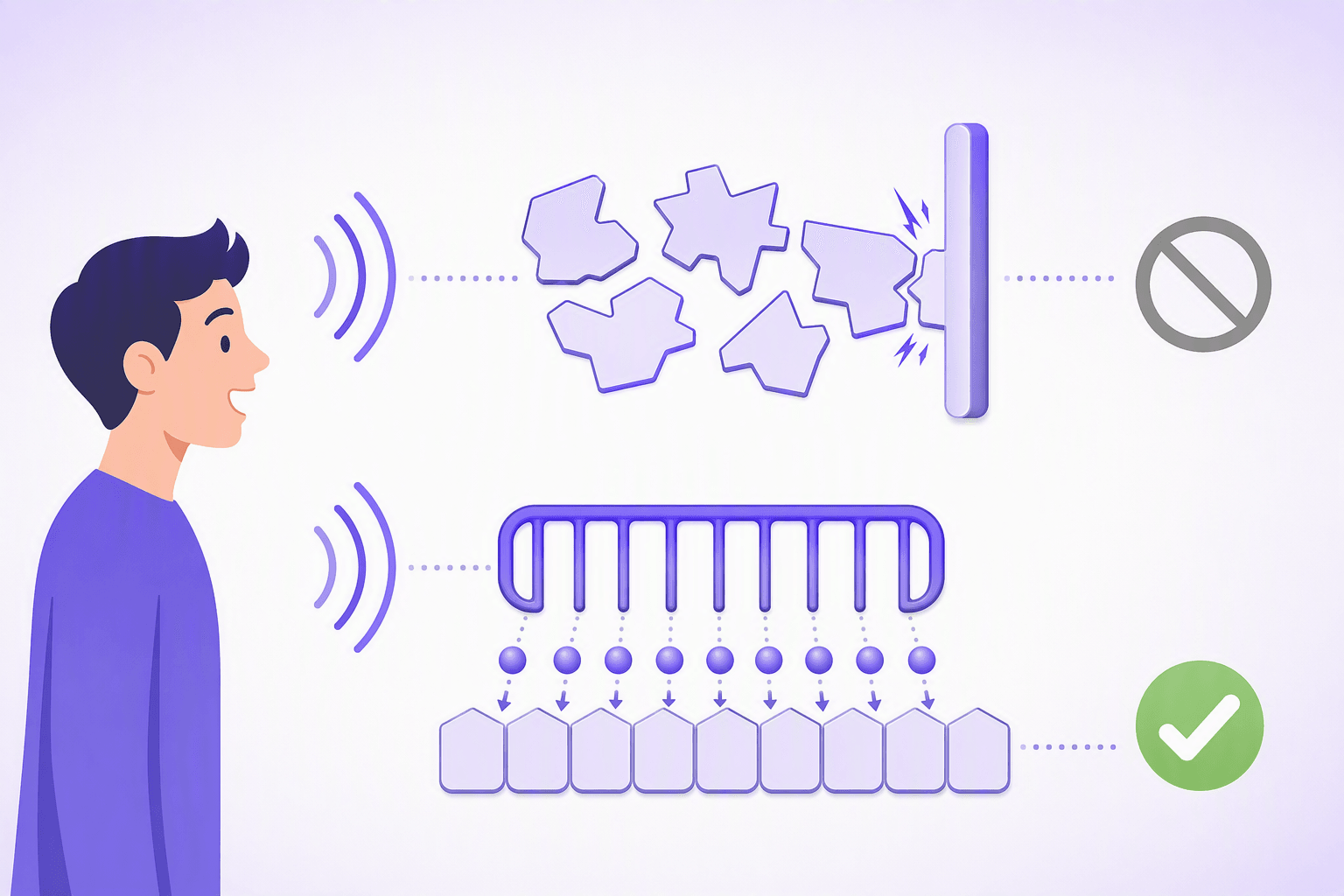
⚠️ Avoid 'katakana by spelling'
Do not convert letter-by-letter from English spelling. Convert sound-by-sound. "George" is not ジオルゲ, it is usually ジョージ (JOH-jee). This is the most common reason auto-converters produce awkward results.
Common name sound problems (and how Japanese usually solves them)
L vs R
Japanese does not have an English-style "l" sound. Both "l" and "r" are typically rendered with ラ行.
Examples:
- "Laura" often becomes ローラ (ROH-rah)
- "Ryan" becomes ライアン (RYE-ahn)
TH
English "th" becomes サ行 or ザ行 depending on voicing and convention.
Examples:
- "Thomas" often トーマス (TOH-mas)
- "Theresa" often テリーサ (te-REE-sah) or テレサ (te-REH-sah)
F and V
Japanese has フ (fu) and combinations like ファ (fa), フィ (fi), フェ (fe), フォ (fo). V is often approximated with ヴ plus a vowel, but B is also common.
Examples:
- "Frank" フランク (foo-RAHN-koo)
- "Vanessa" ヴァネッサ (vah-NES-sah) or バネッサ (bah-NES-sah)
Final consonants
Most final consonants get a vowel added, or become ン (n).
Examples:
- "Mark" マーク (MAH-koo)
- "Ben" ベン (BEN)
- "Chris" クリス (koo-REE-soo)
Worked examples (so you can copy the method)
Below are typical renderings. They are not the only possibilities, but they are widely understood.
| Name (English) | Typical katakana | Pronunciation (English approx) | Notes |
|---|---|---|---|
| Alex | アレックス | ah-REK-soo | Small ッ often appears in "x" names |
| Emily | エミリー | eh-MEE-ree | Long vowel ー for "lee" |
| David | デイビッド | DAY-bid-do | "v" often becomes "b" |
| Sophie | ソフィー | soh-FEE | Long vowel ー at the end |
| Chris | クリス | koo-REE-soo | Adds vowels to fit rhythm |
| John | ジョン | JON | Short and common |
| George | ジョージ | JOH-jee | Long vowel ー is typical |
| Kate | ケイト | KEI-to | Diphthong becomes ケイ |
If you want more everyday Japanese you will actually use alongside your name, learn a few natural greetings from our how to say hello in Japanese guide.
Hiragana names: when it happens, and why it is rare for foreigners
ひらがな
Hiragana (ひらがな, hee-rah-GAH-nah) is used for native Japanese grammar and many Japanese given names, especially feminine names or soft stylistic choices.
A foreigner using hiragana for their name can look cute or friendly, but it is not the default. It can also make people assume you have a Japanese name.
ふりがな
Furigana (ふりがな, foo-ree-GAH-nah) is the reading aid written in kana above kanji. On forms, you often see a furigana field asking for the pronunciation of a name.
If you write your name in kanji (or if the form uses kanji fields), you may be asked to provide furigana in hiragana or katakana. Follow the form’s instruction.
Kanji versions of your name: how they are created (and the cultural tradeoffs)
漢字
A kanji name version is usually made in one of two ways:
- Sound-based (ateji, 当て字, ah-teh-jee): choose kanji for their readings to approximate your name’s sound.
- Meaning-based: choose kanji for a meaning you like, then accept that the reading is a chosen reading, not obvious.
Both can be valid socially. Neither is "more authentic" by default.
当て字
Ateji (当て字, ah-teh-jee) can look impressive, but it is often hard to read. Many kanji have multiple readings, and name readings can be especially unpredictable.
If you pick ateji, always provide a kana reading with it.
名乗り
Nanori (名乗り, nah-NOH-ree) refers to name-specific readings of kanji. These readings can differ from the common dictionary readings.
This is one reason kanji names can confuse even native speakers. The Agency for Cultural Affairs’ standardization efforts (like the Jōyō kanji list) help with literacy, but name readings still vary widely (文化庁 2010).
🌍 Where kanji name versions work best
Kanji versions shine in informal contexts: a hanko-style stamp design, a calligraphy gift, a martial arts dōjō name, or a social media bio. In workplaces and schools, katakana is usually clearer and more practical.
What to write on Japanese forms, emails, and deliveries
Forms: 氏名, 名, 姓
Common fields you might see:
- 氏名 (shi-mei, "shee-MAY"): full name
- 姓 (sei, "SAY"): family name
- 名 (mei, "MAY"): given name
If the form is Japanese-only and expects kana, use katakana for your name unless the form explicitly requests romaji.
Forms: カタカナ, フリガナ, ローマ字
- If it says カタカナ, write your name in katakana.
- If it says フリガナ, provide the reading in kana (often katakana for foreign names).
- If it says ローマ字, use your passport spelling.
Deliveries and reservations
For deliveries, matching the address and phone number matters most. For reservations, the staff often search by katakana, so having a stable katakana name helps.
If you are traveling, pair this with practical phrases from our Japanese goodbye guide so you can handle greetings and exits smoothly.
Pronouncing your katakana name clearly (so people get it right)
Japanese rhythm is mora-timed. That means each kana unit takes roughly equal time.
To be understood, focus on:
- Long vowels (ー): do not rush them
- Small ッ: make a brief stop before the next consonant
- ン: keep it as a nasal "n" sound, not "ng"
A quick practice technique:
- Clap once per kana as you say your katakana name.
- If you cannot clap evenly, you are probably swallowing a long vowel or small ッ.
Movie and TV listening tip: learn names the way Japan hears them
If you learn katakana names only from lists, they can feel abstract. In real dialogue, names come with intonation, honorifics, and emotion.
In Wordy, you can train this by listening to short clips where characters call each other by name, then repeating with the same rhythm. This is especially useful for long vowel marks and small ッ, which are easy to miss in textbooks.
If you are building a broader Japanese foundation, start with our Japanese alphabet guide and then move into greetings like how to say hello in Japanese.
Honorifics with your name (what people may add)
In Japan, people often attach honorifics to names:
- さん (san, "sahn"): neutral polite default
- くん (kun, "koon"): often for boys or junior males, sometimes for subordinates
- ちゃん (chan, "chahn"): affectionate, often for kids or close friends
You do not need to add these when writing your name on forms. People will add them in speech.
💡 A safe introduction line
Use "私の名前は...です" (wah-TAH-shee noh nah-MAE-wah ... dess) and then say your katakana name slowly once. If you want to sound natural, follow with "...と呼んでください" (... toh YOHN-deh koo-DAH-sai).
Mistakes that cause the most confusion (and how to avoid them)
Overusing small vowels and special combinations
Japanese has tools like ティ (ti) and ディ (di), but not every name needs them. Over-precision can make your name harder to read.
Aim for a balance: accurate enough to sound like you, simple enough to be readable.
Inconsistent long vowels
If you write ケビン (KEH-bin) one day and ケービン (KEE-bin) the next, people will hesitate. Pick one.
A good test is: which version do Japanese people naturally say back to you after hearing your name once?
Choosing kanji that are hard to read
If you adopt kanji, choose characters that are common and legible. The more unusual the character, the more often you will need to explain it.
This is not about "right vs wrong," it is about reducing friction in daily interactions.
A quick checklist before you finalize your Japanese name
- Does the katakana match how you introduce yourself out loud?
- Can a Japanese speaker read it without asking twice?
- Are long vowels (ー) and small ッ used consistently?
- Do you have a romaji version that matches your passport for official use?
- If you chose kanji, do you also have a kana reading ready?
For more Japanese expressions you will hear in real dialogue, explore the Wordy blog and keep an eye on register. Some words are affectionate, some are rude, and some are outright offensive, as covered in our guide to Japanese swear words.
Practice mini-script (what to say when asked)
Use this when someone asks your name in Japan:
-
私の名前はアレックスです。
(wah-TAH-shee noh nah-MAE-wah ah-REK-soo dess) -
カタカナで「アレックス」と書きます。
(kah-tah-KAH-nah deh ah-REK-soo toh KAH-kee-mass)
If you want a more personal line for close relationships, you can also learn phrases from our how to say I love you in Japanese guide, but keep in mind that Japanese often expresses affection indirectly.
The bottom line
Write your name in Japanese with katakana unless you have a specific reason not to. Treat kanji versions as optional nicknames, and use romaji exactly as official documents require.
Once you pick a katakana version that matches your pronunciation, keep it consistent. That single choice will make every form, introduction, and reservation in Japan noticeably easier.
Frequently Asked Questions
Do Japanese people write foreign names in katakana or kanji?
How do I choose the correct katakana for my name?
Can I legally use a kanji version of my name in Japan?
Why does my name get an extra vowel in Japanese?
Is it rude if my katakana name sounds different from my original name?
Sources & References
- Agency for Cultural Affairs (文化庁), 常用漢字表 (Jōyō Kanji List), 2010 (as amended)
- The Japan Foundation, Japanese Writing System (Hiragana, Katakana, Kanji), 2020s
- Ethnologue, Japanese (Language of Japan), 27th edition, 2024
- National Institute for Japanese Language and Linguistics (国立国語研究所, NINJAL), Loanword (外来語) and Katakana Usage Resources, 2010s-2020s
Start learning with Wordy
Watch real movie clips and build your vocabulary as you go. Free to download.


