Quick Answer
Advanced Spanish food vocabulary includes menu words such as ración, guiso, escabeche, and punto de sal, plus cooking techniques and texture descriptions. These terms help you read real menus, shop at markets, and understand food conversations across Spain and Latin America.
Advanced Spanish food vocabulary helps you do far more than name ingredients: it lets you read menus, understand a cooking show, buy the right cut at a market, and ask useful questions at a restaurant. Learn terms such as ración /raˈθjon/, sofrito /soˈfɾito/, escabeche /eskaˈβetʃe/, and punto de sal /ˈpunto ðe sal/ to understand how a dish is portioned, cooked, seasoned, and served.
Spanish is spoken by more than 600 million potential speakers worldwide according to Instituto Cervantes, and it is an official language in 20 countries. That reach means there is no single universal Spanish food vocabulary: a word on a menu in Madrid may carry a different everyday meaning in Mexico City, Lima, Buenos Aires, or Bogotá.
If you need everyday ingredient words first, start with our Spanish food vocabulary guide. This article focuses on the higher-value terms that appear on restaurant menus, in markets, and in real food conversations.
| English | Spanish | Pronunciation | Note |
|---|---|---|---|
| Small shared dish | tapa | TAH-pah | IPA /ˈtapa/. A small dish, especially associated with Spain. |
| Large shared portion | ración | rah-SYOHN | IPA /raˈθjon/. A full portion intended for sharing. |
| Half portion | media ración | MEH-dyah rah-SYOHN | IPA /ˈmeðja raˈθjon/. Useful when sharing several dishes. |
| Small individual bite | pincho | PEEN-choh | IPA /ˈpintʃo/. Common in northern Spain, especially the Basque Country. |
| Set lunch menu | menú del día | meh-NOO del DEE-ah | IPA /meˈnu ðel ˈdi.a/. Usually includes several courses for one price. |
| Menu list | carta | KAHR-tah | IPA /ˈkaɾta/. The restaurant's regular menu, not a letter. |
| After-meal conversation | sobremesa | soh-breh-MEH-sah | IPA /soβɾeˈmesa/. Time spent talking at the table after eating. |
| Appetizer or pre-meal drink | aperitivo | ah-peh-ree-TEE-boh | IPA /apeɾiˈtiβo/. Can refer to food, a drink, or the social occasion. |
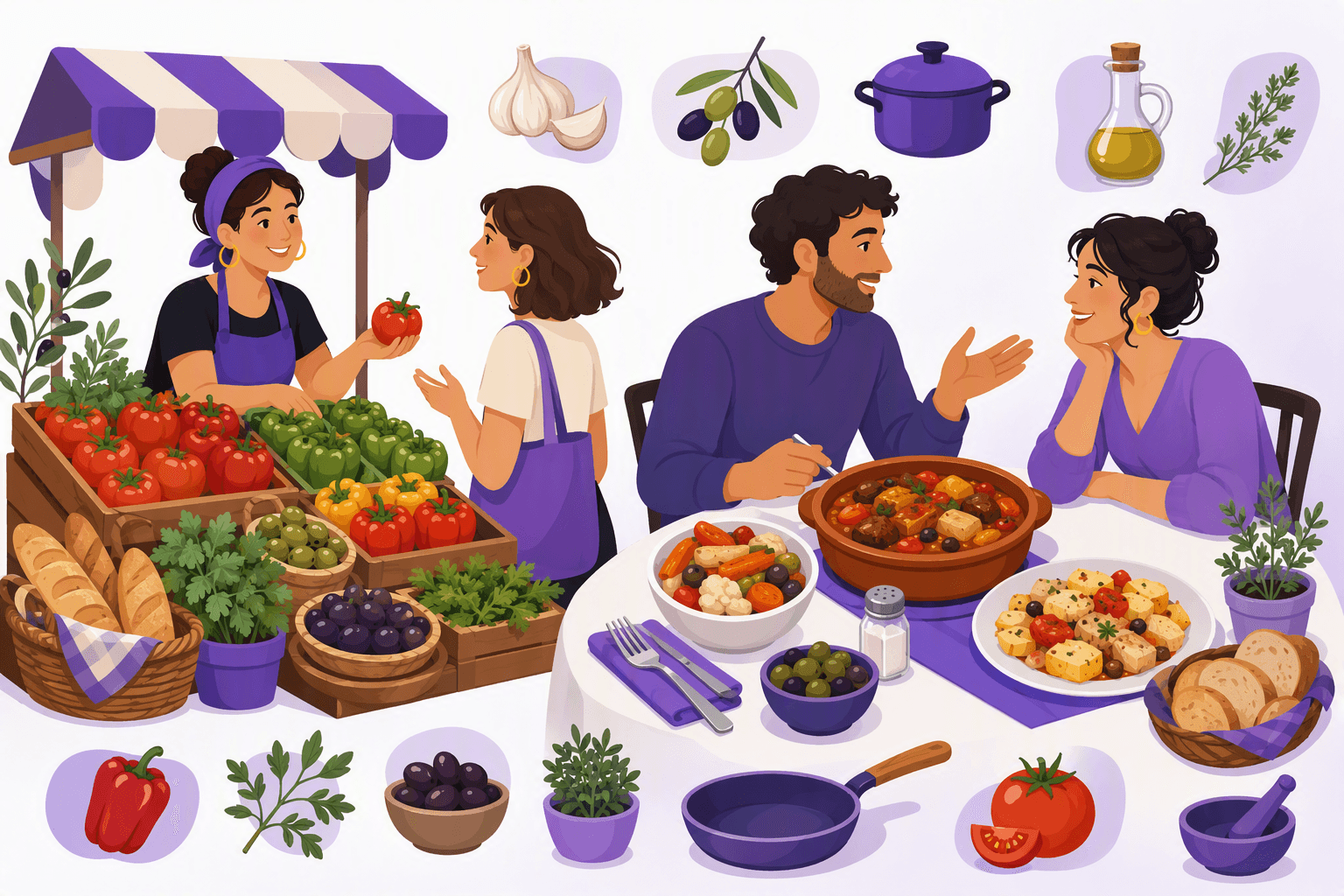
How advanced food words unlock real Spanish menus
A basic learner sees pollo /ˈpoʎo/ and understands chicken. An advanced learner sees pollo al ajillo /ˈpoʎo al aˈxillo/, pollo guisado /ˈpoʎo ɣiˈsaðo/, or pollo rebozado /ˈpoʎo reβoˈsaðo/ and can predict the flavor, cooking process, and texture before ordering.
The Real Academia Española defines many of these words in its Diccionario de la lengua española, but restaurant use adds local context. A ración /raˈθjon/ is not merely a measured serving. It signals a social way of eating, where a table orders several dishes and shares them.
sobremesa
Sobremesa /soβɾeˈmesa/ literally refers to the time after a meal, while people are still seated at the table. It is one of the most culturally useful Spanish food words because it describes a social practice, not an ingredient.
A restaurant might not list sobremesa /soβɾeˈmesa/ on the menu, but you will experience it in long family lunches and relaxed dinners. The meal does not necessarily end when the plates are cleared. Coffee, conversation, and sometimes a small digestif follow.
🌍 Food vocabulary is social vocabulary
The UNESCO-recognized Mediterranean diet is not only about olive oil, vegetables, grains, or fish. UNESCO also emphasizes shared meals, local knowledge, and food traditions. Knowing words such as ración /raˈθjon/ and sobremesa /soβɾeˈmesa/ helps you recognize that social side of eating in Spain.
menú del día
A menú del día /meˈnu ðel ˈdi.a/ is a fixed-price lunch menu, traditionally offered on weekdays in Spain. It often includes a first course, a second course, bread, a drink, and dessert or coffee, though the exact format varies.
Do not confuse menú /meˈnu/ with carta /ˈkaɾta/. The menú del día /meˈnu ðel ˈdi.a/ is the set offer, while the carta /ˈkaɾta/ is the regular list of available dishes. For practical ordering language, see our guide to eating at a restaurant in Spanish.
Cooking methods you will see on menus
Cooking words often come after a la /a la/ or al /al/. These short connectors matter because they introduce the method or style of preparation. If you learn them, long menu descriptions become much easier to decode.
| English | Spanish | Pronunciation | Note |
|---|---|---|---|
| Base of gently cooked aromatics | sofrito | soh-FREE-toh | IPA /soˈfɾito/. Usually onion, garlic, tomato, or peppers cooked slowly in oil. |
| Grilled on a flat hot surface | a la plancha | ah lah PLAHN-chah | IPA /a la ˈplantʃa/. Cooked on a griddle with little added sauce. |
| Cooked with garlic | al ajillo | ahl ah-HEE-yoh | IPA /al aˈxillo/. Often prepared with garlic and olive oil. |
| Cooked over embers or a grill | a la brasa | ah lah BRAH-sah | IPA /a la ˈβɾasa/. Often associated with charcoal-fired cooking. |
| Stew | guiso | GEE-soh | IPA /ˈɣiso/. A slow-cooked, saucy dish with meat, legumes, vegetables, or seafood. |
| Vinegar-preserved preparation | escabeche | eh-skah-BEH-cheh | IPA /eskaˈβetʃe/. Food marinated or preserved with vinegar, oil, and seasonings. |
| Seasoned marinade | adobo | ah-DOH-boh | IPA /aˈðoβo/. A seasoned marinade whose ingredients vary greatly by region. |
| Coated in batter and fried | rebozado | reh-boh-SAH-doh | IPA /reβoˈsaðo/. A light flour, egg, or batter coating before frying. |
sofrito
A sofrito /soˈfɾito/ is a flavor base made by gently cooking aromatic ingredients in fat, often olive oil. In Spain, onion, garlic, tomato, and peppers are common components, but the combination changes by region and household.
Do not translate sofrito /soˈfɾito/ too narrowly as fried sauce. The point is slow cooking that softens ingredients and builds depth before rice, beans, sauces, or stews are added. In a recipe, hacer un sofrito /aˈθeɾ un soˈfɾito/ means to prepare this base.
escabeche
Escabeche /eskaˈβetʃe/ is a preparation involving vinegar, oil, herbs, and spices, often used for fish, poultry, or vegetables. It can be served warm, cold, or at room temperature, and it was historically valuable as a preservation method.
This term is shared across much of the Spanish-speaking world, but local recipes differ. In Spain, mejillones en escabeche /meˈxiʎones en eskaˈβetʃe/ are familiar in tapas bars and canned-food aisles. In Latin America, escabeche /eskaˈβetʃe/ may refer to pickled vegetables served alongside richer dishes.
a la plancha
A la plancha /a la ˈplantʃa/ means cooked on a very hot flat griddle. It is a useful menu term for seafood, vegetables, and meat because it usually signals a direct, relatively simple preparation rather than a heavy sauce.
If a menu offers calamares a la plancha /kalaˈmaɾes a la ˈplantʃa/, expect grilled squid rather than battered, deep-fried squid. This distinction can save you from an unwanted surprise when ordering.
💡 Read the final words first
On Spanish menus, the final phrase often tells you the cooking method. In merluza al horno /meɾˈluθa al ˈoɾno/, the key detail is al horno /al ˈoɾno/, meaning oven-baked. In verduras a la brasa /beɾˈðuɾas a la ˈβɾasa/, it is a la brasa /a la ˈβɾasa/, meaning cooked over embers.
Texture, doneness, and seasoning vocabulary
Texture vocabulary is especially useful when you want to describe what you enjoyed, make a request, or understand a chef's description. It also helps you follow cooking competitions and food-focused Spanish films or series.
| English | Spanish | Pronunciation | Note |
|---|---|---|---|
| Creamy and rice-like texture | meloso | meh-LOH-soh | IPA /meˈloso/. Often used for rice dishes that are moist but not soupy. |
| Juicy | jugoso | hoo-GOH-soh | IPA /xuˈɣoso/. Used for meat, fruit, fillings, and cakes. |
| Crunchy or crisp | crujiente | kroo-HYEN-teh | IPA /kɾuˈxjente/. Used for fried food, bread crusts, and vegetables. |
| Tender | tierno | TYEHR-noh | IPA /ˈtjeɾno/. Common for meat, vegetables, and dough. |
| Rare or lightly cooked | poco hecho | POH-koh EH-choh | IPA /ˈpoko ˈetʃo/. Usually used when ordering meat. |
| Well done | bien hecho | byen EH-choh | IPA /bjen ˈetʃo/. Usually used when ordering meat. |
| Overcooked | pasado | pah-SAH-doh | IPA /paˈsaðo/. Can describe overcooked pasta, rice, meat, or vegetables. |
| Correct salt balance | punto de sal | POON-toh deh SAHL | IPA /ˈpunto ðe sal/. Means balanced seasoning, not simply a salty dish. |
meloso
Meloso /meˈloso/ is a prized texture word, especially for rice. A arroz meloso /aˈros meˈloso/ is moist, rich, and creamy, with enough liquid to coat the grains but not enough to become a soup.
It is distinct from arroz caldoso /aˈros kalˈðoso/, which contains more broth, and from a dry rice dish such as paella. The exact boundary varies among cooks, but the contrast is useful when reading a menu.
punto de sal
Punto de sal /ˈpunto ðe sal/ means that the seasoning has reached the right balance. A cook may say rectificar de sal /rektifiˈkaɾ ðe sal/ when tasting a dish and deciding whether it needs more seasoning.
This phrase reflects a practical rule in Spanish cooking: salt should support the ingredients rather than dominate them. It is also why simply asking for a dish to be salado /saˈlaðo/ is not the same as asking whether it is well seasoned.
poco hecho
When ordering steak, poco hecho /ˈpoko ˈetʃo/ means rare or lightly cooked. Al punto /al ˈpunto/ means medium, while bien hecho /bjen ˈetʃo/ means well done.
These labels are not perfectly standardized in every restaurant, particularly for thicker cuts. If doneness matters, say lo quiero poco hecho /lo ˈkjeɾo ˈpoko ˈetʃo/, meaning that you want it rare, and ask the server what they recommend.
Regional Spanish food vocabulary: why context matters
Francisco Moreno Fernández, in Variedades de la lengua española, documents how Spanish changes across regions and communities. Food is one of the clearest places to notice this variation because vocabulary follows local crops, trade, migration, and family traditions.
The classic example is tortilla /toɾˈtiʎa/. In Spain, tortilla de patatas /toɾˈtiʎa ðe paˈtatas/ is an omelet made with eggs and potatoes. In Mexico, tortilla /toɾˈtiʎa/ usually means a flatbread made from corn or wheat.
Similarly, judías /xuˈði.as/ commonly means beans in much of Spain, while frijoles /fɾiˈxoles/ is widespread in Mexico and parts of Central America. In many South American countries, porotos /poˈɾotos/ or habichuelas /aβiˈtʃwelas/ may be the everyday word instead.
🌍 Avoid calling a regional word wrong
When a Spanish food word differs by country, it is usually a regional preference rather than an error. Ask ¿Cómo le llaman aquí? /ˈkomo le ˈʎaman aˈki/, meaning what do people call it here, to learn the local term respectfully.
How to practice advanced food vocabulary
Use menus as short, realistic reading exercises. Read a dish name once for its main ingredient, again for the cooking method, and a third time for its texture or sauce. This trains you to identify the information that matters when ordering.
Watching food scenes is equally useful because you hear the words in context: someone may complain that meat is pasado /paˈsaðo/, praise a sauce as jugosa /xuˈɣosa/, or offer a ración /raˈθjon/ to the table. For more food-and-culture context, read our guide to Spanish food culture.
Build mini phrase patterns instead of memorizing isolated nouns:
- ¿Qué lleva este plato? /ke ˈʎeβa este ˈplato/, what ingredients does this dish contain?
- ¿Cómo está preparado? /ˈkomo esˈta pɾepaˈɾaðo/, how is it prepared?
- ¿Es para compartir? /es ˈpaɾa kompaɾˈtiɾ/, is it for sharing?
- Lo quiero al punto. /lo ˈkjeɾo al ˈpunto/, I want it medium.
- ¿Tiene frutos secos? /ˈtjene ˈfɾutos ˈsekos/, does it contain nuts?
A strong food vocabulary makes travel conversations warmer and more precise. Pair it with Spanish greetings and polite restaurant language, then listen for these terms in real scenes rather than treating them as a disconnected list.
Frequently Asked Questions
What Spanish food vocabulary should I learn beyond basic foods?
What is the difference between tapa, pincho, and ración?
Do Spanish food terms differ between Spain and Latin America?
How can I understand a Spanish restaurant menu?
What does punto de sal mean in Spanish cooking?
Sources & References
- Real Academia Española, Diccionario de la lengua española, accessed 2026
- Instituto Cervantes, El español: una lengua viva, 2024
- UNESCO, Mediterranean Diet, Representative List of the Intangible Cultural Heritage of Humanity, accessed 2026
- Francisco Moreno Fernández, Variedades de la lengua española, Routledge
Start learning with Wordy
Watch real movie clips and build your vocabulary as you go. Free to download.


