Quick Answer
Spanish food culture is built around late meal times, social eating, and shared dishes: breakfast is light, lunch is the main meal, dinner is late, and tapas are often ordered to share. To fit in, learn a few table phrases, understand how to ask for the bill, and expect long conversations after eating (sobremesa).
Spanish food culture is defined by late meal times, shared dishes, and long social conversations at the table: lunch is typically the biggest meal, dinner starts late, and tapas are as much about moving and chatting as they are about eating.
Spain is also one of the best places to learn real-life Spanish because food talk is constant and repetitive: ordering, offering, refusing politely, and reacting to taste. If you are also learning greetings, pair this with our guide to saying hello in Spanish so you can walk into a bar sounding natural from the first second.
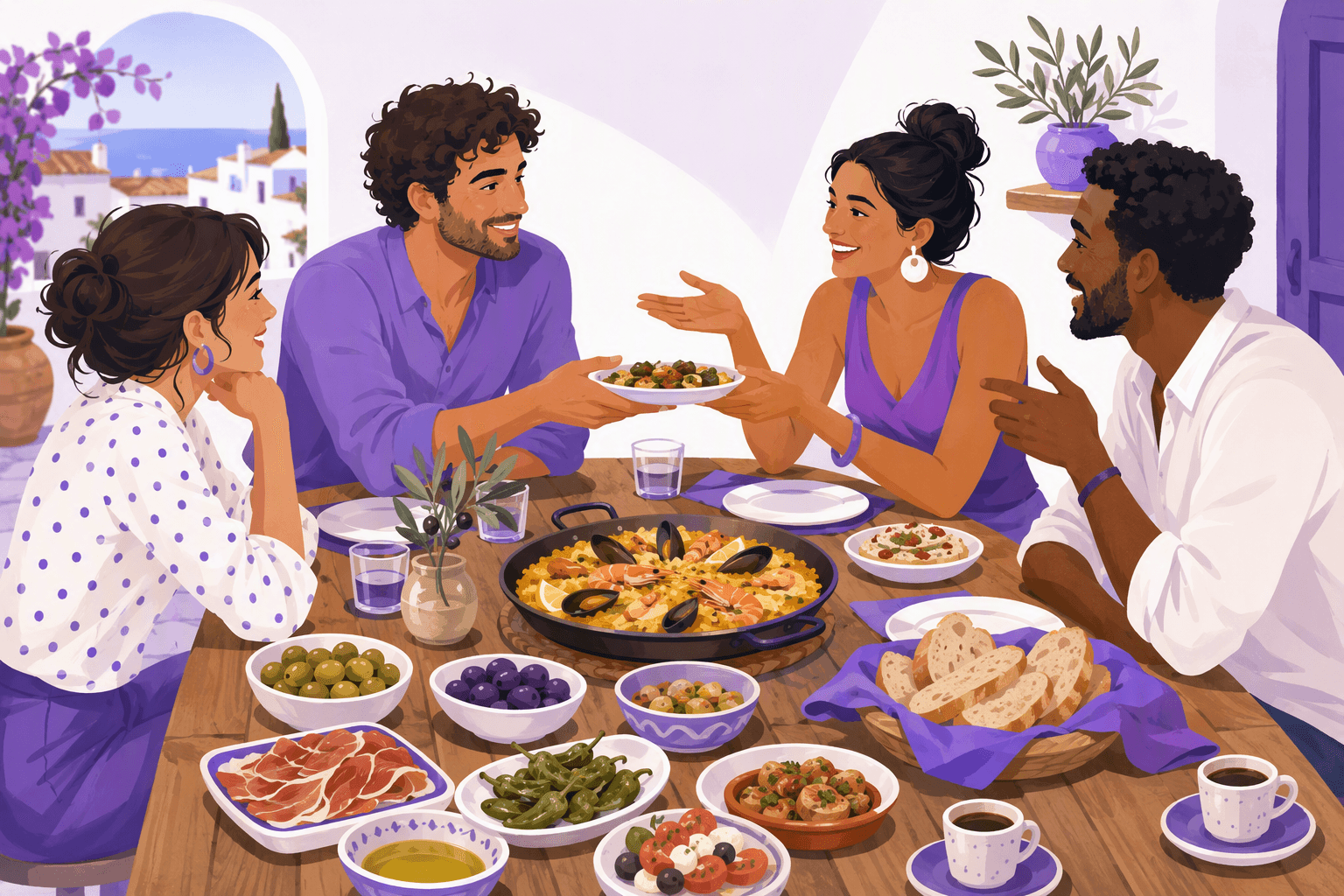
Why Spanish food culture feels different (even if you speak Spanish)
Spain has about 48 million people, and Spanish is spoken far beyond Spain: Ethnologue estimates roughly 500 million native speakers worldwide. That matters because visitors often expect a single “Spanish way,” but Spain itself has strong regional identities, languages, and food traditions.
The core difference is that meals are social blocks of time, not just fuel. Linguist Penelope Brown’s work on politeness (with Stephen Levinson, Politeness: Some Universals in Language Usage, Cambridge University Press) helps explain why: offers, refusals, and softening phrases protect everyone’s “face” at the table, especially when sharing food.
Food is also culture in the formal sense. UNESCO recognizes the Mediterranean diet as intangible cultural heritage, and Spain is one of the countries associated with that tradition, emphasizing seasonal ingredients, olive oil, and shared meals.
The daily rhythm: what Spaniards eat, and when
Desayuno: light breakfast
Desayuno is often quick and small. Common choices include coffee, toast, or a simple pastry.
If you ask for “breakfast” in a cafe, you will usually be offered a few standard items rather than a long menu. In many places, the real morning eating happens later.
Almuerzo: the mid-morning bridge
Almuerzo can mean a mid-morning snack in much of Spain. Think of it as a second breakfast: a bocadillo (sandwich on baguette-style bread) or something small with coffee.
This is one reason lunch is later. People are not starving at noon because they already ate something.
Comida: the main meal (often with a menu)
Comida is typically the biggest meal of the day. In many towns, weekday lunch menus (menú del día) are a practical way to eat a full meal at a set price.
A common structure is first course, second course, dessert or coffee. Portions can be larger than what visitors expect from “Mediterranean diet” stereotypes.
Merienda: late afternoon snack
Merienda is especially common for kids, teens, and anyone with a long gap between lunch and dinner. It can be sweet (chocolate and pastry) or savory.
If you are invited to merienda, treat it as a social snack, not a full meal. You can eat lightly and still be ready for a late dinner.
Cena: late dinner, often lighter than lunch
Dinner in Spain is late compared to many countries. It is also often lighter than lunch, though that depends on the person and the day.
In big cities, you will see dinner services that start when some visitors are already thinking about bed. Plan your day around it, and you will stop feeling like you are “waiting” for restaurants to open.
💡 A practical travel rule
If you want to eat like locals, aim for lunch in the early-to-mid afternoon and dinner later in the evening. If you eat early, choose places that cater to early diners, especially in tourist zones.
Tapas culture: what it is (and what it is not)
Tapas are small dishes, but the deeper rule is social: you order in rounds, share, talk, and often move to another place. Tapas are not automatically “free food,” and the system varies by city and bar.
The RAE defines tapa as a small portion of food served with a drink. In practice, you will see everything from a few olives to elaborate small plates.
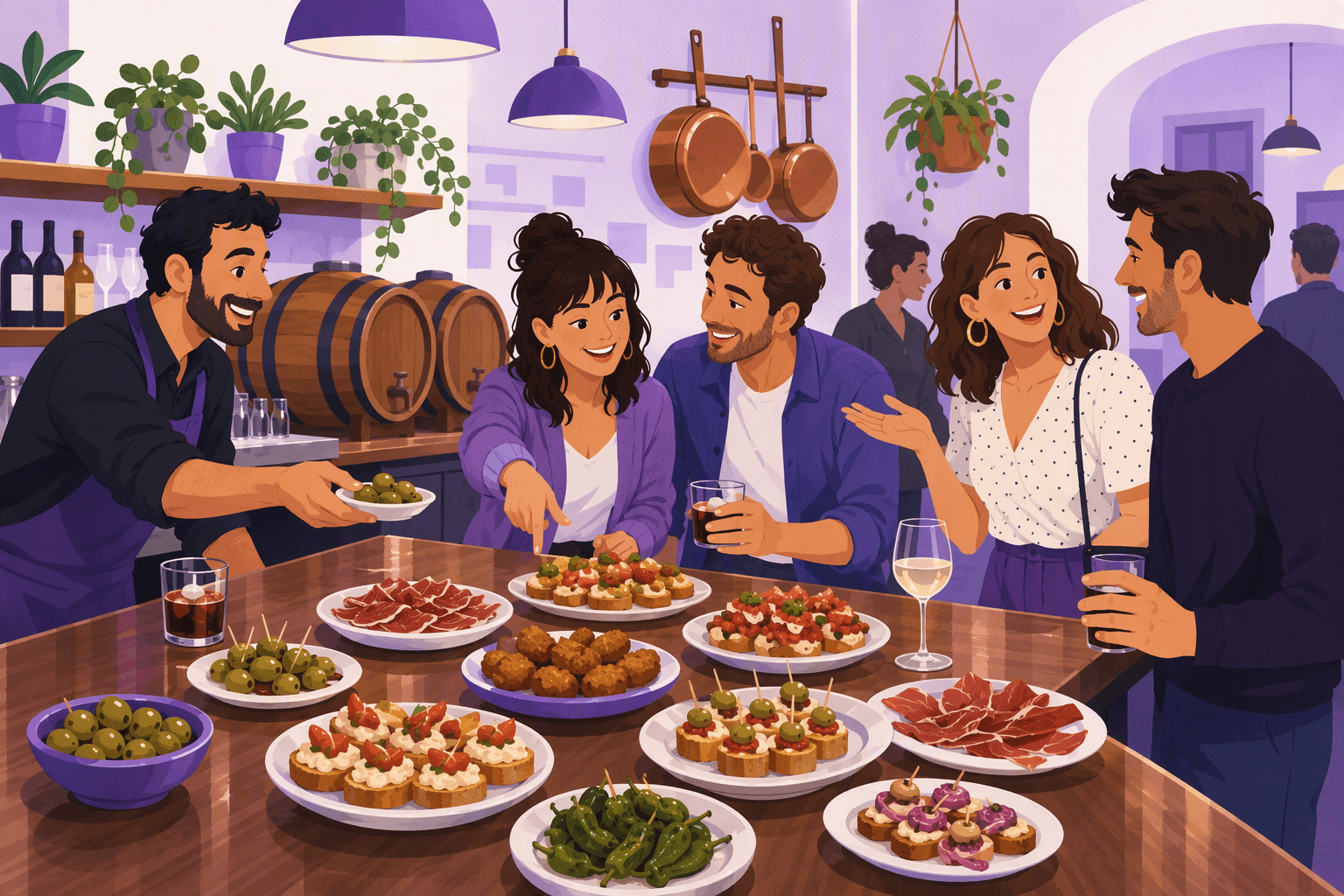
How to order tapas without looking lost
In many bars, you can start with a drink and one tapa to share. Then you add another round once you see what other people are eating.
If the bar is crowded, it is normal to speak up politely and keep your order short. Save long questions for quieter moments.
Sharing rules: forks, plates, and the unspoken choreography
Tapas are usually shared, and people often eat from shared plates. Some bars bring small plates automatically, others do not.
Watch what locals do with toothpicks, napkins, and bread. The “rules” are rarely stated, but they are consistent within a place.
Pintxos vs tapas (a quick note)
In the Basque Country, pintxos are a related tradition, often small items on bread, sometimes held with a toothpick. The ordering and paying system can differ.
If you are traveling across Spain, expect these local systems. Treat it as part of the fun, not as a test you can fail.
Sobremesa: the cultural superpower visitors miss
Sobremesa is the conversation after the meal. It is where relationships deepen, jokes land, and plans get made.
If you leave immediately after eating, nobody will necessarily be offended, but you may miss the most “Spanish” part of the meal. This is also where you will hear the most natural speech: interruptions, storytelling, and friendly teasing.
Author and food writer Claudia Roden, known for documenting Mediterranean and Spanish-adjacent home cooking traditions, highlights in her work how recipes live inside family routines, not just on plates. Sobremesa is one of those routines.
🌍 Why sobremesa matters for language learners
Sobremesa gives you long, low-pressure listening time. You hear the same verbs and phrases repeated: offering, insisting, refusing politely, reacting to taste, and telling short stories. It is a natural “spaced repetition” loop, but with coffee.
Essential Spanish table phrases (with pronunciation)
| English | Spanish | Pronunciation | Formality |
|---|---|---|---|
| A table for two, please. | Una mesa para dos, por favor. | OO-nah MEH-sah PAH-rah dohs, por fah-BOR | polite |
| Do you have a table? | ¿Tienes mesa? | TYEH-nehs MEH-sah | casual |
| The menu, please. | La carta, por favor. | lah KAR-tah, por fah-BOR | polite |
| What do you recommend? | ¿Qué me recomiendas? | keh meh reh-koh-MYEHN-dahs | casual |
| We will share. | Vamos a compartir. | BAH-mohs ah kohm-par-TEER | casual |
| One more, please. | Una más, por favor. | OO-nah mahs, por fah-BOR | polite |
| The bill, please. | La cuenta, por favor. | lah KWEHN-tah, por fah-BOR | polite |
| Can we pay by card? | ¿Podemos pagar con tarjeta? | poh-DEH-mohs pah-GAR kohn tar-HEH-tah | polite |
| It was delicious. | Estaba riquísimo. | eh-STAH-bah ree-KEE-see-moh | casual |
| Cheers! | ¡Salud! | sah-LOOD | casual |
Phrase-by-phrase: how to sound natural (not translated)
Una mesa para dos, por favor.
/OO-nah MEH-sah PAH-rah dohs, por fah-BOR/
Literal meaning: 'A table for two, please.'
“Hola, una mesa para dos, por favor.”
Hi, a table for two, please.
This is the default polite request. In busy places, keep it short and clear. Pairing it with a greeting helps, especially if you are entering a small bar or family-run restaurant.
La carta, por favor.
/lah KAR-tah, por fah-BOR/
Literal meaning: 'The menu, please.'
“Perdona, la carta, por favor.”
Excuse me, the menu, please.
In Spain, 'la carta' is the menu. If you say 'el menú', people may think you mean a set menu option. If you are unsure, 'la carta' is safe.
¿Qué me recomiendas?
/keh meh reh-koh-MYEHN-dahs/
Literal meaning: 'What do you recommend (to me)?'
“¿Qué me recomiendas para compartir?”
What do you recommend to share?
This works best in places that cook daily specials or have a short list. It also signals you are open to local choices, which often gets you better guidance than asking for the 'most popular' item.
Vamos a compartir.
/BAH-mohs ah kohm-par-TEER/
Literal meaning: 'We are going to share.'
“Vamos a compartir, y también una ensalada.”
We will share, and also a salad.
Sharing is normal with tapas and raciones. Saying this early helps the server pace dishes and bring extra plates if the place does that.
La cuenta, por favor.
/lah KWEHN-tah, por fah-BOR/
Literal meaning: 'The bill, please.'
“Cuando puedas, la cuenta, por favor.”
When you can, the bill, please.
In many Spanish restaurants, you ask for the bill when you are ready. Adding 'cuando puedas' softens the request and sounds natural, especially when staff are busy.
Restaurant etiquette in Spain: the small things that matter
Getting the server’s attention
In many Spanish bars, staff move fast and handle multiple conversations at once. A polite “Perdona” (pehr-DOH-nah) or “Disculpa” (dees-KOOL-pah) is common.
Avoid snapping or waving aggressively. A brief eye contact plus a short phrase works.
Bread, olive oil, and what is “included”
Bread may appear automatically, and sometimes it is charged. If you do not want it, you can say “No, gracias” (noh, GRAH-syahs).
If you are unsure about charges, ask early, not at the end. It is normal to clarify.
Paying: one bill vs splitting
Many places prefer one bill per table. Splitting can be possible, but it is not always smooth in busy bars.
A practical approach is to pay together and settle among friends. If you need to split, ask politely before they bring the bill.
⚠️ Avoid this common mistake
Do not assume you can always get separate checks, especially in older-style bars. If splitting is essential, ask early: "¿Podemos pagar por separado?" (poh-DEH-mohs pah-GAR por seh-pah-RAH-doh).
Regional food identities: Spain is not one menu
Spain’s regional cuisines are tied to geography, history, and local pride. Treat “Spanish food” as a family of cuisines.
Andalusia: fried fish, gazpacho, and bar culture
In many Andalusian cities, bar-hopping is a lifestyle. Small plates, quick drinks, and standing at the bar are common.
The social rule is movement: you do not need to stay in one place for hours unless you are doing a full meal.
Valencia: paella as a group lunch
Paella is strongly associated with Valencia, and locals often treat it as a lunch dish. It is also a group dish, more than a solo order.
If you want to be respectful, avoid arguing about “real paella” and ask what the house makes. You will learn more that way.
Basque Country: pintxos and ingredient pride
Basque food culture often emphasizes ingredient quality and technique. Pintxos bars can feel like edible galleries.
Pay attention to how people order and where they place used toothpicks or plates. The system is usually simple once you watch for two minutes.
Catalonia: sauces, seafood, and seasonal traditions
Catalan cuisine has its own classics and seasonal rituals. If you travel during local festivals, you may see foods tied to the calendar.
If you are learning Spanish, remember that Catalonia is bilingual. Starting with Spanish is fine, but being patient with language switching helps.
Food talk is language practice: what you will hear in real conversations
At the table, Spanish repeats the same functional patterns. That is why it is such a good learning environment.
You will hear offers (“¿Quieres?”), soft refusals (“No, gracias”), insistence (“Venga, prueba”), and reactions (“Qué rico”). These are also the moments where politeness strategies show up in real time, exactly the kind of interaction Brown and Levinson analyze in their work.
If you want more everyday phrases that pair well with food situations, review how to say goodbye in Spanish because leaving a table politely is a skill in itself.
How Spanish food culture shows up in movies and TV
Spanish dialogue around food is fast, overlapping, and full of short phrases. Characters interrupt, insist, and negotiate what to order.
This is also where you hear regional accents and casual reductions. If you are using clips to learn, focus on micro-goals: catch “la cuenta,” catch “una más,” catch “para compartir,” then build up.
For a broader foundation, combine this article with the 100 most common Spanish words. Food scenes recycle high-frequency verbs like querer, poder, tener, and poner.
A few cultural “don’ts” that save you awkwardness
Do not judge meal times out loud. People hear it constantly from visitors, and it gets old.
Do not treat tapas like a strict checklist. The point is the social flow, not “trying everything.”
Do not confuse loudness with anger. Spanish table talk can be energetic and affectionate.
If you are joking with friends, remember that swear words exist in food banter too, but they are not beginner tools. If you are curious, read our guide to Spanish swear words so you recognize them without copying them blindly.
Mini playbook: how to eat like a local for one day
Start with a simple coffee and toast. Keep it light.
Have a mid-morning snack if you are walking a lot. A small bocadillo is enough.
Make lunch your main event. Choose a place with a lunch menu, and do not rush.
Take a break in the afternoon. If you do merienda, keep it small.
Do a late dinner or tapas crawl. Order in rounds, share, and slow down.
If you want to sound warm, not just correct
Spanish food culture is relationship culture. The phrases are simple, but the tone matters.
A friendly greeting, a polite “por favor,” and a genuine “Estaba riquísimo” go far. If you are with someone you care about, you will also hear affectionate language around food and care, which connects naturally to our guide to saying 'I love you' in Spanish.
💡 One sentence that makes you sound human
Try: "Cuando puedas, la cuenta, por favor." It is polite, patient, and very natural in Spain.
Learn Spanish the way Spain speaks it
Spanish is spoken across more than 20 countries, but Spain’s food culture gives you an everyday setting where the same phrases repeat with real emotion and real timing. If you want to train your ear for that fast, overlapping speech, practice with short scenes and rewatch them until the phrases become automatic.
If you want structured listening practice with real dialogue, Wordy uses movie and TV clips to help you catch phrases like la cuenta and vamos a compartir in context, then review them with built-in quizzes at your level.
Frequently Asked Questions
What time do people eat in Spain?
What is 'sobremesa' in Spain?
Do you tip in Spain?
How do tapas work in Spain?
Is paella eaten for dinner in Spain?
Sources & References
- Instituto Cervantes, El español: una lengua viva (accessed 2026)
- Real Academia Española (RAE), Diccionario de la lengua española, entries for 'tapa' and 'sobremesa' (accessed 2026)
- UNESCO, Mediterranean diet inscription on the Representative List of the Intangible Cultural Heritage of Humanity (accessed 2026)
- FAO, Food-based dietary guidelines: Spain (accessed 2026)
- Ethnologue, 27th edition, 2024
Start learning with Wordy
Watch real movie clips and build your vocabulary as you go. Free to download.


