Quick Answer
The most common way to say hello in Spanish is 'Hola' (OH-lah). It works in every country and situation. Beyond Hola, native speakers rely on time-of-day greetings like 'Buenos días,' casual check-ins like '¿Qué tal?,' and regional expressions like '¿Qué onda?' in Mexico or '¿Qué más?' in Colombia.
The Short Answer
The most common way to say hello in Spanish is Hola (OH-lah). It works across all 21 Spanish-speaking countries, at any time of day, and in both formal and casual settings. But native speakers reach for a much wider set of greetings depending on the context.
Spanish is spoken by approximately 559 million people worldwide, making it the second most spoken language by native speakers, according to Ethnologue's 2024 data. With that reach comes rich regional variety in how people greet each other, from Buenos días in a Madrid office to ¿Qué onda? among friends in Mexico City.
"The way a person greets you tells you more about their regional identity, social class, and relationship to you than almost any other single utterance in the language."
(Francisco Moreno Fernández, Variedades de la lengua española, Routledge, 2020)
This guide covers 18 essential Spanish greetings organized by category: universal, time-of-day, casual, formal, and regional. Each one includes pronunciation, an example sentence, and cultural context so you know exactly when and where to use it.
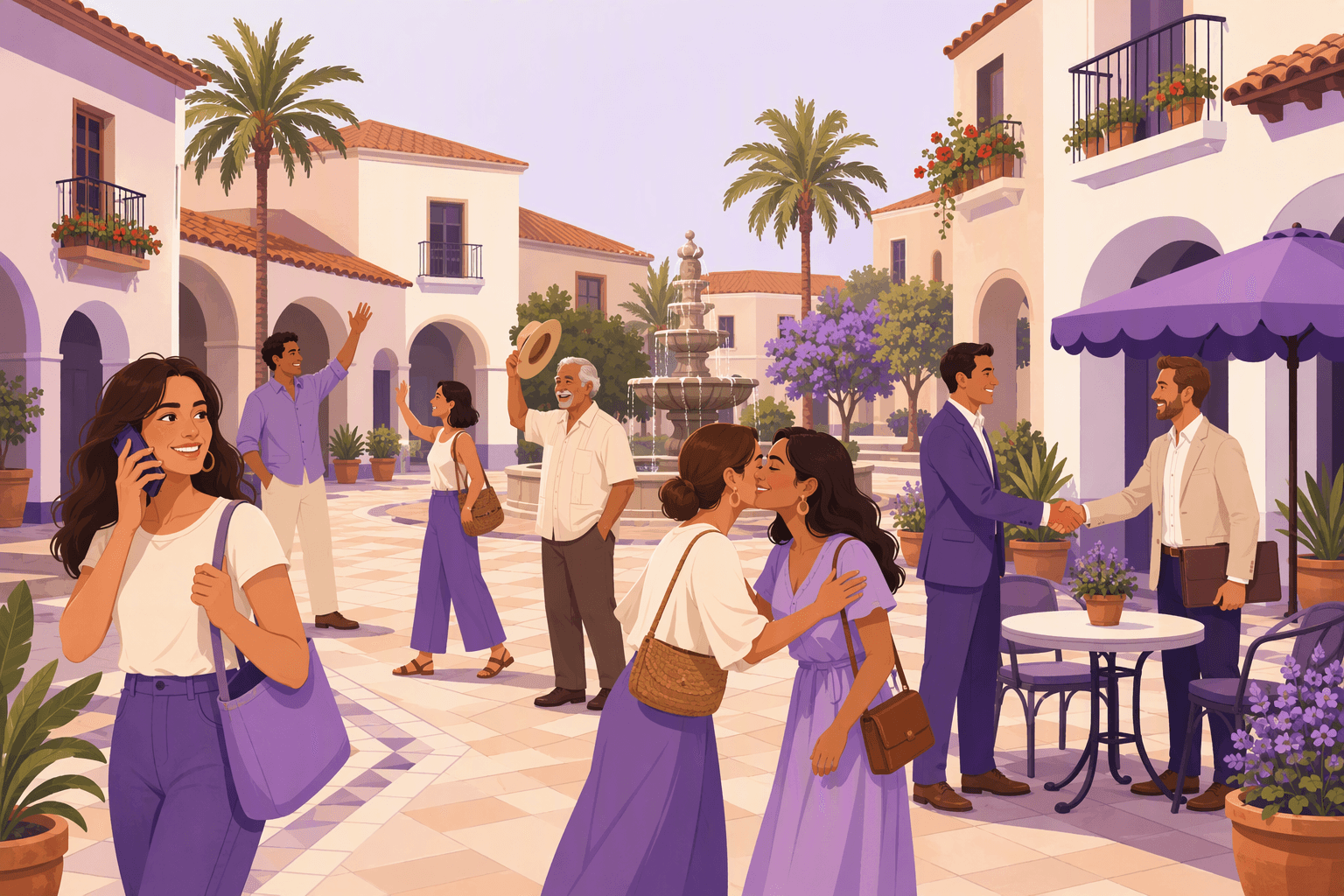
Quick Reference: Spanish Greetings at a Glance
| English | Spanish | Pronunciation | Formality |
|---|---|---|---|
| Hello | Hola | OH-lah | casual |
| Good morning | Buenos días | BWEH-nohs DEE-ahs | polite |
| Good afternoon | Buenas tardes | BWEH-nahs TAR-dehs | polite |
| Good evening / night | Buenas noches | BWEH-nahs NOH-chehs | polite |
| Hey! (any time) | ¡Buenas! | BWEH-nahs | casual |
| How's it going? | ¿Qué tal? | keh TAHL | casual |
| How are you? | ¿Cómo estás? | KOH-moh ehs-TAHS | casual |
| What's up? | ¿Qué pasa? | keh PAH-sah | casual |
| How are you? (formal) | ¿Cómo está usted? | KOH-moh ehs-TAH oos-TEHD | formal |
| Nice to meet you | Mucho gusto | MOO-choh GOOS-toh | formal |
| Delighted to meet you | Encantado/a | ehn-kahn-TAH-doh/dah | formal |
| What's the vibe? (Mexico) | ¿Qué onda? | keh OHN-dah | slang |
| What else? (Colombia) | ¿Qué más? | keh MAHS | casual |
| Hey, what are you up to? (Argentina) | Che, ¿qué hacés? | cheh keh ah-SEHS | casual |
| Dude/Girl (Spain) | Tío / Tía | TEE-oh / TEE-ah | slang |
| Hello? (Mexico, phone) | ¿Bueno? | BWEH-noh | casual |
| Hello? (Spain, phone) | ¿Diga? / ¿Dígame? | DEE-gah / DEE-gah-meh | polite |
| Hello? (Latin America, phone) | ¿Aló? | ah-LOH | casual |
Universal Greetings
These greetings work across every Spanish-speaking country. According to the Real Academia Española (RAE), the governing body of the Spanish language, they have remained unchanged for centuries.
Hola
/OH-lah/
Literal meaning: Hello
“¡Hola! ¿Cómo estás?”
Hello! How are you?
Works in every country, every context, and every formality level. The single most important Spanish greeting you'll learn.
Hola is the Swiss Army knife of Spanish greetings. It works at 8 AM and at 11 PM, in a boardroom and at a beach bar, in Spain, Mexico, Argentina, and everywhere in between.
The "H" in Spanish is always silent. The word sounds like "OH-lah," with stress on the first syllable. A common mistake is pronouncing it "hoh-LAH," so avoid that. Hola can stand alone or pair with any other greeting: Hola, buenos días, Hola, ¿qué tal?, or Hola, buenas tardes.
💡 When 'Hola' Alone Is Enough
Among friends, coworkers you know well, or in a small shop, a simple Hola is perfectly natural. In more formal settings, pair it with a time-appropriate greeting for extra courtesy.
Time-of-Day Greetings
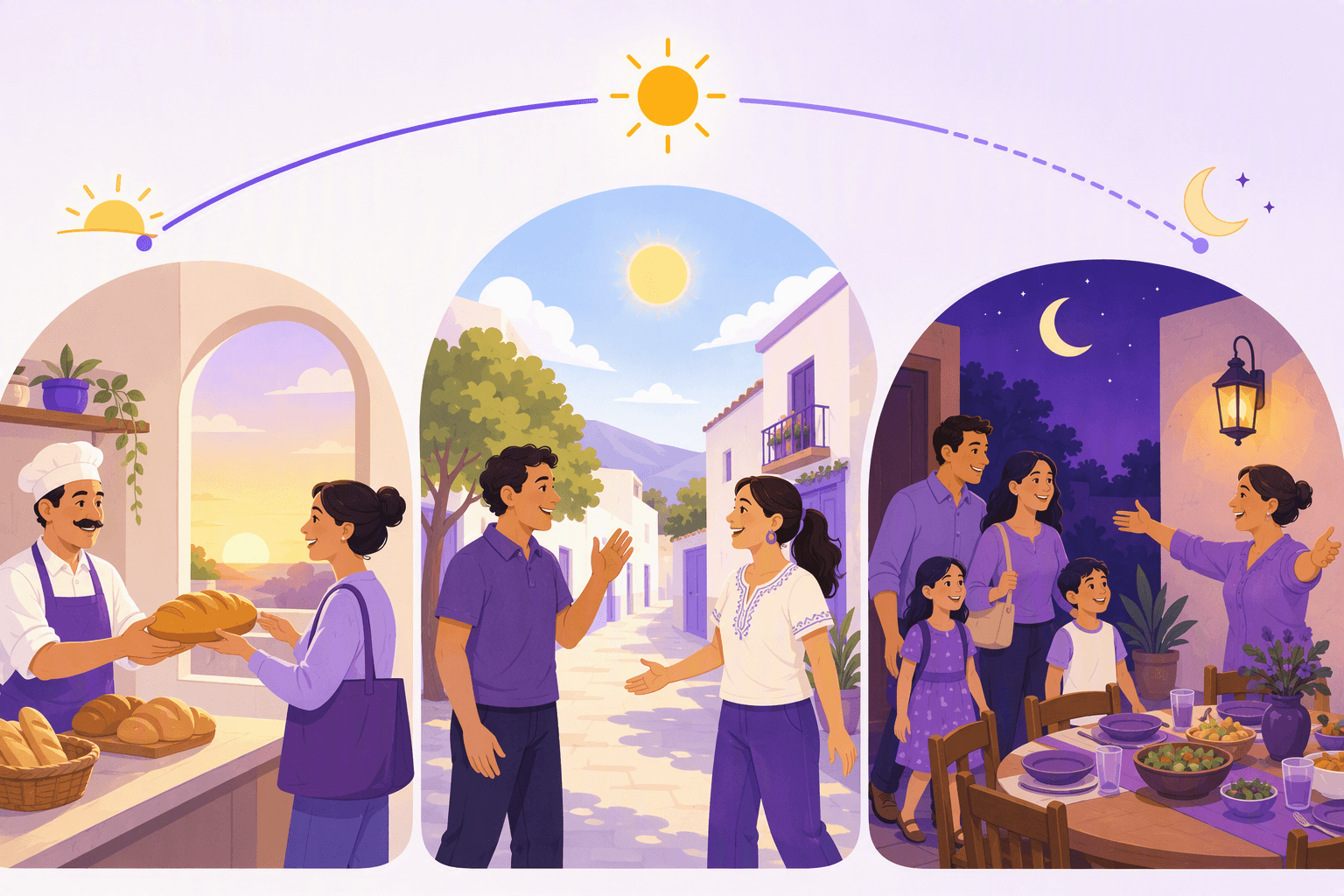
Spanish has three time-based greetings that cover every hour of the day, plus a clever shortcut that works anytime.
Buenos días
/BWEH-nohs DEE-ahs/
Literal meaning: Good days
“Buenos días, señora García. ¿Cómo amaneció?”
Good morning, Mrs. García. How did you wake up?
Used from sunrise until noon. In Spain, it can stretch until 2 PM because of the later lunch schedule.
The standard morning greeting. The switch time to Buenas tardes varies by country: as early as noon in Colombia, as late as 2-3 PM in Spain where lunch happens later.
Buenas tardes
/BWEH-nahs TAR-dehs/
Literal meaning: Good afternoons
“Buenas tardes. ¿En qué puedo ayudarle?”
Good afternoon. How can I help you?
Covers noon/lunchtime until sunset. The longest greeting window, especially in Spain where summer sunsets can be as late as 10 PM.
Notice the grammatical shift from buenos (masculine, matching días) to buenas (feminine, matching tardes). In many Latin American countries, entering a room or elevator and not offering a Buenas tardes to those present is considered rude, a key cultural difference from English-speaking norms.
Buenas noches
/BWEH-nahs NOH-chehs/
Literal meaning: Good nights
“Buenas noches, don Miguel. Gracias por la cena.”
Good evening, Don Miguel. Thank you for the dinner.
Unlike English, 'Buenas noches' works as BOTH a greeting (hello in the evening) AND a farewell (goodnight). Context makes the meaning clear.
This is the one that trips up English speakers. Buenas noches doubles as both "good evening" (when arriving) and "good night" (when leaving). Context makes the meaning clear.
¡Buenas!
/BWEH-nahs/
Literal meaning: Good ones! (abbreviated)
“¡Buenas! ¿Hay mesa para dos?”
Hey there! Is there a table for two?
Drops the time reference entirely, so it works at any hour. Extremely common in casual settings across all Spanish-speaking countries.
Textbooks rarely teach this one, but native speakers use it constantly. By dropping días, tardes, or noches, you skip the guesswork entirely. Walking into a shop at that awkward noon-ish hour? Just say Buenas!
Casual Greetings
These are the greetings you will hear most in everyday conversation. They work like both a hello and a "how are you?" rolled into one.
¿Qué tal?
/keh TAHL/
Literal meaning: What such? / How so?
“¡Hola! ¿Qué tal el fin de semana?”
Hey! How was the weekend?
The most versatile casual greeting after Hola. Used across all Spanish-speaking countries. Can be extended: '¿Qué tal el trabajo?' (How's work?).
¿Qué tal? is both a greeting and a light question. You can use it standalone or extend it with a topic: ¿Qué tal la familia? (How's the family?). The standard reply is Bien, ¿y tú? (Good, and you?).
¿Cómo estás?
/KOH-moh ehs-TAHS/
Literal meaning: How are you?
“Hola, María. ¿Cómo estás?”
Hi, María. How are you?
The informal 'you' form (tú). Use '¿Cómo está usted?' for formal situations. In Argentina, you'll hear '¿Cómo estás?' with voseo pronunciation (ehs-TAHS stays the same).
This is the informal form using tú. In formal settings, switch to ¿Cómo está usted? (covered below). The expected response is brief and positive (Bien, gracias) even if your day has been rough.
¿Qué pasa?
/keh PAH-sah/
Literal meaning: What happens?
“¡Ey! ¿Qué pasa? ¿Tienes planes para hoy?”
Hey! What's up? Do you have plans for today?
Casual and friendly, used across all countries. Can also express concern: '¿Qué te pasa?' (What's wrong with you?), tone and context determine the meaning.
A casual, energetic greeting that works everywhere in the Spanish-speaking world. Be aware of the subtle shift with a pronoun: ¿Qué te pasa? changes the meaning to "What's wrong with you?"
Formal Greetings
Essential for professional settings, meeting elders, or any situation where you want to show respect. For more on navigating formal vs. informal registers, our Spanish learning hub has interactive exercises that help.
¿Cómo está usted?
/KOH-moh ehs-TAH oos-TEHD/
Literal meaning: How are you? (formal)
“Buenos días, doctor López. ¿Cómo está usted?”
Good morning, Dr. López. How are you?
The formal 'you' (usted) signals respect. Used with elders, authority figures, strangers in professional contexts, and anyone you want to show deference to.
The key difference from ¿Cómo estás? is the pronoun: usted (formal you) instead of tú (informal you). Use this with bosses, elderly people, officials, and anyone you have just met in a professional setting.
Mucho gusto
/MOO-choh GOOS-toh/
Literal meaning: Much pleasure
“Mucho gusto, señor Ramírez. He oído hablar mucho de usted.”
Nice to meet you, Mr. Ramírez. I've heard a lot about you.
The standard first-meeting greeting. Respond with 'Igualmente' (likewise), 'El gusto es mío' (the pleasure is mine), or simply echo 'Mucho gusto' back.
The go-to phrase when meeting someone for the first time. The most natural responses are Igualmente (likewise), El gusto es mío (the pleasure is mine), or just echoing Mucho gusto right back.
Encantado/a
/ehn-kahn-TAH-doh / ehn-kahn-TAH-dah/
Literal meaning: Enchanted / Delighted
“Encantada de conocerle, profesora.”
Delighted to meet you, professor.
Gendered: men say 'Encantado,' women say 'Encantada.' It matches the gender of the speaker, not the person being addressed.
A slightly more elegant alternative to Mucho gusto. Remember: this word matches the gender of the speaker, not the listener. A man says Encantado, a woman says Encantada.
Regional Greetings
With 21 countries spanning four continents, Spanish has developed fascinating regional variations. As the Instituto Cervantes reports, each region contributes unique vocabulary and greeting customs. These phrases will immediately signal cultural awareness to native speakers.
¿Qué onda?
/keh OHN-dah/
Literal meaning: What wave?
“¡Ey! ¿Qué onda, güey? ¿Vamos al cine?”
Hey! What's up, dude? Shall we go to the movies?
Distinctly Mexican. 'Onda' (wave) has taken on the slang meaning of 'vibe' or 'scene.' Casual, youthful, widely understood throughout Mexico.
¿Qué onda? is one of the most recognizable Mexican greetings. You will hear it constantly in Mexican films and TV shows. Check out our guide to the best movies for learning Spanish for great viewing recommendations.
¿Qué más?
/keh MAHS/
Literal meaning: What more? / What else?
“¡Hola, parcero! ¿Qué más? ¿Cómo va todo?”
Hey, buddy! What's up? How's everything going?
The quintessential Colombian greeting. Often paired with 'parcero/parce' (buddy). You'll also hear '¿Quiubo?' (a contraction of '¿Qué hubo?') in Colombia.
Colombia's signature greeting. You will also hear ¿Quiubo?, a rapid contraction of ¿Qué hubo? (What was there?) that functions identically. Both are casual and warm.
Che, ¿qué hacés?
/cheh keh ah-SEHS/
Literal meaning: Hey, what are you doing?
“Che, ¿qué hacés? ¿Tomamos unos mates?”
Hey, what are you up to? Shall we have some mate?
'Che' is Argentina's iconic interjection (yes, like Che Guevara's nickname). The 'vos' conjugation 'hacés' instead of 'haces' is distinctive Argentine Spanish.
Che is so closely associated with Argentina that it became the nickname of revolutionary Ernesto "Che" Guevara. The vos conjugation (haces becomes hacés) is another hallmark of Argentine and Uruguayan Spanish.
Tío / Tía
/TEE-oh / TEE-ah/
Literal meaning: Uncle / Aunt
“¡Tía, qué alegría verte! ¿Cuánto tiempo!”
Girl, how great to see you! It's been ages!
Spain's equivalent of 'dude' or 'mate.' Literally means 'uncle/aunt' but used universally among friends in Spain. Rarely used this way in Latin America.
In Spain, tío/tía has a double life: literally "uncle/aunt," but in casual speech it means "dude/girl." You will hear it constantly in Spanish shows like La Casa de Papel and Elite. This usage is specific to Spain, and using it in Latin America would sound unusual.
Phone Greetings
Phone greetings are one of the most country-specific aspects of Spanish. Here is a quick summary:
| Country | Phone Greeting | Pronunciation |
|---|---|---|
| Mexico | ¿Bueno? | BWEH-noh |
| Spain | ¿Diga? / ¿Dígame? | DEE-gah / DEE-gah-meh |
| Colombia, Peru, Chile | ¿Aló? | ah-LOH |
| Argentina, Uruguay | ¿Hola? | OH-lah |
| Cuba | ¿Oigo? | OY-goh |
These differ completely from face-to-face greetings. Mexico's Bueno? (Good?) and Spain's Diga? (Speak?) are only used on the phone, never in person.
How to Respond to Spanish Greetings
Knowing how to greet someone is half the equation. Here is how to respond to the most common greetings.
Responses to Universal and Time-Based Greetings
| They Say | You Say | Notes |
|---|---|---|
| ¡Hola! | ¡Hola! / ¡Hola! ¿Qué tal? | Echo it back, optionally add a follow-up |
| Buenos días | Buenos días | Echo the same greeting |
| Buenas tardes | Buenas tardes | Echo the same greeting |
| ¡Buenas! | ¡Buenas! / ¡Hola! | Casual echo |
Responses to Casual Greetings
| They Say | You Say |
|---|---|
| ¿Qué tal? | Bien, ¿y tú? / Todo bien |
| ¿Cómo estás? | Bien, gracias, ¿y tú? |
| ¿Qué pasa? | Nada, ¿y tú? / Aquí andamos |
Responses to Formal Greetings
| They Say | You Say |
|---|---|
| ¿Cómo está usted? | Muy bien, gracias. ¿Y usted? |
| Mucho gusto | Igualmente / El gusto es mío |
| Encantado/a | Igualmente / Encantado/a |
💡 The 'Echo and Add' Strategy
When unsure how to respond, use "Echo and Add": repeat their greeting back (the echo) and add a follow-up question (the add). Buenas tardes becomes Buenas tardes, ¿cómo está? This works in virtually every situation.
🌍 Physical Greetings Matter Too
Spanish greetings go beyond words. In Spain, two cheek kisses are standard between women and between men and women. In most of Latin America, it is one kiss on the cheek. In business settings everywhere, a firm handshake is the norm. When in doubt, let the local person initiate the physical greeting and follow their lead.
Practice With Real Spanish Content
Reading about greetings is a great start, but hearing them spoken naturally by native speakers is what makes them stick. Spanish-language shows on streaming platforms are an excellent resource: La Casa de Papel for casual Spain Spanish, Club de Cuervos for Mexican greetings, and Narcos for Colombian Spanish.
Wordy takes this a step further. You can watch Spanish movies and shows with interactive subtitles, tapping on any greeting to see its meaning, pronunciation, and cultural context in real time. Instead of memorizing phrases in isolation, you absorb them from real conversations with authentic intonation and body language.
For more Spanish content, explore our blog for guides including the best movies to learn Spanish. You can also visit our Spanish learning page to start practicing today.
Frequently Asked Questions
What is the most common way to say hello in Spanish?
How do you say good morning in Spanish?
What's the difference between 'Hola' and '¿Qué tal?'
Is it rude to just say 'Hola' in Spanish?
How do you greet someone on the phone in Spanish?
What are some slang ways to say hello in Spanish?
Sources & References
- Real Academia Española (RAE), Diccionario de la lengua española, 23rd edition
- Instituto Cervantes, El español en el mundo, 2024 annual report
- Ethnologue: Languages of the World, Spanish language entry (2024)
- Moreno Fernández, F. (2020). 'Variedades de la lengua española.' Routledge.
Start learning with Wordy
Watch real movie clips and build your vocabulary as you go. Free to download.


