Spanish Holidays and Festivals: 12 Celebrations You’ll Actually See (and What People Say)
Quick Answer
Spanish holidays and festivals mix national public holidays (like Semana Santa and Día de la Hispanidad) with intensely local traditions (like Las Fallas or San Fermín). This guide explains what happens, when to go, what to expect culturally, and the Spanish phrases you will actually hear during parades, family meals, and street celebrations.
Spanish holidays and festivals range from nationwide public holidays like Semana Santa and Navidad to hyper-local celebrations like Las Fallas and San Fermín, and the best way to understand them is to learn what happens on the street, what happens at home, and the Spanish phrases people actually say in each setting.
If you want everyday Spanish that matches real life, pair this guide with a quick refresher on greetings like how to say hello in Spanish and leave-takings like how to say goodbye in Spanish, because festivals are basically nonstop hellos, goodbyes, and introductions.
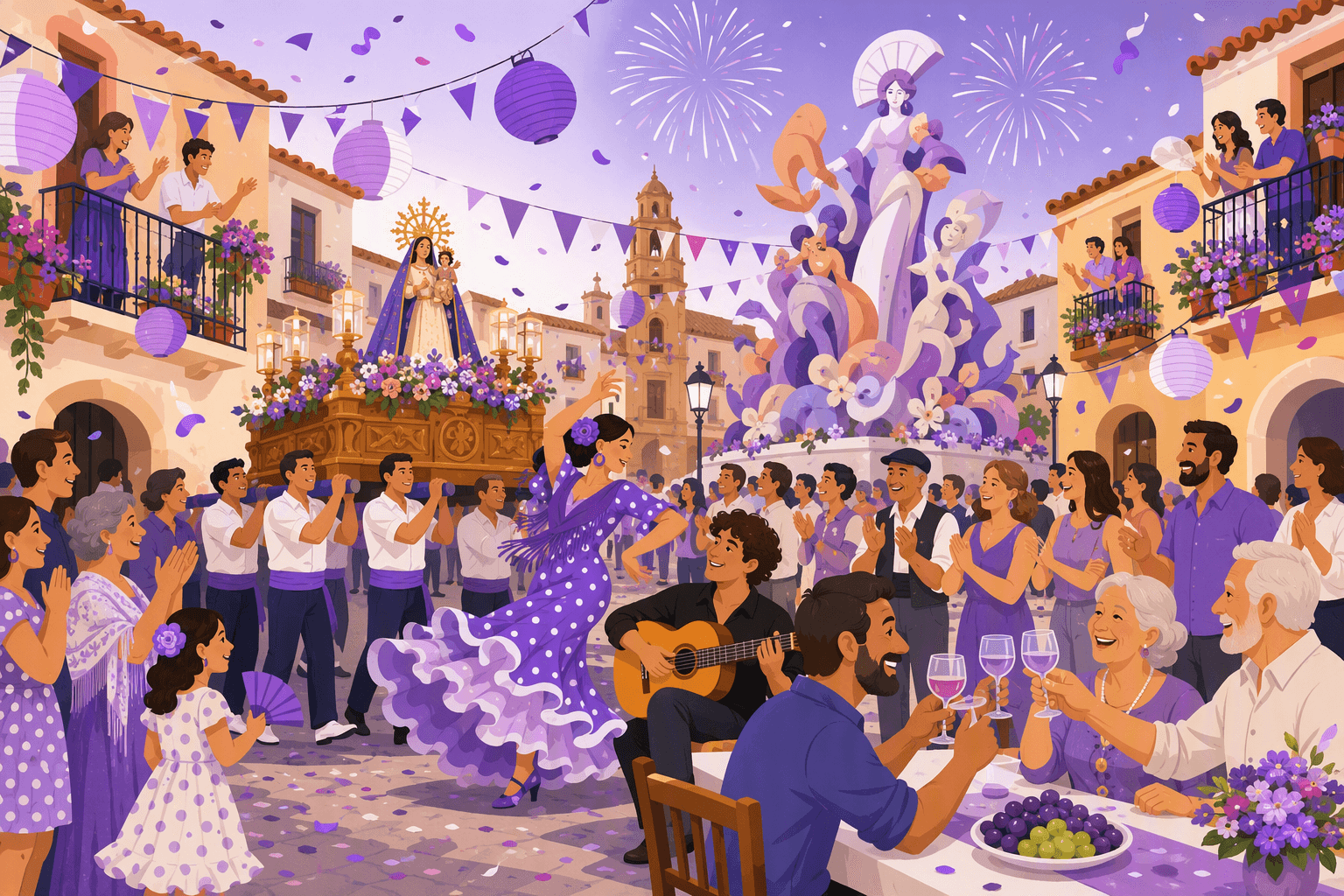
Why Spanish festivals matter for learning Spanish
Spanish is one of the world’s most widely spoken languages. Ethnologue (27th edition, 2024) counts hundreds of millions of Spanish speakers worldwide, and Instituto Cervantes tracks Spanish as a global language across many countries and education systems.
That scale matters because the same holiday name can feel different depending on where you are. Even inside Spain, regional identity shapes what people celebrate, how they celebrate, and what vocabulary you hear, Catalan-influenced Valencia during Fallas does not sound like Seville during Feria.
From a language-learning perspective, festivals are high-density input. You hear set phrases repeated by strangers, announcements over loudspeakers, chants, toasts, and polite formulas, which is exactly the kind of repeated, meaningful exposure that Paul Nation’s work on vocabulary learning emphasizes as necessary for retention.
A quick map: public holidays vs local festivals
Spain has official public holidays (fiestas laborales) set nationally and by each autonomous community. The BOE publishes the annual calendar, and it is the closest thing to an authoritative list of what is actually a day off.
Local festivals are different. They can be huge, even internationally famous, but not automatically a national holiday. A city can shut down for its patron saint day while the rest of the country works normally.
💡 A practical rule for travelers
If you see 'festivo' on a calendar, expect closures. If you see 'fiestas' or 'feria', expect crowds, street noise, and late dinners, even if shops still open.
12 Spanish holidays and festivals you should know
Semana Santa
Semana Santa (seh-MAH-nah SAHN-tah) is Holy Week, and in many cities it is the most visually intense tradition of the year. Processions (procesiones, proh-seh-SYOH-nehs) carry pasos, large religious floats, through narrow streets.
In Andalusia, especially Seville and Málaga, the soundscape is part of the experience: marching bands, drums, and spontaneous singing called saetas. You will also hear respectful, formal language, because the event is framed as devotion, not a party.
What people say:
- "Buenas noches" (BWEH-nahs NOH-chehs) as people arrive late
- "Con permiso" (kohn pehr-MEE-soh) to pass through crowds
- "Qué impresionante" (keh eem-preh-syoh-NAHN-teh) as floats pass
Las Fallas
Las Fallas (lahs FAH-yahs) in Valencia is a fire festival built around giant satirical sculptures (ninots, nee-NOHTS). The climax is La Cremà (lah kreh-MAH), when many sculptures are burned.
The festival is loud by design. Daily mascletàs are daytime firecracker shows that feel like controlled shockwaves, and locals will talk about them like a performance, not just noise.
What people say:
- "¡Qué barbaridad!" (keh bahr-bah-ree-DAHD) for something extreme
- "Vamos a la mascletà" (BAH-mohs ah lah mahs-kleh-TAH)
- "Cuidado" (kwee-DAH-doh) in dense crowds
🌍 Satire is part of the tradition
Fallas humor often targets politics and celebrity culture. If you learn Spanish through media, this is where you notice how irony and exaggeration work in everyday speech, a topic that shows up in Spanish pragmatics research, including work by Francisco Moreno Fernández on variation and social context.
Carnaval
Carnaval (kahr-nah-BAHL) happens before Lent, and it is celebrated across Spain, with especially famous scenes in Cádiz and the Canary Islands. Costumes, street music, and playful insults are common, but the tone varies by city.
In Cádiz, carnival groups perform witty songs that rely on wordplay and current events. If you are learning, it is a reminder that Spanish humor is often fast, referential, and full of local pronunciation.
What people say:
- "¿De qué vas?" (deh keh BAHSS) meaning "what are you dressed as?"
- "¡Qué disfraz más currado!" (keh dees-FRAHSS mahs koo-RRAH-doh) meaning a well-made costume
Feria de Abril
Seville’s Feria de Abril (feh-REE-ah deh ah-BREEL) is a fairground festival with casetas (private or semi-private tents), flamenco fashion, dancing, and late nights. It is social, not touristic by default, which is why language matters.
You will hear invitations and polite refusals constantly. This is a perfect place to practice softening, a concept central to politeness research in Penelope Brown and Stephen Levinson’s work on face and social interaction.
What people say:
- "¿Te apetece una copa?" (teh ah-peh-TEH-seh OO-nah KOH-pah) meaning "do you feel like a drink?"
- "Ahora voy" (ah-OH-rah BOY) meaning "I’m coming now"
- "Encantado/a" (ehn-kahn-TAH-doh/dah) when meeting someone
San Fermín
San Fermín (sahn fehr-MEEN) in Pamplona is known for the encierro, the morning bull run. It is also a week of concerts, parades, and constant street life.
This is not a festival to improvise. Safety rules are strict, and locals can be blunt about what not to do. If you go, listen to instructions, and do not treat warnings as optional.
What people say:
- "No te metas ahí" (noh teh MEH-tahs ah-EE) meaning "don’t go in there"
- "Está a reventar" (eh-STAH ah reh-behn-TAHR) meaning "it’s packed"
- "¡Viva San Fermín!" (BEE-bah sahn fehr-MEEN) during chants
⚠️ Language tip that is also a safety tip
In crowded festivals, 'cuidado' (kwee-DAH-doh) and 'ojo' (OH-hoh) are real warnings. Treat them like you would treat 'watch out' in English.
La Tomatina
La Tomatina (lah toh-mah-TEE-nah) in Buñol is a tomato fight with rules, entry limits, and a very specific time window. It is playful chaos, but it is organized chaos.
The Spanish you hear is mostly logistics: where to stand, when to stop, where to rinse off. It is a good reminder that festivals have infrastructure vocabulary, not just party vocabulary.
What people say:
- "¿Dónde está la ducha?" (DOHN-deh eh-STAH lah DOO-chah)
- "Se acabó" (seh ah-kah-BOH) meaning "it’s over"
Navidad
Navidad (nah-bee-DAHD) is the Christmas season, but in Spain it is a long arc: lights go up early, family meals cluster around 24 to 25 December, and the season continues through early January.
Food vocabulary matters here. You will hear turrón, polvorones, marisco, and cava, and you will hear people negotiating plans with extended family, which is where polite Spanish becomes practical Spanish.
What people say:
- "¡Feliz Navidad!" (feh-LEES nah-bee-DAHD)
- "Brindamos" (breen-DAH-mohs) meaning "let’s toast"
- "Que aproveche" (keh ah-proh-BEH-cheh) said before eating
If you want romantic language for the season, you will also hear couples use phrases covered in how to say I love you in Spanish, especially in messages and toasts.
Nochevieja and Año Nuevo
Nochevieja (noh-cheh-BYEH-hah) is New Year’s Eve. The most famous tradition is eating 12 grapes at midnight, one for each chime, called las uvas de la suerte.
The language around midnight is formulaic, which makes it easy to learn. People repeat the same wishes, and you can join in without sounding unnatural.
What people say:
- "¡Feliz Año Nuevo!" (feh-LEES AH-nyoh NWEH-boh)
- "¡Salud!" (sah-LOOD) as a toast
- "¡Prosperidad!" (prohs-peh-ree-DAHD) in longer toasts
Reyes Magos
Reyes Magos (RRAY-yehs MAH-gohs) on 6 January is huge for kids. The night before, many cities hold a Cabalgata de Reyes parade with floats and candy.
You will hear children asking for sweets, adults managing crowds, and a lot of future tense about what will happen tomorrow morning.
What people say:
- "¿Has sido bueno/a?" (ahs SEE-doh BWEH-noh/nah) meaning "have you been good?"
- "Mañana abrimos los regalos" (mah-NYAH-nah ah-BREE-mohs lohs rreh-GAH-lohs)
Día de la Hispanidad (Fiesta Nacional)
Spain’s national day is 12 October, officially Fiesta Nacional de España, and it is also called Día de la Hispanidad in many contexts. In Madrid, there is a military parade and official ceremonies.
The language is formal and institutional. If you watch coverage, you will hear titles, honorifics, and set phrases, which is useful listening practice if you want to understand news Spanish.
What people say:
- "Feliz Día de la Fiesta Nacional" (feh-LEES DEE-ah deh lah FYEH-stah nah-syoh-NAHL) in official messaging
- "Acto oficial" (AHK-toh oh-fee-SYAHL) in broadcasts
Todos los Santos and Día de los Difuntos
1 November is Todos los Santos, and 2 November is Día de los Difuntos. In Spain, these are remembrance days marked by cemetery visits, flowers, and family gatherings.
The tone is quiet and respectful. You will hear softer voices, affectionate family terms, and phrases of condolence, especially if someone recently lost a relative.
What people say:
- "Lo siento mucho" (loh SYEHN-toh MOO-choh)
- "Un abrazo" (oon ah-BRAH-soh) in messages
Local patron saint days
Every town has its own calendar. You will see fiestas patronales with processions, fireworks, and community meals. This is where you learn the most local Spanish, including nicknames for neighborhoods and foods.
If you want to prepare, learn the words for street setups: escenario (stage), verbena (outdoor dance), and peña (a social group that organizes activities).
What people say:
- "Nos vemos en la plaza" (nohs BEH-mohs ehn lah PLAH-sah)
- "¿Vienes a la verbena?" (BYEH-nehs ah lah behr-BEH-nah)
Spanish phrases you will hear at festivals (and how to pronounce them)
| English | Spanish | Pronunciation | Formality |
|---|---|---|---|
| Happy holidays! | ¡Felices fiestas! | feh-LEE-sehs FYEH-stahs | polite |
| Cheers! | ¡Salud! | sah-LOOD | casual |
| Enjoy your meal. | Que aproveche. | keh ah-proh-BEH-cheh | polite |
| Excuse me (to pass). | Con permiso. | kohn pehr-MEE-soh | polite |
| Watch out. | Cuidado. | kwee-DAH-doh | casual |
| See you later. | Hasta luego. | AHS-tah LWEH-goh | casual |
| Congratulations! | ¡Felicidades! | feh-lee-see-DAH-dehs | polite |
| Have a good time. | Pásalo bien. | PAH-sah-loh BYEHN | casual |
How to sound natural: the social rules behind the words
Greetings are repeated, not one-time
At festivals, you greet people multiple times because you keep rejoining groups. A quick "¡Hola!" (OH-lah) plus a check-in like "¿Qué tal?" (keh TAHL) is more natural than a single formal greeting.
If you need a full menu of greetings, use how to say hello in Spanish as a warm-up before you go.
Politeness is often indirect
Spanish can be direct, but requests in crowded social settings are often softened. You will hear conditional or hedging phrases like "¿Te importa...?" and "¿Podrías...?" because they reduce friction.
This is exactly the kind of face-saving behavior described in Brown and Levinson’s politeness framework, and it shows up constantly when people are negotiating space, time, and favors.
Swearing exists, but context decides everything
Big crowds, heat, and alcohol can produce strong language. You might hear swear words in chants or late-night conversations, but copying them is risky if you do not control register.
If you are curious, read Spanish swear words as cultural literacy, not as a script to perform.
⚠️ A safe substitute when emotions run high
Instead of repeating a swear word you heard, use "¡Madre mía!" (MAH-dreh MEE-ah) or "¡Qué fuerte!" (keh FWEHR-teh). They express surprise without escalating the tone.
What to watch for in movies and TV clips
Festivals are a goldmine for listening practice because they combine predictable formulas with messy real speech. In clips, focus on three layers: the announcement voice (clear), the family table talk (fast but repetitive), and the street crowd (overlapping).
A useful strategy is to replay short segments and track just one phrase at a time. Wordy-style clip learning works well here because you can loop the same toast or greeting until your ear stops translating and starts recognizing.
For more Spanish listening ideas, browse the Wordy blog and then pick a theme you actually enjoy, food, romance, or travel, so you keep watching long enough for repetition to do its job.
Planning tips: when to go, what to book, what to expect
Book early for the big three
Semana Santa in Andalusia, Fallas in Valencia, and San Fermín in Pamplona can sell out accommodation far in advance. Even if you do not attend the headline events, the city logistics change.
Expect late schedules
Dinner can start late, and festival nights can run into early morning. If you are learning Spanish, this is when you hear the most casual speech, but it is also when fatigue makes listening harder.
Learn the exit phrases
Leaving politely matters. "Me voy" (meh BOY) is normal, and adding a reason is common: "Que mañana trabajo" (keh mah-NYAH-nah trah-BAH-hoh). For more options, keep how to say goodbye in Spanish handy.
A simple study plan using festivals as your theme
Pick one festival and learn:
- The name and key verbs (celebrar, salir, brindar).
- Five street phrases from the Quick Reference.
- One toast and one goodbye that you can say without thinking.
Then watch for those exact phrases in clips. You will be surprised how often the same language repeats across different celebrations.
If you want a broader base for everyday Spanish, combine this with the core vocabulary in 100 most common Spanish words, because festivals are fun, but function words are what make the sentences.
Closing thought
Spanish festivals are not just spectacles, they are social systems with predictable language: greetings, invitations, warnings, toasts, and goodbyes. Learn those phrases, listen for them in real clips, and you will understand more than the schedule, you will understand what people are doing together.
Frequently Asked Questions
What are the biggest holidays in Spain?
Is Día de los Muertos celebrated in Spain?
When do Spaniards exchange gifts, Christmas or Three Kings?
What should I say to congratulate someone during a festival?
Are Spanish festivals family-friendly or mostly about drinking?
Sources & References
- Instituto Cervantes, El español: una lengua viva (annual report, accessed 2026)
- Ethnologue, 27th edition, 2024
- BOE (Boletín Oficial del Estado), Calendario de fiestas laborales (accessed 2026)
- UNESCO, Intangible Cultural Heritage listings for Spain (accessed 2026)
- Real Academia Española (RAE), Diccionario de la lengua española entries (accessed 2026)
Start learning with Wordy
Watch real movie clips and build your vocabulary as you go. Free to download.


