Quick Answer
Spanish reggaeton vocabulary includes music terms such as perreo, dembow, and tiraera, plus Puerto Rican everyday slang such as corillo and janguear. Learning these words helps you understand the genre’s lyrics, social references, and the Caribbean Spanish behind its global sound.
Spanish reggaeton vocabulary is the mix of Caribbean music language, Puerto Rican street speech, dance terms, and lyrical attitude that you hear in songs from artists across the Latin music world. Start with perreo /peˈreo/, dembow /demˈbow/, flow /flo/, corillo /koˈɾiʎo/, and janguear /xaŋˈɡeaɾ/: these words unlock references that literal translations often miss.
Reggaeton is not simply “Spanish pop with a beat.” It developed through exchanges among Puerto Rican hip-hop, Jamaican dancehall, Panamanian reggae en español, and Caribbean club culture. That history explains why a song may move between standard Spanish, Puerto Rican slang, English, and rhythmic vocal sounds in a single verse.
Spanish is spoken by more than 600 million people worldwide when native speakers, second-language speakers, and learners are counted, according to Instituto Cervantes. Reggaeton reaches many of those listeners, but its vocabulary remains rooted in local identities. If you want a foundation beyond music, begin with these everyday Spanish greetings and then train your ear for informal speech.
| English | Spanish | Pronunciation | Note |
|---|---|---|---|
| Reggaeton dance style | perreo | peh-RREH-oh | A close, rhythmic dance style associated with reggaeton. |
| Core rhythmic pattern | dembow | dem-BOW | The beat pattern central to reggaeton and a related Dominican genre. |
| Style, delivery, confidence | flow | floh | Can describe an artist's voice, rhythm, fashion, or self-assurance. |
| Chorus | coro | KOH-roh | The repeated hook or chorus of a song. |
| Instrumental track | pista | PEES-tah | Also means a track, clue, or lane depending on context. |
| Diss track or lyrical feud | tiraera | tee-reh-AH-rah | Puerto Rican term for lyrical attacks between artists. |
| Friend group, crew | corillo | koh-RREE-yoh | Common in Puerto Rican Spanish. |
| To hang out | janguear | hahn-geh-AR | Puerto Rican verb adapted from English 'hang out'. |
| Flirtatious or sensual energy | bellaqueo | beh-yah-KEH-oh | Usually party and dance context, often adult in tone. |
| To show off | frontear | frohn-teh-AR | Showing status, confidence, clothes, money, or success. |
| Neighborhood | barrio | BAH-ryoh | Can signal community, origin, and local pride. |
| Public housing complex | caserío | kah-seh-REE-oh | Especially significant in Puerto Rican social and musical history. |
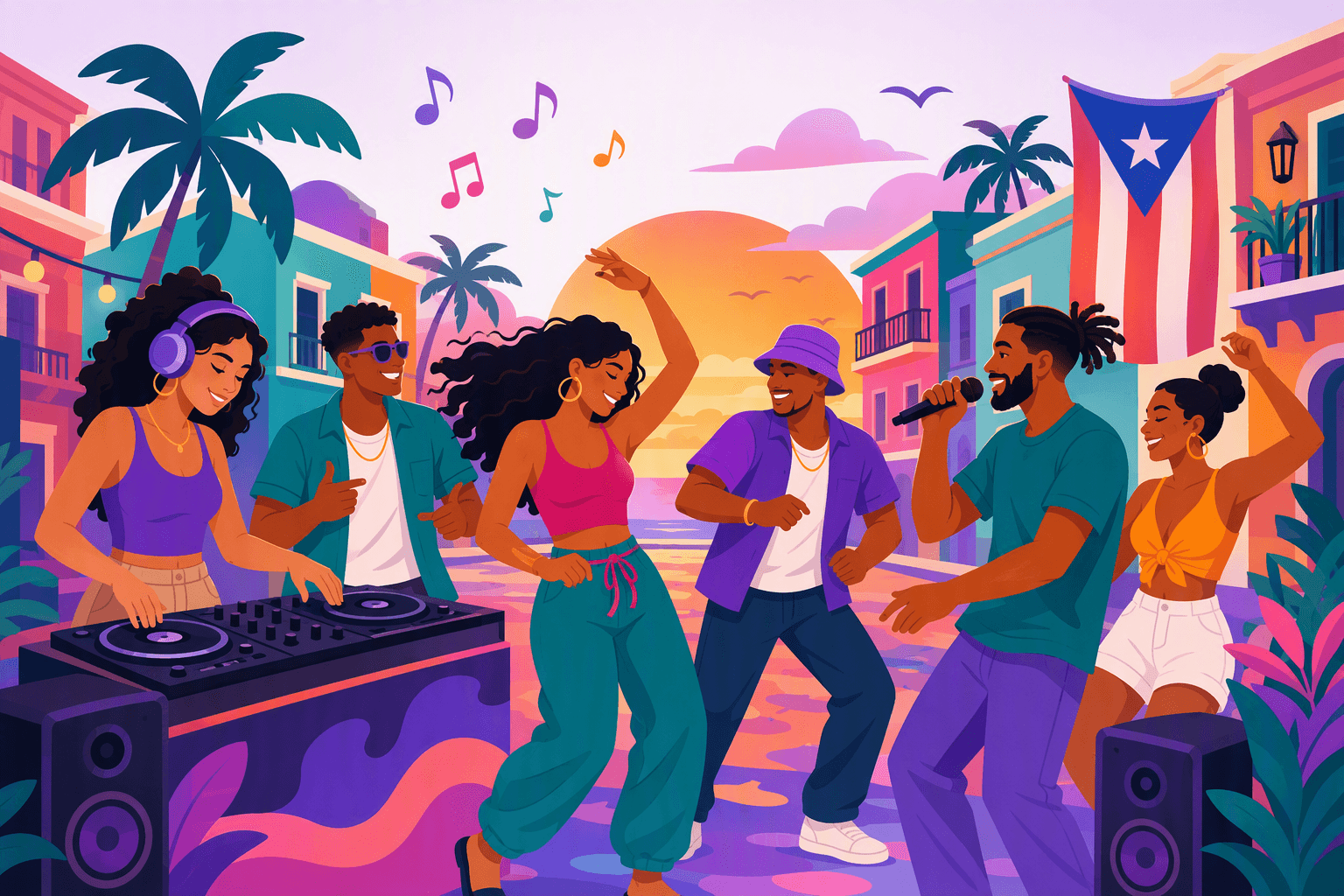
Why reggaeton Spanish sounds different
A learner may understand classroom Spanish and still struggle with a reggaeton verse. That is normal. Songs compress grammar, use local pronunciation, stretch vowels to fit the beat, and favor images over complete sentences.
Reggaeton also treats language as sound. An artist’s flow /flo/ is not only what they say, but how syllables land against the rhythm. A repeated phrase can become memorable because of stress, rhyme, vocal texture, and bass placement rather than because it forms a textbook-perfect sentence.
Petra R. Rivera-Rideau’s Remixing Reggaetón: The Cultural Politics of Race in Puerto Rico places the genre within Puerto Rico’s debates about race, class, language, and national identity. That context matters: words associated with the barrio /ˈbarjo/ or caserío /kaseˈɾio/ can carry lived social meaning, not just urban atmosphere.
Música urbana
Música urbana /ˈmusika uɾˈbana/ is a broad label used by platforms, awards, labels, and fans. It includes reggaeton but can also include Latin trap, hip-hop, drill, Afrobeat-influenced tracks, and pop songs with urban production.
When someone says an artist makes música urbana /ˈmusika uɾˈbana/, do not assume every track uses the classic reggaeton beat. The phrase describes a musical field, while reggaeton identifies a more specific rhythmic and historical tradition.
Dembow
Dembow /demˈbow/ is the term you need for the rhythmic engine behind reggaeton. In casual music talk, someone might say a track has good dembow /demˈbow/ to praise its groove or danceability.
The term has another important use. Dominican dembow /demˈbow/ is also a genre in its own right, typically faster and shaped by Dominican artists, producers, neighborhoods, and dance scenes. Calling every Spanish-language club track reggaeton erases those distinctions.
Wayne Marshall, Raquel Z. Rivera, and Deborah Pacini Hernandez examine these transnational musical routes in Reggaeton. Their work shows why the genre cannot be explained as a single-country invention: Caribbean migration and Black diasporic music are central to its formation.
Dance and party vocabulary
Perreo
Perreo /peˈreo/ is the iconic reggaeton dance. It refers to moving close to another person with a low, hip-driven rhythm, though people use it broadly for dancing to reggaeton at a party.
The word comes from perro /ˈpero/, meaning dog, but translating it word for word is not useful. In real use, perreo /peˈreo/ signals a dance culture, not an animal comparison.
You may hear perrear /pereˈaɾ/, the verb form, meaning to dance perreo. A line about wanting to perrear /pereˈaɾ/ often means wanting to go out, hear loud music, and dance without formality.
Bellaqueo
Bellaqueo /beʝaˈkeo/ refers to flirtatious, sensual, or sexually charged behavior. In reggaeton, it often appears around club scenes, mutual attraction, and bold dancing.
This is not a neutral word for every situation. It is best understood as adult party vocabulary. Use it cautiously outside music discussion, especially with people you do not know well.
🌍 A word can be playful or too direct
Bellaqueo /beʝaˈkeo/ is common in reggaeton lyrics, but its tone depends heavily on context. Understanding a word in a song does not mean it is appropriate to use in a workplace, classroom, or first conversation.
Janguear
Janguear /xaŋˈɡeaɾ/ means to hang out, often with friends and often without a fixed plan. It is a Puerto Rican adaptation of the English phrase “hang out,” transformed into a Spanish-style verb.
A group might say they are going to janguear /xaŋˈɡeaɾ/ after work, meet at a bar, drive around, or spend time at someone’s house. The noun jangueo /xaŋˈɡeo/ means a hangout or social outing.
This is a useful reminder that Caribbean Spanish is not isolated from English. Puerto Rico’s political relationship with the United States and its bilingual media environment have made English influence especially visible in everyday vocabulary.
Lyrics, competition, and attitude
Flow
In reggaeton, flow /flo/ can mean an artist’s rhythmic delivery, fashion, charisma, confidence, or entire public presence. Someone can have flow /flo/ even when they are not singing.
For example, a performer praised for tener flow /teˈneɾ flo/ has style and presence. The idea overlaps with English “swagger,” but it is deeply established in Spanish-language urban music.
Tiraera
Tiraera /tiˈɾeaɾa/ is a Puerto Rican term for a lyrical attack, diss track, or continuing musical feud. It comes from tirar /tiˈɾaɾ/, “to throw,” because an artist throws verbal shots at a rival.
A tiraera /tiˈɾeaɾa/ can be explicit, but it can also rely on coded references, clever wordplay, and indirect insults. Fans often debate whether a line is a genuine tiraera /tiˈɾeaɾa/ or merely competitive bragging.
For stronger language that can appear in diss tracks, consult this Spanish swear words guide. Recognition is useful, but repeating insults without understanding their regional force is rarely a good idea.
Frontear
Frontear /fɾonteˈaɾ/ means to show off or flaunt status. An artist may frontear /fɾonteˈaɾ/ about cars, clothes, success, neighborhood credibility, or romantic attention.
The word is not always a criticism. In a song, frontear /fɾonteˈaɾ/ can be part of the performance of confidence. In a conversation, however, saying someone is fronteando /fɾonteˈando/ can imply they are being boastful.
Corillo
A corillo /koˈɾiʎo/ is a close friend group, crew, or regular social circle. In Puerto Rican usage, it has warmth and familiarity: your corillo /koˈɾiʎo/ is the group you trust and spend time with.
The word is more specific in feeling than simply amigos /aˈmiɣos/, “friends.” It evokes shared place, history, jokes, and belonging. That is why it appears so naturally in songs about nightlife, loyalty, and local pride.
The Puerto Rican roots behind the vocabulary
Puerto Rico is central to reggaeton’s modern history, but the genre’s sound also reflects Panama, Jamaica, New York, the Dominican Republic, and wider Caribbean networks. Panamanian reggae en español helped establish Spanish-language versions of Jamaican dancehall styles long before reggaeton became a global industry category.
The word caserío /kaseˈɾio/ is especially important in Puerto Rican cultural discussion. It commonly refers to a public housing complex, and it can appear in lyrics as a marker of background, exclusion, survival, or local affiliation.
Do not treat caserío /kaseˈɾio/ as generic scenery. It describes real communities with diverse residents and histories. The same care applies to barrio /ˈbarjo/, which can mean a neighborhood but often carries strong ideas of community identity.
🌍 Language carries place
Reggaeton spreads across countries, but its vocabulary does not become culturally empty when it goes global. A term may be understood in Mexico, Colombia, Spain, or the United States while still sounding distinctly Puerto Rican in origin, pronunciation, or emotional association.
How to learn from reggaeton without copying blindly
First, listen for repeated words in a clean or lyric-video version of a song. Identify whether the word describes the beat, a dance, a relationship, a place, or an attitude. Context tells you far more than a direct dictionary translation.
Second, separate passive understanding from active use. You can recognize perreo /peˈreo/, bellaqueo /beʝaˈkeo/, and tiraera /tiˈɾeaɾa/ without needing to say them yourself. This approach prevents awkward register mistakes.
Third, compare a lyric with a spoken interview by the same artist. Interviews reveal how the artist uses normal sentence structure, pronunciation, greetings, and humor outside a song. Our guide to Spanish listening practice can help you turn that comparison into a repeatable routine.
Finally, pay attention to regional variation. A Puerto Rican artist may say janguear /xaŋˈɡeaɾ/, while speakers elsewhere may prefer salir /saˈliɾ/, pasar el rato /paˈsaɾ el ˈrato/, or another local expression. There is no single universal slang register.
A practical listening checklist
When you hear a reggaeton track, ask four questions:
- Is this song built on a recognizable dembow /demˈbow/ rhythm?
- Is the speaker describing perreo /peˈreo/, romance, status, a party, or neighborhood identity?
- Are words such as corillo /koˈɾiʎo/ and janguear /xaŋˈɡeaɾ/ signaling Puerto Rican speech?
- Is the artist using standard Spanish, local slang, English borrowings, or all three?
That method lets you hear songs as cultural texts rather than vocabulary lists. It also makes memorable lyrics useful for Spanish listening, provided you remain aware of adult themes and regional slang.
Reggaeton gives Spanish learners a direct route into rhythm, identity, and contemporary Caribbean expression. Learn the words, respect their context, and keep building your everyday foundations with phrases for saying goodbye in Spanish and expressing affection naturally.
Frequently Asked Questions
What are the most important Spanish reggaeton words to learn first?
Is reggaeton vocabulary only used in Puerto Rico?
What does perreo mean in reggaeton?
What is dembow in Spanish music?
Are reggaeton lyrics good for learning Spanish?
What is the difference between reggaeton and música urbana?
Sources & References
- Instituto Cervantes, El español: una lengua viva, 2024
- RIAA, 2024 Year-End Revenue Statistics
- Petra R. Rivera-Rideau, Remixing Reggaetón: The Cultural Politics of Race in Puerto Rico, Duke University Press
- Wayne Marshall, Raquel Z. Rivera, and Deborah Pacini Hernandez, Reggaeton, Duke University Press
- Real Academia Española, Diccionario de la lengua española, accessed 2026
Start learning with Wordy
Watch real movie clips and build your vocabulary as you go. Free to download.


