Quick Answer
The most effective Spanish listening routine is 20-30 minutes a day with audio you mostly understand, worked in short repeated clips rather than long single plays. This guide explains why listening feels like the hardest skill (connected speech, speed, dialects), how to find your CEFR level, the best real resources from A1 to C1, active versus chill listening, the clip-repetition method, dictation and shadowing, accent exposure, and a 4-week sample plan.
The single most effective Spanish listening routine is this: 20-30 minutes a day with audio you understand about 90% of, worked in short clips you play three times, once for gist, once with the transcript or subtitles, once clean. Consistency at the right difficulty beats every clever technique, and everything else in this guide builds on that base.
Below: why listening feels harder than the other skills (it is not your ear), how to find your level, what to actually listen to from A1 to C1, active versus chill listening, and the techniques, clip repetition, dictation, shadowing, that convert hours into comprehension.
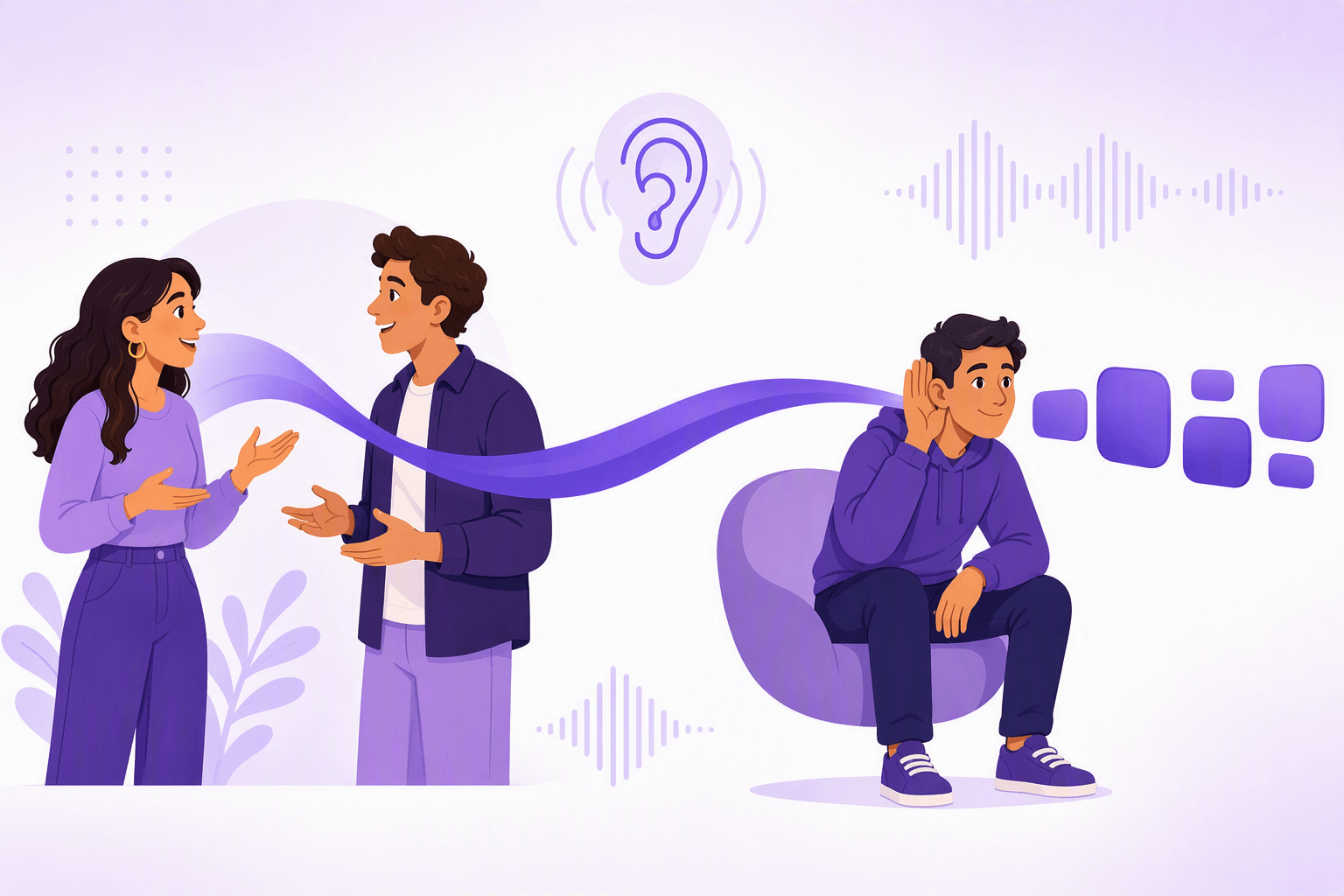
Why listening feels like the hardest skill
Most learners can read Spanish far above the level they can hear it. Three real mechanisms explain the gap, and none of them is talent.
Connected speech. Written Spanish gives you word boundaries; spoken Spanish erases them. Vowels merge across words (sinalefa), so "¿Cómo ha estado?" flows out as one unbroken stream, and everyday speech compresses further: para adelante becomes pa'lante in half the Spanish-speaking world. When you "can't hear the words", what is actually happening is that your brain is searching for boundaries the audio does not contain. Reading skill cannot fix this; only exposure to connected speech can.
Speed. This one is not your imagination. A cross-language study by Pellegrino, Coupé and Marsico measured speech rates across languages and found Spanish among the fastest in syllables per second ('A cross-language perspective on speech information rate', Language, 2011). Spanish packs less information per syllable than English and compensates with rate, so natives really do fire syllables at you faster than you are used to.
Dialects. A learner trained only on Mexico City Spanish meets a Chilean, an Andalusian, or a Cuban and feels like a beginner again. Final s aspirated to a breath, ll/y pronounced "sh" in Buenos Aires, the th-like z of Spain: Spanish is pluricentric, and comprehension of one standard does not automatically transfer.
The researchers who study this are blunt about why the skill lags: it is trained worst. As Vandergrift and Goh put it in the standard reference on the subject, listening is too often "caught, not taught", tested with comprehension questions rather than actually developed (Teaching and Learning Second Language Listening, Routledge, 2012). The fix is a real training plan, which is the rest of this article.
Assess your level first
Everything downstream, what you listen to, how you work it, depends on your starting point. Run this two-minute self-test on a piece of native audio (a podcast clip, a TV scene):
- Can you retell what happened in your own words? If not, the material is above your training level, whatever your grammar knowledge says.
- How many unknown words per minute? A few you can guess from context: perfect. A dictionary emergency every sentence: step down.
- Does comprehension survive five minutes, or does it dissolve into sound? Collapsing comprehension means the level is slightly too high or you need subtitles as scaffolding.
Then map yourself roughly to the CEFR scale: A2 listeners follow slow, clear speech on everyday topics; B1 catches the main points of standard speech; B2 follows native podcasts and shows on familiar subjects; C1 handles fast, idiomatic, regionally flavored speech. Aim your practice material at the level where you understand roughly 90-98% — the comprehensible input band where acquisition actually happens (full explanation here).
Training by level: what to actually listen to
The resources below are all real, all proven with learners, and mostly free.
A1-A2: comprehensible before authentic
At this stage, native media is noise, and pretending otherwise wastes months. You need input made to be understood:
- Dreaming Spanish. Hundreds of free videos where teachers speak simplified Spanish supported by drawings and gestures, sorted from superbeginner up. The most reliable on-ramp that exists for Spanish listening.
- Coffee Break Spanish and similar structured learner podcasts: short lessons, clear speech, gradual build.
- Short repeated clips of very simple scenes, greetings, ordering food, played several times rather than once.
Goal for the stage: 60-100 hours of listening you genuinely follow. Volume of understood Spanish, not difficulty, is the metric.
B1-B2: the bridge to real Spanish
This is where most learners stall, stuck between learner audio (too easy) and native media (too fast). Bridge materials solve it:
- Español con Juan. A podcast in natural but articulate Spanish about everyday topics, funny, rambling, and pitched exactly at intermediate ears.
- News in Slow Spanish. Current events at adjustable speeds; use it as a ramp, moving toward native pace, not as a permanent home.
- TV series with Spanish subtitles. Real dialogue with a text safety net. Start with dialogue-clear shows and work in scenes, not episodes; our guide to the best TV shows for learning Spanish ranks options by difficulty.
Goal for the stage: retire the slow versions. Every month, spend a bit more time at full native speed with subtitle support, and a bit less on learner audio.
C1: volume, range, and accents
Comprehension is no longer the problem; coverage is. Your job is breadth:
- Radio Ambulante. Narrative journalism from every corner of Latin America, with transcripts. One episode can move from a Colombian narrator to Chilean interviewees, which is exactly the accent range you need.
- Native radio and podcasts (RTVE and its podcast catalog, interview shows, comedy), films without subtitles, fast panel discussions where speakers interrupt each other.
Goal: nothing commonly spoken surprises you, whether it comes from Madrid, Mexico City, or Buenos Aires.
Active vs. passive listening
Not all listening minutes are equal, and the difference is attention. Active listening means working a piece of audio: predicting, checking a transcript, replaying a sentence, summarizing out loud. It is effortful, which is why it drives the fastest gains and why nobody can do it for hours. Passive listening, in the strict sense of background audio while your attention is elsewhere, teaches very little; acquisition happens when you attend to meaning, and podcasts behind your work emails are atmosphere, not input.
But there is a third mode between them, and it deserves its own name because learners search for exactly this.
Chill Spanish listening practice
Chill listening is relaxed, low-effort listening at a level you find genuinely easy: a story you follow without strain, an episode of a show you have already seen, a Dreaming Spanish video one level below your ceiling. You are paying attention, you are just not working.
This mode is not a guilty pleasure; it is load-bearing. Easy-level volume reinforces half-known words until they become automatic, builds stamina for longer stretches of Spanish, and keeps the habit alive on days when focused study will not happen. Stephen Krashen's whole framework points this way:
"We acquire language in one way and only one way: when we understand messages. We call this comprehensible input." — Stephen Krashen
A healthy diet is roughly one part focused work to two or three parts chill listening. Grow with the hard sessions; consolidate with the easy ones. The only failure mode is letting chill listening drift into true background noise, if you could not say what just happened, it stopped counting.
The clip-repetition method
The highest-yield active technique is embarrassingly simple: stop measuring listening in episodes and start measuring it in clips.
- Pick a 1-3 minute scene or segment at your level, TV dialogue works best because context carries meaning.
- Play it clean and note what you caught: who wants what, what happened.
- Play it with Spanish subtitles or the transcript, and mark the moments where sound and text refuse to match; that mismatch is connected speech, and noticing it is the lesson.
- Play it clean again. Lines that were mush on pass one arrive as words. That shift, audible within a single session, is the skill being built.
- Keep the new words. Two or three per clip into your review system is plenty.
The replay is the method: new content maximizes unknowns, while a repeated scene lets your ear decode the same real-speed Spanish until it resolves. This loop is exactly what Wordy is built around, short clips from real movies and shows with instant word lookups and quizzes, so each rewatch turns a bit more native-speed audio into vocabulary you keep.
💡 One scene a day
One three-minute scene, worked through the full loop, is a complete daily session. Twenty minutes of this outperforms two hours of half-followed streaming, and it fits inside any schedule.
There is a vocabulary floor under all of this: Webb and Rodgers found you need roughly the 3,000 most frequent word families to cover about 95% of movie dialogue ('The Lexical Coverage of Movies', Applied Linguistics, 2009). If native scenes feel impenetrable, the clip loop still works, just aim it at easier material while your core vocabulary grows.
Dictation and shadowing
Two classic techniques sharpen specific weaknesses. Use them as weekly supplements, not daily staples.
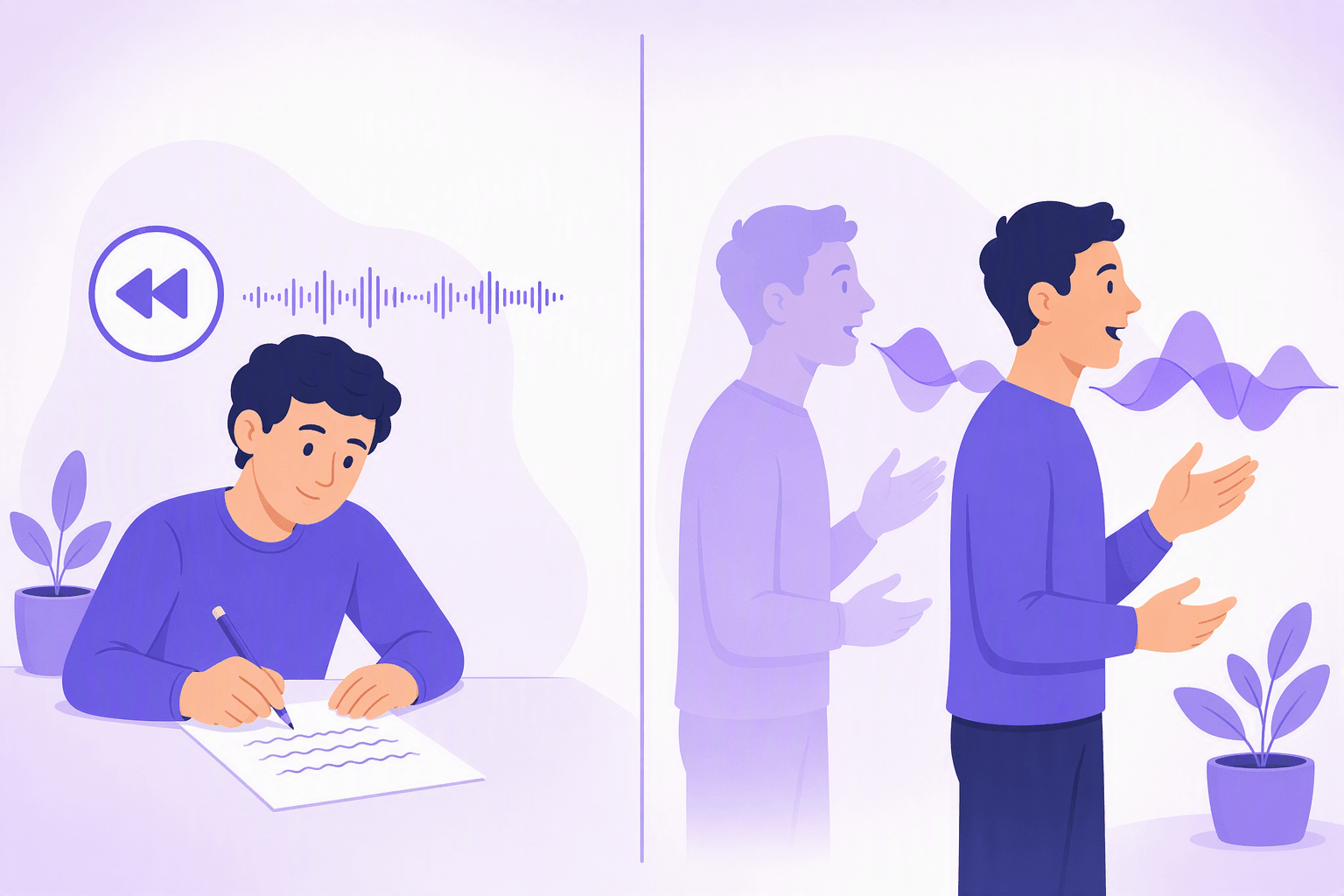
Dictation attacks word boundaries. Take a 30-60 second clip, play one sentence at a time, and write exactly what you hear, replaying as often as needed. Then check against the transcript. The errors are a map of your listening gaps: swallowed object pronouns (se lo di), merged vowels, s you assumed but never heard. Ten minutes of dictation tells you more about your ear than an hour of quizzes.
Shadowing attacks speed. Play audio and speak along with it, echoing a half-second behind, matching rhythm and intonation rather than perfection. To keep up, your brain must predict where sentences are going, which is precisely the processing skill fast speech demands. Start with slower, clear audio and short 30-second bursts; it is genuinely tiring. As a bonus, shadowing is the single best carryover from listening practice to sounding natural yourself.
Accent exposure: Spain, Mexico, Argentina and beyond
Train on one accent and you learn that accent; train on several and you learn Spanish. The three biggest targets:
- Spain. The th-sound for z and soft c (gracias, cerveza), crisp rhythm, vosotros forms, and in the south, aspirated final s. RTVE and Spanish series are your exposure source.
- Mexico. Often called the clearest widely-heard accent: full vowels, conserved consonants, distinctive melody and slang (órale, ahorita). Mexican film and TV give you the variety the most Spanish learners will hear most in media.
- Argentina (Rioplatense). The famous "sh" for ll and y (calle as "cashe"), vos instead of tú with its own verb forms, and Italian-influenced intonation. Argentine films and Buenos Aires podcasts cover it.
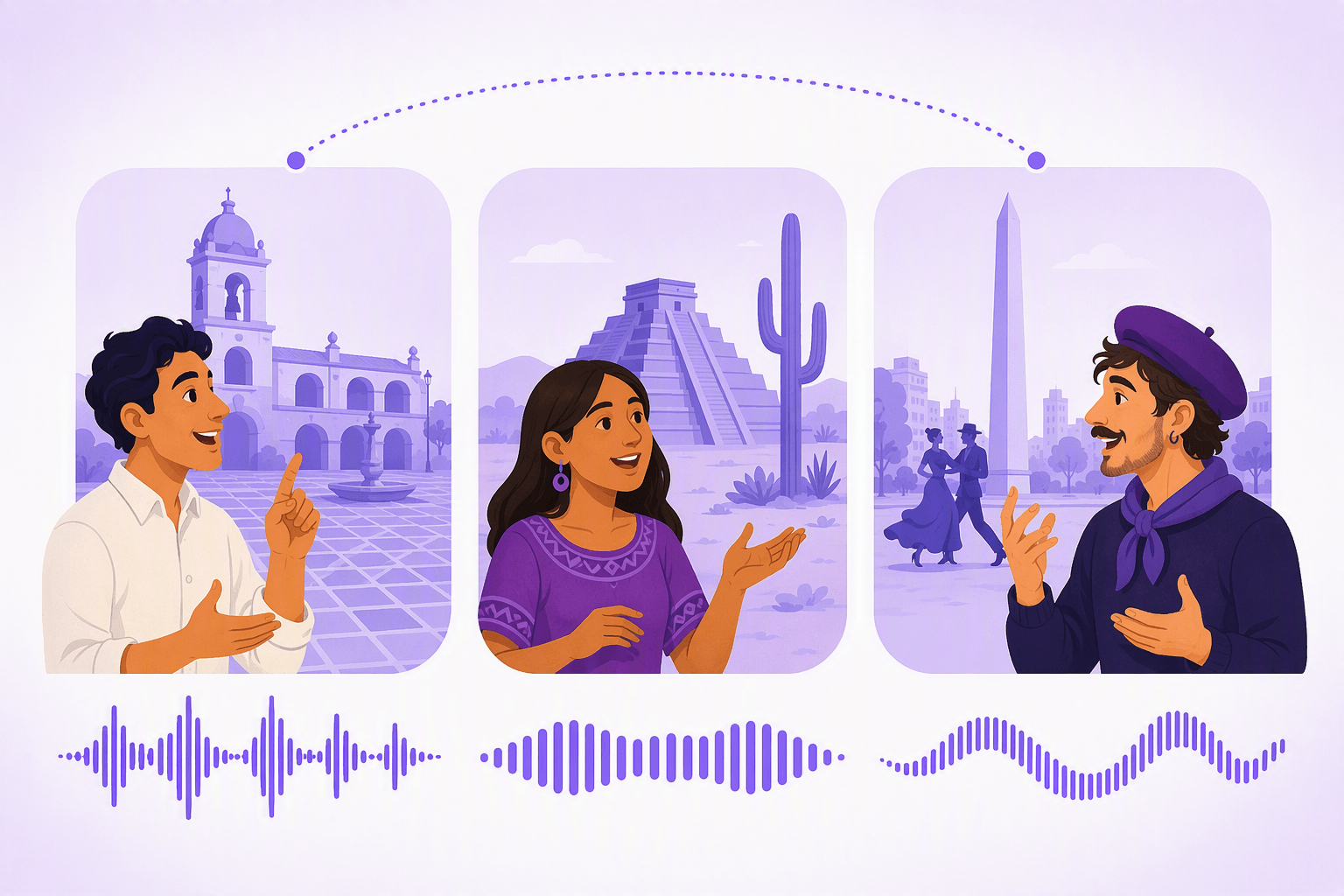
You do not need to master every variety. A practical policy: pick one home accent for the bulk of your input, then schedule one session a week in a different one. Comprehension generalizes surprisingly fast once your ear learns that variation is normal, and pan-regional sources like Radio Ambulante do the rotation for you.
A 4-week sample plan
Twenty to forty minutes a day, six days a week, adjusted to your level:
| Week | Focus | Daily core (20-30 min) | Plus |
|---|---|---|---|
| 1 | Calibration | Self-test, then daily listening at your true level (Dreaming Spanish / Español con Juan / easy scenes) | Note unknown-word density; adjust level |
| 2 | Clip loop | One scene or segment daily through the 3-pass loop | 2-3 new words per day into review |
| 3 | Techniques | Clip loop 4 days; dictation once; shadowing once | One session in a second accent |
| 4 | Stretch | Clip loop at slightly harder material; one full episode with Spanish subtitles | Chill listening on the commute all week |
After week 4, repeat the cycle one notch harder. Progress will not feel linear, listening improves in sudden clicks after quiet stretches, so judge yourself monthly, not daily: retest on the same kind of audio you used in week 1, and you will hear the difference your ears could not feel day to day.
The whole method in one line: mostly-understandable audio, every day, in small repeated pieces, with your attention on. Everything else is optimization.
Frequently Asked Questions
How can I improve my Spanish listening?
Why do native Spanish speakers sound so fast?
Is passive listening useful for Spanish?
How many hours a day should I practice Spanish listening?
What is the best podcast for Spanish listening practice?
Sources & References
- Vandergrift, L. & Goh, C., Teaching and Learning Second Language Listening: Metacognition in Action, Routledge, 2012
- Pellegrino, F., Coupé, C. & Marsico, E., 'A cross-language perspective on speech information rate', Language, 2011
- Webb, S. & Rodgers, M.P.H., 'The Lexical Coverage of Movies', Applied Linguistics, 2009
- Krashen, S., Principles and Practice in Second Language Acquisition, Pergamon Press, 1982
- Council of Europe, Common European Framework of Reference for Languages (CEFR)
Start learning with Wordy
Watch real movie clips and build your vocabulary as you go. Free to download.


