Quick Answer
Spanish tapas vocabulary helps you understand small-plate menus, order confidently, and recognize regional classics such as tortilla, croquetas, and gambas al ajillo. Learn the food words, useful ordering phrases, and the dining customs that make tapas more than just snacks.
Spanish tapas vocabulary is the language you need to read a bar menu, order small plates, and understand how people eat socially in Spain. Start with tapa /ˈta.pa/, a small serving, then learn portion words such as ración /raˈθjon/ and practical phrases such as ¿Qué me recomienda? /ke me rekomˈjenda/, meaning “What do you recommend?” Tapas are meant to be shared, discussed, and ordered gradually rather than treated as a rushed meal.
Spanish is spoken by more than 600 million people worldwide, according to the Instituto Cervantes, and food vocabulary changes noticeably across its 21 Spanish-speaking countries. This guide focuses on tapas culture in Spain, where a short stop for a drink can turn into a long evening of conversation and plates in the middle of the table. Before ordering, brush up on Spanish greetings for first impressions, because a warm hello matters in a neighborhood bar.
| English | Spanish | Pronunciation | Formality |
|---|---|---|---|
| What do you recommend? | ¿Qué me recomienda? | keh meh reh-koh-MYEN-dah | polite |
| Can we have this, please? | ¿Nos pone esto, por favor? | nohs POH-neh EHS-toh por fah-BOR | polite |
| One portion, please. | Una ración, por favor. | OO-nah rah-SYOHN por fah-BOR | polite |
| A half portion, please. | Media ración, por favor. | MEH-dyah rah-SYOHN por fah-BOR | polite |
| Another round? | ¿Otra ronda? | OH-trah ROHN-dah | casual |
| The bill, please. | La cuenta, por favor. | lah KWEHN-tah por fah-BOR | polite |
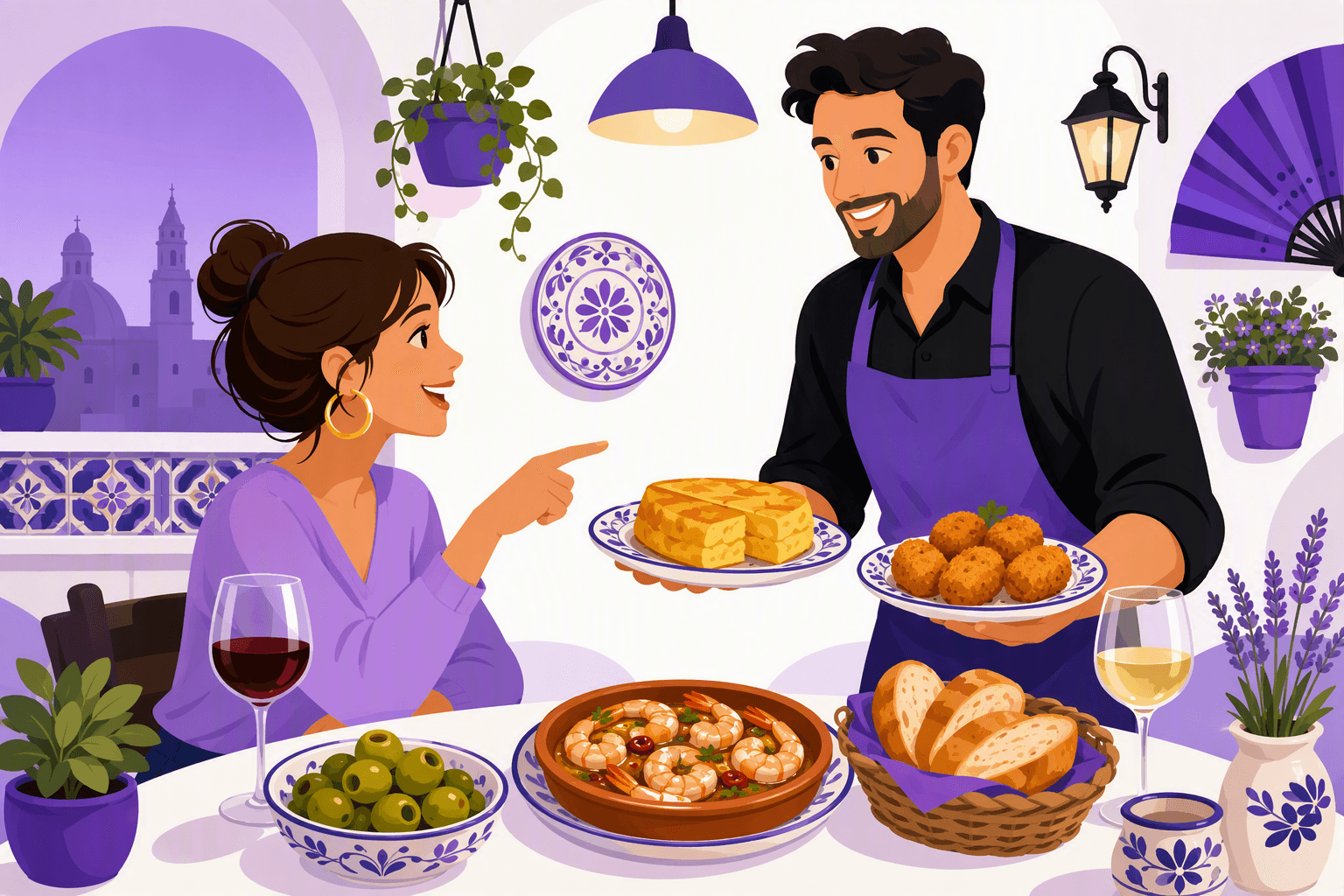
What tapas really are
A tapa /ˈta.pa/ is not simply a Spanish word for appetizer. The Real Academia Española defines it as a small portion of food served as an accompaniment to a drink, but real-life practice is wider than that definition. A tapa might be a free bite with a beer, a tiny dish at a counter, or a carefully plated specialty ordered from a menu.
The plural tapas /ˈta.pas/ often describes the whole social eating format. People meet at a bar /baɾ/, order drinks and several plates, share them, then perhaps move to another place. This movement is called ir de tapas /iɾ de ˈta.pas/, literally going for tapas.
The story that tapas were invented when a king covered a drink with bread is popular, but it is not a settled historical fact. What is clear is that the word tapa /ˈta.pa/ can mean cover or lid, and food served with drinks developed through many local bar traditions rather than one single royal event.
🌍 Tapas are a format, not a fixed menu
A tapa /ˈta.pa/ can be cold, hot, vegetarian, fried, grilled, simple, or elaborate. Do not expect every bar to serve the same dishes. The local specialty is often the most rewarding choice.
Portion sizes on Spanish menus
Menu labels can be confusing because a “small plate” means different amounts in different cities. Learn these labels before you assume a dish is for one person.
| Spanish menu word | IPA | What it usually means |
|---|---|---|
| tapa | /ˈta.pa/ | Small serving, sometimes individual, sometimes shareable |
| pincho | /ˈpin.tʃo/ | Small snack, often served on bread or secured with a pick |
| media ración | /ˈme.ðja raˈθjon/ | Half portion, usually suitable for two people |
| ración | /raˈθjon/ | Full shared portion |
| plato | /ˈpla.to/ | Plate or dish, sometimes a full individual meal |
| menú del día | /meˈnu ðel ˈdi.a/ | Fixed-price daytime menu, often not tapas-focused |
In much of Spain, c before e or i and z sound like /θ/, similar to the start of English “think.” In many Latin American varieties and in parts of southern Spain, those sounds are pronounced /s/. Both pronunciations are correct.
Tapa
Tapa /ˈta.pa/ is the singular form. You might order una tapa de croquetas /ˈu.na ˈta.pa ðe kɾoˈke.tas/, meaning one small serving of croquettes.
A bar may list fixed tapas on a menu, while another may give one automatically with your drink. Ask ¿La tapa está incluida? /la ˈta.pa esˈta iŋˈklu.i.ða/, meaning “Is the tapa included?”
Ración
Ración /raˈθjon/ means portion. A ración is commonly intended for a group, although the actual amount depends on the bar and the dish.
If you are two people and want variety, a media ración /ˈme.ðja raˈθjon/ is often ideal. It gives you room to try another dish instead of filling up on one large plate.
Pincho
A pincho /ˈpin.tʃo/, also spelled pintxo /ˈpin.tʃo/ in Basque, is especially associated with northern Spain. In Basque Country bars, these small, often elaborate bites are displayed along the counter.
The word comes from the idea of a pick or skewer. In some venues, guests take their own pinchos /ˈpin.tʃos/ and the staff counts the toothpicks or plates later.
🌍 Tapas culture changes by city
Granada is famous for generous free tapas with drinks. Seville has a lively standing-at-the-bar culture and many traditional small plates. San Sebastián is strongly associated with pintxos /ˈpin.tʃos/, while Barcelona menus may use the Catalan term platillo /plaˈti.ʎo/ for a small dish.
Essential Spanish tapas vocabulary
| English | Spanish | Pronunciation | Note |
|---|---|---|---|
| Spanish omelet | tortilla de patatas | tor-TEE-yah deh pah-TAH-tahs | Egg and potato omelet, often served at room temperature. |
| Croquettes | croquetas | kroh-KEH-tahs | Fried rolls with a creamy filling, often ham, chicken, or mushroom. |
| Spicy potatoes | patatas bravas | pah-TAH-tahs BRAH-bahs | Fried potatoes with a spicy sauce, recipes vary by bar. |
| Garlic shrimp | gambas al ajillo | GAHM-bahs ahl ah-HEE-yoh | Shrimp cooked in olive oil, garlic, and often chili. |
| Cured Iberian ham | jamón ibérico | hah-MOHN ee-BEH-ree-koh | Premium cured ham from Iberian pigs. |
| Marinated olives | aceitunas aliñadas | ah-say-TOO-nahs ah-lee-NYAH-dahs | Olives seasoned with herbs, garlic, or citrus. |
| Bread with tomato | pan con tomate | pahn kohn toh-MAH-teh | Bread rubbed with tomato, common in Catalonia. |
| Fried calamari | calamares fritos | kah-lah-MAH-rehs FREE-tohs | Often served with lemon or aioli. |
| Meatballs | albóndigas | ahl-BOHN-dee-gahs | Usually served in tomato, almond, or rich meat sauce. |
| Cured cheese | queso curado | KEH-soh koo-RAH-doh | Aged cheese with a firmer texture and stronger flavor. |
The dishes you will see most often
Tortilla de patatas
Tortilla de patatas /toɾˈti.ʎa ðe paˈta.tas/ is one of Spain’s defining dishes. Despite the English label “Spanish omelet,” it is usually thick, round, and made from eggs, potatoes, olive oil, and sometimes onion.
The onion debate is real and playful. Con cebolla /kon θeˈbo.ʎa/ means with onion, while sin cebolla /sin θeˈbo.ʎa/ means without it. If you see poco hecha /ˈpo.ko ˈe.tʃa/, the center may be soft or runny.
Croquetas
Croquetas /kɾoˈke.tas/ are crisp on the outside and soft inside. The filling is usually bound with a thick bechamel /be.tʃaˈmel/ sauce, then breaded and fried.
Look for croquetas de jamón /kɾoˈke.tas ðe xaˈmon/, ham croquettes, or croquetas de setas /kɾoˈke.tas ðe ˈse.tas/, mushroom croquettes. They are hot, so wait a moment before biting into one.
Patatas bravas
Patatas bravas /paˈta.tas ˈbɾa.βas/ are fried potatoes served with salsa brava /ˈsal.sa ˈbɾa.βa/, a punchy sauce that can include paprika, chili, garlic, or vinegar. There is no single national recipe.
Some bars also add alioli /aˈli.o.li/, a garlic mayonnaise-like sauce. The spelling aioli /aˈjo.li/ is also common, especially where Catalan influence is strong.
Gambas al ajillo
Gambas al ajillo /ˈgam.bas al aˈxi.ʎo/ are shrimp cooked in sizzling olive oil with garlic. They often arrive in a small earthenware dish called a cazuela /kaˈθwe.la/.
Use bread to enjoy the flavored oil, but do so politely. Tear off a piece of pan /pan/ rather than dipping an entire roll into a shared dish.
Jamón ibérico
Jamón ibérico /xaˈmon iˈβe.ɾi.ko/ is cured ham made from Iberian pigs. It is different from jamón serrano /xaˈmon seˈra.no/, another cured ham that is generally more affordable and widely available.
When a menu says bellota /beˈʎo.ta/, it refers to acorn-fed production, a prestigious category. Order a small plate if you are curious, since thin slices are rich and meant to be savored slowly.
How to order tapas naturally
In a busy bar, begin with hola /ˈo.la/ or buenas /ˈbwe.nas/, a casual shortened greeting. Make eye contact, wait patiently, and order clearly once staff acknowledge you.
Use para compartir /paɾa kompaɾˈtiɾ/, meaning “to share,” when you want guidance on portions. A useful full question is ¿Esto es para compartir? /ˈes.to es paɾa kompaɾˈtiɾ/, meaning “Is this for sharing?”
/keh meh reh-koh-MYEN-dah/
Literal meaning: What do you recommend to me?
“Es nuestra primera vez aquí. ¿Qué me recomienda?”
It is our first time here. What do you recommend?
A respectful, useful question in a traditional bar. It often leads to a regional specialty or the freshest dish of the day.
/nohs TRAH-eh OH-trah/
Literal meaning: Do you bring us another one?
“Estas croquetas están buenísimas. ¿Nos trae otra ración?”
These croquettes are excellent. Could you bring us another portion?
Tapas are usually ordered in rounds. Adding another dish after tasting the first plates is normal, not indecisive.
For polite basics such as por favor /poɾ faˈβoɾ/ and gracias /ˈgɾa.θjas/, see our guide to please and thank you in Spanish. The phrases are small, but they affect the tone of every interaction.
Tapas etiquette that visitors often miss
Tapas are social food. Plates belong in the center, and people serve themselves in a loose, conversational rhythm. Waiting for a formal signal to start is usually unnecessary, though it is courteous to make sure everyone has access to the dish.
Standing at the bar is normal, especially during the evening rush. A barra /ˈba.ra/ can be faster and livelier than a table, but service is not always first-come, first-served in an obvious line. Observe who is waiting and catch the server’s attention without shouting.
Meal times also run later than many visitors expect. Lunch often begins around 2:00 p.m., while dinner may start after 9:00 p.m. Tapas fill the space before dinner, replace dinner, or extend into a long night out.
UNESCO recognizes the Mediterranean diet as intangible cultural heritage, emphasizing shared meals, local products, food knowledge, and hospitality. Spanish tapas culture fits this social pattern particularly well: the point is not merely to consume a dish, but to stay, talk, and share time.
Food writer Claudia Roden’s The Food of Spain highlights how strongly Spanish cooking is shaped by region, climate, and local ingredients. That is why ordering jamón /xaˈmon/ in Andalusia, seafood in Galicia, or pintxos /ˈpin.tʃos/ in the Basque Country gives you a different experience even when the menu category is “tapas.”
Simone Ortega’s 1080 recetas de cocina remains an influential home-cooking reference because familiar Spanish dishes depend on technique as much as ingredients. A good tortilla /toɾˈti.ʎa/, for example, is about the texture of the potatoes, the temperature of the oil, and how set the egg should be.
Regional words and menu surprises
In Catalonia, you may encounter pa amb tomàquet /pa am tuˈma.kət/, the Catalan name for tomato bread. In Galicia, pulpo a la gallega /ˈpul.po a la ɣaˈʎe.ɣa/ is octopus served with olive oil, paprika, and salt.
In the Basque Country, pintxos /ˈpin.tʃos/ may be more prominent than the word tapas /ˈta.pas/. In Andalusia, a montadito /montaˈði.to/ is a small filled roll, while pescaíto frito /peskaˈi.to ˈfɾi.to/ refers to small fried fish in the local Andalusian style.
Do not worry if a menu includes unfamiliar regional language. Ask ¿Qué lleva? /ke ˈʎe.βa/, meaning “What does it contain?” It is especially useful for allergies, dietary preferences, and dishes with names that do not reveal their ingredients.
💡 A reliable tapas order for two
Choose one cold item, one fried item, one vegetable or potato dish, and one protein dish. For example: aceitunas /a.θejˈtu.nas/, croquetas /kɾoˈke.tas/, patatas bravas /paˈta.tas ˈbɾa.βas/, and gambas al ajillo /ˈgam.bas al aˈxi.ʎo/.
Practice tapas Spanish with real dialogue
Food vocabulary sticks when you hear it at natural speed and attach it to a scene. Watch a restaurant scene, pause when characters order, and repeat the phrase with the same rhythm. This makes words such as ración /raˈθjon/ and cuenta /ˈkwen.ta/ easier to retrieve at a real table.
Build your first practice set around five items you would genuinely order, then add one phrase for asking a question and one for paying. For more restaurant-ready language, use our Spanish food vocabulary guide and Spanish travel phrases.
When you leave, a simple hasta luego /ˈas.ta ˈlwe.ɣo/ works well if the interaction was casual. For more natural farewells, see how to say goodbye in Spanish. The best tapas vocabulary is the vocabulary you can use warmly, clearly, and without treating the meal like a script.
Frequently Asked Questions
What does tapas mean in Spanish?
Do you get free tapas in Spain?
What is the difference between a tapa, a ración, and a media ración?
What are the most common tapas to order in Spain?
Is it rude to share tapas in Spain?
Sources & References
- Real Academia Española, Diccionario de la lengua española, tapa entry, accessed 2026
- Instituto Cervantes, El español: una lengua viva, 2025
- UNESCO, Mediterranean diet, Representative List of the Intangible Cultural Heritage of Humanity
- Ministerio de Agricultura, Pesca y Alimentación, Alimentos de España, accessed 2026
- Claudia Roden, The Food of Spain, Ecco
Start learning with Wordy
Watch real movie clips and build your vocabulary as you go. Free to download.


