Quick Answer
The most essential Spanish food words are: comida (food), carne (meat), pollo (chicken), pescado (fish), arroz (rice), pan (bread), queso (cheese), and fruta (fruit). Spanish food vocabulary varies significantly between Spain and Latin America, for example, banana vs plátano, gamba vs camarón, patata vs papa, and zumo vs jugo. Learning these regional differences is just as important as learning the words themselves.
Food is the fastest way into any culture, and across the 559 million Spanish speakers worldwide, comida sits at the center of daily life. Whether you are navigating a tapas bar in Seville, ordering street tacos in Mexico City, or shopping at a mercado in Buenos Aires, food vocabulary is among the most immediately useful Spanish you can learn.
What makes Spanish food vocabulary especially rich is its dual heritage. Many everyday words trace back to indigenous American languages: tomate, chocolate, and aguacate all come from Nahuatl, the language of the Aztec empire. Meanwhile, Spain's culinary traditions carry Arabic, Latin, and Mediterranean influences that created an entirely different vocabulary for the same basic foods.
"Spanish food terminology is one of the clearest windows into the language's colonial history. The Columbian Exchange did not just move foods between continents; it permanently fused two linguistic traditions into one vocabulary." (Sophie D. Coe & Michael D. Coe, The True History of Chocolate, Thames & Hudson, 2013)
This guide covers 30+ essential food words organized by category, with pronunciation, regional variations between Spain and Latin America, and the cultural context that makes each word stick.
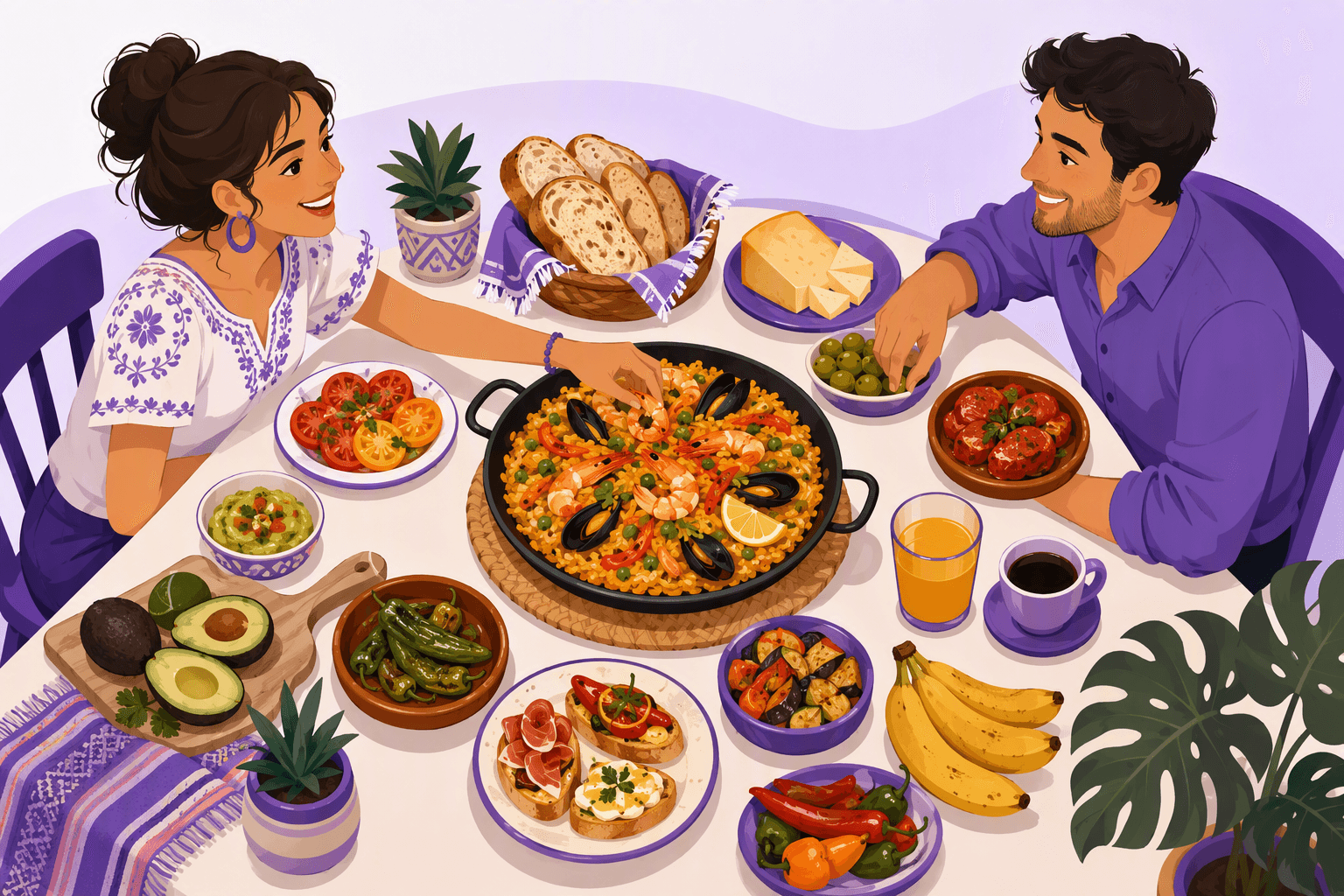
Quick Reference: 30 Essential Spanish Food Words
| English | Spanish | Pronunciation | Note |
|---|---|---|---|
| Food | Comida | koh-MEE-dah | |
| Apple | Manzana | mahn-SAH-nah | |
| Orange | Naranja | nah-RAHN-hah | |
| Banana | Plátano / Banana | PLAH-tah-noh / bah-NAH-nah | Spain: plátano; LatAm: banana |
| Tomato | Tomate | toh-MAH-teh | From Nahuatl tomatl |
| Onion | Cebolla | seh-BOH-yah | |
| Garlic | Ajo | AH-hoh | |
| Potato | Patata / Papa | pah-TAH-tah / PAH-pah | Spain: patata; LatAm: papa |
| Lettuce | Lechuga | leh-CHOO-gah | |
| Pepper | Pimiento / Chile | pee-mee-EN-toh / CHEE-leh | Chile from Nahuatl chīlli |
| Meat | Carne | KAR-neh | |
| Chicken | Pollo | POH-yoh | |
| Beef | Res / Ternera | rehs / tehr-NEH-rah | LatAm: res; Spain: ternera |
| Pork | Cerdo / Puerco | SEHR-doh / PWEHR-koh | Mexico also uses puerco |
| Fish | Pescado | pehs-KAH-doh | |
| Shrimp | Camarón / Gamba | kah-mah-ROHN / GAHM-bah | LatAm: camarón; Spain: gamba |
| Milk | Leche | LEH-cheh | |
| Cheese | Queso | KEH-soh | |
| Egg | Huevo | WEH-boh | |
| Bread | Pan | pahn | |
| Rice | Arroz | ah-ROHS | |
| Beans | Frijoles / Judías | free-HOH-lehs / hoo-DEE-ahs | Mexico: frijoles; Spain: judías |
| Avocado | Aguacate | ah-gwah-KAH-teh | From Nahuatl ahuacatl |
| Chocolate | Chocolate | choh-koh-LAH-teh | From Nahuatl xocolātl |
| Water | Agua | AH-gwah | |
| Wine | Vino | BEE-noh | |
| Juice | Jugo / Zumo | HOO-goh / SOO-moh | LatAm: jugo; Spain: zumo |
| Sugar | Azúcar | ah-SOO-kahr | From Arabic as-sukkar |
| Salt | Sal | sahl | |
| Oil | Aceite | ah-SAY-teh | From Arabic az-zayt |
Fruits: Las Frutas
Spanish has a remarkably wide fruit vocabulary thanks to the blending of European and American crops. According to the RAE, over 40 distinct fruit names are in common use across the Spanish-speaking world, with significant regional variation.
Manzana
The apple is one of the most universal fruits across all Spanish-speaking countries. The word manzana comes from Latin mattiana, a type of apple cultivated in the Roman Empire. Interestingly, manzana also means "city block" in Latin American Spanish, and context always makes the meaning clear.
Naranja
Naranja entered Spanish through Arabic (nāranj), which in turn came from Sanskrit. Spain was historically one of Europe's great orange-growing regions, and Valencia oranges remain world-famous. The color naranja (orange) takes its name from the fruit, not the other way around.
Plátano
This is where regional differences get interesting. In Spain, plátano means the common yellow banana. In Mexico and Central America, plátano often refers to plantains (the large, starchy cooking variety), while banana or banano means the sweet dessert fruit. In the Caribbean and South America, usage varies by country.
🌍 Plátano vs. Banana: A Map
Spain: plátano = banana (the sweet fruit). Mexico: plátano = both types, but often plantain specifically. Caribbean (Cuba, DR, PR): plátano = plantain, guineo = banana. Colombia: plátano = plantain, banano = banana. Argentina: banana = banana (plátano is rare). Knowing which word to use immediately signals your familiarity with the local dialect.
Vegetables: Las Verduras
Spanish vegetable vocabulary has a fascinating etymological split. Some words come from Latin and Arabic (reflecting Spain's medieval history), while others entered Spanish from Nahuatl and Quechua after the colonization of the Americas.
Tomate
One of the most globally successful Nahuatl loanwords. The Aztec tomatl originally referred to a broader category of round, pulpy fruits. When the Spanish brought tomatoes back to Europe in the 16th century, Italians initially called them pomo d'oro (golden apple), but the Nahuatl-derived name eventually won out across most European languages.
Cebolla
From Latin caepulla, a diminutive of caepa (onion). The onion has been central to Spanish cooking for centuries. The phrase en capas como una cebolla (in layers like an onion) is the Spanish equivalent of "like peeling an onion."
Ajo
Garlic is arguably the most important ingredient in Spanish cuisine. From Latin alium, ajo appears in countless expressions: estar en el ajo (to be in the know), revolver el ajo (to stir up trouble). The Real Academia de Gastronomia considers garlic the backbone of Mediterranean Spanish cooking.
Patata / Papa
This is one of the clearest Spain-versus-Latin-America vocabulary splits. Spain uses patata (a blend of the Taino batata and the Quechua papa), while virtually all of Latin America uses papa. The original Quechua word papa makes linguistic sense, since the potato was domesticated in the Andes over 7,000 years ago.
💡 Patata or Papa?
If you are traveling to Spain, always say patata. Everywhere else in the Spanish-speaking world, say papa. Using the wrong one will not cause confusion, but locals will immediately notice. The classic dish tortilla de patatas in Spain becomes tortilla de papas in Latin America.
Meat and Seafood: Carnes y Mariscos
Spanish-speaking countries span from the cattle ranches of Argentina to the fishing villages of Galicia, creating diverse meat and seafood vocabularies.
Carne
The generic word for meat, from Latin carnem. In everyday conversation, carne without a qualifier usually implies beef, especially in Latin America. The phrase carne asada (grilled meat) is practically a cultural institution across Mexico and Central America.
Pollo
Chicken is the most consumed meat in the Spanish-speaking world. Pollo comes from Latin pullus (young animal). The word is consistent across all regions, one of the rare cases where Spain and Latin America fully agree.
Pescado
An important distinction exists in Spanish that English lacks: pescado is fish that has been caught (the food), while pez is a living fish swimming in water. If you order at a restaurant, you want pescado. If you are at an aquarium, you are looking at peces.
Camarón / Gamba
Shrimp is camarón across Latin America and gamba in Spain. The Spanish film Priscilla, Queen of the Desert popularized the phrase "gambas al ajillo" internationally, but if you order gambas in Mexico, you might get confused looks. Ask for camarones al ajillo instead.
Dairy, Grains & Staples: Lácteos, Cereales y Básicos
These are the building blocks of daily meals across the Spanish-speaking world.
Leche
Milk, from Latin lac. The phrase estar de mala leche (to be in a bad mood) is extremely common in Spain. Leche appears in dozens of expressions and even mild expletives, making it one of the most culturally loaded food words in Spanish.
Queso
Cheese, from Latin caseus. Spain alone produces over 100 varieties of cheese, according to the Real Academia de Gastronomía. The most famous include manchego (from La Mancha), cabrales (blue cheese from Asturias), and idiazábal (smoked Basque cheese). In Mexico, queso fresco and queso Oaxaca are kitchen staples.
Pan
Bread is culturally sacred across the Spanish-speaking world. From Latin panis, the word pan appears in numerous proverbs: contigo, pan y cebolla (with you, bread and onion, meaning love conquers all). Mexican pan dulce (sweet bread) and Spanish pan de pueblo (village bread) represent two entirely different baking traditions.
Arroz
Rice, originally from Arabic ar-ruz, reflecting the Moorish influence on Spanish cuisine during the 700 years of Al-Andalus. Rice is the foundation of Spain's most iconic dish, paella valenciana, and is equally central to Caribbean, Mexican, and South American cooking.
Iconic Dishes: Platos Emblemáticos
Understanding dish names gives you cultural literacy that goes far beyond vocabulary.
Paella
Spain's most internationally recognized dish, originating in Valencia. The word paella comes from the Old French paele (pan), itself from Latin patella. Authentic paella valenciana traditionally contains rabbit, chicken, snails, and green beans, not seafood. The seafood version is paella de mariscos. Calling any rice dish "paella" in Valencia is a reliable way to start an argument.
Tacos
Mexico's most emblematic food. The word taco in its culinary sense dates to 18th-century Mexican silver mines, where miners wrapped food in tortillas for portable meals. In 2010, UNESCO inscribed Traditional Mexican Cuisine as an Intangible Cultural Heritage of Humanity, the first cuisine to receive this designation. The taco was central to that recognition.
Empanadas
Found across Latin America and Spain, empanadas (from empanar, to bread or wrap in dough) vary dramatically by country. Argentine empanadas are baked with a wheat flour crust. Chilean empanadas are larger and often filled with pino (beef, onion, egg, olive). Colombian empanadas use corn dough and are deep-fried. Spanish empanada gallega is a large, flat pie.
🌍 UNESCO and Spanish-Speaking Food Traditions
Three culinary traditions from the Spanish-speaking world hold UNESCO Intangible Cultural Heritage status: Traditional Mexican Cuisine (2010), the Mediterranean Diet (2013, shared with Spain, Italy, Greece, and others), and the cultural significance of ajiaco in Colombian identity (represented through broader Colombian cultural practices). This global recognition reflects how deeply food is woven into the identity of Spanish-speaking cultures.
Words from Nahuatl: The Aztec Legacy
Some of the most common Spanish food words are not Spanish at all. They are Nahuatl, the language of the Aztec empire. When Spanish conquistadors arrived in Mexico in the 16th century, they encountered foods with no European equivalent and adopted the indigenous names.
| English | Spanish | Pronunciation | Note |
|---|---|---|---|
| Tomato | Tomate | toh-MAH-teh | From Nahuatl tomatl |
| Chocolate | Chocolate | choh-koh-LAH-teh | From Nahuatl xocolātl (bitter water) |
| Avocado | Aguacate | ah-gwah-KAH-teh | From Nahuatl ahuacatl |
| Chili pepper | Chile | CHEE-leh | From Nahuatl chīlli |
| Turkey | Guajolote | gwah-hoh-LOH-teh | From Nahuatl huexōlōtl (Mexico) |
| Corn/Maize | Elote | eh-LOH-teh | From Nahuatl ēlōtl (corn on the cob) |
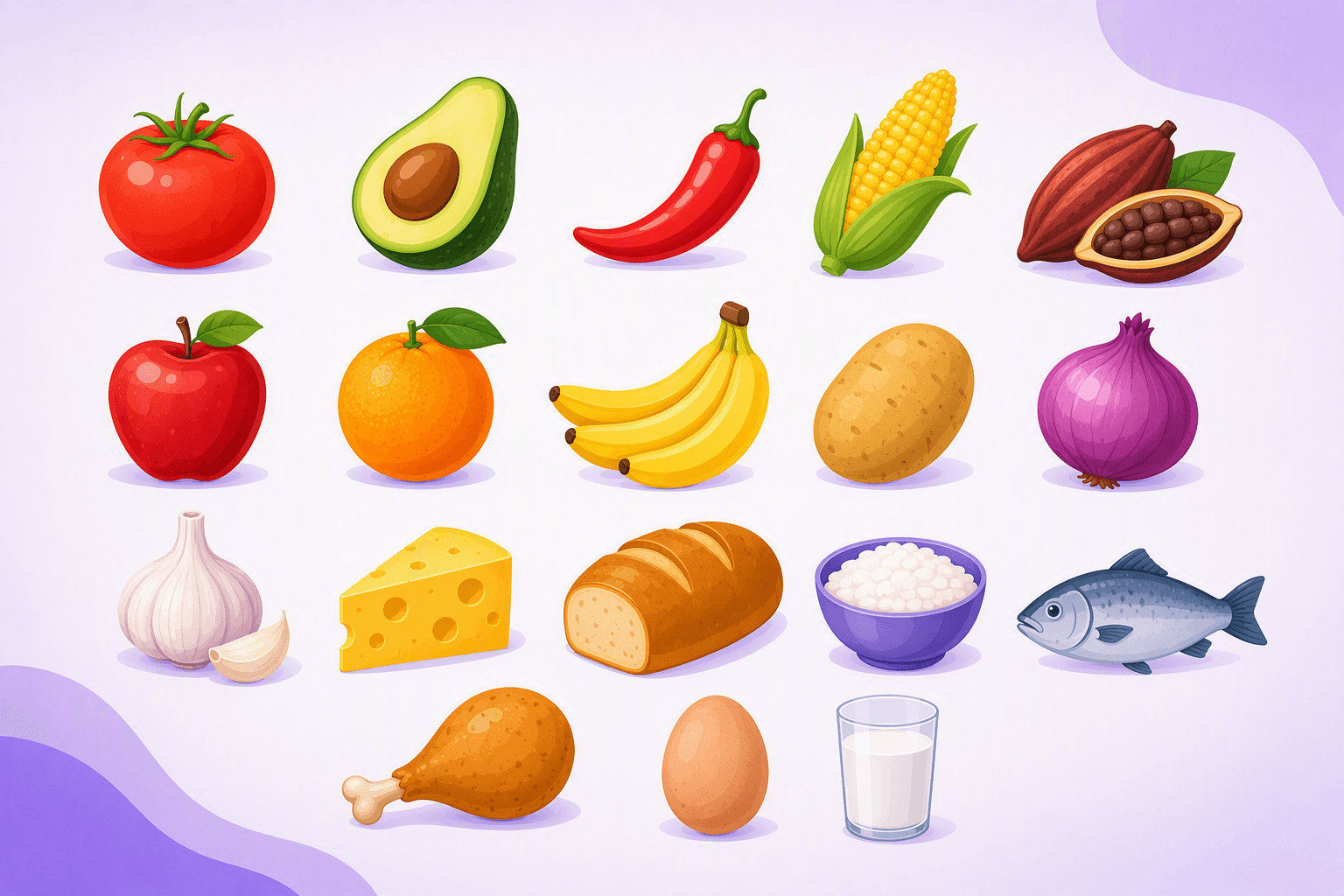
The Nahuatl word ahuacatl (avocado) also meant "testicle" in Aztec culture, a reference to the fruit's shape. This etymology is well documented by linguists but rarely mentioned in polite conversation. The word chocolate comes from xocolātl, likely meaning "bitter water," describing the unsweetened cacao drink that Aztec nobility consumed.
"The linguistic impact of the Columbian Exchange was asymmetric: while Spanish imposed itself as the dominant language of the Americas, the food vocabulary of the Americas permanently reshaped Spanish itself." (Real Academia Española, Diccionario de la lengua española, 23rd edition, etymological notes)
Regional Differences: Spain vs. Latin America
One of the biggest challenges with Spanish food vocabulary is that the same food often has different names depending on the country. Here are the most important splits to know.
| English | Spanish | Pronunciation | Note |
|---|---|---|---|
| Banana | Plátano / Banana | PLAH-tah-noh / bah-NAH-nah | Spain: plátano; LatAm: banana |
| Shrimp | Gamba / Camarón | GAHM-bah / kah-mah-ROHN | Spain: gamba; LatAm: camarón |
| Potato | Patata / Papa | pah-TAH-tah / PAH-pah | Spain: patata; LatAm: papa |
| Juice | Zumo / Jugo | SOO-moh / HOO-goh | Spain: zumo; LatAm: jugo |
| Peach | Melocotón / Durazno | meh-loh-koh-TOHN / doo-RAHS-noh | Spain: melocotón; LatAm: durazno |
| Beans | Judías / Frijoles | hoo-DEE-ahs / free-HOH-lehs | Spain: judías; Mexico: frijoles |
| Corn | Maíz / Elote / Choclo | mah-EES / eh-LOH-teh / CHOH-kloh | Maíz (general); elote (Mex); choclo (S. America) |
| Peanut | Cacahuete / Maní | kah-kah-WEH-teh / mah-NEE | Spain: cacahuete; LatAm: maní |
⚠️ Don't Mix Regions
Using gamba in Mexico or camarón in Spain will not cause misunderstanding, but it immediately marks you as unfamiliar with the local variety. When in doubt, learn the local term for the country you are visiting or the dialect you are studying. Both are correct Spanish, and there is no "better" version.
Restaurant Phrases: En el Restaurante
Knowing food words is only half the battle. You also need the phrases to order, ask questions, and pay.
| English | Spanish | Pronunciation | Note |
|---|---|---|---|
| I'm hungry | Tengo hambre | TEN-goh AHM-breh | |
| I'm thirsty | Tengo sed | TEN-goh sehd | |
| The menu, please | La carta, por favor | lah KAR-tah por fah-BOR | Spain: la carta; LatAm: el menú |
| I would like... | Quisiera... | kee-see-EH-rah | |
| Can you bring me...? | ¿Me puede traer...? | meh PWEH-deh trah-EHR | |
| The check, please | La cuenta, por favor | lah KWEN-tah por fah-BOR | |
| Tip | Propina | proh-PEE-nah | |
| Delicious! | ¡Delicioso! / ¡Riquísimo! | deh-lee-see-OH-soh / ree-KEE-see-moh | |
| I'm allergic to... | Soy alérgico/a a... | soy ah-LEHR-hee-koh ah | Critical for food allergies |
| Without [ingredient] | Sin [ingrediente] | seen |
Sobremesa: The After-Meal Tradition
No guide to Spanish food vocabulary is complete without sobremesa, a concept with no direct English equivalent. Literally meaning "over the table," sobremesa refers to the time spent lingering at the table after a meal, talking, drinking coffee or digestifs, and simply enjoying company.
In Spain, a weekday sobremesa might last 30 minutes. A Sunday family lunch sobremesa can stretch to two or three hours. In Latin America, the tradition is equally strong. Colombian and Argentine families are especially known for extended sobremesa that blends into the late afternoon.
The word itself reveals a cultural priority: meals in Spanish-speaking countries are social events, not just fuel. According to studies cited by the Instituto Cervantes, Spanish speakers spend an average of 80 minutes at the table per meal, nearly twice the average in the United States. This is not inefficiency. It is sobremesa.
🌍 Sobremesa Etiquette
If you are invited to a meal in a Spanish-speaking country, never rush to leave when the food is finished. The sobremesa is considered the best part. Asking for the check too quickly at a restaurant is seen as abrupt. Relax, order a café or a copa, and let the conversation unfold naturally.
Practice with Real Spanish Content
Food vocabulary appears in virtually every Spanish-language film and show: market scenes, family dinners, cooking sequences, and restaurant conversations provide constant reinforcement. Check out our guide to the best movies for learning Spanish for recommendations that showcase different regional cuisines and dialects.
Wordy lets you practice food vocabulary in real context by watching Spanish content with interactive subtitles. When a food word appears in dialogue, you can tap it to see the translation, hear the pronunciation, and save it for review. Explore our blog for more Spanish learning guides, or visit our Spanish learning page to start building your vocabulary today.
Frequently Asked Questions
What is the difference between plátano and banana in Spanish?
Why do so many Spanish food words come from Nahuatl?
What is sobremesa in Spanish food culture?
How do you order food in Spanish?
What are the main differences between Spanish and Mexican food vocabulary?
Sources & References
- Real Academia de Gastronomía, Diccionario Gastronómico Español
- Real Academia Española (RAE), Diccionario de la lengua española, 23rd edition
- UNESCO Intangible Cultural Heritage, Traditional Mexican Cuisine (inscribed 2010)
- Ethnologue: Languages of the World, 27th edition (2024)
- Coe, S.D. & Coe, M.D. (2013). The True History of Chocolate, 3rd edition. Thames & Hudson.
Start learning with Wordy
Watch real movie clips and build your vocabulary as you go. Free to download.


