Quick Answer
To sound like a native Spanish speaker, focus less on rolling your R and more on Spanish rhythm: clean vowels, steady syllable timing, natural linking, and the right level of formality. Pair that with high-frequency chunks (not single words) and daily listening to real dialogue, and your accent will improve faster than by drilling isolated sounds.
Sounding like a native Spanish speaker is mostly about rhythm and habits: keep vowels clean, hit stress where it belongs, link words smoothly, and rely on common phrase chunks instead of translating word by word. If you build those four skills with daily imitation of real dialogue, your Spanish will start to feel native-like even before your tricky consonants are perfect.

What "sound like a native" really means (and what to aim for)
Most learners imagine "native" as a single accent, but Spanish has many. Spanish is spoken across 20+ countries as an official language, and the Instituto Cervantes estimates hundreds of millions of speakers worldwide, with Spanish among the most widely used languages on Earth.
Ethnologue (27th edition, 2024) lists Spanish as one of the top languages by total speakers, and Spanish is official in 20 countries plus widely used in the United States. That means there is no single native sound, there are families of native sounds.
A practical goal is: native-like rhythm and phrasing, plus an accent that clearly matches one region. You want people to stop thinking about your accent and start thinking about your ideas.
💡 Pick one accent model for 90 days
Choose one reference accent (Mexico City, Bogotá, Madrid, Buenos Aires, etc.) and copy it consistently. Mixing features, like Spain's ceceo with Caribbean dropping of final s, can sound unnatural even if each feature is real somewhere.
The four pillars that make Spanish sound native
1) Clean vowels, no "uh" vowel
Spanish vowels are stable. English learners often reduce unstressed vowels into a neutral sound, which makes Spanish sound mumbled.
Spanish has five main vowel qualities, and they stay recognizable even in fast speech. If you fix only one thing, fix this.
Try these minimal pairs in your head:
- "casa" should sound like KAH-sah, not KUH-suh
- "pero" should sound like PEH-roh, not PUR-oh
2) Syllable timing and steady rhythm
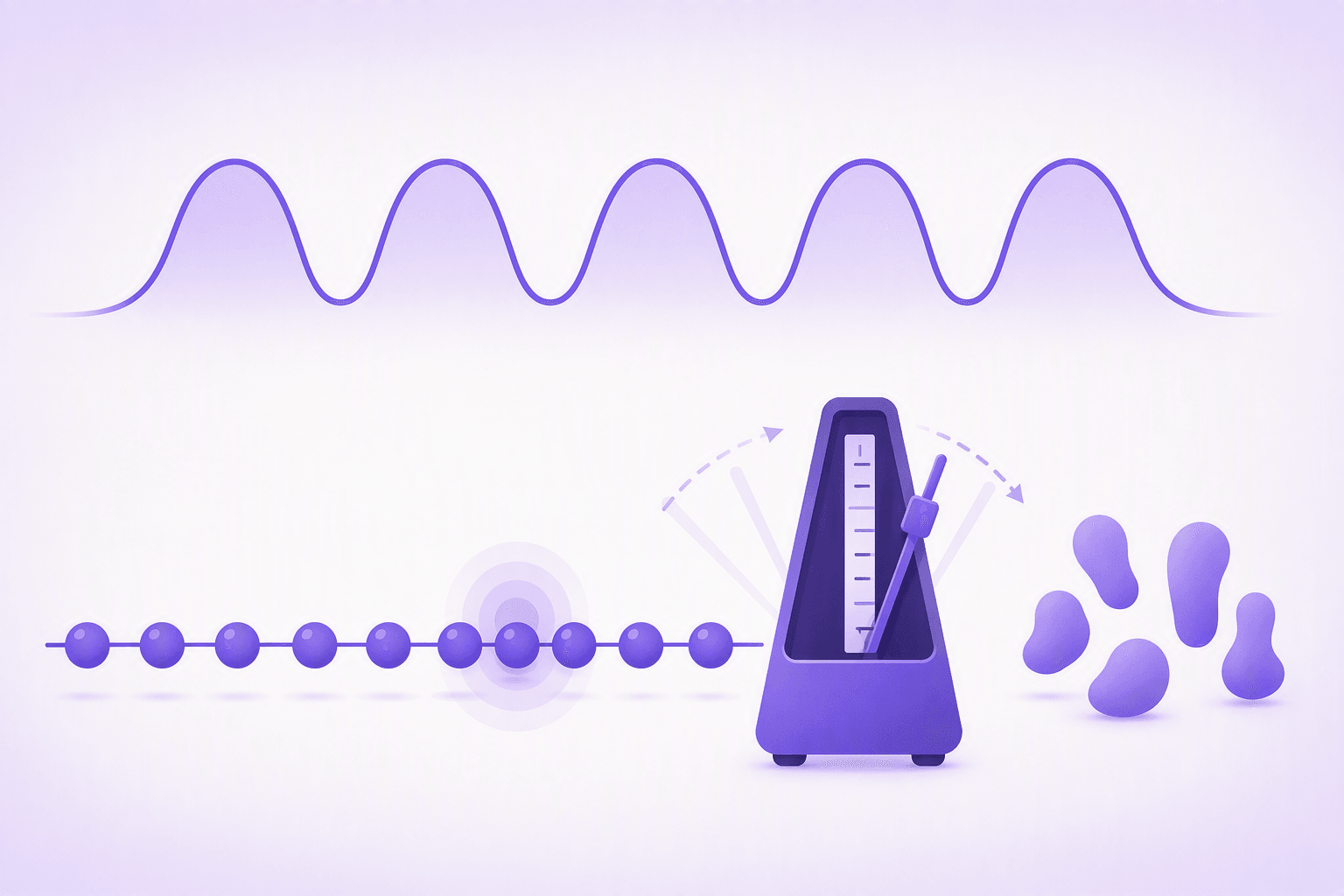
Spanish is often described as more syllable-timed than English. In practice, this means Spanish keeps a steadier beat, while English stretches stressed syllables and compresses unstressed ones.
David Eddington, in his work on Spanish phonology and variation, emphasizes that learners need to internalize patterns, not just individual sounds. Rhythm is a pattern.
A fast native sentence still has clear vowel targets and a steady pulse. That is why Spanish can sound "machine-gun fast" to beginners.
3) Stress placement and sentence melody
Spanish word stress is predictable more often than English, and accent marks tell you when stress breaks the default rules. If you miss stress, you can sound foreign even with perfect consonants.
Examples:
- "hablo" is AH-bloh
- "habló" is ah-BLOH
- "háblo" is AH-bloh (rare, but the accent mark would force it)
Spanish intonation also differs by region. Some Caribbean varieties have a different melodic contour than central Mexico, and Rioplatense Spanish often has a distinctive rising pattern in statements.
4) Chunks, not single words
Native speech is built from chunks: "¿Qué tal?", "No pasa nada", "A ver", "O sea". If you speak in chunks, you sound fluent faster because your timing becomes native-like.
This aligns with what psycholinguists call formulaic language: frequent sequences stored and retrieved as units. Alison Wray's work on formulaic sequences is a useful frame here, because it explains why memorizing "whole lines" can outperform memorizing isolated vocabulary.
If you want high-frequency chunks for greetings, start with our guides to how to say hello in Spanish and how to say goodbye in Spanish, then practice them in real dialogue.
Accent features that matter most (and the ones that are overrated)
High impact: vowels, stress, linking
These are the "native feel" features. They affect every sentence you say.
If you only drill the rolled R, you might get one sound right while the rest of your speech still has English rhythm. Native listeners notice rhythm first.
Medium impact: R vs RR, D, and B/V softness
Spanish consonants often have softer versions between vowels. For example, the "d" in "cada" is often softer than an English D, closer to a gentle TH-like sound in some accents.
Also, Spanish "b" and "v" are not strongly distinguished in most dialects. They are often pronounced similarly, with a softer sound between vowels.
Lower impact: perfect trills and rare sounds
A perfect trill is nice, but many native speakers themselves have variation in how strong it is. Some speakers have a lighter trill, and in some regions it can sound different.
Aim for intelligibility and naturalness first. Research on intelligibility and comprehensibility by Derwing and Munro is helpful here: being easy to understand is not the same as sounding identical to a specific native speaker.
Linking and reduction: the "secret" of fast Spanish
Spanish does not reduce vowels like English, but it does link words tightly. This is why learners hear a blur.
Vowel-to-vowel linking
When one word ends in a vowel and the next starts with a vowel, Spanish often connects them smoothly.
Example:
- "de acuerdo" often feels like deh ah-KWEHR-doh, with the vowels flowing together.
Consonant-to-vowel linking
Spanish also likes open syllables, so consonants often attach to the next vowel.
Example:
- "los amigos" often feels like loh sah-MEE-gohs, not lohs ah-MEE-gohs.
Final s and other regional reductions
In parts of the Caribbean, coastal areas, and Andalusia, final s can be softened or dropped in casual speech. That is real, but it is also easy to overdo and sound like a parody.
Copy reductions only after you have a solid base accent, and only if your chosen model uses them.
🌍 Why copying slang too early backfires
Slang and strong informal speech can make you sound less native if your pronunciation is not stable yet, because slang is judged socially. If you want to understand stronger language without using it, our Spanish swear words guide focuses on meaning, severity, and context.
The "native Spanish" sound is different by region
Spanish is a global language. Instituto Cervantes reports Spanish is used across multiple continents, and Spanish-speaking communities exist far beyond the 20 official-country core.
That matters because "native-like" depends on your target community.

Spain: ceceo and the "distinción" model
In much of Spain, "c" before e/i and "z" are pronounced with a TH sound. That means "gracias" can sound like GRAH-thyahs in that model, while most of Latin America uses GRAH-syahs.
If you choose Spain as your model, commit to it consistently, including vocabulary and intonation.
Mexico and much of Latin America: seseo and clearer s
Most of Latin America uses seseo, meaning "c" before e/i and "z" sound like s. This is the most common model in Spanish learning materials.
Mexico City Spanish is often considered a clear reference accent for learners because it tends to keep consonants relatively audible compared to some coastal varieties.
Rioplatense (Argentina and Uruguay): "sh" sound and intonation
In Buenos Aires and nearby areas, "ll" and "y" can sound like SH or ZH, so "yo" can sound like zhoh or shoh depending on speaker and context.
If you love that accent, it is very learnable, but you need to copy it from real audio, not from spelling.
A practical pronunciation checklist (in priority order)
Step 1: lock in the five vowels
Practice with slow, clear repetition. Record yourself and compare.
- a = AH
- e = EH
- i = EE
- o = OH
- u = OO
Keep them stable in fast speech.
Step 2: master Spanish stress
Use accent marks as instructions, not decoration. If you are rusty on stress rules, pair this with a quick review of accent marks and syllables in your study routine.
A simple habit: when you learn a new word, learn it with its stress and an example phrase.
Step 3: get the tapped R before the trilled RR
Tapped R appears constantly. It is the sound in "pero" (PEH-roh). The trilled RR is in "perro" (PEH-rroh), and it is rarer.
A good drill is alternating:
- "pero, perro, pero, perro"
Keep it short and daily.
Step 4: smooth out your linking
Shadow short clips. Do not read slowly from a textbook and expect linking to appear.
Linking is a listening skill first, then a speaking skill.
How to train your ear and mouth with real dialogue (movie method)
If your input is too clean, your accent will stay too clean. Native speech includes overlap, interruptions, laughter, and emotion.
This is why learning with short, repeatable clips works. You can loop the same two seconds until your timing matches.
If you want a structured approach to using media, read how to learn a language with movies. It explains how to choose clips and avoid passive watching.
The 3-pass clip routine (10 minutes)
-
Pass 1: meaning only
Watch with subtitles, understand the scene. -
Pass 2: sound only
Listen again and focus on linking and stress. Ignore unknown words. -
Pass 3: shadowing
Repeat the line immediately after the actor. Copy timing first, then sounds.
Research frameworks like Flege's Speech Learning Model (SLM) help explain why this works: adults can form new sound categories, but they need repeated, meaningful exposure and feedback. Shadowing gives you both.
⚠️ Do not shadow with your 'reading voice'
If you read the subtitles and speak like you are reading a presentation, you will practice the wrong rhythm. Listen first, then imitate the audio, even if you miss a word.
Sounding native also means choosing native-like politeness
Accent is not only phonetics. It is also social choices: when you use "tú" vs "usted", how direct you are, and how you soften requests.
Brown and Levinson's work on politeness is useful here because it frames everyday speech as face-management. In Spanish, that often shows up in small softeners:
- "¿Me puedes...?" instead of direct commands
- "Por favor" used strategically, not on every sentence
- "Disculpa" and "Perdón" used differently by region
If you want to sound native, match your politeness to your target region and situation.
Common "non-native" tells (and the fix)
You speak too slowly, then too fast
Many learners alternate between careful slow speech and sudden speed bursts. Native speech is steady.
Fix: practice at one comfortable tempo, then increase by small steps. Use a metronome if needed.
You pronounce every letter
Spanish spelling is consistent, but real speech still links and simplifies. Over-articulation can sound stiff.
Fix: copy connected speech from audio, not from text.
You translate English structures
Even with perfect pronunciation, English-like phrasing sounds foreign.
Fix: memorize chunks and sentence frames. For affection phrases, see how to say I love you in Spanish and practice them in full sentences, not as isolated lines.
A realistic 14-day plan to sound more native
Days 1-3: vowels and stress
- 10 minutes: vowel drill with 20 common words
- 10 minutes: shadow 3 short lines, focus on stress only
Days 4-7: linking
- 15 minutes: shadow one scene repeatedly
- Record yourself once per day, compare to the original
Days 8-10: tapped R and soft consonants
- 5 minutes: tapped R drill
- 10 minutes: shadow lines with lots of r sounds
Days 11-14: chunks and delivery
- 15 minutes: memorize and perform a short dialogue
- Focus on emotion and timing, not perfect consonants
If you do this consistently, you will usually hear a difference in your own recordings within two weeks. Other people often notice it around week three or four, when your rhythm becomes automatic.
The fastest feedback loops (what to use and what to avoid)
Use: recordings and comparison
Your brain lies to you in real time. Recordings do not.
Make one "reference recording" per week: same text, same conditions. You will hear progress clearly.
Use: one feature at a time
Pick one feature per week:
- Week A: vowels
- Week B: stress
- Week C: linking
- Week D: intonation
This prevents the common problem of trying to fix 12 things at once and fixing none.
Avoid: accent stereotypes
Do not force regional features you do not fully control. It can sound like imitation rather than belonging.
Native-like speech is subtle.
Where Wordy fits (and how to use it without wasting time)
Apps are best when they give you repeatable, level-appropriate audio with tools to loop, slow down, and test recall. That is exactly what you need for accent work.
Wordy is useful here because short movie and TV clips make it easy to repeat the same line until your rhythm matches, and you can build a personal library of lines that fit your target accent.
If you want more Spanish basics to support your fluency, browse the Spanish learning page and the Wordy blog for topic-based guides you can turn into shadowing scripts.
Final rule: native-like is built from boring repetition
The most reliable path is not talent, it is repetition with feedback. Clean vowels, correct stress, smooth linking, and chunk-based speech will make you sound native-like faster than obsessing over one consonant.
Pick one accent model, copy real dialogue daily, and measure progress with recordings. Your Spanish will start to sound like it belongs.
Frequently Asked Questions
Can I sound native in Spanish if I started as an adult?
What is the single biggest mistake that makes Spanish sound non-native?
Do I need to roll my R to sound native?
Is Spain Spanish easier or harder to imitate than Latin American Spanish?
How much listening do I need to improve my Spanish accent?
Sources & References
- Instituto Cervantes, El español: una lengua viva (annual report series)
- Ethnologue, 27th edition, 2024
- Real Academia Española (RAE), Diccionario panhispánico de dudas, accessed 2026
- Flege, J.E., Speech Learning Model (SLM) publications
- Derwing, T.M. & Munro, M.J., research on intelligibility and comprehensibility
Start learning with Wordy
Watch real movie clips and build your vocabulary as you go. Free to download.


