At the Restaurant in Spanish: 35+ Phrases for Ordering, Paying, and Polite Talk
Quick Answer
To speak Spanish at a restaurant, you mainly need polite attention-getters (Perdón, Disculpe), ordering phrases (Quisiera..., Para mí...), and payment lines (La cuenta, por favor). This guide gives you 35+ real phrases with pronunciation plus cultural tips for Spain vs Latin America, including how to ask about ingredients, tipping, and reservations.
| English | Spanish | Pronunciation | Formality |
|---|---|---|---|
| A table for two, please. | Una mesa para dos, por favor. | OO-nah MEH-sah PAH-rah dohs, por fah-BOR | polite |
| Do you have a reservation? | ¿Tiene reserva? | TYEH-neh reh-SEHR-bah | polite |
| We have a reservation under (name). | Tengo una reserva a nombre de (nombre). | TEHN-goh OO-nah reh-SEHR-bah ah NOHM-breh deh (NOHM-breh) | polite |
| Excuse me. | Perdón. | pehr-DOHN | polite |
| Excuse me (formal). | Disculpe. | dees-KOOL-peh | formal |
| Could you bring us the menu? | ¿Nos trae el menú, por favor? | nohs TRAH-eh el meh-NOO, por fah-BOR | polite |
| What do you recommend? | ¿Qué me recomienda? | keh meh reh-koh-MYEHN-dah | polite |
| I'll have the (dish). | Para mí, (plato). | PAH-rah MEE, (PLAH-toh) | casual |
| I would like (dish). | Quisiera (plato). | kee-SYEH-rah (PLAH-toh) | polite |
| Without (ingredient), please. | Sin (ingrediente), por favor. | seen (een-greh-DYEHN-teh), por fah-BOR | polite |
| I'm allergic to (ingredient). | Soy alérgico/alérgica a (ingrediente). | soy ah-LEHR-hee-koh/ah-LEHR-hee-kah ah (een-greh-DYEHN-teh) | polite |
| Is it spicy? | ¿Pica? | PEE-kah | casual |
| The bill, please. | La cuenta, por favor. | lah KWEHN-tah, por fah-BOR | polite |
| Can I pay by card? | ¿Puedo pagar con tarjeta? | PWEH-doh pah-GAHR kohn tahr-HEH-tah | polite |
| Keep the change. | Quédese con el cambio. | KEH-deh-seh kohn el KAHM-byoh | polite |
To speak Spanish at a restaurant, focus on three things: getting attention politely (Perdón, Disculpe), ordering with a soft request (Quisiera, Para mí), and handling payment (La cuenta, por favor). With those patterns, you can eat comfortably in Spain or Latin America even if your vocabulary is small.
Spanish is spoken by hundreds of millions of people worldwide, and it is an official language in 20 countries, plus widely used in the United States. That means restaurant Spanish is very learnable, but it also varies in small, practical ways, from how you ask for the check to how direct you sound when ordering.
If you want a quick warm-up before you walk in, review how to say hello in Spanish and how to say goodbye in Spanish. Those two moments, greeting and leaving, carry a lot of the politeness load.
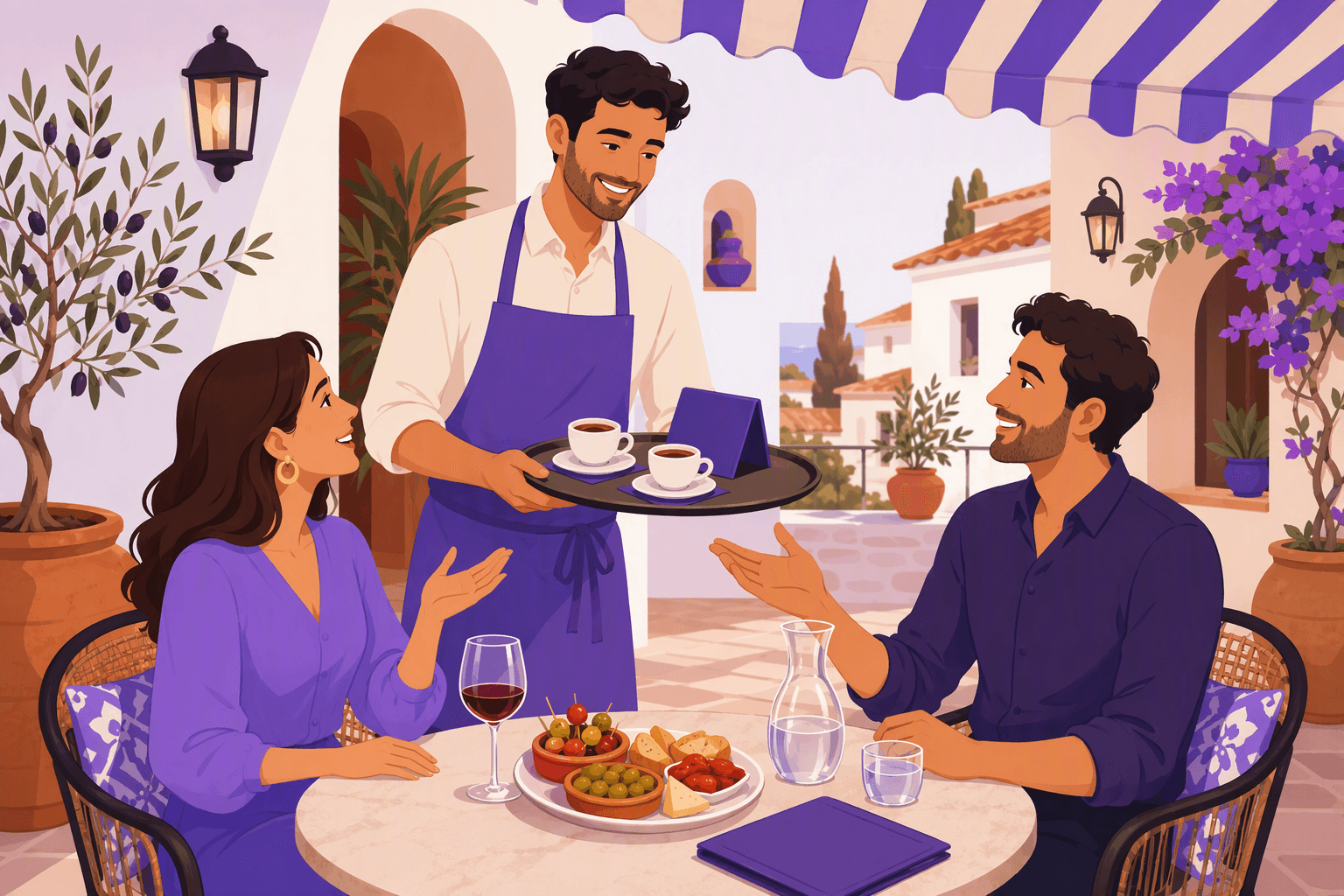
How restaurant Spanish actually works (so you sound natural)
Restaurant Spanish is less about fancy food words and more about social tone. A short, clear sentence with a polite marker is usually better than a long sentence with grammar mistakes.
Linguist Penelope Brown and Stephen Levinson’s work Politeness: Some Universals in Language Usage is useful here: in service encounters, speakers often protect the other person’s “face” by phrasing requests indirectly. In Spanish, that shows up in conditional-style politeness like Quisiera and Me gustaría, and in softeners like por favor.
Reference grammars such as Butt and Benjamin’s A New Reference Grammar of Modern Spanish also highlight how Spanish uses mood and tense choices to signal stance. In restaurants, you feel this in the difference between Dame agua (too direct in many contexts) vs ¿Me trae agua, por favor? (service-friendly).
💡 The easiest politeness upgrade
If you only remember one trick, add "por favor" (por fah-BOR) and use a question form: "¿Nos trae...?" or "¿Me puede traer...?" It instantly sounds more like real restaurant Spanish.
Getting seated: reservations, tables, and timing
Una mesa
Una mesa para dos, por favor (OO-nah MEH-sah PAH-rah dohs, por fah-BOR) is the default line for “a table for two.” Swap the number and you are done.
In Spain, you may also hear ¿Para cuántos? (PAH-rah KWAHN-tohs), meaning “for how many?” In many Latin American cities, staff might ask ¿Cuántas personas? (KWAHN-tahs pehr-SOH-nahs).
/OO-nah MEH-sah PAH-rah dohs, por fah-BOR/
Literal meaning: A table for two, please.
“Hola, una mesa para dos, por favor.”
Hi, a table for two, please.
Works everywhere. In Spain, adding a greeting first is common. In busy places, you might be asked if you have a reservation.
Reserva
Reservations are straightforward: Tengo una reserva a nombre de... (TEHN-goh OO-nah reh-SEHR-bah ah NOHM-breh deh). If they ask you, ¿Tiene reserva? (TYEH-neh reh-SEHR-bah) is the common question.
In Spain, meal timing can surprise visitors. Lunch can be later, and dinner often starts later than in the US or Northern Europe. If you show up early, you may hear La cocina abre a las... (lah koh-SEE-nah AH-breh ah lahs), meaning the kitchen opens at a certain time.
Terraza
If you want to sit outside, ask: ¿Tiene mesa en la terraza? (TYEH-neh MEH-sah en lah teh-RAH-sah). In Spain, terraza is a high-frequency word in everyday dining.
Getting the server’s attention politely
Perdón
Perdón (pehr-DOHN) is the most useful, low-effort attention-getter. It is short, friendly, and works in casual and mid-range restaurants.
Disculpe
Disculpe (dees-KOOL-peh) is more formal and careful. Use it when you are interrupting, when the restaurant is upscale, or when you need to correct something.
Oiga
Oiga (OY-gah) exists, but it can sound sharp depending on tone and region. If you are unsure, stick to Perdón or Disculpe.
⚠️ Avoid snapping or shouting
In Spanish-speaking cultures, it is usually better to make eye contact and say "Perdón" than to call loudly. A raised hand can be fine, but keep it subtle.
Menus and recommendations: what to ask
El menú
In much of Latin America, el menú (meh-NOO) is the menu. In Spain, you will also see la carta (lah KAHR-tah), especially for the full menu, and el menú del día (meh-NOO del DEE-ah) for a set lunch menu.
Ask for it with: ¿Nos trae el menú, por favor? (nohs TRAH-eh el meh-NOO, por fah-BOR). If you are alone: ¿Me trae...? (meh TRAH-eh).
¿Qué me recomienda?
¿Qué me recomienda? (keh meh reh-koh-MYEHN-dah) is the cleanest way to ask “What do you recommend?” It is polite and puts the choice on the staff, which is often welcomed.
If you want a local specialty: ¿Qué es típico de aquí? (keh es TEE-pee-koh deh ah-KEE).
🌍 Spain: 'menú del día' is a real strategy
In Spain, the "menú del día" is often the best value and the most predictable experience for learners: fewer choices, clear structure (starter, main, dessert or coffee), and staff who are used to explaining it quickly.
Ordering: the three safest patterns
Para mí
Para mí, ... (PAH-rah MEE) is natural and simple. It is common in group ordering because it clearly marks whose dish it is.
Example: Para mí, la paella (PAH-rah MEE, lah pah-EH-yah).
Quisiera
Quisiera... (kee-SYEH-rah) is a classic polite request. It is especially useful if you want to sound respectful without overthinking grammar.
Me gustaría
Me gustaría... (meh goos-tah-REE-ah) is another polite option. It can feel slightly more “considerate” than a direct present tense.
/kee-SYEH-rah (PLAH-toh)/
Literal meaning: I would want (dish).
“Quisiera el pollo asado, por favor.”
I'd like the roast chicken, please.
A safe, polite ordering verb across regions. It avoids sounding like a command, especially helpful in Spain where direct imperatives can feel abrupt in service contexts.
Customizing your order: without, with, and substitutions
Sin
Sin (seen) means “without.” It is the fastest way to customize: Sin cebolla, por favor (seen seh-BOH-yah, por fah-BOR).
Con
Con (kohn) means “with.” Example: Con arroz (kohn ah-ROHS).
¿Puede ser...?
If you want a substitution, use: ¿Puede ser con... ? (PWEH-deh sehr kohn). It is softer than telling them what to do.
Example: ¿Puede ser con ensalada? (PWEH-deh sehr kohn en-sah-LAH-dah).
💡 A tiny word that saves you
Use "para" (PAH-rah) to indicate purpose: "¿Tiene algo para vegetarianos?" (TYEH-neh AHL-goh PAH-rah beh-heh-tah-RYAH-nohs). It sounds more natural than translating word-for-word from English.
Allergies and dietary needs (say this clearly)
Food safety language should be direct. Politeness matters, but clarity matters more.
Alérgico / alérgica
Use Soy alérgico (soy ah-LEHR-hee-koh) if you identify as male, Soy alérgica (soy ah-LEHR-hee-kah) if you identify as female. If you want to avoid gendered adjectives, Tengo alergia a... (TEHN-goh ah-LEHR-hyah ah) works for everyone.
¿Esto tiene...?
¿Esto tiene... ? (EHS-toh TYEH-neh) means “Does this have…?” It is the best follow-up question.
Example: ¿Esto tiene nueces? (EHS-toh TYEH-neh NWAY-sehs).
/soy ah-LEHR-hee-koh/ah-LEHR-hee-kah ah (een-greh-DYEHN-teh)/
Literal meaning: I am allergic to (ingredient).
“Soy alérgica a los mariscos. ¿Esto tiene mariscos?”
I'm allergic to shellfish. Does this have shellfish?
Say this early, before ordering. In busy restaurants, repeating the key ingredient once is normal. If it's severe, add 'Es grave' to signal seriousness.
Drinks: water, coffee, and common misunderstandings
Agua
Ask: ¿Me trae agua, por favor? (meh TRAH-eh AH-gwah, por fah-BOR). If you want sparkling, say con gas (kohn gahs). Still water is sin gas (seen gahs).
In Spain, you might be asked if you want bottled water: ¿Agua del grifo o botella? (AH-gwah del GREE-foh oh boh-TEH-yah). Grifo means tap.
Café
Coffee culture varies, but the vocabulary is stable. In Spain, café con leche (kah-FEH kohn LEH-cheh) is common, and cortado (kor-TAH-doh) is espresso “cut” with a little milk.
If you want the check after coffee, you can combine: Un café y la cuenta, por favor (oon kah-FEH ee lah KWEHN-tah, por fah-BOR).
For more food vocabulary beyond restaurant lines, pair this with Spanish food vocabulary.
During the meal: checking in, compliments, and fixing problems
Está buenísimo / buenísima
If something is delicious, Está buenísimo (es-TAH bweh-NEE-see-moh) is very natural. Use buenísima (bweh-NEE-see-mah) if you are describing a feminine noun like la sopa.
La verdad...
If you need to complain, Spanish often uses softening openers. La verdad... (lah sehr-DAHD) is a common “to be honest…” lead-in that reduces bluntness.
Disculpe, hay un problema
A neutral fix-it line: Disculpe, hay un problema (dees-KOOL-peh, eye oon proh-BLEH-mah). Then state the issue simply.
Examples:
- Está frío (es-TAH FREE-oh), it’s cold.
- Esto no es lo que pedí (EHS-toh noh es loh keh peh-DEE), this isn’t what I ordered.
Paying: check, splitting, and card vs cash
La cuenta
La cuenta, por favor (lah KWEHN-tah, por fah-BOR) is the phrase you will use most. In Spain, you can also say ¿Me trae la cuenta? to sound a bit more conversational.
¿Podemos pagar por separado?
Splitting the bill: ¿Podemos pagar por separado? (poh-DEH-mohs pah-GAHR por seh-pah-RAH-doh). In some places it is easy, in others it is inconvenient, especially with large groups.
¿Puedo pagar con tarjeta?
Card payment: ¿Puedo pagar con tarjeta? (PWEH-doh pah-GAHR kohn tahr-HEH-tah). If you want contactless: ¿Con tarjeta sin contacto? (kohn tahr-HEH-tah seen kohn-TAHK-toh).
/lah KWEHN-tah, por fah-BOR/
Literal meaning: The account/bill, please.
“Perdón, la cuenta, por favor.”
Excuse me, the bill, please.
Works across regions. In Spain, the check often arrives only when you ask. In many Latin American restaurants, staff may bring it sooner, but asking is always normal.
Spain vs Latin America: small differences that matter
The core phrases in this guide work everywhere, but a few patterns change.
Carta vs menú
Spain uses carta a lot for the menu, while menú is universal but can also mean a set menu. In Latin America, menú is the most common everyday word.
Tipping language
Because tipping expectations vary, the most practical question is: ¿Está incluido el servicio? (es-TAH een-kloo-EE-doh el sehr-BEE-syoh). If service is included, you can still leave a small extra amount if you want, but you are no longer guessing.
Directness and tone
In Spain, you may hear very direct-sounding service talk that is not rude, it is efficient. In some Latin American contexts, you may hear more overt politeness markers. Either way, using por favor and question forms keeps you safe.
If you want a broader view of regional differences, read Latin American vs Spain Spanish.
A realistic practice routine with movie and TV clips
Restaurant scenes repeat the same language patterns: greeting, seating, ordering, clarifying, paying. That repetition is ideal for learning because you can predict the next line and focus on pronunciation.
A good method is to pick one scene and extract five lines you will actually say. Then practice them until you can say them at normal speed without translating in your head.
For a bigger plan, see how to learn a language with movies. For core high-frequency words that fill in the gaps, combine this with 100 most common Spanish words.
🌍 A quick note on 'strong language' in restaurants
If you are frustrated, avoid copying insults you hear in movies. Swearing has different weight across countries and can escalate fast in service settings. If you are curious for recognition only, use our Spanish swear words guide as a decoding tool, not a script.
The essential phrases, grouped by moment (so you can memorize fast)
Llegar
- Hola, una mesa para dos, por favor. (OO-nah MEH-sah PAH-rah dohs, por fah-BOR)
- Tengo una reserva a nombre de... (TEHN-goh OO-nah reh-SEHR-bah ah NOHM-breh deh)
Pedir
- ¿Nos trae el menú, por favor? (nohs TRAH-eh el meh-NOO, por fah-BOR)
- ¿Qué me recomienda? (keh meh reh-koh-MYEHN-dah)
- Quisiera... (kee-SYEH-rah)
- Para mí... (PAH-rah MEE)
Aclarar
- Sin..., por favor. (seen, por fah-BOR)
- ¿Esto tiene... ? (EHS-toh TYEH-neh)
- Soy alérgico/alérgica a... (soy ah-LEHR-hee-koh/ah-LEHR-hee-kah ah)
Pagar
- La cuenta, por favor. (lah KWEHN-tah, por fah-BOR)
- ¿Puedo pagar con tarjeta? (PWEH-doh pah-GAHR kohn tahr-HEH-tah)
- Quédese con el cambio. (KEH-deh-seh kohn el KAHM-byoh)
Closing: what to learn next
If you can say Perdón, Quisiera..., and La cuenta, por favor, you can handle most restaurant situations in Spanish. Add one allergy sentence and one substitution question, and you are ready for real travel.
Next, build your “social glue” phrases so you sound friendly even when your grammar is simple. Start with how to say hello in Spanish, then add how to say goodbye in Spanish. If you want a fun, high-context set of lines for dates and compliments, how to say I love you in Spanish gives you useful tone control.
Frequently Asked Questions
What is the most polite way to order food in Spanish?
How do you ask for the check in Spanish?
How do you say 'I am allergic to' in Spanish at a restaurant?
Is 'Disculpe' or 'Perdón' better for getting a server's attention?
Do you need to tip in Spanish-speaking countries?
Sources & References
- Real Academia Española (RAE), Diccionario de la lengua española, 23rd edition
- FundéuRAE, recommendations on courtesy formulas and everyday usage (accessed 2026)
- Instituto Cervantes, El español en el mundo, 2024 annual report
- Ethnologue: Languages of the World, Spanish language entry (2024)
- Butt, J. & Benjamin, C., A New Reference Grammar of Modern Spanish, Routledge
Start learning with Wordy
Watch real movie clips and build your vocabulary as you go. Free to download.


