Quick Answer
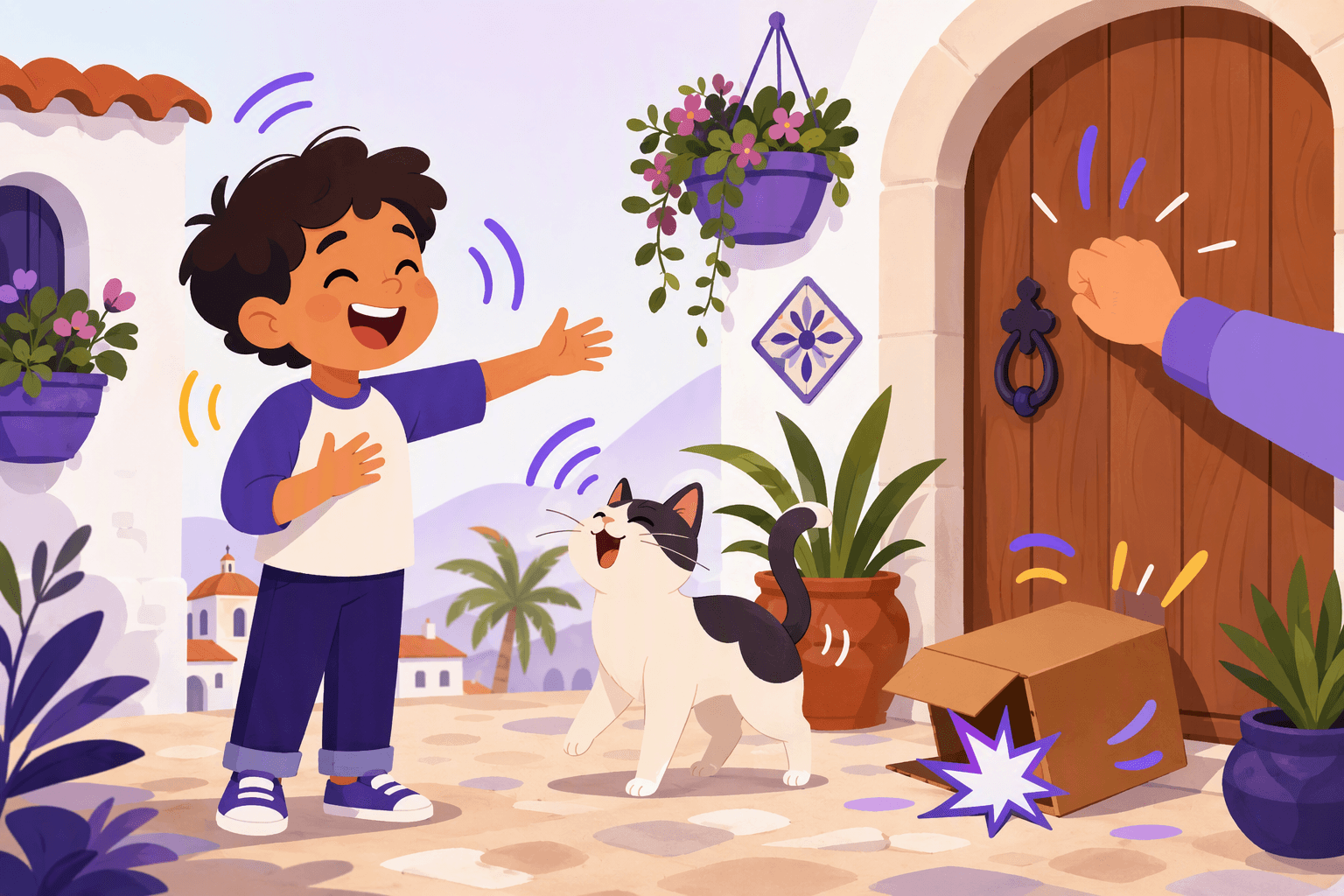
Spanish onomatopoeia includes sound words such as ¡pum!, miau, toc toc, and jajaja. These words imitate noises, reactions, and actions, but many differ from English because each language interprets the same sound through its own spelling and rhythm.
Spanish onomatopoeia is the set of sound-imitating words Spanish speakers use for bangs, animal noises, laughter, knocks, reactions, and motion. Learn forms such as ¡pum! /pum/, toc toc /tok tok/, guau /ɡwau/, and jajaja /xaˈxaxa/ and you will understand Spanish comics, captions, messages, and dramatic dialogue much more naturally.
Spanish has more than 500 million native speakers and is an official language in 20 sovereign countries, so sound words vary by region. Still, the core forms below are broadly recognizable from Mexico to Spain, Argentina, Colombia, and beyond. They are a fun complement to practical basics such as Spanish greetings, because they show how Spanish looks and feels when people react spontaneously.
| English | Spanish | Pronunciation | Note |
|---|---|---|---|
| Bang / thud | ¡Pum! | /pum/ | A heavy impact, explosion, or sudden drop. |
| Knock knock | Toc toc | /tok tok/ | Used at a door, like English knock knock. |
| Buzz | Bzzzz | /bsss/ | A bee, phone vibration, or electrical buzzing. |
| Meow | Miau | /ˈmjaw/ | The standard sound of a cat. |
| Woof | Guau | /ɡwau/ | The standard sound of a dog. |
| Cock-a-doodle-doo | Quiquiriquí | /kikiɾiˈki/ | The sound of a rooster. |
| Ribbit | Croac | /kɾoˈak/ | A frog's croak. |
| Ha ha ha | Jajaja | /xaˈxaxa/ | The usual written Spanish laughter. |
| Ouch | ¡Ay! | /aj/ | Pain, surprise, worry, or sympathy. |
| Yuck | ¡Puaj! | /pwaχ/ | Disgust, often at food or a bad smell. |
| Shh | ¡Chist! | /tʃist/ | A request for quiet. |
| Pow / smack | ¡Zas! | /sas/ | A sharp hit or sudden action in comics. |
Why Spanish Sound Words Do Not Match English
Onomatopoeia may seem universal because it imitates real sounds. Yet it is never a perfect recording. A rooster, a dog, and a door make noises, but speakers select the parts that fit the sound system and spelling habits of their language.
The Spanish linguist and educator often treats these words as imitaciones fónicas /imitasjoˈnes ˈfonikas/, sound-based imitations rather than exact copies of reality. The Real Academia Española classifies many of them as interjections, a category built for immediate reactions and expressive sounds.
In Sound Symbolism, Leanne Hinton, Johanna Nichols, and John J. Ohala examine how sound and meaning can be connected without being identical across languages. That explains why English speakers hear a dog as woof, while Spanish speakers conventionally write guau /ɡwau/.
Spanish spelling also shapes the result. English uses shh, but Spanish uses chist /tʃist/ or chsss /tʃsss/. English speakers write haha, while Spanish writers usually choose jajaja /xaˈxaxa/ because the Spanish letter j corresponds to the sound they hear in laughter.
The Sounds You Hear in Everyday Spanish
¡Pum!
¡Pum! /pum/ marks a loud, low impact: a box falling, a door slamming, an explosion, or a dramatic comic-book hit. It is one of the most flexible Spanish sound effects.
A speaker might say: Se cayó el libro y hizo ¡pum! /se kaˈʝo el ˈliβɾo i ˈiso pum/. That means the book fell and went thud.
You will also see pum pum /pum pum/ for repeated impacts or a pounding heartbeat. In storytelling, repetition makes a scene feel immediate.
Toc toc
Toc toc /tok tok/ is the sound of someone knocking on a door. It appears in children’s jokes, messages, and casual speech.
For example: Toc toc, ¿se puede? /tok tok se ˈpweðe/ means knock knock, may I come in? The phrase ¿se puede? is a polite way to ask permission before entering a room or home.
Unlike an English knock-knock joke, toc toc does not automatically signal a joke in Spanish. It can simply represent an actual knock.
¡Zas!
¡Zas! /sas/ signals a quick, sharp impact or sudden action. It is especially common in comics, cartoons, humorous narration, and animated conversation.
You may read: Le dio un empujón y, ¡zas!, cayó al agua. /le ðjo un empaˈxon i sas kaˈjo al ˈaɣwa/. The effect is similar to saying and bam, he fell into the water.
Spanish comic art has long used compact effects such as zas /sas/, plaf /plaf/, crac /kɾak/, and paf /paf/. Translation traditions matter here: imported superhero comics may preserve English-style bang or boom, while Spanish-created comics often favor local conventions.
¡Plaf!
¡Plaf! /plaf/ is a flat, soft, or slightly comic impact. Picture a pie hitting someone’s face, a wet towel landing on the floor, or a character falling awkwardly.
The distinction between pum /pum/ and plaf /plaf/ is about texture. Pum sounds heavy and round, while plaf suggests a flatter, more spread-out impact.
This kind of sound symbolism is not a strict grammar rule. It is a shared creative instinct, which is why writers can invent a variation and readers still understand it from context.
¡Crac!
¡Crac! /kɾak/ represents something snapping, cracking, or breaking. A branch, bone, wooden chair, ice cube, or brittle cookie can make crac /kɾak/.
For example: Pisó una rama, crac, y todos se dieron la vuelta. /piˈso una ˈrama kɾak i ˈtoðos se ˈdjeɾon la ˈβwelta/. He stepped on a branch, crack, and everyone turned around.
Spanish also uses crujir /kɾuˈxiɾ/, meaning to creak or crunch, as a regular verb. Sound words often coexist with ordinary vocabulary rather than replacing it.
Bzzzz
Bzzzz /bsss/ is the visual sound of a bee, mosquito, vibrating phone, or small electrical device. The exact number of letters is flexible, and extra z characters make the sound seem longer.
A message might say: El móvil hizo bzzzz toda la noche. /el মোˈβil ˈiso bsss ˈtoða la ˈnotʃe/. The phone buzzed all night.
In ordinary speech, people are more likely to use the verb vibrar /biˈbɾaɾ/ for a phone. The written bzzzz /bsss/ is expressive, visual, and common in captions or informal writing.
💡 Read the scene, not just the spelling
Spanish sound effects are deliberately elastic. A writer can stretch a vowel or consonant, as in ¡nooo!, bueeeno, or bzzzzzz, to show duration, emotion, or volume. The extra letters are not a spelling mistake when they serve an expressive purpose in informal dialogue.
Spanish Animal Sounds
Animal sounds are among the first onomatopoeia learners notice, and they are excellent evidence that sound words are cultural conventions. A Spanish-speaking child learns miau /ˈmjaw/ and guau /ɡwau/ just as an English-speaking child learns meow and woof.
Miau
A cat says miau /ˈmjaw/ in Spanish. The word is also used as a noun, as in el miau del gato /el ˈmjaw del ˈɡato/, the cat’s meow.
In playful speech, hacer miau /aˈseɾ ˈmjaw/ means to make a meowing sound. It is common in songs, books, and conversations with children.
Guau
A dog says guau /ɡwau/. Do not confuse it with guau /ɡwau/ used as an expression of amazement, similar to wow.
Context makes the meaning clear. El perro hace guau guau /el ˈpero ˈase ɡwau ɡwau/ describes a barking dog, while ¡Guau, qué bonito! /ɡwau ke βoˈnito/ means wow, how beautiful.
Quiquiriquí
A rooster says quiquiriquí /kikiɾiˈki/. The final stressed í matters: it gives the word its rising, crow-like rhythm.
Spanish speakers may also use cantar /kanˈtaɾ/, literally to sing, for a rooster’s crowing. El gallo canta al amanecer /el ˈɡaʝo ˈkanta al amaneˈseɾ/ is more natural in a neutral description than spelling out the sound.
Croac
A frog says croac /kɾoˈak/. This sound is often repeated as croac croac /kɾoˈak kɾoˈak/ in children’s books and cartoons.
Other familiar Spanish animal sounds include pio pio /ˈpjo ˈpjo/ for a chick, muu /mu/ for a cow, oinc /oink/ for a pig, and bee /be/ for a sheep. Regional choices exist, particularly in children’s media.
🌍 Animal sounds reveal spelling habits
Spanish animal sounds frequently use vowel sequences that fit Spanish phonology, such as /ɡwau/ in guau and /mjaw/ in miau. They are not translations of English sounds. They are established Spanish representations that native speakers learn as part of early literacy and play.
Reactions, Emotion, and Digital Spanish
Onomatopoeia does more than describe objects. It gives text a voice. In chats, subtitles, memes, and social media, Spanish sound words carry facial expression, timing, and attitude.
Jajaja
Jajaja /xaˈxaxa/ is the standard written laughter in Spanish. The first thing English speakers need to remember is that Spanish j does not sound like English j.
A short ja /xa/ can be dry or sarcastic. Jajaja /xaˈxaxa/ is ordinary laughter, and jajajajaja /xaxaxaxaxa/ is stronger laughter. The exact length communicates intensity.
Jejeje /xeˈxeˈxe/ often suggests a sly, embarrassed, or teasing laugh. Jijiji /xiˈxiˈxi/ can feel cute, shy, or playful, though tone depends heavily on the relationship and context.
Spanish texting also uses jaja /ˈxaxa/ as a softener. Compare No puedo hoy /no ˈpweðo oj/, I cannot today, with No puedo hoy jaja /no ˈpweðo oj ˈxaxa/. The second can sound friendlier, but it should not be added automatically in formal communication.
¡Ay!
¡Ay! /aj/ expresses pain, alarm, sympathy, longing, or frustration. It is one of Spanish’s most versatile interjections.
¡Ay, me duele! /aj me ˈðwele/ means ow, it hurts. Ay, qué pena /aj ke ˈpena/ can mean oh, what a shame, while Ay, Dios mío /aj ðjos ˈmi.o/ expresses strong surprise or worry.
The punctuation matters in standard Spanish writing. Interjections are normally enclosed in opening and closing exclamation marks: ¡Ay! /aj/.
¡Puaj!
¡Puaj! /pwaχ/ expresses disgust, often toward a bad smell, unpleasant food, or something revolting. English equivalents include yuck, ew, or bleh.
For example: ¡Puaj! Esto sabe raro. /pwaχ ˈesto ˈsaβe ˈraro/ means yuck, this tastes strange. It is informal and expressive, so avoid it when you need to sound tactful.
¡Chist!
¡Chist! /tʃist/ asks someone to be quiet. It is close to English shh, though its sound and spelling are distinct.
Use it carefully. Saying ¡Chist! /tʃist/ to an adult you do not know can sound abrupt. In a classroom, theater, or conversation among friends, it is far more normal.
For polite Spanish, context-sensitive language matters as much as vocabulary. Compare the direct energy of chist /tʃist/ with the courteous formulas in how to say goodbye in Spanish or affectionate wording in how to say I love you in Spanish.
Onomatopoeia in Comics, Film, and Conversation
Spanish comics use onomatopoeia as visual choreography. A single ¡zas! /sas/ can make a punch sudden, while tic tac /tik tak/ creates suspense before a clock strikes. In subtitles, captions, and scripts, these words help viewers interpret sounds that may be partially masked by music or rapid dialogue.
The Real Academia Española’s Nueva gramática de la lengua española treats interjections as a meaningful part of grammar, not disposable noise. They can stand alone, combine with punctuation, and convey a complete reaction without a verb.
Film and television are especially useful for learning this timing. Watch a short scene once with subtitles, then again while listening for small sounds: a sigh, a laugh, a knock, an interruption. This active method works well alongside Spanish listening practice because it connects spelling, sound, gesture, and emotion.
🌍 Do not overuse comic-book effects
Native speakers understand sound words, but everyday adult conversation does not sound like a comic strip. Use them when telling a vivid story, joking, texting friends, reacting naturally, or quoting a sound. In professional writing, replace them with precise verbs such as golpear, crujir, vibrar, ladrar, or suspirar.
How to Learn Spanish Sound Words Naturally
Start with high-frequency forms you can recognize immediately: jajaja /xaˈxaxa/, ¡ay! /aj/, guau /ɡwau/, miau /ˈmjaw/, toc toc /tok tok/, and ¡pum! /pum/. These appear in messages, children’s content, comics, and everyday storytelling.
Next, connect each sound to a real scene instead of memorizing a translation list. Picture a dropped phone for ¡pum! /pum/, a visitor at the door for toc toc /tok tok/, and an awkward joke for jajaja /xaˈxaxa/.
Finally, notice the difference between a sound effect and a regular verb. You may read crac /kɾak/ in a comic, but say La rama se rompió /la ˈrama se romˈpjo/ in a straightforward report. Learning both gives you expressive Spanish without sounding forced.
Spanish onomatopoeia is small vocabulary with a large payoff. Once you recognize these sound words, Spanish dialogue becomes more vivid, jokes make more sense, and written reactions feel less mysterious. For more lively informal language, see our guide to Spanish swear words, with clear notes on tone and when restraint is the better choice.
Frequently Asked Questions
What is onomatopoeia in Spanish?
Why do Spanish animal sounds differ from English animal sounds?
How do Spanish speakers write laughter in texts?
Is jajaja pronounced like English 'jajaja'?
Are Spanish comic book sound effects the same in every country?
Sources & References
- Real Academia Española and Asociación de Academias de la Lengua Española, Diccionario de la lengua española, accessed 2026
- Real Academia Española and Asociación de Academias de la Lengua Española, Nueva gramática de la lengua española
- Instituto Cervantes, El español: una lengua viva, accessed 2026
- Leanne Hinton, Johanna Nichols, and John J. Ohala, Sound Symbolism, Cambridge University Press
- FundéuRAE, recommendations on Spanish writing and punctuation, accessed 2026
Start learning with Wordy
Watch real movie clips and build your vocabulary as you go. Free to download.


