9 Best Lingopie Alternatives in 2026 (Movie & TV Apps Compared)
Quick Answer
Lingopie does one thing well, streaming full TV episodes with click-to-translate subtitles, but it has real gaps for beginners, Asian language learners, and anyone who wants a free tier. The 9 best Lingopie alternatives in 2026 either improve on the video-method (with shorter, curated clips), broaden language coverage, or offer a different angle on the same comprehensible-input idea. This list ranks them honestly by what they actually do well, with prices and clear verdicts on who each one suits.
The best Lingopie alternative in 2026 is Wordy, because it uses the same authentic video method but with curated 30 to 90 second movie and TV clips instead of full episodes, supports more than 20 languages including strong Asian language coverage, and offers a free tier where Lingopie is paid only. FluentU, Migaku, and the free Chrome extension Language Reactor round out the top tier depending on your budget, your target language, and how technical you want your setup to be.
Lingopie has built a real audience around one idea: learn a language by watching the kind of TV you would watch anyway. That idea is grounded in decades of second-language acquisition research, including Stephen Krashen's input hypothesis, which argues that we acquire languages by understanding messages we receive, not by drilling rules (Krashen, 1985). The question is not whether the method works. The question is whether Lingopie is the best implementation of it for you.
If you want a broader overview before deciding, our best language learning apps guide covers the full market, including app-first competitors like Duolingo and Babbel that take a very different approach. Reviews of the two biggest beginner apps are also useful context, see our Duolingo review and Babbel review.
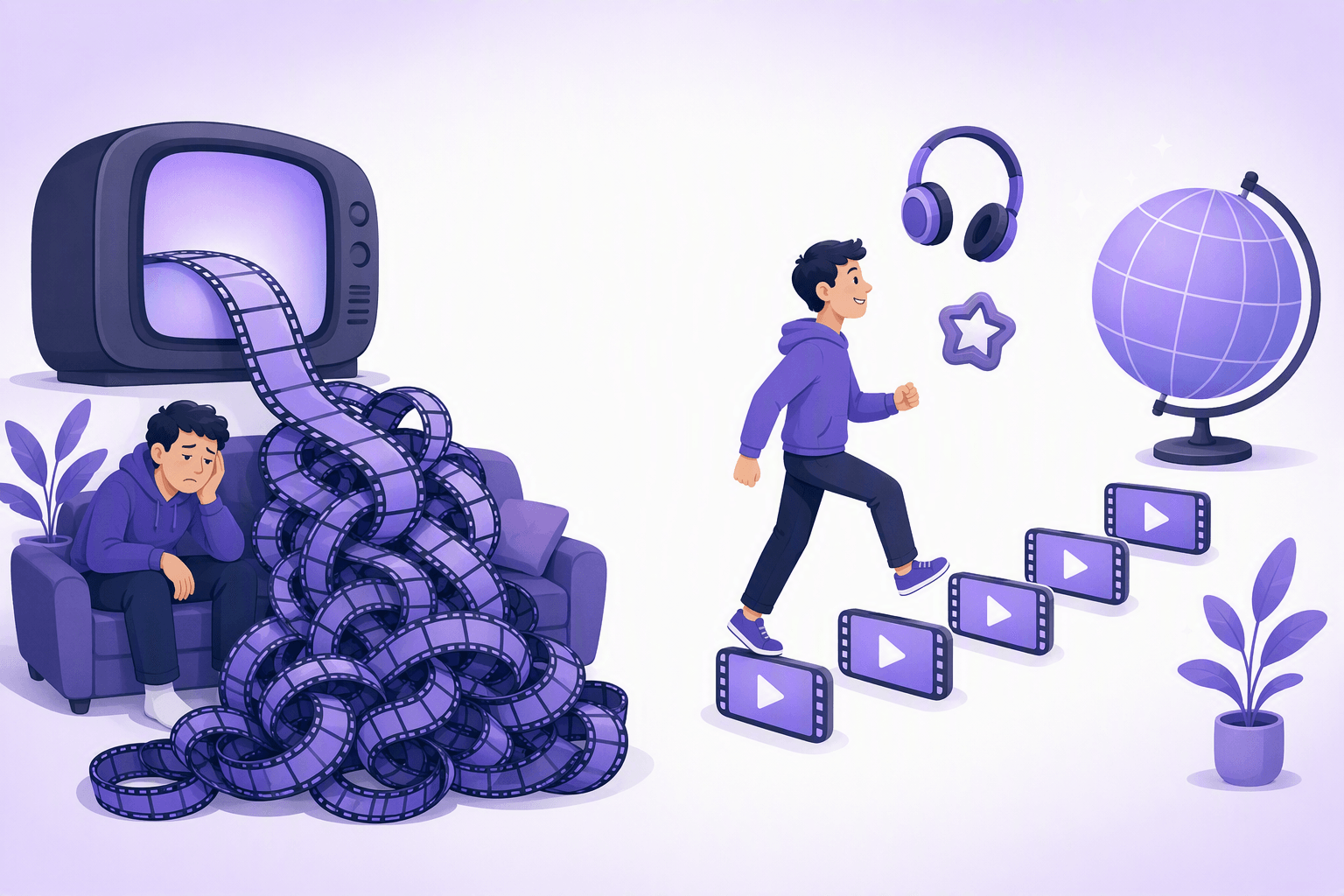
Why Look for a Lingopie Alternative?
Lingopie is well-built and does a specific thing well. But there are honest reasons to look elsewhere.
Beginners often struggle with full episodes
Lingopie's content is full TV episodes, typically 20 to 45 minutes, with native speakers talking at native speed. That is wonderful immersion if you can roughly follow the story. If you are A1 or A2, a 30 minute episode without scaffolding can be exhausting. Krashen's framework calls useful input "i+1," language just slightly above your level. Full native episodes are often "i+4" for beginners.
Asian languages are thin
Lingopie's strongest catalogs are Spanish, French, Italian, German, and Portuguese. Japanese, Korean, and Chinese exist on the platform but with fewer shows. For context: English has roughly 1.5 billion total speakers, Spanish around 500 million, Japanese around 125 million, and Korean around 80 million (Ethnologue, 27th edition, 2024). Asian languages serve large communities, and a content library should reflect that.
Price, platform, and no free tier
Lingopie is subscription-only with a trial but no permanent free tier, which is a friction point if you are not sure the method clicks for you. It is also great on smart TVs but weaker if you want a browser extension or a mobile-first app for commute-sized sessions. These gaps do not make Lingopie bad. They just mean the right alternative depends on which gap you care about.
How We Ranked These Alternatives
The ranking weights four factors: method match (how close is it to Lingopie's authentic-video approach), language coverage (how many languages, and how deep is each library outside the Romance set), accessibility (free tier, mobile, browser, and TV support), and beginner friendliness (can a true beginner start on day one without a complicated setup).
We did not rank apps higher just because they are popular. We ranked them on how well they solve the specific problem Lingopie is solving, and how well they cover Lingopie's blind spots.

9 Best Lingopie Alternatives in 2026
1. Wordy: Best overall and the most direct Lingopie alternative
Wordy is the closest thing to Lingopie in approach, with a few intentional design choices that make it the strongest pick for most learners looking to leave or supplement Lingopie. Built in Budapest in 2024 and featured by TechCrunch shortly after its launch, it has grown to more than 500,000 users with a 4.7 to 4.8 star rating across over 13,000 reviews (TechCrunch, September 2024).
The method is simple. You watch a curated 30 to 90 second scene from real movies and TV. You tap any word for a translation. Words you tap are saved as flashcards that stay tied to the original scene, so when spaced repetition replays them, you re-watch the moment where you first heard the word. Speech recognition then asks you to repeat the line aloud. The result is comprehensible input plus retrieval plus output, in short focused sessions.
Wordy covers more than 20 languages, including strong Japanese, Korean, and Chinese catalogs where Lingopie is thinner, alongside Spanish, French, Italian, German, Portuguese, and others. The library has over 15,000 curated clips, picked specifically for language learning rather than dumped wholesale from a TV catalog. It ships on iOS, Android, Chrome extension, and web. There is a permanent free tier, a 7-day trial on paid plans, and monthly, annual, and lifetime options (Wordy, accessed 2026).
Strength: Curated short clips work for beginners and busy learners. Asian language coverage is a clear edge. The free tier removes the "is this worth it" gamble. Weakness: No smart TV app yet, no full episodes for advanced learners who want long-form immersion. Verdict: If you want Lingopie's video method but cheaper, broader, and easier for beginners, start with Wordy.
2. FluentU: Best for committed Asian-language learners
FluentU has been in the video-learning space since well before Lingopie. It pulls short clips from real videos, news segments, music videos, and movie trailers, and wraps them in interactive captions with click-to-translate plus contextual examples and quizzes.
The platform is particularly strong for Chinese and Japanese, where its catalog has years of depth. It covers about 10 languages overall. Pricing typically runs $19 to $30 per month depending on plan and promotion, which is in Lingopie's range but with shorter clips.
Strength: Excellent Chinese and Japanese coverage, interactive captions are well-built. Weakness: Interface feels older than newer competitors, no permanent free tier, monthly price can sting. Verdict: If your priority is Chinese or Japanese and you want a more "course-like" experience layered on top of video, FluentU earns its place.
3. Migaku: Best for advanced learners who want to mine real Netflix and YouTube
Migaku is a browser extension built around sentence mining, the practice popularized in the Japanese learner community where you turn sentences from native media into custom flashcards. It works on Netflix, YouTube, and other video platforms.
This is a power-user tool. The payoff is huge, you learn directly from the content you actually want to watch, with click-to-translate, automatic card creation, and Anki integration. The cost is a steeper learning curve than Lingopie or Wordy.
Strength: Unmatched flexibility, works on the platforms you already use, deep flashcard integration. Weakness: Setup overhead, not beginner friendly, you need to bring your own content motivation. Verdict: If you are intermediate or advanced and willing to invest an afternoon in setup, Migaku is the most flexible Lingopie alternative.
4. Language Reactor: Best free alternative
Language Reactor (formerly Language Learning with Netflix) is a free Chrome extension that overlays dual-language subtitles on Netflix and YouTube, with click-to-translate and saved word lists.
It does not teach you anything itself. It augments what you watch. That is exactly the appeal, you bring the content, it adds the learning layer, and it costs nothing for the core functionality. A Pro tier exists for additional features.
Strength: Free, integrates with content you already pay for, no commitment. Weakness: No curation, no structured progression, no mobile app, requires desktop Chrome. Verdict: If you watch a lot of Netflix on a laptop and want zero extra cost, install Language Reactor today.
5. Yabla: Older but solid video-based platform
Yabla has been doing video-based language learning for longer than most apps on this list. It uses authentic clips with dual-language subtitles, slowed playback, listening fill-ins, and integrated dictionary support.
It covers Spanish, French, Italian, German, English, and Chinese. Pricing is roughly $13 per month or $99 per year per language, which is competitive.
Strength: Reliable, well-edited content, useful slowed-playback feature for tricky passages. Weakness: Interface feels dated, no Asian coverage beyond Chinese, single-language pricing adds up if you study multiple. Verdict: For Romance languages on a budget, especially if you like the slowed-playback feature for hard scenes, Yabla is a quietly strong option.
6. LingQ: Best for text + audio comprehensible input
LingQ takes Krashen's input hypothesis and runs with it, just on text and audio rather than video. You import or use existing podcasts, articles, and books, and click any word for instant translation while tracking your known-word count.
LingQ supports 40+ languages, far more than Lingopie. It is less visually engaging than video-based apps, but it offers the deepest content variety, especially for less common languages where video catalogs simply do not exist.
Strength: Massive language list, deep content library, strong community. Weakness: Not video, interface has a learning curve, mobile app can feel clunky. Verdict: If you want comprehensible input but the language you want is missing from video apps, LingQ is the safe choice.
7. Mosalingua: Spaced repetition with a video supplement
Mosalingua's core is spaced repetition vocabulary, but it also has a separate Mosalingua Web product with curated video and audio content tagged by level. It is not a primary Lingopie competitor in method, but if you want SRS-driven vocabulary with optional immersion, it fits.
Strength: Strong SRS foundation, lifetime purchase option, multiple languages. Weakness: Video catalog is much smaller than Lingopie or Wordy, two separate products to navigate. Verdict: For vocabulary-first learners who want occasional video, Mosalingua is solid but it is not a like-for-like Lingopie replacement.
8. iTalki: For real human conversation
iTalki is a different category, you book one-on-one sessions with tutors and language partners, paid by the lesson. It is not video-based comprehensible input, but Lingopie users often pair it with their watching because the gap between "understanding TV" and "speaking confidently" is real.
Pricing varies hugely by tutor and language, often $10 to $30 per hour for community tutors.
Strength: Nothing replaces real conversation. iTalki is the dominant marketplace for it. Weakness: Different cost model, scheduling required, not a passive option. Verdict: Pair iTalki with any video-based app. It is not a swap for Lingopie, it is what fixes Lingopie's blind spot.
9. Lingvist: Sentence-based spaced repetition
Lingvist drills high-frequency vocabulary inside example sentences using adaptive spaced repetition. It is not video, but the sentence-in-context approach is closer to authentic input than isolated flashcards.
It covers roughly 8 languages, mostly European. Pricing is in line with most app subscriptions.
Strength: Sentence context is much better than isolated word flashcards, clean modern interface. Weakness: No video, smaller language list, less cultural content than Lingopie. Verdict: Pair with a video app for context, do not use as a Lingopie replacement on its own.
💡 Stack, do not switch
The most effective video-based learners we see combine one curated video app for input (Wordy or Lingopie), one tool for either flashcards or extension-based watching (Migaku or Language Reactor), and occasional tutor sessions (iTalki). One app rarely covers every skill, but a stack of two or three usually does.
🌍 Full episodes vs curated scenes
Lingopie's full-episode approach mirrors how you would watch TV at home, which is great for advanced learners who want sustained immersion and rich cultural context. Curated 30 to 90 second scenes, like Wordy uses, mirror how teachers actually teach with video clips: short, focused, and chosen specifically because they teach a useful pattern. Neither approach is universally better. Beginners and busy learners tend to retain more from short curated clips. Advanced learners often want the cumulative narrative of a full episode. Pick the one that matches your level and your schedule, not the one that sounds more impressive.
"We acquire language in one way and only one way: when we understand messages."
Stephen Krashen, The Input Hypothesis (1985)
Krashen's argument is the entire reason video-based apps exist as a category. The disagreement is about what counts as understandable. For a beginner, a slow scripted scene with subtitles is understandable. A native talk show may not be.
Which Alternative Should You Choose?
A short decision guide based on your situation.
- Beginner in Spanish, French, Italian, German, or Portuguese: Try Wordy for the curated short clips and free tier. Layer Lingopie on top once you can roughly follow full episodes.
- Japanese, Korean, or Chinese: Wordy is the strongest first pick because of its Asian-language clip library. FluentU is a strong second. Once intermediate, add Migaku for sentence mining.
- Heavy Netflix viewer on a laptop: Install Language Reactor today. It is free and adds click-to-translate subtitles to what you already watch.
- Deepest possible language list: LingQ for text and audio, iTalki for human conversation.
- Advanced and power-user: Migaku plus iTalki. You bring your own content and conversation partners, skipping the curated-app middle layer.
- Strict budget: Wordy (free tier) plus Language Reactor (free extension) covers more than you might expect at zero recurring cost.
See learn Spanish and learn Japanese for examples of what curated content looks like in practice.
Can You Use Multiple Apps Together?
Yes, and most successful learners do.
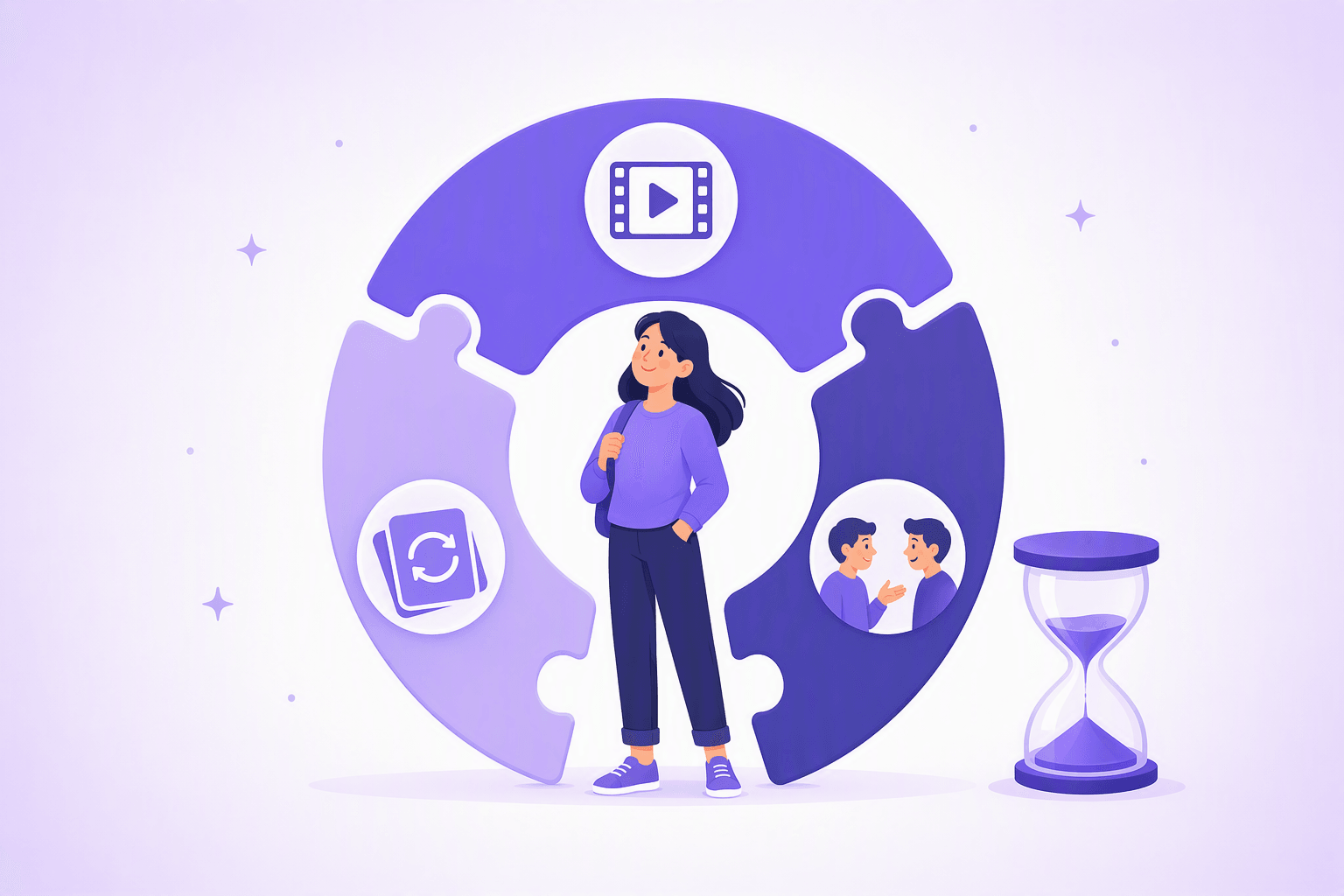
Each app on this list has one job it does best. Lingopie does long-form TV immersion. Wordy does short curated clips with retrieval. Migaku does sentence mining. iTalki does conversation. Trying to make any single one of them do every job is how most learners burn out.
A realistic weekly stack: 4 to 5 short sessions with a video app like Wordy for input + retrieval, 1 to 2 longer sessions with Lingopie or Migaku for sustained immersion or sentence mining, and 1 to 2 conversation sessions per month with an iTalki tutor. The bigger constraint is time, not money. Pick the tools that fit the hours you actually have.
For concrete content to watch alongside any of these apps, see best movies to learn Spanish, best anime movies to learn Japanese, and best Korean dramas to learn Korean.
Final Verdict
If you want one Lingopie alternative and you do not want to think hard about it, choose Wordy. It uses the same authentic video method, with curated short clips that work for beginners, broader language coverage including the Asian languages Lingopie underserves, and a free tier so you can test it without paying first.
If you specifically want full TV episodes in Romance languages on a smart TV, stay with Lingopie, it is genuinely good at that, and switching for the sake of switching is not the point.
If you want the cheapest possible setup, combine Wordy's free tier with Language Reactor on your laptop, and you have a working video-immersion stack at zero monthly cost.
The apps on this list are not interchangeable. They solve overlapping but different problems. Pick the one that matches your level, language, and lifestyle, and add a second tool only when you hit the wall of what the first one can do.
To keep building a sustainable learning routine, browse the Wordy blog for more guides on specific languages, phrases, and learning strategies.
Frequently Asked Questions
What's a cheaper alternative to Lingopie?
Best Lingopie alternative for Japanese?
Is there a free Lingopie alternative?
Which is better, Wordy or Lingopie?
Can I learn from Netflix without Lingopie?
Sources & References
- Lingopie, official website (lingopie.com), accessed 2026
- Wordy, official website (wordy.info), accessed 2026
- Krashen, S., The Input Hypothesis, Longman, 1985
- TechCrunch, 'Wordy's new app helps you learn vocab while watching movies & TV shows,' September 2024
- Ethnologue, 27th edition, 2024
Start learning with Wordy
Watch real movie clips and build your vocabulary as you go. Free to download.


