Quick Answer
Korean webtoon vocabulary includes practical reading words such as 웹툰 for webtoon, 회차 for episode, and 댓글 for comments, plus fandom terms for romance, action, cliffhangers, and character types. Learning these terms helps you read Korean webtoons, understand platform labels, and follow fan conversations without relying on translation.
Korean webtoon vocabulary is the set of words readers use to label episodes, genres, characters, plot twists, comments, and release schedules. Start with 웹툰 /wɛp.tʰun/, 회차 /çwe.tɕʰa/, 댓글 /tɛt.k͈ɯl/, and 다음 화 /ta.ɯm hwa/, then add fandom terms such as 남주 /nam.dʑu/ and 사이다 /sa.i.da/ to understand what Korean readers are reacting to. These words turn a webtoon from a picture-supported reading exercise into a real window into Korean online culture.
Korean has roughly 81.7 million first- and second-language speakers worldwide, according to Ethnologue's 27th edition. That means webtoon Korean is not a tiny niche: it overlaps with the everyday language, internet culture, and entertainment vocabulary used across a major global media ecosystem.
For a broader foundation before you read, review common Korean words and learn how Korean speech levels shape the dialogue you see in dramas and comics through Korean formal and informal speech.
| English | Korean | Pronunciation | Note |
|---|---|---|---|
| webtoon | 웹툰 | wep-TOON | A vertically scrolling Korean digital comic. |
| episode | 회차 | hweh-chah | An installment number, often shown as 1화, 2화, and so on. |
| episode | 화 | hwah | Short label used after a number, as in 10화. |
| next episode | 다음 화 | DAH-eum hwah | Used when readers eagerly wait for the next installment. |
| comment | 댓글 | deht-GEUL | Reader comment under an episode. |
| recommendation | 추천 | choo-CHEON | A recommendation, upvote, or suggested title. |
| favorite | 관심 작품 | gwan-SHEEM jak-POOM | A title added to a reader's interest or favorites list. |
| new work | 신작 | shin-JAHK | A newly launched series. |
| completed series | 완결 | wahn-GYEOL | A story that has finished publication. |
| hiatus | 휴재 | hyoo-JEH | A temporary publication break. |
Why webtoon Korean is worth learning
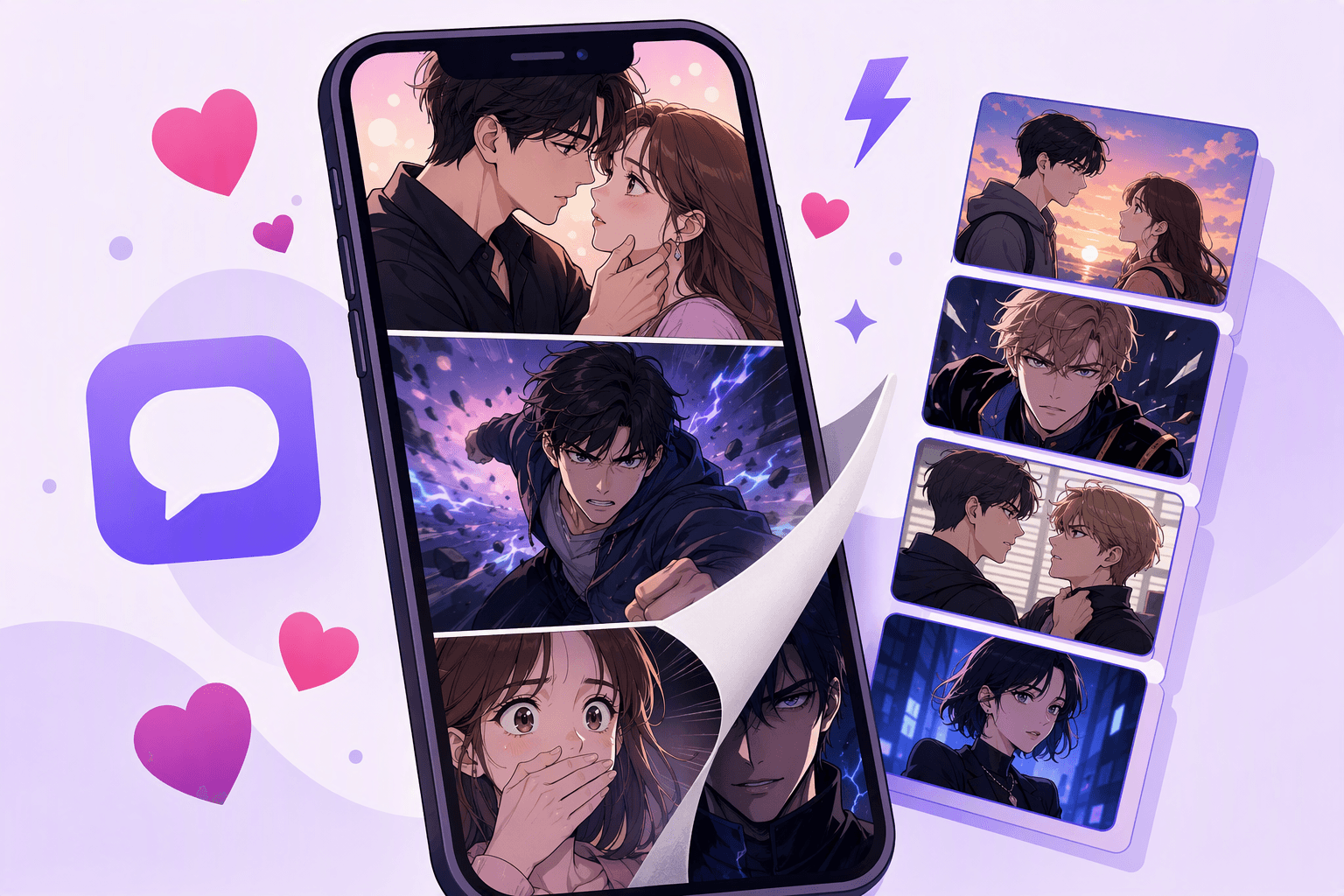
Webtoons are built for scrolling, not for turning pages. Panels often use short bursts of dialogue, sound effects, reaction images, text messages, narration boxes, and comments. That format gives learners repeated words with unusually strong visual clues.
The Korean webtoon industry has also become economically significant. Korea Creative Content Agency statistics place domestic webtoon industry revenue above 2 trillion won in the early 2020s, reflecting how comics, adaptations, licensing, and platforms have become connected parts of Korean popular culture.
Scott McCloud's Understanding Comics explains how readers construct meaning from the spaces between panels. Webtoons make that process especially visible: a long vertical gap can create suspense, a tiny reaction panel can carry a whole emotional turn, and a single sound effect can tell you whether a scene is awkward, frightening, or funny.
This is why webtoons work well alongside screen-based study. If you also learn from spoken media, try K-drama vocabulary or use Korean dramas for learners to hear related phrases in natural delivery.
Platform and reading vocabulary
웹툰
웹툰 /wɛp.tʰun/ is the Korean term for a webtoon. The first syllable comes from the English word web, while 툰 is a shortened adaptation of cartoon.
A Korean webtoon is usually designed around vertical scrolling. Instead of page turns, you follow a continuous sequence of panels down a phone screen, often with deliberate blank space before an important reveal.
회차
회차 /çwe.tɕʰa/ means episode number or installment. You may see 1회차 /il çwe.tɕʰa/, but platforms more often use the shorter counter 화 /hwa/ after a number.
For example, 35화 /sam.sip.o hwa/ means episode 35. When a reader writes 다음 화가 기다려져요 /ta.ɯm hwa.ga ki.da.ɾjʌ.dʑjʌ.jo/, they mean they are waiting eagerly for the next episode.
미리보기
미리보기 /mi.ɾi.bo.gi/ means preview. On many platforms, it refers to early access to episodes that have not yet become freely available.
The verb 미리 보다 /mi.ɾi po.da/ literally means to see in advance. This is useful beyond webtoons too, for trailers, previews, and checking something before an event.
쿠키
쿠키 /kʰu.kʰi/ literally means cookie, but on some Korean webtoon platforms it is the name for a digital payment item used to unlock episodes. It is platform-specific vocabulary, not a general Korean word for online payments.
Do not assume that every mention of 쿠키 /kʰu.kʰi/ in Korean media means a snack. Context matters: an episode unlock screen and a café scene obviously use the same word differently.
휴재
휴재 /çju.dʑɛ/ means a temporary hiatus. A notice saying 휴재 공지 /çju.dʑɛ koŋ.dʑi/ is an announcement that the series will take a break.
Creators may pause between seasons, recover from illness, prepare a new arc, or manage a demanding production schedule. Korean readers often respond with 건강이 우선이에요 /kʌŋ.gaŋ.i u.sʌn.i.e.jo/, meaning health comes first.
🌍 Weekly release culture
Many Korean webtoons publish on a fixed weekday. Readers form habits around a Monday, Wednesday, or Friday update, and comment sections become especially active soon after a new episode appears. Knowing the weekday names helps, so keep the Korean days of the week guide nearby.
Genre words and story tags
Genres are useful because they tell you what kind of Korean you are likely to encounter. A school romance uses different vocabulary from a historical revenge story, while an action fantasy may have formal titles, invented place names, and combat sound effects.
| English | Korean | Pronunciation | Note |
|---|---|---|---|
| romance | 로맨스 | roh-MEN-seu | Romantic relationships are the main story focus. |
| romantic comedy | 로맨틱 코미디 | roh-MEN-tik koh-MEE-dee | Often shortened in fan discussion. |
| fantasy | 판타지 | pahn-TAH-jee | Magic, alternate worlds, powers, or non-realistic settings. |
| action | 액션 | aek-SHYON | Fight scenes, chases, and physical conflict. |
| thriller | 스릴러 | seu-RIL-leo | Suspense, danger, and psychological tension. |
| historical drama | 사극 | sah-GEUK | A story set in a Korean historical period. |
| daily life | 일상 | il-SAHNG | Everyday-life stories and low-stakes humor. |
| school story | 학원물 | hahg-WON-mool | A genre centered on school life. |
| regression story | 회귀물 | hweh-GWEE-mool | A protagonist returns to an earlier point in time. |
| reincarnation story | 빙의물 | bing-EE-mool | Often means possession or awakening in another body. |
로맨스
로맨스 /ɾo.mɛn.sɯ/ means romance. You will see it on platform category pages and in comments about couples, confessions, misunderstandings, and relationship progress.
Korean romance stories often rely on indirectness. A character may express care through food, concern, or small favors rather than immediately saying 사랑해 /sa.ɾaŋ.ɦɛ/, meaning I love you. For the real-life range of romantic phrases, see how to say I love you in Korean.
사극
사극 /sa.gɯk/ refers to a historical drama or historical fiction genre. The term combines 사 /sa/, historical, and 극 /gɯk/, drama.
Historical webtoons can be enjoyable but challenging for beginners. Their dialogue may include court titles, honorifics, old-fashioned phrasing, and social hierarchies that are uncommon in everyday modern Korean.
회귀물
회귀물 /çwe.gwi.mul/ is a regression story, usually one where a protagonist returns to the past with memories of a previous timeline. The final syllable 물 /mul/ means a type of work or story, so it appears in many genre labels.
This is a useful reading shortcut. If you see 회귀물 /çwe.gwi.mul/, expect words about fate, regret, changing the future, and a character who knows events that have not happened yet.
빙의물
빙의물 /piŋ.ɰi.mul/ is a possession or transmigration genre, often involving someone waking up inside another person's body or inside the world of a novel. It is especially common in romance fantasy webtoons.
The Korean word 빙의 /piŋ.ɰi/ has a broader meaning of spiritual possession. In webtoon tagging, it usually signals a specific fantasy premise rather than a horror story.
Character vocabulary readers use
Webtoon readers frequently compress long descriptions into quick labels. These words are common in comments, recommendation posts, and fan discussions, but some are more casual than others.
남주
남주 /nam.dʑu/ is short for 남자 주인공 /nam.dʑa dʑu.iŋ.goŋ/, male protagonist. It often means the main male romantic lead in a romance series.
A reader may ask 남주가 누구예요? /nam.dʑu.ga nu.gu.je.jo/, meaning who is the male lead? In a love triangle, the question can become a serious comment-section debate.
여주
여주 /jʌ.dʑu/ is short for 여자 주인공 /jʌ.dʑa dʑu.iŋ.goŋ/, female protagonist. Like 남주 /nam.dʑu/, it is a fandom shorthand rather than a formal term you would use in every setting.
You may also see 여주인공 /jʌ.dʑu.iŋ.goŋ/ written in full. It sounds more neutral and is useful when discussing films, novels, plays, or dramas.
서브남주
서브남주 /sʌ.bɯ nam.dʑu/ means second male lead. It describes an important male character who is not the primary romantic lead.
The phrase is strongly associated with romance fandom. Readers may sympathize with a kind, dependable second lead who seems unlikely to end up with the protagonist.
악녀
악녀 /aŋ.njʌ/ means villainess or wicked woman. In modern webtoon fantasy, it is often a genre label for a female character who has been cast as the villain inside a fictional story.
The word can be playful in a title, but calling a real person 악녀 /aŋ.njʌ/ can be harsh. It implies calculated cruelty, not simply a flawed or confident personality.
최애
최애 /tɕʰwe.ɛ/ means your ultimate favorite, usually a favorite character, celebrity, or idol. It comes from 최애캐 /tɕʰwe.ɛ.kʰɛ/, itself shortened from 최애하는 캐릭터 /tɕʰwe.ɛ.ɦa.nɯn kʰɛ.ɾik.tʰʌ/.
For example, 제 최애는 민준이에요 /tɕe tɕʰwe.ɛ.nɯn min.dʑun.i.e.jo/ means Minjun is my favorite. The expression also appears constantly in K-pop communities.
Plot reactions and comment-section Korean
사이다
사이다 /sa.i.da/ literally means cider or soda, but in webtoon culture it describes a satisfyingly decisive moment. It is the feeling of watching a bully exposed, a villain defeated, or an unfair situation corrected.
A comment such as 사이다 전개예요 /sa.i.da tɕʌn.gɛ.je.jo/ means the plot development is cathartic and satisfying. The opposite is 고구마 /ko.gu.ma/, literally sweet potato, for frustratingly slow or unresolved storytelling.
고구마
고구마 /ko.gu.ma/ means sweet potato. In online Korean, it describes a plot that feels stifling, slow, or irritating, as if you need water after eating a dry sweet potato.
Readers might complain 고구마 전개 너무 답답해요 /ko.gu.ma tɕʌn.gɛ nʌ.mu tap.tap.ɛ.jo/, meaning this frustrating plot development is making me impatient. It is figurative slang, so use it mainly in media discussion.
반전
반전 /pan.dʑʌn/ means reversal or plot twist. A major surprise at the end of an episode often produces comments such as 마지막 반전 뭐예요? /ma.dʑi.mak pan.dʑʌn mwʌ.je.jo/, meaning what was that final twist?
A good webtoon cliffhanger is designed to make the reader scroll one panel further, then wait a week. That reading rhythm is part of the form, not merely a plot device.
작화
작화 /tɕa.kʰwa/ means artwork or drawing quality in comics and animation. Readers praise detailed panels, expressive faces, color work, and dramatic composition with comments such as 작화가 예뻐요 /tɕa.kʰwa.ga je.p͈ʌ.jo/, meaning the art is beautiful.
The term is useful because Korean webtoons are collaborative industries. A series may credit a writer, artist, studio, or adaptation team separately, and readers often discuss the art as carefully as the plot.
댓글
댓글 /tɛt.k͈ɯl/ means comment, and webtoon comments are a genre of writing in themselves. They can include emotional reactions, jokes, spoilers, predictions, memes, and direct encouragement for creators.
Henry Jenkins, in Convergence Culture, examines how audiences become active participants rather than passive consumers. Webtoon comment sections show that clearly: readers collectively interpret clues, argue about characters, and create shared catchphrases beneath every new installment.
⚠️ Watch for spoilers
Korean readers often write 스포 /sɯ.pʰo/, short for spoiler, before revealing a plot point. Do not assume every comment section hides spoilers automatically. Read comments after finishing an episode, especially around finales and major twists.
Sound effects that make webtoons feel alive
Korean webtoons use onomatopoeia heavily. Unlike many dialogue words, these sound effects may be placed inside the artwork rather than in speech bubbles, so recognizing them makes the visual story much clearer.
| Korean | IPA | Typical meaning |
|---|---|---|
| 쿵 | /kʰuŋ/ | A heavy thud, crash, or heartbeat-like impact |
| 탁 | /tʰak̚/ | A sharp click, slap, or sudden placement |
| 벌떡 | /pʌl.t͈ʌk̚/ | Jumping up suddenly |
| 두근두근 | /tu.gɯn.du.gɯn/ | A pounding or fluttering heart |
| 훌쩍 | /hul.t͈ɕʌk̚/ | Sniffling or quietly crying |
| 쓱 | /s͈ɯk̚/ | A smooth, quick motion, such as glancing or sliding |
| 째릿 | /t͈ɕɛ.ɾit̚/ | A jolt, spark, or sudden electric feeling |
The National Institute of Korean Language dictionary is particularly useful for these words because it records definitions, usage labels, and variant forms. When a sound effect has no exact English equivalent, focus first on the movement or emotion shown in the panel.
Korean onomatopoeia also rewards rereading. Two syllables repeated together, such as 두근두근 /tu.gɯn.du.gɯn/, create a continuing effect, while a short form such as 탁 /tʰak̚/ often marks one abrupt event.
A practical routine for learning through webtoons
Choose a genre you already enjoy and begin with one episode a day. Read it once for plot, then reread only a few panels where the language repeats or feels useful.
Save whole phrases, not isolated nouns. For example, instead of memorizing 기다리다 /ki.da.ɾi.da/, to wait, save 다음 화 기다릴게요 /ta.ɯm hwa ki.da.ɾil.ge.jo/, meaning I will wait for the next episode.
Use comments selectively. The top comments often contain jokes and abbreviations, but they also reveal exactly which scene readers found romantic, funny, unfair, or shocking.
Do not copy every line of dialogue into real life. Villains, historical princes, wealthy CEOs, and supernatural characters speak in heightened styles. Compare their expressions with practical everyday language such as the phrases in Korean greetings and Korean goodbyes.
🌍 Webtoons are not just comics on a phone
Korean webtoons often move across media: a successful title may become a drama, animation, film, game, merchandise line, or translated series. This creates a distinctive loop between readers, platforms, creators, and adaptation audiences. Learning the original Korean terms helps you notice details that titles and subtitles may simplify.
The words to learn first
If you only memorize ten items, make them 웹툰 /wɛp.tʰun/, 화 /hwa/, 다음 화 /ta.ɯm hwa/, 댓글 /tɛt.k͈ɯl/, 완결 /wan.gjʌl/, 휴재 /çju.dʑɛ/, 남주 /nam.dʑu/, 여주 /jʌ.dʑu/, 반전 /pan.dʑʌn/, and 사이다 /sa.i.da/.
They tell you what you are reading, where you are in the story, whether a new episode is coming, and why other readers are excited or frustrated. Once these become familiar, webtoon Korean stops looking like a wall of labels and starts functioning as a living fandom language.
Frequently Asked Questions
What is the Korean word for webtoon?
Can beginners learn Korean through webtoons?
What does 댓글 mean in Korean webtoons?
What does 휴재 mean on a webtoon platform?
Are Korean webtoon romance terms useful in real Korean conversation?
Sources & References
- National Institute of Korean Language, Standard Korean Language Dictionary, accessed 2026
- King Sejong Institute Foundation, Korean Language Learning Resources, accessed 2026
- Korea Creative Content Agency, Content Industry Statistics, accessed 2026
- Ethnologue, Korean, 27th edition, 2024
- Scott McCloud, Understanding Comics, HarperPerennial
Start learning with Wordy
Watch real movie clips and build your vocabulary as you go. Free to download.


