Quick Answer
A practical K-drama vocabulary guide focuses on the high-frequency Korean words that repeat across scenes: greetings, honorifics, relationship terms, emotions, and workplace language. Learn the core set with pronunciation and nuance so you can follow common plot beats, from confessions and apologies to office politics and family drama.
K-drama vocabulary is mostly everyday Korean: greetings, apologies, honorifics, family titles, and emotional reactions that repeat across episodes. If you learn the high-frequency words below (with the right politeness level), you will understand a surprising amount of dialogue even before you catch every grammar ending.
Korean is spoken by roughly 82 million people worldwide (Ethnologue, 27th edition, 2024), and dramas reflect one of the most important realities of Korean: speech level matters. A single word choice can signal respect, intimacy, or conflict.
If you want a foundation for the basics first, start with how to say hello in Korean and how to say goodbye in Korean, then come back here to fill in the drama-specific gaps.
How K-drama dialogue actually works
K-dramas feel fast because characters stack meaning into small pieces: a title (오빠), a politeness marker (요), and a softener (좀) can do more than a full English sentence. That is why vocabulary plus context beats memorizing long lines.
Linguist Sohn Ho-min’s work on Korean (for example, his writing on address terms and honorifics) highlights how social relationships are encoded directly in everyday speech. In drama scripts, writers use that encoding as a shortcut for character dynamics.
Politeness: the hidden “plot device”
You will constantly hear polite endings like -요 and formal endings like -습니다 in workplaces, first meetings, and service scenes. You will hear 반말 (casual speech) between close friends, siblings, and couples, or when someone is being rude.
💡 A fast listening trick
When you hear 요 (yoh) at the end of many lines, assume polite speech. When it disappears, pay attention: the relationship just got closer, or the speaker is asserting power.
Why the same words repeat across genres
Rom-coms, thrillers, and legal dramas all share “daily life” scenes: greetings, eating, commuting, office talk, family talk. That is why a core vocabulary list pays off across shows.
For a method that makes this repeatable, clip-based learning works well because you re-hear the same line in multiple contexts. Wordy’s approach is built around that idea: short scenes, interactive subtitles, and review.
Core K-drama words and phrases (with pronunciation)
Below is a practical list of words you will hear constantly. Pronunciations are English approximations, and Korean pronunciation changes in fast speech, but these will get you close enough to recognize them.
| English | Korean | Pronunciation | Note |
|---|---|---|---|
| Hello (polite) | 안녕하세요 | ahn-NYUHNG-hah-seh-yoh | Default polite greeting. Often shortened in fast speech. |
| Thank you | 감사합니다 | gahm-SAH-hahm-nee-dah | Formal-polite. Also heard as 고마워요 (casual-polite). |
| Sorry / excuse me (formal) | 죄송합니다 | chweh-SOHNG-hahm-nee-dah | Stronger and more formal than 미안해요. |
| Sorry (casual) | 미안해 | mee-AHN-heh | Between close people. Can sound harsh if relationship is not close. |
| Excuse me (attention) | 저기요 | juh-gee-YOH | Used to call a waiter, stop someone, or get attention politely. |
| Wait a second | 잠깐만 | jahm-KKAHN-mahn | Very common in arguments and interruptions. |
| Really? | 진짜? | jin-JJAH | Tone matters: surprise, disbelief, annoyance. |
| Seriously? / For real? | 말도 안 돼 | mahl-doh ahn DWEH | Literally 'it doesn't make sense'. |
| What are you doing? | 뭐 해? | mwoh HEH | Casual. Polite version: 뭐 해요? (mwoh HEH-yoh). |
| I don't know | 몰라 | mohl-LAH | Casual. Polite: 몰라요 (mohl-LAH-yoh). |
| I know | 알아 | ah-RAH | Casual. Polite: 알아요 (ah-RAH-yoh). |
| It's okay / I'm fine | 괜찮아 | gwen-CHAH-nah | Very common reassurance. Polite: 괜찮아요. |
| No way / absolutely not | 절대 안 돼 | juhl-DAY ahn DWEH | Used for forbidding, strong refusal. |
| Please (request) | 제발 | jeh-BAHL | Often emotional: begging, pleading, desperation. |
| Let's go | 가자 | gah-JAH | Casual. Polite: 가요 (gah-YOH). |
| Hurry up | 빨리 | ppahl-LEE | Can be playful or bossy depending on tone. |
| Eat (casual) | 먹어 | muh-GUH | Polite: 먹어요. Honorific: 드세요. |
| Delicious | 맛있어 | mah-SHEE-suh | Polite: 맛있어요. Often exclaimed while eating. |
| Are you okay? | 괜찮아? | gwen-CHAH-nah | Same form as 'it's okay' but with questioning intonation. |
| I like you | 좋아해 | joh-AH-heh | Common confession line. Polite: 좋아해요. |
| I love you | 사랑해 | sah-RANG-heh | Strong. Also heard: 사랑해요, 사랑합니다. |
| Let's date | 사귀자 | sah-gwee-JAH | Direct. Often a pivotal rom-com line. |
| Break up | 헤어져 | heh-UH-juh | Casual. Polite: 헤어져요. Heavy emotional weight. |
| Trust me | 믿어 | mee-DUH | Polite: 믿어요. Often used in thriller twists too. |
| Promise | 약속 | yahk-SOK | As a noun. Verb: 약속해 (yahk-SOK-heh). |
🌍 Why 'please' feels different in Korean
English uses 'please' as a default politeness marker. Korean often uses verb endings (요, -습니다) and honorific verbs (드세요) to encode politeness. 제발 (jeh-BAHL) is not a neutral 'please', it is closer to 'I’m begging you', which is why it shows up in dramatic scenes.
Relationship titles you hear constantly
K-dramas teach you quickly that Korean uses titles where English might use names. These are not just vocabulary, they are social positioning.
The National Institute of Korean Language’s dictionary entries for address terms make clear that usage depends on age, gender, and relationship, not just literal family ties.
오빠
오빠 (oh-ppah) is used by a woman to an older male: a biological brother, a boyfriend, or a close older male friend. In dramas, it often signals closeness, sometimes flirtation, sometimes emotional leverage.
언니
언니 (uhn-nee) is used by a woman to an older female. In dramas it can be affectionate, supportive, or sharply hierarchical depending on the scene, especially in school settings.
형
형 (hyuhng) is used by a man to an older male. You will hear it in bromance dynamics, workplace mentorship scenes, and conflict scenes where respect is demanded.
누나
누나 (noo-nah) is used by a man to an older female. In dramas it can sound sweet, teasing, or intimate, and it often appears in noona romance storylines.
⚠️ Do not copy titles blindly
Calling a stranger 오빠 or 언니 can sound overly familiar or creepy outside specific contexts. In real life, many Koreans prefer names plus -씨, or a role title like 선생님, especially in professional settings.
Honorifics and name endings: the subtitles rarely explain them
Honorifics are the glue of K-drama dialogue. If you learn three, you will suddenly understand who outranks whom.
-씨
-씨 (shee) is a polite suffix attached to a name, like 민수 씨. It is common among adults who are not close, or in semi-formal settings.
-님
-님 (neem) is more respectful than -씨 and often attaches to roles: 고객님 (customer), 팀장님 (team leader). In office dramas, -님 is everywhere.
선배 / 후배
선배 (suhn-BEH) is a senior, and 후배 (hoo-BEH) is a junior, usually in school or workplace cohorts. These terms carry expectations: mentoring, deference, and sometimes resentment.
If you want a deeper foundation on social language, pair this article with Korean greetings to see how speech levels map to real situations.
The five “scene engines” of K-dramas (and the words that power them)
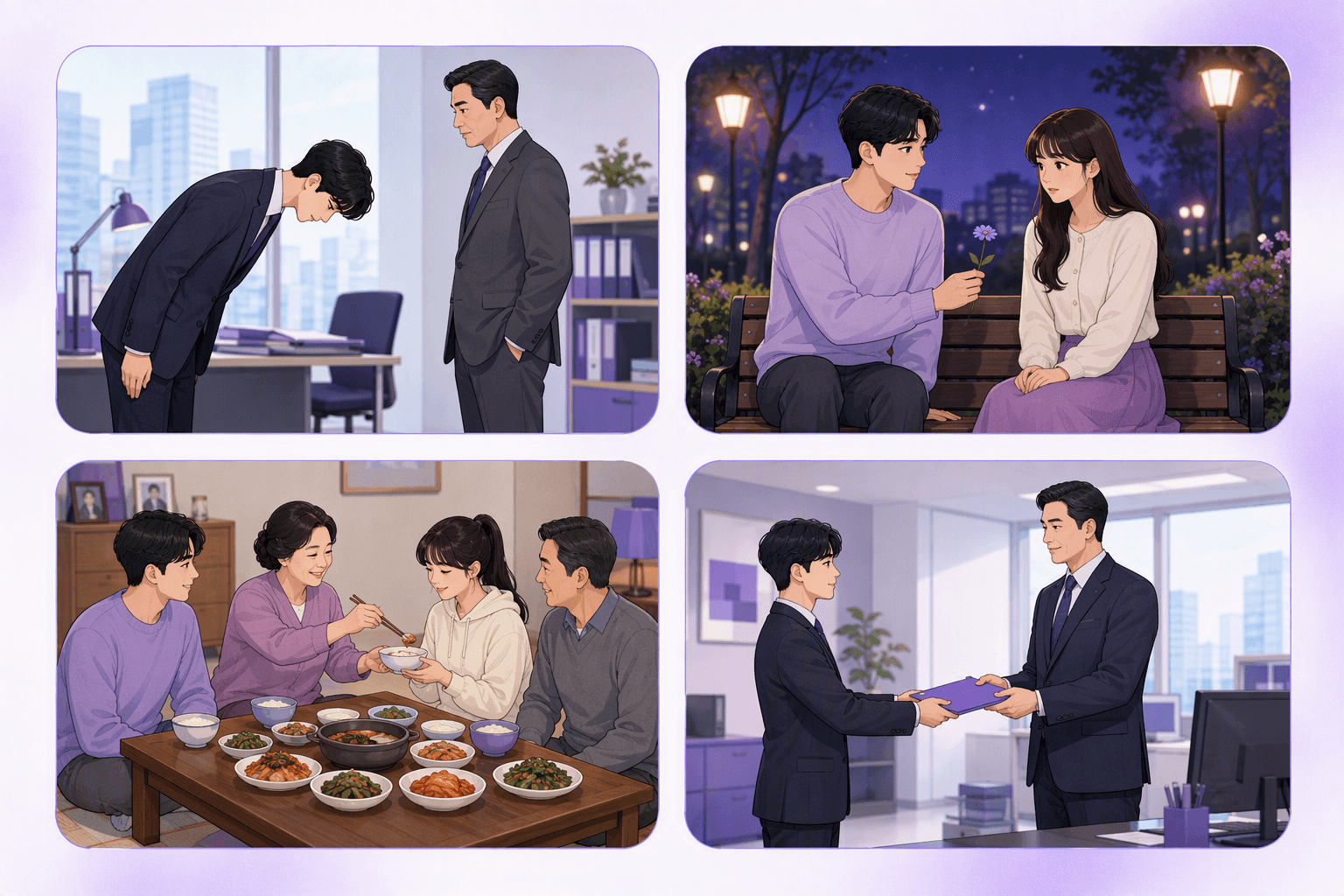
Most drama scenes fall into repeatable patterns. Learn the vocabulary by scene type and you will remember it faster.
Apologies and responsibility scenes
죄송합니다 (chweh-SOHNG-hahm-nee-dah) and 미안해 (mee-AHN-heh) are not interchangeable. 죄송합니다 is formal and face-saving, and it fits public mistakes and workplace hierarchy.
Research on face and politeness in pragmatics, such as the framework in Brown and Levinson’s Politeness: Some Universals in Language Usage (Cambridge UP), helps explain why Korean dramas lean so hard on honorific apologies: the language makes social repair explicit.
Confession scenes
좋아해 (joh-AH-heh) and 사랑해 (sah-RANG-heh) are different levels of commitment. Many dramas build tension by delaying 사랑해, or by using it only at peak moments.
For more romantic phrasing, see how to say I love you in Korean, then come back and listen for which speech level the confession uses.
Food and caretaking scenes
먹어 (muh-GUH), 빨리 (ppahl-LEE), 맛있어 (mah-SHEE-suh) show up because feeding someone is a common caretaking trope. The honorific form 드세요 (deuh-SEH-yoh) is a politeness signal, and it often marks a relationship shift.
Workplace hierarchy scenes
-님, 팀장님, and formal endings (-습니다) are the soundtrack of office dramas. Even if you do not understand the whole sentence, hearing -님 plus a formal ending usually means the speaker is “performing professionalism.”
Conflict and boundary scenes
말도 안 돼 (mahl-doh ahn DWEH), 절대 안 돼 (juhl-DAY ahn DWEH), and 잠깐만 (jahm-KKAHN-mahn) are common because they allow fast escalation. The same words can be playful in rom-coms and threatening in thrillers, so always track tone.
Mini listening drills: what to focus on in a real clip
You do not need to catch every word to learn from dramas. You need to catch the “anchors” that repeat.
Drill 1: Catch the politeness ending
Listen for 요 (yoh) and -니다 (nee-dah) endings. Then ask: are they talking up (respect), sideways (neutral), or down (casual)?
Drill 2: Catch the address term
Did they use a name, -씨, -님, or a relationship title like 오빠? That one choice often explains the entire scene’s tension.
Drill 3: Catch the emotional pivot word
Words like 진짜 (jin-JJAH), 제발 (jeh-BAHL), and 괜찮아 (gwen-CHAH-nah) often mark the emotional turn. Rewind and repeat those lines out loud.
💡 Subtitle strategy that actually helps
Watch once with subtitles to understand the scene. Then rewatch a 10 to 20 second segment with Korean subtitles only and focus on spotting 2 to 3 anchor words. This is close to how extensive listening becomes intensive learning.
What not to copy from K-dramas
Dramas are great input, but they also contain language you should treat carefully.
Overly dramatic lines
제발 and 헤어져 are real, but they are emotionally loaded. If you repeat them casually, you can sound intense.
Insults and swearing
Many dramas soften swearing for broadcast, or they use insults that are socially harsh. If you are curious, use a controlled guide and learn severity and context first, for example our guide to Korean swear words.
“Cute” speech that does not fit you
Aegyo-style phrasing can be real, but it is situational. If you are not sure, stick to neutral polite speech and let your personality come through naturally.
How to turn K-drama vocabulary into real speaking ability
A list is only step one. The goal is to recognize, then produce, then adapt.
Build a personal “scene deck”
Pick 10 clips that match your life: ordering food, apologizing, making plans. Save the lines and practice them with the same rhythm you hear.
If you like spaced repetition, our Anki guide for language learning shows how to convert lines into flashcards without turning your deck into a mess.
Learn one word with three speech levels
For a verb like “to eat,” learn:
- 먹어 (casual)
- 먹어요 (polite)
- 드세요 (honorific request)
This mirrors how the King Sejong Institute materials teach functional language: same meaning, different social packaging.
Use dramas as pronunciation training
Korean pronunciation is less about individual sounds and more about connected speech. A good baseline is to learn Hangul early so you can map sound to spelling, then shadow short lines.
For pronunciation mechanics, see Korean pronunciation guide and focus on batchim (final consonants) and common sound changes.
A simple weekly plan (that fits real life)
Two episodes per week, but only five minutes of “study”
Watch normally for enjoyment. Then pick one short scene and do:
- Listen and read Korean subtitles.
- Repeat the anchor words out loud.
- Write one line you would actually say in your life.
Consistency beats intensity. Five minutes of repeatable practice is enough to make drama vocabulary stick.
Where to go next
If you want to keep building from high-frequency speech, combine this guide with:
- how to say hello in Korean for greeting patterns
- how to say goodbye in Korean for exits and endings
- how to say I love you in Korean for romance language that matches real speech levels
And if you want more structured listening practice, explore Korean learning on Wordy and turn the lines you love into repeatable, trackable vocabulary.
Frequently Asked Questions
What Korean words do you hear most in K-dramas?
Do K-dramas use realistic Korean, or is it exaggerated?
What is the difference between 오빠 and 형?
Why do characters switch between 존댓말 and 반말?
Is it okay to learn Korean from K-dramas as a beginner?
Sources & References
- Ethnologue, Korean (27th edition, 2024)
- National Institute of Korean Language (국립국어원), Standard Korean Language Dictionary (accessed 2026)
- King Sejong Institute Foundation, Korean Language Learning Resources (accessed 2026)
- Korean Culture and Information Service (KOCIS), Guide to Korean Culture and Language (accessed 2026)
Start learning with Wordy
Watch real movie clips and build your vocabulary as you go. Free to download.


