Quick Answer
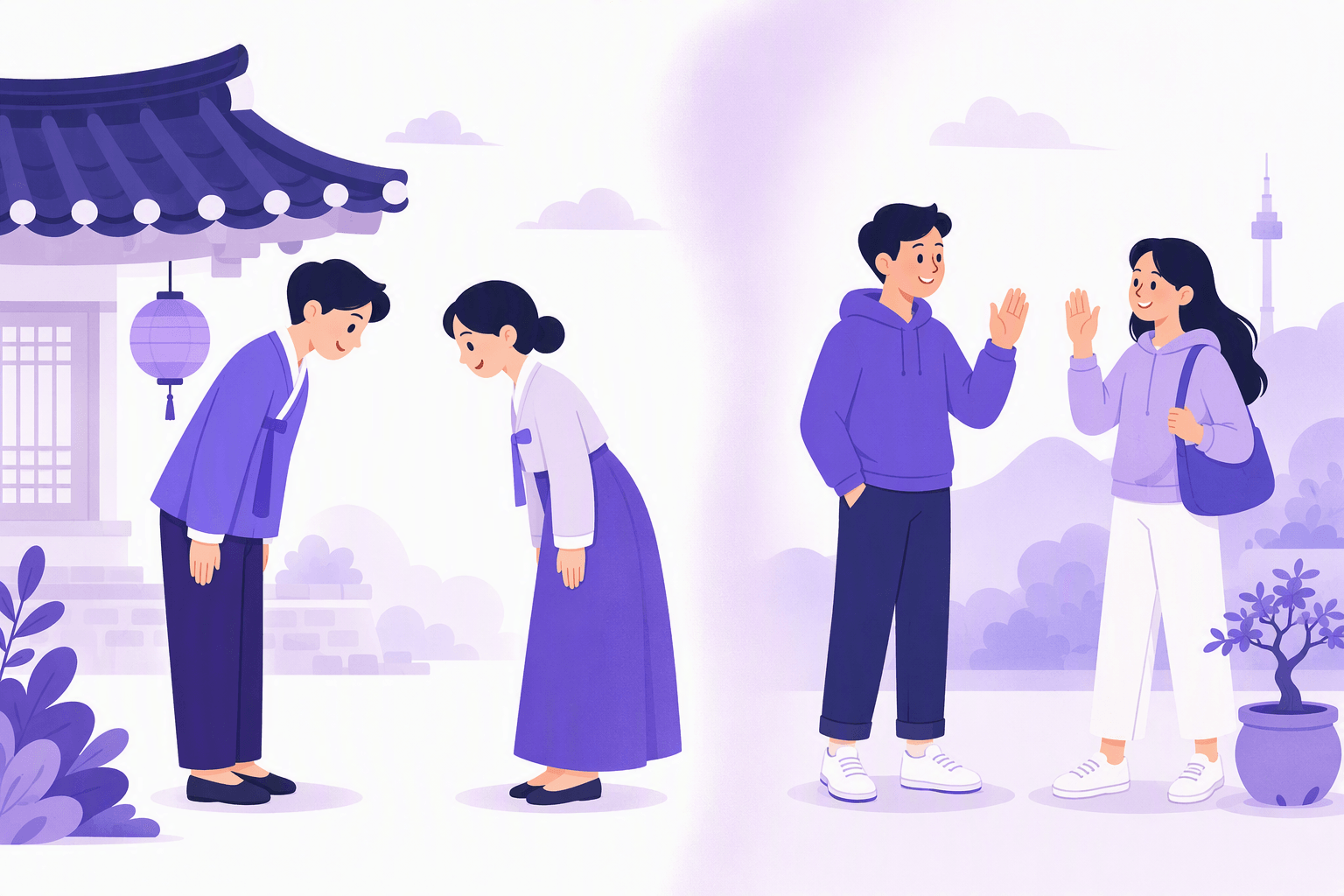
Korean greetings depend on formality and relationship, not just time of day. Use 안녕하세요 (ahn-nyuhng-hah-SEH-yoh) as the safe default, then switch to casual 안녕 (ahn-NYUHNG) with friends, and workplace forms like 안녕하십니까 (ahn-nyuhng-hah-SHIM-nee-kka) for announcements or very formal settings.
Korean greetings are built around politeness and relationship, so the "right" hello or goodbye depends on who you are talking to and the setting. If you want one safe greeting that works almost everywhere, use 안녕하세요 (ahn-nyuhng-hah-SEH-yoh), then learn a few upgrades for friends, work, and leave-taking.
| English | Korean | Pronunciation | Formality |
|---|---|---|---|
| Hello (polite default) | 안녕하세요 | ahn-nyuhng-hah-SEH-yoh | polite |
| Hi / bye (casual) | 안녕 | ahn-NYUHNG | casual |
| Hello (very formal) | 안녕하십니까 | ahn-nyuhng-hah-SHIM-nee-kka | formal |
| Nice to meet you (polite) | 만나서 반가워요 | mahn-nah-suh bahn-gah-WOH-yoh | polite |
| Please take care of me (first meeting) | 잘 부탁드립니다 | jal boo-TAK-deu-reem-nee-dah | formal |
| Goodbye (to the person leaving) | 잘 가요 | jal GAH-yoh | polite |
| Goodbye (to the person staying) | 잘 있어요 | jal ISS-uh-yoh | polite |
| See you later (casual) | 나중에 봐 | nah-JOONG-eh bwah | casual |
Korean is spoken by tens of millions of people worldwide, and it is the national language of South Korea and North Korea. Ethnologue (27th ed., 2024) estimates about 82 million speakers globally, which means your greeting choices matter in real, everyday interactions across communities, workplaces, and travel.
If you are also building your Korean basics, start with our focused guides on how to say hello in Korean and how to say goodbye in Korean. This article connects those phrases into a single system you can actually use.
The core idea: Korean greetings are about social distance
In English, "hello" is mostly neutral. In Korean, a greeting also signals respect, closeness, and sometimes hierarchy.
That is why you will hear the same person switch greetings depending on who walks into the room. It is not inconsistency, it is social precision.
"Politeness is not just about being 'nice', it is a system for managing social relationships and avoiding friction in interaction."
Paul Brown and Stephen C. Levinson, Politeness: Some Universals in Language Usage (1987)
Two quick rules that prevent most mistakes
-
When in doubt, go more polite, not more casual.
안녕하세요 (ahn-nyuhng-hah-SEH-yoh) is rarely wrong. -
Use titles more than names in formal contexts.
In many workplaces, greeting someone as 과장님 (gwah-jahng-NIM) or 팀장님 (team-jahng-NIM) can sound more natural than using their first name.
💡 A practical default
If you only memorize one greeting and one goodbye for your first week, choose 안녕하세요 (ahn-nyuhng-hah-SEH-yoh) and 안녕히 가세요 (ahn-nyuhng-hee gah-SEH-yoh). They are polite, common, and easy to pair with a small bow.
How formality works in greetings (without the grammar headache)
Korean speech levels can get technical fast, but you do not need a linguistics lecture to greet people correctly.
Think in three lanes:
- Casual: friends, close peers, younger people
- Polite: strangers, most daily interactions, service encounters
- Formal: announcements, presentations, very respectful situations
You will see these lanes in the endings:
- Casual often ends with no 요 (yoh).
- Polite often ends with 요 (yoh).
- Formal often ends with -니다 (nee-dah) or -니까 (nee-kka).
Hello greetings you will actually hear
안녕하세요
안녕하세요 (ahn-nyuhng-hah-SEH-yoh) is the standard polite "hello." It is appropriate in shops, elevators, first meetings, and with older people.
It is also used in the morning, because Korean does not rely on "good morning" as heavily as English does.
Use it like this:
- 안녕하세요, 처음 뵙겠습니다. (ahn-nyuhng-hah-SEH-yoh, choh-eum bwehp-geh-sseum-nee-dah)
- 안녕하세요, 감사합니다. (ahn-nyuhng-hah-SEH-yoh, gahm-sah-hahm-nee-dah)
안녕
안녕 (ahn-NYUHNG) is casual and can mean both "hi" and "bye." With friends, it is warm and normal.
With a stranger or a superior, it can sound like you are talking to a child or assuming closeness. Save it for people in your casual lane.
안녕하십니까
안녕하십니까 (ahn-nyuhng-hah-SHIM-nee-kka) is very formal. You will hear it in speeches, military contexts, news-style intros, and sometimes customer-facing announcements.
If you use it in a casual cafe with a friend, it will sound comedic or theatrical.
좋은 아침이에요
좋은 아침이에요 (joh-eun ah-CHIM-ee-eh-yoh) means "good morning," but it is less frequent than English "good morning." It can sound a bit scripted, like a textbook line, depending on context.
In real workplaces, people often still say 안녕하세요 in the morning, or they greet with a bow and a title.
🌍 Why 'good morning' feels different in Korea
Korean greetings often prioritize respect and smooth interaction over time-of-day formulas. In offices, a greeting can be a bow plus a short 안녕하세요, and then you move straight into the purpose of the interaction. This can feel abrupt to English speakers, but it is efficient and normal.
Nice to meet you: first meetings and introductions
A Korean introduction often has two parts: a friendly line and a relationship-setting line.
만나서 반가워요
만나서 반가워요 (mahn-nah-suh bahn-gah-WOH-yoh) means "nice to meet you." It is polite and friendly.
Casual version: 만나서 반가워 (mahn-nah-suh bahn-gah-WOH). Use it only with friends or peers.
처음 뵙겠습니다
처음 뵙겠습니다 (choh-eum bwehp-geh-sseum-nee-dah) is more formal, literally "this is the first time I see you" using the honorific verb 뵙다 (bwehp-dah).
It is common in business settings, interviews, and meeting someone senior.
잘 부탁드립니다
잘 부탁드립니다 (jal boo-TAK-deu-reem-nee-dah) is one of the most culturally loaded lines in Korean greetings. It is often used after introductions and roughly means "please take good care of me" or "I look forward to working with you."
It signals cooperation and humility, not weakness. In teams, it sets a smooth tone.
🌍 A natural 'first meeting' script
Try this sequence in professional contexts: 안녕하세요 (ahn-nyuhng-hah-SEH-yoh) + 이름입니다 (ee-reum-im-nee-dah) + 잘 부탁드립니다 (jal boo-TAK-deu-reem-nee-dah). It sounds more Korean than translating an English-style self-introduction word-for-word.
Goodbye greetings: leaving is a two-person system
English "goodbye" does not care who leaves. Korean does.
This is where learners most often flip the phrases.
잘 가요
잘 가요 (jal GAH-yoh) is said to the person who is leaving. Think: "go well."
More formal and common in public: 안녕히 가세요 (ahn-nyuhng-hee gah-SEH-yoh).
잘 있어요
잘 있어요 (jal ISS-uh-yoh) is said to the person who stays behind. Think: "stay well."
More formal: 안녕히 계세요 (ahn-nyuhng-hee gyeh-SEH-yoh).
조심히 가세요
조심히 가세요 (joh-SIM-hee gah-SEH-yoh) means "go carefully," like "take care on your way." It is extremely common when someone is heading out, especially at night, in bad weather, or after drinking.
It is polite without being stiff.
⚠️ The most common goodbye mistake
Do not say 잘 있어요 (jal ISS-uh-yoh) to the person leaving. It sounds like you are telling them to 'stay' when they are walking out. If they are leaving, choose 잘 가요 (jal GAH-yoh) or 안녕히 가세요 (ahn-nyuhng-hee gah-SEH-yoh).
Bowing and body language: the greeting you do not say
In Korea, greetings are not only verbal. A small bow can carry as much meaning as the words.
| English | Korean | Pronunciation | Note |
|---|---|---|---|
| Quick nod (very casual) | 가벼운 목례 | gah-byuh-woon mohk-lyeh | Common with peers, quick hallway greetings. |
| Standard polite bow | 목례 | mohk-lyeh | Typical with strangers, customers, older people. |
| Deeper bow (more respect) | 큰절 | keun-JUHL | Used in major holidays or very respectful moments, not everyday. |
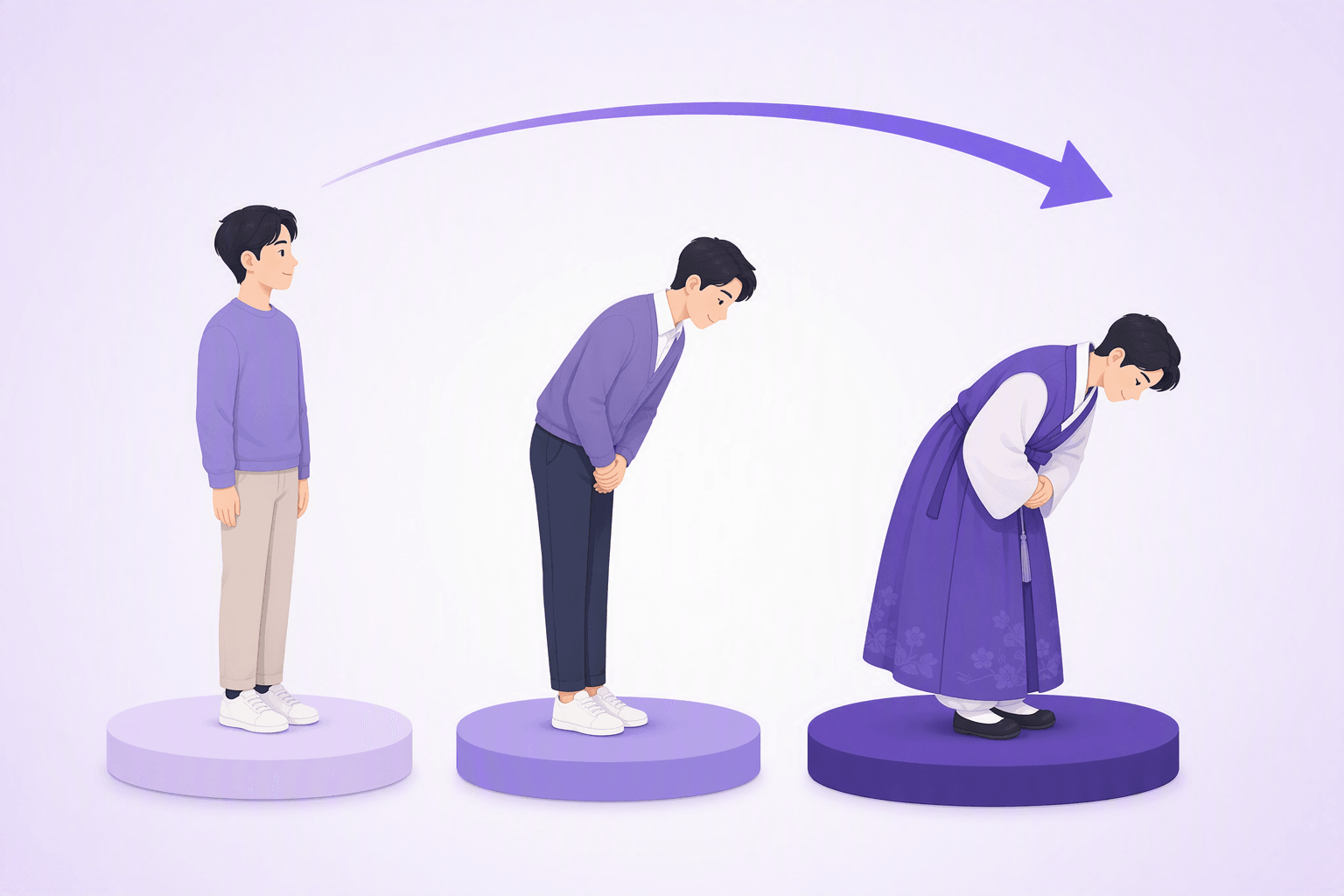
A useful rule: the more formal the relationship, the more your body language matters. Even a slight nod paired with 안녕하세요 can make you sound more respectful than perfect pronunciation alone.
Situational greetings: what to say where
In shops, cafes, and restaurants
Staff often greet customers first, sometimes with a louder, energetic tone. You can respond with a simple 안녕하세요 (ahn-nyuhng-hah-SEH-yoh) or 네 (neh) plus a small bow.
If you want to sound especially natural, keep it short. Over-explaining can feel foreign in fast service interactions.
In elevators and hallways
A quiet 안녕하세요 with a nod is common. If you see the same coworker repeatedly, you might switch to a lighter greeting like 안녕하세요 again, or just a nod.
Korean workplaces often value not creating social pressure in micro-interactions. A brief greeting respects that.
On the phone
A standard polite opener is 여보세요 (yuh-boh-SEH-yoh), meaning "hello" on the phone. It is not used face-to-face.
In business calls, you may hear a company name plus greeting, but 여보세요 remains the default.
Texting and messaging
Korean texting often uses shortened, friendly forms:
- 안녕 (ahn-NYUHNG)
- ㅎㅇ (hee-eh) as a slangy "hi" (very casual)
- 잘자 (jal-jah) meaning "sleep well" (casual)
Be careful with slang abbreviations. They can feel too informal with coworkers or older people.
If you are learning modern casual Korean, pair this guide with our Korean slang guide for context on what is playful vs what is risky.
Pronunciation notes that make greetings clearer
You do not need perfect accent to be understood, but a few sounds matter in greetings because they are short.
안녕 (ahn-NYUHNG)
The ㄴ + 녕 combination can feel nasal. Keep it smooth: ahn-NYUHNG, not "an-yong" with a hard break.
안녕하세요 (ahn-nyuhng-hah-SEH-yoh)
The middle 하세 (hah-SEH) should be clean and light. Many learners swallow the vowels and it becomes muddy.
If you want extra help on sound patterns, use our Korean alphabet Hangul guide alongside movie clips so you can match spelling to real speech.
Titles and names: greeting people the Korean way
Korean greetings often attach to a title:
- 선생님 (sun-saeng-NIM): teacher, also used politely for instructors
- 사장님 (sah-jahng-NIM): boss, also used for shop owners
- 기사님 (gee-sah-NIM): driver (taxi, bus)
The -님 (NIM) ending is a respect marker. It is safer to include it than to omit it.
🌍 Why first names can feel too direct
In many Korean contexts, using a first name without a suffix can sound intimate or blunt. Titles and suffixes let you be friendly without crossing boundaries. This is one reason greetings and address terms are tightly connected in Korean.
What to avoid: greetings that can backfire
Overusing very formal speech
Using 안녕하십니까 (ahn-nyuhng-hah-SHIM-nee-kka) everywhere can sound like you are performing. Polite 요-style greetings are usually the right middle ground.
Mixing casual and polite endings
Switching between 안녕 (ahn-NYUHNG) and 안녕하세요 (ahn-nyuhng-hah-SEH-yoh) in the same interaction can signal uncertainty. Pick one lane per person per setting.
Swearing as a "friendly" greeting
Some learners pick up strong language from dramas and think it is casual bonding. In real life, it can damage relationships fast.
If you are curious about what you hear in gritty scenes, read our guide to Korean swear words, but treat it as comprehension, not a starter kit.
Learn greetings faster with movie and TV clips
Greetings are high-frequency, but they are also high-context. A drama scene shows you who is older, who is junior, who is angry, and who is flirting, all before the first word.
That context is why clip-based learning works well for greetings. You hear the same phrase delivered differently in a workplace, a family kitchen, and a first date.
For romantic language after you master the basics, continue with how to say I love you in Korean. You will notice the same politeness logic, just with higher emotional stakes.
A simple practice plan (10 minutes a day)
Day 1 to 2: lock the default
Practice:
- 안녕하세요 (ahn-nyuhng-hah-SEH-yoh)
- 안녕히 가세요 (ahn-nyuhng-hee gah-SEH-yoh)
Say them with a small bow. Record yourself once.
Day 3 to 5: add the two-person goodbye
Practice mini-dialogues:
- A leaves: B says 잘 가요 (jal GAH-yoh)
- A leaves: A says 잘 있어요 (jal ISS-uh-yoh)
Day 6 to 7: add introductions
Practice:
- 만나서 반가워요 (mahn-nah-suh bahn-gah-WOH-yoh)
- 잘 부탁드립니다 (jal boo-TAK-deu-reem-nee-dah)
Then watch one clip where two people meet formally and one where they meet casually. Notice which lane each character chooses.
💡 One metric that matters
If you can correctly choose between 잘 가요 (jal GAH-yoh) and 잘 있어요 (jal ISS-uh-yoh) in real time, your Korean greeting skills are already above average for beginners. That choice is pure context, not memorization.
Key takeaways
Korean greetings are not just vocabulary, they are social signals. Use 안녕하세요 (ahn-nyuhng-hah-SEH-yoh) as your safe default, learn the two-person goodbye system, and pay attention to titles and small bows.
When you learn greetings through real scenes, you also learn when not to say them, which is what makes you sound natural. For more structured learning paths, browse the Wordy blog or start practicing directly on the Korean learning page.
Frequently Asked Questions
What is the most common Korean greeting?
Is 안녕 rude in Korean?
How do Koreans greet each other in professional settings?
What is the difference between 잘 가요 and 잘 있어요?
Do Koreans say 'good morning' like English speakers do?
Sources & References
- National Institute of Korean Language (국립국어원), Standard Korean Language Dictionary (표준국어대사전), ongoing
- King Sejong Institute Foundation, Sejong Korean Conversation (세종한국어 회화) series, 2012-
- Ethnologue, Ethnologue: Languages of the World (27th edition), 2024
- Brown, P. & Levinson, S.C., Politeness: Some Universals in Language Usage, 1987
- Kramsch, C., Language and Culture, Oxford University Press, 1998
Start learning with Wordy
Watch real movie clips and build your vocabulary as you go. Free to download.


