Quick Answer
Korean food culture is built around shared dishes, respect for seniors, and a fast rhythm of eating that pairs rice, soup, and banchan. If you learn a few phrases like '잘 먹겠습니다' before eating and '잘 먹었습니다' after, plus basic etiquette with chopsticks and pouring drinks, you can feel confident at Korean meals at home or in restaurants.
Korean food culture is a shared-table culture where respect and timing matter as much as taste: you eat rice and soup with many side dishes (banchan), follow the lead of elders, and use set phrases before and after meals to show gratitude. Learn a few etiquette rules and you can comfortably handle everything from a casual barbecue dinner to a formal family meal.
| English | Korean | Pronunciation | Formality |
|---|---|---|---|
| Thanks for the meal (before eating) | 잘 먹겠습니다 | jal meok-gehs-seum-nee-dah | polite |
| Thanks for the meal (after eating) | 잘 먹었습니다 | jal meok-eoht-seum-nee-dah | polite |
| Please give me more side dishes | 반찬 좀 더 주세요 | bahn-chahn johm duh joo-seh-yoh | polite |
| It tastes good | 맛있어요 | mah-shee-suh-yoh | polite |
| I'm full | 배불러요 | beh-bool-luh-yoh | polite |
| Cheers | 건배 | guhn-beh | casual |
| Please pour me a drink | 한 잔 따라 주세요 | hahn jahn ttah-rah joo-seh-yoh | polite |
| Let's eat | 먹자 | muhk-jah | casual |
Why Korean meals feel different (and why that is the point)
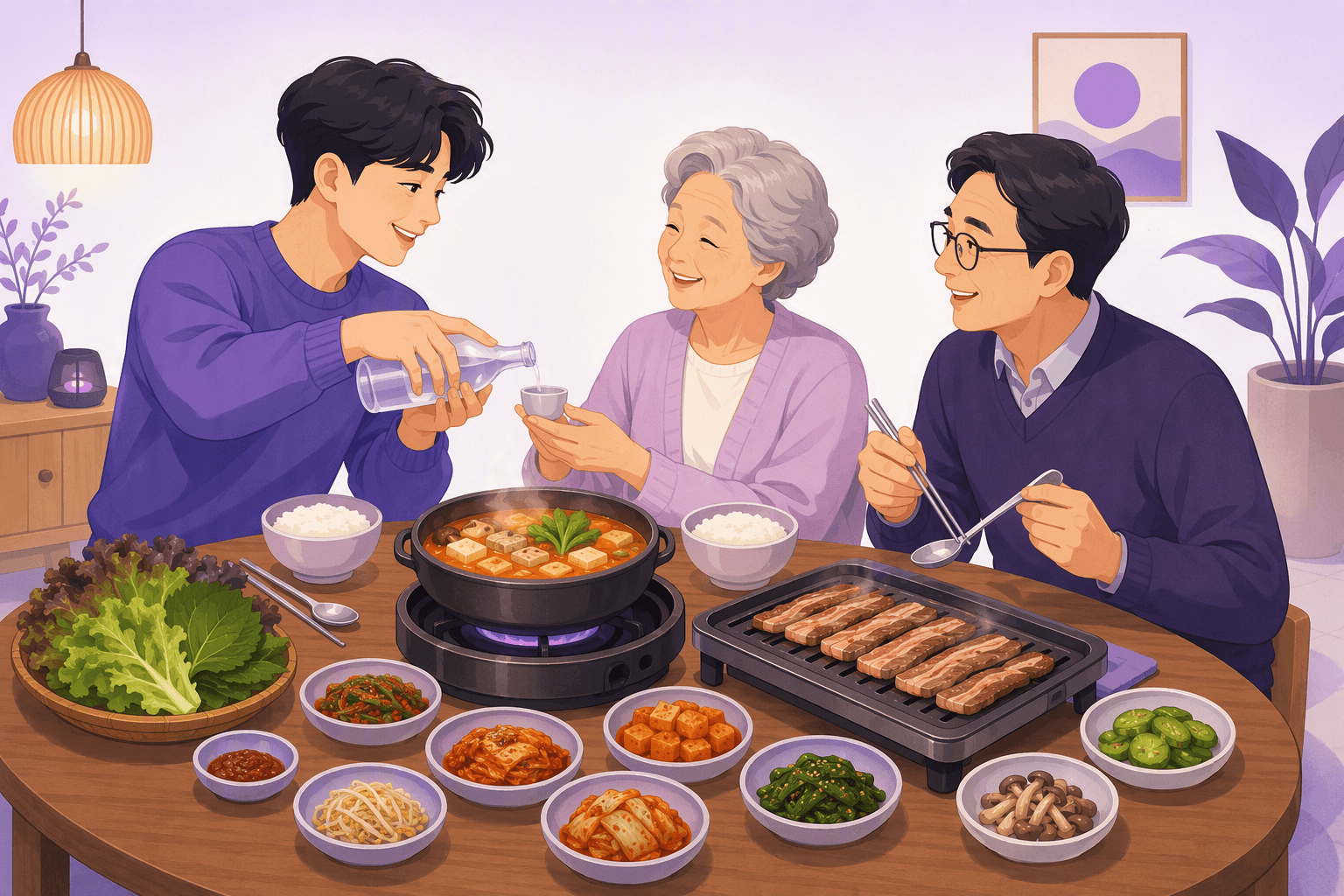
Korean meals are built around togetherness: shared dishes in the center, constant passing, and a rhythm that keeps everyone engaged. Even in a restaurant, the table often behaves like a small community, especially when food is cooked at the table.
Korean is spoken by about 82 million people worldwide (Ethnologue, 27th edition, 2024). That matters because the “default” meal style you encounter in Korea is also the style many Korean families keep abroad, especially for celebrations.
In Korean Cuisine: An Illustrated History, Michael J. Pettid describes how Korean food traditions developed around seasonal ingredients and communal eating. That historical lens helps explain why banchan, soups, and fermented foods are not “extras”, they are structural.
The core structure of a Korean table
Rice, soup, and banchan
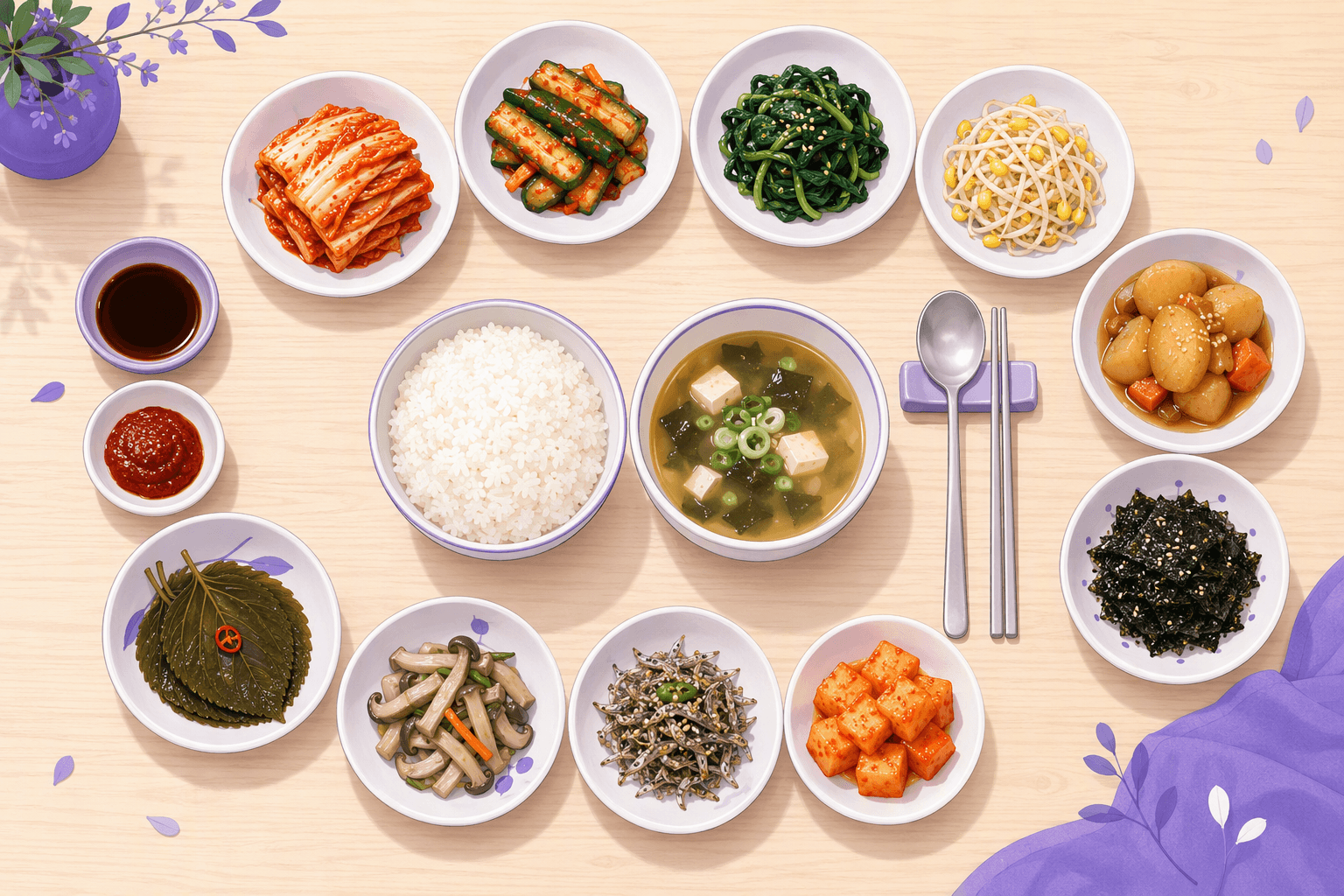
A common home-style setting is rice (밥), soup or stew (국 or 찌개), and several banchan (반찬). Banchan are not appetizers, they are part of the meal’s balance, so you eat them alongside rice and soup.
In many restaurants, banchan arrive automatically. In some places, refills are free, but not everywhere, so ask politely rather than assuming.
Shared mains and table cooking
Korean barbecue (고기구이) and dishes like 닭갈비 often involve cooking at the table. That creates an unspoken role system: someone tends the grill, someone cuts meat, someone manages lettuce wraps.
If you are a guest, it is polite to offer help, but also normal to let the most experienced person run the grill. Watch first, then mirror.
💡 A simple guest strategy
If you are unsure what to do, take small portions, eat at the group’s pace, and copy the most senior person’s rhythm. In Korean meals, matching the table matters more than being fast or adventurous.
The two phrases that instantly make you sound respectful
잘 먹겠습니다
잘 먹겠습니다 (jal meok-gehs-seum-nee-dah) is the classic “before eating” phrase. It signals gratitude, usually toward the person who cooked, hosted, or paid.
It is not a literal “I will eat well” in the English sense of diet talk. It is closer to “Thank you, I will enjoy this.”
/jal meok-gehs-seum-nee-dah/
Literal meaning: I will eat well.
“오늘도 잘 먹겠습니다.”
Thanks for the meal today, too.
Said before starting, especially when someone else cooked or is treating. In a group, people often say it together right before the first bite.
잘 먹었습니다
잘 먹었습니다 (jal meok-eoht-seum-nee-dah) is the matching “after eating” phrase. It closes the meal politely and thanks the cook or payer.
In a restaurant, it can also be a gentle way to signal you are done, especially if staff are nearby.
/jal meok-eoht-seum-nee-dah/
Literal meaning: I ate well.
“정말 잘 먹었습니다. 감사합니다.”
I really enjoyed the meal. Thank you.
Common after finishing, especially when you were treated. It is a safe, respectful default in both homes and restaurants.
Table manners that matter in Korea
Wait for elders, and follow the table’s pace
Hierarchy is a real social factor at meals. In many settings, you wait until the eldest person starts eating before you begin.
This is not about fear or stiffness. It is a practical way of showing respect, similar to how speech levels work in Korean greetings, if you want a refresher, see How to Say Hello in Korean.
Chopsticks and spoon: what goes with what
Korean meals commonly use both chopsticks (젓가락) and a spoon (숟가락). A simple rule is: spoon for rice and soup, chopsticks for banchan and shared dishes.
Do not stab food with chopsticks or wave them around while talking. When you pause, place utensils down neatly rather than leaving them stuck in food.
Don’t “camp” on the shared dishes
Because many dishes are shared, Korean dining rewards small, frequent portions. Take a bite-sized amount, then return to your rice, rather than hovering over the center plate.
If you want more of something, wait a moment and take another small portion. This keeps the table feeling fair without anyone needing to say it.
Phone use and attention
In casual settings, people do use phones, but during a hosted meal, it can read as disengaged. If the meal is a “treat” (someone is paying), attention and appreciation are part of the social exchange.
A quick compliment like 맛있어요 (mah-shee-suh-yoh) goes a long way.
Banchan culture: the side dishes are the meal
What banchan are really doing
Banchan provide contrast: crunchy vs soft, spicy vs mild, fermented vs fresh. They also let a table adapt to different preferences without customizing the main dish for each person.
UNESCO’s listing of kimjang (communal kimchi-making) highlights how food preparation can be a social practice, not just cooking. That same social logic shows up at the table when banchan are shared and replenished.
How to ask for refills politely
In many Korean restaurants, you can ask for more side dishes. Use:
- 반찬 좀 더 주세요 (bahn-chahn johm duh joo-seh-yoh), “Please give me more side dishes.”
If you want a specific one, point and name it if you can. If you cannot, pointing is acceptable in a busy restaurant, but keep it subtle.
/bahn-chahn johm duh joo-seh-yoh/
Literal meaning: Please give (us) a bit more side dishes.
“이거 반찬 좀 더 주세요.”
Please give me a bit more of this side dish.
Common in restaurants. '좀' softens the request, making it sound less demanding.
Korean drinking culture at meals (soju, beer, and rules of respect)
Alcohol is not required, but when people drink together, etiquette becomes more visible. The rules are mostly about showing consideration, not about being strict.
Pouring and receiving with two hands
A common norm is to pour drinks for others and receive with two hands, especially when someone older is involved. If you are younger, you usually do not pour your own first.
If you do not drink, you can still participate socially: keep a non-alcoholic drink and toast with it. The group ritual matters more than the substance.
Turning away when drinking with elders
You may see people turn slightly away when taking a sip in front of an elder. This is a traditional respect gesture that still appears in formal or work settings.
In a casual friend group, it may not happen. If you are unsure, a small turn is a safe choice.
건배
건배 (guhn-beh) is “cheers.” It is short and widely used.
If you want to sound natural, match the energy of the table. A quiet “건배” is fine at a calm dinner, and a louder one fits a lively group.
Restaurant flow in Korea: what surprises visitors
Calling staff is normal
In many Korean restaurants, it is normal to call staff rather than waiting for them to check in repeatedly. You will hear 저기요 (juh-gee-yoh), roughly “excuse me over there,” used to get attention.
If you want more restaurant language, pair this article with Korean travel phrases for ordering, directions, and emergencies.
Paying can happen at the counter
In plenty of places, you pay at the front counter. Do not be surprised if the server does not bring a bill to the table automatically.
If you need it, ask politely: 계산서 주세요 (gyeh-sahn-seo joo-seh-yoh). At the counter, you will also hear the shorter 계산해 주세요 (gyeh-sahn-heh joo-seh-yoh), “please ring me up.”
Sharing costs vs treating
Splitting is common among friends, but “treating” is also common, especially from seniors to juniors. If someone insists on paying, a polite pushback once is normal, then accept graciously.
Your “thank you” can be verbal, and it can also be social: offering coffee later, sending a message, or inviting them next time.
Compliments and small talk that fit Korean meals
맛있어요
맛있어요 (mah-shee-suh-yoh) means “It’s delicious.” It is polite, safe, and used constantly.
A stronger compliment is 진짜 맛있어요 (jin-jjah mah-shee-suh-yoh), “It’s really delicious,” but keep it genuine.
/mah-shee-suh-yoh/
Literal meaning: It is tasty.
“와, 이거 진짜 맛있어요.”
Wow, this is really delicious.
A standard compliment to the cook or to friends who chose the restaurant. Saying it early, after the first bite, feels natural.
배불러요
배불러요 (beh-bool-luh-yoh) means “I’m full.” It can also be a gentle way to decline more food.
If someone keeps offering, you can combine it with thanks: 배불러요, 감사합니다 (beh-bool-luh-yoh, gahm-sah-hahm-nee-dah).
Home meals: what to do when you are a guest
Bring something small
A small gift is common when visiting someone’s home, fruit, dessert, or a drink. It does not need to be expensive, it needs to show thought.
If the host refuses at first, that can be polite ritual. Offer once or twice, then accept their response.
Where to sit and when to start
The host may guide seating. In more traditional settings, the most senior person sits in the most comfortable spot.
Wait for the host’s cue, and for elders to begin. Then say 잘 먹겠습니다 and start.
Helping with cleanup
Offering to help is polite. The host may refuse, but the offer itself matters.
If you do help, follow the host’s instructions. Korean kitchens can be fast and system-based, and “helping” without coordination can slow things down.
🌍 Why the meal feels like a social contract
In many Korean contexts, a meal is a way to create and maintain relationships. Linguist Sohn Ho-min, in his work on Korean language and culture, connects speech levels and social hierarchy to everyday interaction. Dining etiquette is one of the places where that social grammar becomes visible without anyone explaining it.
Food culture vocabulary you will actually hear
Korean food talk is full of short, practical words. If you learn a few, you can follow conversations even when you cannot name every dish.
| English | Korean | Pronunciation | Note |
|---|---|---|---|
| Side dishes | 반찬 | bahn-chahn | Shared small dishes served with rice. |
| Rice | 밥 | bahp | Also used broadly to mean 'a meal'. |
| Soup | 국 | gook | Often part of a standard home meal. |
| Stew | 찌개 | jjee-geh | Hearty, often spicy, eaten with rice. |
| Kimchi | 김치 | gim-chee | Fermented vegetables, many regional types. |
| Korean barbecue | 고기구이 | goh-gee-goo-ee | Meat grilled at the table. |
| Lettuce wrap | 쌈 | ssahm | Wrap meat and rice with greens and sauces. |
| Soy sauce | 간장 | gahn-jahng | Common base seasoning. |
| Red chili paste | 고추장 | goh-choo-jahng | Sweet-spicy fermented paste. |
| Soybean paste | 된장 | dwen-jahng | Fermented paste, strong savory flavor. |
| Soju | 소주 | soh-joo | Common Korean spirit, often shared. |
| Beer | 맥주 | mek-joo | Often paired with fried foods. |
How to learn Korean through food scenes in movies and K-dramas
Food scenes are dense with real Korean: requests, refusals, teasing, and respect language. You also hear the “softeners” that make Korean sound natural, like 좀 (a bit) in requests.
If you are studying through clips, focus on one micro-skill per scene: one phrase, one etiquette moment, one pronunciation detail. This is the same logic behind spaced review systems, see our spaced repetition guide if you want a structure that sticks.
A practical clip routine:
- Watch once with subtitles for meaning.
- Rewatch and shadow one line, aiming for rhythm.
- Save 5 to 10 words from the scene, then review them the next day.
If your Korean pronunciation feels hard, especially with batchim (final consonants), use Korean pronunciation guide alongside food content so you do not memorize unclear sounds.
Common mistakes foreigners make (and how to fix them fast)
Starting too early
If you start eating before the eldest person, you can create awkwardness. The fix is simple: pause, smile, and wait for the first movement from the senior person.
Treating banchan like personal plates
Taking large portions from shared dishes can look inconsiderate. Take small amounts, then return later if you want more.
Overusing casual speech
Food settings often mix casual warmth with polite language, especially when you are not close friends. If you are unsure, use polite endings like -요 and polite set phrases.
If you want a clean overview of greeting politeness, connect this with How to Say Goodbye in Korean. Goodbye phrases often reveal the same respect patterns you see at the table.
⚠️ A quick note on swearing at the table
Korean meals can be loud and playful, but profanity is still risky around elders or in work dinners. If you are curious, read our guide to Korean swear words for context and what to avoid.
A short, realistic “first meal” script
You do not need perfect Korean to be polite. You need timing, a few phrases, and calm body language.
- Greet: 안녕하세요 (ahn-NYUHNG-hah-seh-yoh).
- Sit and wait for the cue.
- Before eating: 잘 먹겠습니다 (jal meok-gehs-seum-nee-dah).
- Compliment once: 맛있어요 (mah-shee-suh-yoh).
- If offered more: accept or decline gently.
- After eating: 잘 먹었습니다 (jal meok-eoht-seum-nee-dah).
- Say goodbye politely, see How to Say Goodbye in Korean.
If you are eating with a partner’s family, you may also want affectionate language for messages after the meal. How to Say I Love You in Korean covers natural options that do not sound like textbook lines.
The cultural logic behind “eating well”
Korean food culture is not only about dishes like kimchi or barbecue. It is about relationship maintenance through shared routines: waiting, offering, pouring, thanking, and matching the table.
Anthropologist Sidney Mintz, in Sweetness and Power, shows how food can organize social life and status, not just nutrition. Korean dining etiquette is a clear example: the meal is a social system you can participate in, even as a beginner.
If you want to learn Korean the way it is actually spoken, food scenes are one of the best entry points because they combine everyday vocabulary with real politeness. For more ways to learn through real dialogue, browse the Wordy blog and build a clip-based routine that fits your life.
Frequently Asked Questions
What is the most important rule in Korean dining etiquette?
What do Koreans say before and after eating?
Is it rude to pick up your rice bowl in Korea?
Do you have to finish all the banchan?
How do you politely ask for the bill in a Korean restaurant?
Sources & References
- National Institute of Korean Language (국립국어원), Standard Korean Language Dictionary (표준국어대사전), accessed 2026
- Korean Culture and Information Service (KOCIS), Guide to Korean Culture and Daily Life, accessed 2026
- UNESCO, Kimjang: Making and Sharing Kimchi in the Republic of Korea, accessed 2026
- Ethnologue, Korean, 27th edition, 2024
- Korea Tourism Organization, Korean Food and Dining Etiquette, accessed 2026
Start learning with Wordy
Watch real movie clips and build your vocabulary as you go. Free to download.


