Quick Answer
Korean untranslatable words describe relationships, emotions, social awareness, and habits that English often needs a full sentence to explain. Words such as 정, 눈치, 한, and 빨리빨리 reveal how Korean speakers frame belonging, restraint, collective feeling, and daily life.
Korean has no magical set of words that English speakers are incapable of understanding, but it does have compact expressions for social awareness, shared attachment, restrained emotion, and cultural habits that English usually explains with a phrase. Words such as 정 /tɕʌŋ/, 눈치 /nuntɕʰi/, 한 /han/, and 빨리빨리 /p͈al.li p͈al.li/ are valuable because they show how Korean speakers often read relationships and situations, not just dictionary definitions.
Korean is spoken by an estimated 81.7 million people worldwide, according to Ethnologue's 27th edition. It is the national language of both South Korea and North Korea, and it is also used in large diaspora communities across China, the United States, Japan, Central Asia, and beyond.
Learning these concepts will not make someone instantly culturally fluent. It will, however, make dialogue in dramas, films, family scenes, and ordinary conversations much easier to interpret. Start with familiar everyday speech in our guide to saying hello in Korean, then use the words below to notice what characters are communicating indirectly.
| Cultural idea | Korean | Pronunciation | Note |
|---|---|---|---|
| Deep bond built over time | 정 | juhng | Affection, attachment, and mutual obligation formed through shared life. |
| Social awareness | 눈치 | noon-chee | Reading the room and noticing unstated feelings or expectations. |
| Enduring unresolved sorrow | 한 | hahn | A complex feeling tied to grief, injustice, longing, and endurance. |
| Urgency culture | 빨리빨리 | pahl-lee pahl-lee | Literally 'quickly quickly,' expressing speed and impatience with delay. |
| Excited collective energy | 흥 | heung | Lively enthusiasm, rhythm, playfulness, and emotional momentum. |
| Ready-made answer seeker | 답정너 | dahp-juhng-nuh | Someone who asks a question but expects one particular answer. |
| Exemplary child comparison | 엄친아 | uhm-chin-ah | Short for 'mother's friend's son,' an unrealistically impressive comparison person. |
| Taste of a person's hand | 손맛 | sohn-maht | The distinctive care and personal touch in home cooking. |
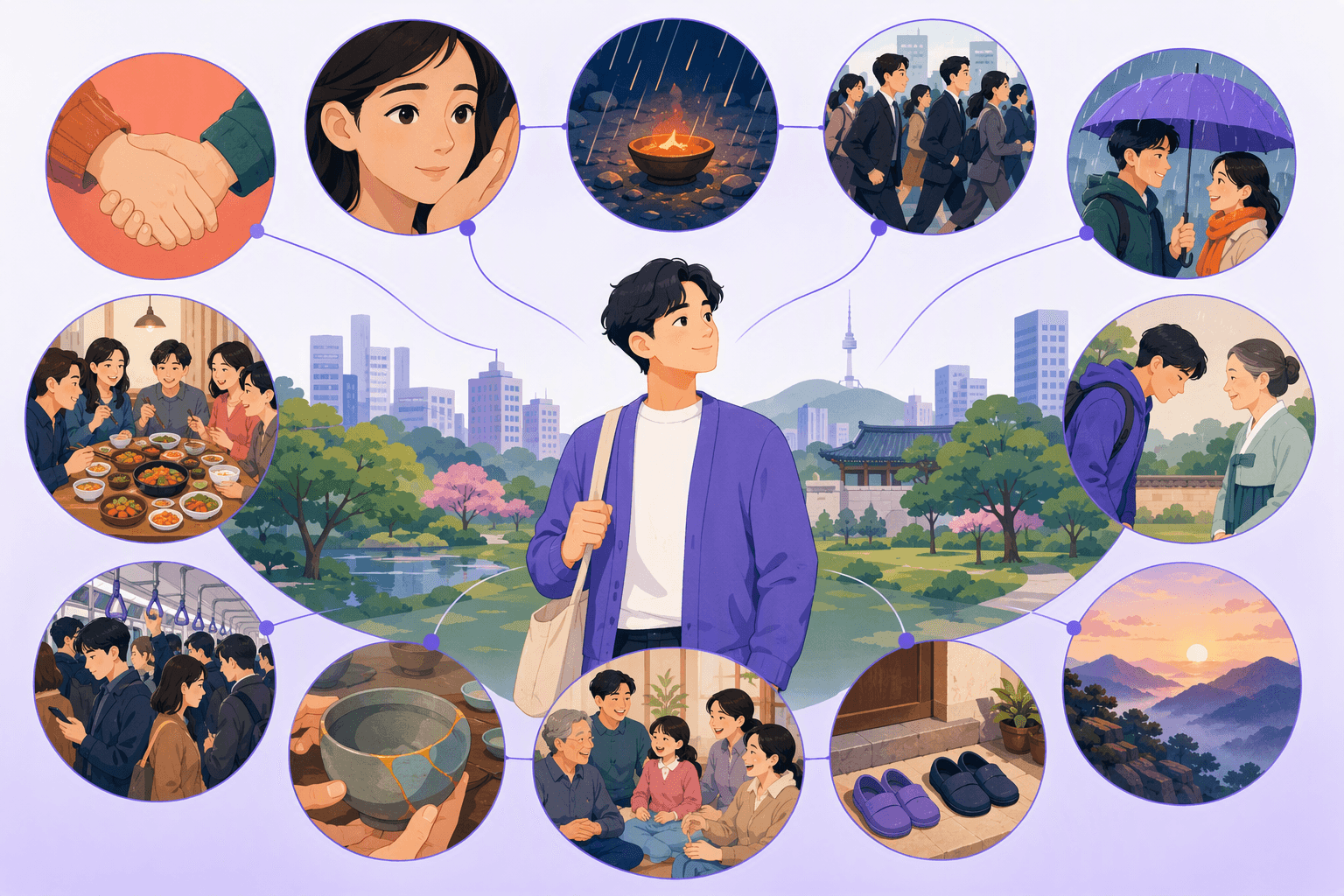
Why these Korean words matter
An untranslatable word is not a word with no translation at all. It is a word whose social force, emotional range, or cultural associations cannot be transferred neatly into one English equivalent.
The National Institute of Korean Language defines words through usage and context, not through simplistic one-word substitutes. That matters with Korean cultural vocabulary because the meaning often changes according to age, relationship, place, tone, and shared history.
Ho-min Sohn, in The Korean Language, highlights how Korean interaction is shaped by speech levels and relationship-sensitive choices. Concepts such as 눈치 /nuntɕʰi/ are therefore not decorative cultural trivia. They help explain why a speaker might soften a refusal, avoid a direct request, or wait for a group signal before acting.
Korean also uses a writing system designed for remarkable accessibility. Young-Key Kim-Renaud's work on Hangul explains the historical and structural importance of the alphabet. Yet even when you can read 한글 /han.ɡɯl/, understanding the cultural layer behind a short word takes repeated exposure to real people and scenes.
정
정 /tɕʌŋ/ is often translated as affection, attachment, warmth, or bond. None is fully wrong, but none is enough.
A person can feel 정 /tɕʌŋ/ toward a childhood neighborhood, an elderly shop owner, a longtime coworker, a pet, or even a restaurant they have visited for years. The feeling is built rather than declared. It includes familiarity, care, memory, loyalty, and sometimes an obligation to show up for someone.
Unlike romantic love, 정 /tɕʌŋ/ does not require intensity or passion. Two people may argue constantly and still have strong 정 /tɕʌŋ/ because they have a long shared history.
In a drama, a character who continues helping an irritating relative may not be motivated by simple duty. The scene may be about 정 /tɕʌŋ/, an attachment that survives inconvenience and conflict.
미운 정
미운 정 /mi.un tɕʌŋ/ describes attachment toward someone you find difficult, frustrating, or even annoying. English has phrases such as fond exasperation, but Korean packages the contradiction in two short words.
It often appears in relationships where repeated annoyance has become inseparable from care. A parent might complain about an adult child while continuing to cook for them, worry about them, and defend them to outsiders.
🌍 Jeong is not always positive
정 /tɕʌŋ/ can make separation hard. It may explain why people remain attached to a workplace, neighborhood, relationship, or routine even when it is no longer fully satisfying.
눈치
눈치 /nuntɕʰi/ means the ability to sense what is happening socially without needing everything explained aloud. It is often rendered as reading the room, but it includes noticing hierarchy, mood, timing, and indirect signals.
Someone with 좋은 눈치 /tɕo.ɯn nuntɕʰi/, literally good social awareness, recognizes that a colleague is busy, that a host is ready to end a visit, or that a senior person should be allowed to speak first. Someone with 없는 눈치 /ʌm.nɯn nuntɕʰi/, no social awareness, misses these signals.
This does not mean Korean communication is always vague. Koreans can be extremely direct, particularly among close friends or when the situation requires clarity. But in many settings, paying attention before speaking is treated as considerate and competent.
눈치 없다
눈치 없다 /nuntɕʰi ʌp.t͈a/ literally means to lack 눈치 /nuntɕʰi/. It can be a teasing comment among friends or a sharp criticism when someone ignores obvious discomfort.
For example, continuing to tell jokes after everyone has become quiet could earn this label. So could asking a personal question at an inappropriate moment. Tone determines whether it feels playful or insulting.
Korean shows often portray the socially oblivious character for comedy. When subtitles say clueless, tactless, or unable to read the room, the original line may involve 눈치 /nuntɕʰi/.
한
한 /han/ is one of the most discussed Korean emotional concepts. It refers to a lasting, unresolved feeling associated with sorrow, frustration, loss, injustice, longing, and persistence.
It should not be treated as an emotion every Korean person experiences in the same way. Scholars and artists have debated the term for decades, and using it as a fixed national personality stereotype misses its complexity.
In literature, music, and film, 한 /han/ can describe pain that does not disappear because there has been no adequate resolution. It can be personal, such as grief after a family loss, or collective, such as a response to historical hardship.
한풀이
한풀이 /han.pʰu.ri/ means releasing or working through 한 /han/. The word combines 한 /han/ with 풀다 /pʰul.da/, meaning to untie, loosen, or resolve.
In performance traditions, storytelling, and emotional scenes, 한풀이 /han.pʰu.ri/ may involve expression rather than silent endurance. Crying, singing, speaking openly, or ritual action can all represent an attempt to give form to pain.
🌍 Avoid reducing han to 'Korean sadness'
한 /han/ is not a shorthand for an entire people. It is better understood as a culturally significant word used to discuss certain forms of unresolved emotion, historical memory, and endurance.
빨리빨리
빨리빨리 /p͈al.li p͈al.li/ literally means quickly, quickly. It captures a recognizable Korean preference for speed, efficiency, and prompt action.
You may hear it from parents urging children to get ready, from customers waiting for service, or from friends hurrying each other along. It can sound impatient, affectionate, practical, or humorous depending on the relationship.
South Korea's rapid industrialization and dense urban life are often linked to the cultural visibility of 빨리빨리 /p͈al.li p͈al.li/. It is visible in fast delivery expectations, quick service, mobile infrastructure, and the pressure to avoid wasted time.
빨리빨리 문화
빨리빨리 문화 /p͈al.li p͈al.li mun.hwa/ means fast-fast culture. It is sometimes praised as a source of responsiveness and innovation, and sometimes criticized for stress, burnout, and impatience.
The important point for learners is pragmatic. If a Korean speaker says 빨리 /p͈al.li/ to you, they may simply mean hurry up, not necessarily expressing anger. Watch the facial expression and relationship before deciding how serious it is.
For more on the norms behind everyday interaction, read our guide to Korean etiquette and customs.
흥
흥 /hɯŋ/ is spirited excitement, enjoyment, emotional lift, and a sense of rhythmic energy. It can describe the force that makes people clap, sing along, dance, joke, or become fully absorbed in a fun moment.
English words such as vibe, enthusiasm, and party spirit overlap with 흥 /hɯŋ/, but the Korean word often has a communal feeling. It is not only about one person's happiness. It is about an energy that spreads through a group.
You may hear 흥이 나다 /hɯŋ.i na.da/, meaning that excitement or spirit arises, when someone becomes animated by music, food, a game, or a gathering. In K-pop and variety shows, the concept is easy to spot when a quiet room suddenly becomes loud, playful, and participatory.
흥을 깨다
흥을 깨다 /hɯŋ.ɯl k͈ɛ.da/ literally means to break the excitement or spoil the mood. A person who interrupts a celebration with excessive criticism might be accused of doing this.
This phrase reveals that enjoyment can be treated as something shared and worth protecting. It also explains why someone may avoid an overly serious comment at a festive meal.
답정너
답정너 /tap.t͡ɕʌŋ.nʌ/ is modern Korean internet slang formed from 답은 정해져 있고 너는 대답만 하면 돼 /ta.bɯn tɕʌŋ.hɛ.d͡ʑʌ it.k͈o nʌ.nɯn tɛ.dap.man ha.mjʌn twe/. The expanded sentence means that the answer has already been decided, and you only need to give it.
A 답정너 /tap.t͡ɕʌŋ.nʌ/ asks what seems like an open question but expects approval of one predetermined answer. For example, someone asks which outfit looks best while clearly wanting praise for the outfit they already chose.
The word can be light teasing among friends. It can also criticize a person who uses questions to control a conversation rather than genuinely hear others.
The social logic behind 답정너
답정너 /tap.t͡ɕʌŋ.nʌ/ is funny because it points to a common conversational tension. People often want reassurance, but they may present that need as a neutral request for advice.
The term is useful for Korean learners because it appears in comment sections, reality shows, and casual chat. It also teaches a valuable rule: a question may carry an emotional purpose beyond its literal content.
엄친아 and 엄친딸
엄친아 /ʌm.tɕʰi.na/ is short for 엄마 친구 아들 /ʌm.ma tɕʰin.ɡu a.dɯl/, meaning mother's friend's son. It refers to the impossibly accomplished comparison figure a parent might mention: excellent grades, impressive career, polite behavior, and perfect habits.
엄친딸 /ʌm.tɕʰin.t͈al/, mother's friend's daughter, works the same way. These terms are usually humorous, though they reflect real pressure around achievement and comparison.
A Korean character might groan when their parent brings up an 엄친아 /ʌm.tɕʰi.na/. The joke is not that the person literally knows the family. The joke is that there is always a supposedly flawless peer used as a benchmark.
This vocabulary can help viewers notice generational expectations in K-dramas. It connects naturally with themes of school, work, family reputation, and the desire to define success independently.
손맛
손맛 /son.mat/ literally means hand taste. It describes the individual touch, practice, care, and intuition that make a person's cooking distinctive.
A recipe can list ingredients and measurements, but it cannot always reproduce 손맛 /son.mat/. A grandmother may adjust seasoning by sight, sound, smell, and experience. The final dish tastes like her cooking because her methods are embodied rather than fully written down.
The word is especially meaningful in home food culture. It honors the labor behind a meal without reducing that labor to technical skill alone.
Why 손맛 matters at the table
Calling a meal 손맛 /son.mat/ is often a compliment to the cook's personal care. It recognizes that food can carry memory, family connection, and identity.
If you want practical expressions for meals and restaurants, see our Korean restaurant phrases guide. Notice how politeness, shared dishes, and gratitude reinforce the relational side of food.
How to learn cultural words without forcing them
Do not try to insert every Korean cultural word into conversation immediately. A word like 정 /tɕʌŋ/ can sound natural in a reflective discussion, but it may feel strange if used as a dramatic label for a new acquaintance.
Instead, learn each word through repeated scenes. When watching Korean media, pause when a subtitle says atmosphere, attachment, reading the room, bottled-up pain, or hurry. Ask what Korean term was used and what relationship is visible in the scene.
Use a simple three-part note: the Korean word, the literal translation, and a real situation. For 눈치 /nuntɕʰi/, write social awareness, then add a scene where someone notices an uncomfortable silence and changes the topic.
💡 Learn the scene, not only the gloss
Cultural words become memorable when you connect them to faces, tone, and consequences. A short drama clip showing someone with bad 눈치 /nuntɕʰi/ teaches more than a dictionary definition alone.
Korean affection is also expressed through context rather than repeated direct declarations. Compare these cultural concepts with the phrases in our guide to saying I love you in Korean, then listen for care shown through food, practical help, teasing, and concern.
A final perspective on Korean words that resist translation
Words such as 정 /tɕʌŋ/, 눈치 /nuntɕʰi/, 한 /han/, 흥 /hɯŋ/, and 손맛 /son.mat/ are not mysterious codes available only to native speakers. They are useful cultural lenses.
English can explain every one of them. Korean simply makes certain emotional and social patterns easier to name, recognize, and discuss. The best way to understand them is to meet them repeatedly in real conversations, songs, films, family scenes, and daily interactions.
When it is time to leave one of those conversations, the right farewell also depends on relationship and setting. Our guide to saying goodbye in Korean will help you choose a natural ending.
Frequently Asked Questions
What is the most famous untranslatable Korean word?
Does 눈치 mean intuition in Korean?
Is 한 always a negative Korean emotion?
Can Korean untranslatable words be used in everyday conversation?
Why does Korean have words that seem untranslatable?
Sources & References
- National Institute of Korean Language, Standard Korean Language Dictionary, accessed 2026
- King Sejong Institute Foundation, Korean Language and Culture Resources, accessed 2026
- Ethnologue, Korean, 27th edition, 2024
- Ho-min Sohn, The Korean Language, Cambridge University Press
- Young-Key Kim-Renaud, The Korean Alphabet: Its History and Structure, University of Hawai'i Press
Start learning with Wordy
Watch real movie clips and build your vocabulary as you go. Free to download.