Quick Answer
Seollal is the Korean Lunar New Year, a major family holiday centered on honoring ancestors, visiting relatives, eating tteokguk, giving gifts, and offering respectful New Year bows. Learn the traditions, etiquette, food, and Korean phrases you will hear during Seollal.
| English | Korean | Pronunciation | Formality |
|---|---|---|---|
| Happy New Year | 새해 복 많이 받으세요 | seh-heh bok MAH-nee pah-deu-SEH-yoh | polite |
| Please receive lots of blessings in the new year | 새해 복 많이 받으십시오 | seh-heh bok MAH-nee pah-deu-SHIP-shee-oh | formal |
| Happy New Year | 새해 복 많이 받아 | seh-heh bok MAH-nee pah-dah | casual |
| Have a happy Lunar New Year holiday | 즐거운 설날 보내세요 | jeul-guh-oon suhl-lahl boh-neh-SEH-yoh | polite |
| Thank you for your kind words | 덕담 감사합니다 | duhk-dahm gahm-SAH-hahm-nee-dah | polite |
Seollal, written 설날 and pronounced /sʌl.lal/, is Korea's Lunar New Year holiday: a time when families return home, honor ancestors, eat rice-cake soup, exchange good wishes, and reconnect across generations. If you are visiting Korea or celebrating with Korean friends, the safest greeting is 새해 복 많이 받으세요 /sɛ.he bok ma.ni pa.dɯ.se.jo/, meaning that you hope the listener receives abundant good fortune in the new year.
Seollal is one of South Korea's most important public holidays, alongside Chuseok /tɕʰu.sʌk/, the autumn harvest festival. It is also an intensely busy travel period, because many people leave Seoul and other cities to visit parents and grandparents in their hometowns. For a broader foundation in everyday Korean greetings before the holiday, see our guide to how to say hello in Korean.
Korean is spoken by roughly 81 million people worldwide, according to Ethnologue's 27th edition. Seollal customs are strongest in South Korea, but Korean families in North Korea and diaspora communities also observe Lunar New Year traditions in varied forms.
What Seollal means in Korea
The word 설날 /sʌl.lal/ refers specifically to the first day of the lunar year. Because the lunar calendar does not align exactly with the Gregorian calendar, Seollal falls on a different date each year, usually between late January and mid-February.
In 2026, Lunar New Year falls on February 17. In South Korea, the official Seollal holiday period normally includes the day before, the day itself, and the day after, allowing families time to travel and gather.
Seollal is not simply a party or a countdown night. Its center is family obligation, respect for elders, remembrance of ancestors, and the hope that the coming year will be healthy and fortunate.
The National Folk Museum of Korea describes the holiday as a seasonal ritual that combines family rites, food, play, and age-based etiquette. Those elements remain visible even in households that celebrate in a modern, low-key way.
The main Seollal traditions
차례
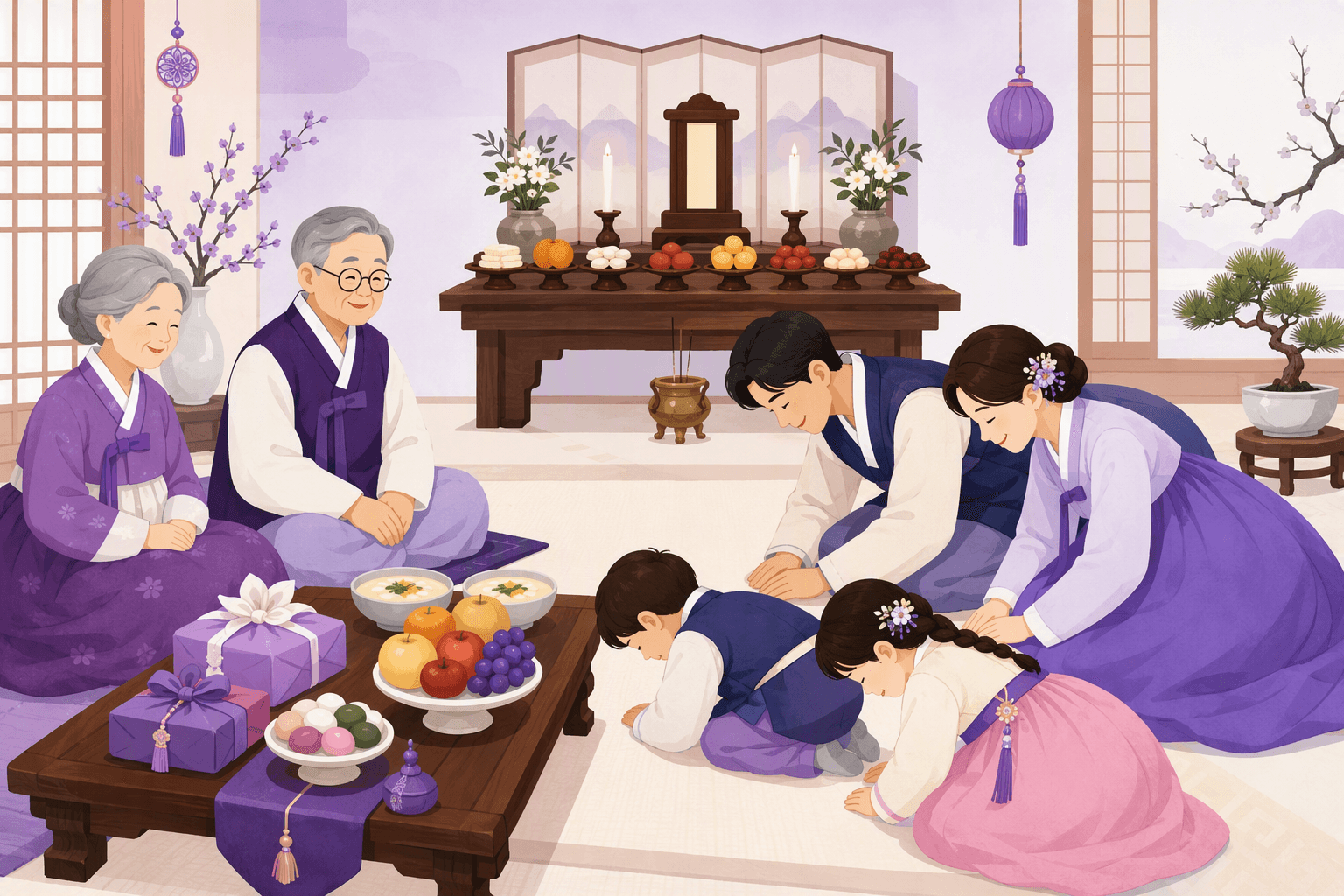
Many families begin the morning with 차례 /tɕʰa.ɾje/, an ancestral memorial rite. Food is carefully placed on a table, family members pay respects, and the family remembers deceased relatives.
Not every Korean household performs 차례 /tɕʰa.ɾje/ in the same way. Some families follow detailed regional or family rules, while others keep a short and simple ceremony, or do not hold one at all.
Martina Deuchler's The Confucian Transformation of Korea explains how Confucian family structures shaped Korean ritual life over centuries. Seollal memorial practices are one living example, although contemporary families interpret and adapt them differently.
If you are a guest, do not rearrange the ritual table, begin eating before being invited, or photograph the ceremony without permission. Quiet observation and following the host's lead are usually the right choices.
세배
After the family rite, younger relatives may perform 세배 /se.be/, a formal New Year bow to parents, grandparents, and older family members. The bow is not casual: it communicates gratitude, respect, and recognition of family hierarchy.
Traditionally, men and women have used slightly different hand positions for the bow. In practice, a guest does not need to master every detail immediately. Ask a trusted Korean friend or relative to show you, and follow their instruction rather than guessing.
After the bow, elders often give 덕담 /tʌk.tam/, warm wishes or advice for the year ahead. A grandparent may wish a student academic success, good health, or patience. The younger person responds respectfully, often with 감사합니다 /kam.sa.ham.ni.da/, pronounced /kam.sa.ham.ni.da/.
세뱃돈
Children commonly receive 세뱃돈 /se.bet.t͈on/, New Year money, after offering 세배 /se.be/. The money is generally given in an envelope and is a familiar source of excitement for children.
The custom is not a payment for bowing. It is a symbolic gift that conveys care, luck, and hopes for the child's future. Adults may also give gift sets, fruit, health products, or money to parents and relatives.
🌍 If you receive a Seollal gift
Accept it with both hands when practical, especially from an older person. Thank the giver directly and avoid opening money or a wrapped present immediately unless they encourage you to do so.
덕담
덕담 /tʌk.tam/ means a kind New Year message. Unlike an empty formula, it often reflects the listener's stage of life: health for grandparents, success for someone beginning work, or encouragement for a student facing exams.
Good 덕담 /tʌk.tam/ is supportive rather than intrusive. Questions about marriage, children, grades, or salary can be sensitive, even though relatives may raise them in some families.
Seollal greetings you can use
The most useful Seollal expression is 새해 복 많이 받으세요 /sɛ.he bok ma.ni pa.dɯ.se.jo/. Literally, it asks someone to receive many blessings in the new year. It is polite, warm, and suitable for most people.
새해
새해 /sɛ.he/ means new year. The first syllable 새 /sɛ/ means new, while 해 /he/ means year. It appears in the standard holiday greeting and in New Year cards, messages, and workplace emails.
Use 새해 복 많이 받으세요 /sɛ.he bok ma.ni pa.dɯ.se.jo/ with people you do not know closely, older relatives, teachers, coworkers, and neighbors. The ending 세요 /se.jo/ makes it appropriately polite.
/seh-heh bok MAH-nee pah-deu-SEH-yoh/
Literal meaning: Please receive many blessings in the new year
“할머니, 새해 복 많이 받으세요.”
Grandmother, Happy New Year.
This is the standard Seollal greeting. Use it with relatives, colleagues, and people older than you.
설날
설날 /sʌl.lal/ is Lunar New Year's Day. To wish someone a pleasant holiday rather than only a happy new year, say 즐거운 설날 보내세요 /tɕɯl.kʌ.un sʌl.lal po.ne.se.jo/.
This phrase means have an enjoyable Seollal holiday. It works well in a message sent before people travel or when you know someone will be with family.
/jeul-guh-oon suhl-lahl boh-neh-SEH-yoh/
Literal meaning: Please spend an enjoyable Seollal
“가족과 함께 즐거운 설날 보내세요.”
Have a happy Seollal with your family.
A natural message for coworkers, friends, and acquaintances before the holiday break.
복
복 /pok̚/ means blessing, fortune, or good luck. It is the key noun in the standard New Year greeting, and its positive meaning is why the phrase sounds warmer than a direct translation of Happy New Year.
You may see 복 /pok̚/ written on decorative signs or hear it in holiday messages. It has a final consonant sound that is short and unreleased, not a fully pronounced English-style k.
덕담
When an elder gives you 덕담 /tʌk.tam/, a respectful response is 덕담 감사합니다 /tʌk.tam kam.sa.ham.ni.da/, meaning thank you for your kind wishes. This is useful when you want to acknowledge a longer blessing or piece of advice graciously.
/duhk-dahm gahm-SAH-hahm-nee-dah/
Literal meaning: I am thankful for your good words
“좋은 덕담 감사합니다.”
Thank you for your kind New Year wishes.
Use this after an older relative, teacher, or colleague offers a New Year message.
Seollal food and its symbolism
떡국
떡국 /t͈ʌk̚.kuk̚/ is the food most closely associated with Seollal. It is a soup of thinly sliced rice cakes, usually served in broth with egg garnish, seaweed, meat, dumplings, or other family-specific additions.
The oval rice-cake slices are often associated with old Korean coin shapes, while their pale color suggests a clean beginning. Food symbolism differs among families, but the association between 떡국 /t͈ʌk̚.kuk̚/ and the first meal of the year is widespread.
A familiar question is 떡국 먹었어요? /t͈ʌk̚.kuk̚ mʌ.gʌ.s͈ʌ.jo/, literally did you eat rice-cake soup? It can playfully imply have you become a year older?
Korea's legal age system changed to use the international age standard in 2023 for many official purposes. Yet the joking connection between eating 떡국 /t͈ʌk̚.kuk̚/ and getting older remains part of everyday Seollal conversation.
전
전 /tɕʌn/ refers to savory pan-fried dishes, often made with vegetables, seafood, fish, meat, or tofu coated in egg and flour. Families may prepare many varieties before the holiday, making the kitchen a major part of Seollal preparation.
The smell of frying 전 /tɕʌn/ is deeply associated with holiday visits for many Koreans. It is also labor-intensive, which has prompted wider public conversations about sharing holiday cooking and household work fairly.
잡채
잡채 /tɕap.tɕʰɛ/ is a dish of glass noodles, vegetables, sesame oil, and often meat. It is not exclusive to Seollal, but it frequently appears on a large holiday table because it serves a crowd and can be prepared in advance.
Food varies by region and household. Some families emphasize dumplings, braised short ribs, seafood, or particular kinds of rice cake, so there is no single mandatory Seollal menu.
🌍 Do not assume every family celebrates identically
Seollal is meaningful across Korea, but households differ by religion, region, generation, work schedules, and family history. Some people travel for elaborate rites, while others eat one meal together, call relatives, or use the holiday to rest.
Traditional clothes, games, and modern celebrations
한복
Some people wear 한복 /han.bok̚/, traditional Korean clothing, for Seollal. Children may especially wear colorful outfits for family photos and 세배 /se.be/, but everyday clothing is also completely normal.
A 한복 /han.bok̚/ is not a costume requirement. If you are invited to a Seollal gathering, wear neat, modest clothes unless your host specifically suggests traditional dress.
윷놀이
윷놀이 /jut.no.ɾi/ is a traditional board game played with four marked wooden sticks. Players throw the sticks to determine how their tokens move around a board.
The game is easy to see during holiday broadcasts, family gatherings, and community events. It creates a social kind of competition that works well across generations, which is one reason it remains associated with Seollal.
For more vocabulary that appears in Korean media, family scenes, and celebrations, explore our K-Drama vocabulary guide. Seeing greetings and family speech in context makes their social tone far easier to remember.
Seollal etiquette for visitors
Start with the polite greeting 새해 복 많이 받으세요 /sɛ.he bok ma.ni pa.dɯ.se.jo/. Use both hands when giving or receiving gifts, pour drinks for older people with care, and wait for the host to indicate where to sit or when to begin eating.
If elders are present, use polite Korean endings such as 요 /jo/ or the more formal 합니다 /ham.ni.da/ style. You do not need perfect Korean to show respect, but avoid abruptly using casual speech with someone much older or someone you have just met.
Do not make jokes about family ceremonies, ancestry, or age. A curious question such as 이 음식은 뭐예요? /i ɯm.ɕi.gɯn mwo.je.jo/, meaning what is this food, is usually welcome. A helpful Korean etiquette and customs guide can prepare you for broader social situations.
A note on holiday pressure
For many people, Seollal is joyful. For others, travel costs, traffic, family conflict, caregiving, and personal questions can make it stressful. Contemporary Korean media often portrays both sides of the holiday: affection and reunion, but also exhaustion and obligation.
Anthropologist Laurel Kendall's work on Korean family and ritual life emphasizes that rituals are social acts, shaped by relationships rather than frozen museum practices. That perspective helps explain why Seollal changes across generations while remaining emotionally important.
Learn Seollal Korean through real scenes
Holiday episodes in Korean dramas and variety shows are useful listening practice because they contain repeated family language: greetings, honorifics, food vocabulary, and casual talk between cousins. Watch a short scene once for the overall moment, then replay it to catch a phrase such as 새해 복 많이 받으세요 /sɛ.he bok ma.ni pa.dɯ.se.jo/.
Notice who uses casual speech and who uses polite endings. A child speaking to a grandparent, a sibling teasing another sibling, and an employee greeting a manager will not sound the same.
You can also practice leaving naturally after a family visit. Our guide to saying goodbye in Korean includes respectful farewells that fit Seollal visits and ordinary social situations.
Seollal Korean is ultimately about more than memorizing one holiday phrase. Learn the greeting, understand why people bow and eat 떡국 /t͈ʌk̚.kuk̚/, and pay attention to respect in the moment. That combination will make your words feel considerate rather than rehearsed.
Frequently Asked Questions
What is Seollal in Korea?
What do Koreans eat during Seollal?
How do you say Happy New Year in Korean for Seollal?
What is sebae during Seollal?
Is Seollal the same as Chinese New Year?
Sources & References
- National Folk Museum of Korea, Seollal: Lunar New Year's Day, accessed 2026
- Korea.net, Korean Lunar New Year Seollal, accessed 2026
- National Institute of Korean Language, Standard Korean Language Dictionary entries for 설날 and 세배, accessed 2026
- Ethnologue, Korean, 27th edition, 2024
- Martina Deuchler, The Confucian Transformation of Korea, Harvard University Asia Center
Start learning with Wordy
Watch real movie clips and build your vocabulary as you go. Free to download.