Quick Answer
Japanese social etiquette is built around showing respect, avoiding burdening others, and reading context. Learn the essentials, bowing basics, polite phrases with pronunciation, gift and dining rules, and the most common mistakes visitors make so you can act naturally in Japan.
Japanese social etiquette is a set of practical rules for showing respect and keeping interactions smooth, especially with strangers, elders, and in shared spaces. If you learn a few core ideas, bow lightly, use polite set phrases, and avoid the biggest taboos (especially around chopsticks and public behavior), you will come across as considerate even without perfect Japanese.
| English | Japanese | Pronunciation | Formality |
|---|---|---|---|
| Hello (polite) | こんにちは | kohn-NEE-chee-wah | polite |
| Good morning (polite) | おはようございます | oh-hah-YOH goh-ZAH-ee-mas | polite |
| Excuse me / sorry | すみません | soo-mee-MEHN | polite |
| Thank you (polite) | ありがとうございます | ah-ree-GAH-toh goh-ZAH-ee-mas | polite |
| Please (request) | お願いします | oh-neh-gah-ee shee-MAS | polite |
| Nice to meet you | はじめまして | hah-jee-MEH-she-teh | polite |
| Please treat me well | よろしくお願いします | yoh-roh-SHEH-koo oh-neh-gah-ee shee-MAS | polite |
| I'm sorry (stronger) | 申し訳ありません | moh-shee-WEH-keh ah-ree-MAH-sehn | formal |
Why Japanese etiquette feels different (and what it is really for)
Etiquette in Japan is less about "fancy manners" and more about predictability. People rely on shared scripts so strangers can cooperate smoothly in crowded cities, workplaces, and public transit.
Japan has about 123 million residents, and Japanese is among the world's largest languages by native speakers. Ethnologue (27th ed., 2024) estimates roughly 123 million native speakers of Japanese, concentrated primarily in Japan, which means social norms are reinforced at national scale.
The three ideas that explain most rules
1) Avoiding burden (迷惑, meiwaku)
迷惑 (MAY-wah-koo) is "causing trouble or burden." Many rules, like quiet trains and tidy shared spaces, are basically "do not make your problem someone else's problem."
2) Reading the situation (空気, kūki)
空気 (KOO-kee) literally means "air," but in social talk it often points to the vibe or unspoken context. "Reading the air" is noticing what everyone else is doing and matching it.
3) Politeness as a system (敬語, keigo)
敬語 (KAY-goh) is the honorific system, a structured way to show respect through word choice and verb forms. Japan's Agency for Cultural Affairs publishes guidance on keigo and how it is used in public life.
"Politeness is not simply a matter of saying 'please' and 'thank you' but a system for managing face and social relationships."
Peter Brown and Stephen C. Levinson, Politeness: Some Universals in Language Usage (1987)
That "system" is exactly what you feel in Japan: politeness is built into language, timing, and body movement.
💡 A simple visitor rule
If you are unsure what to do, copy the most considerate-looking person nearby: volume, pace, where they stand, and how they handle objects. In Japan, matching the local rhythm is often more important than doing a single gesture perfectly.
Bowing basics: what to do with your body
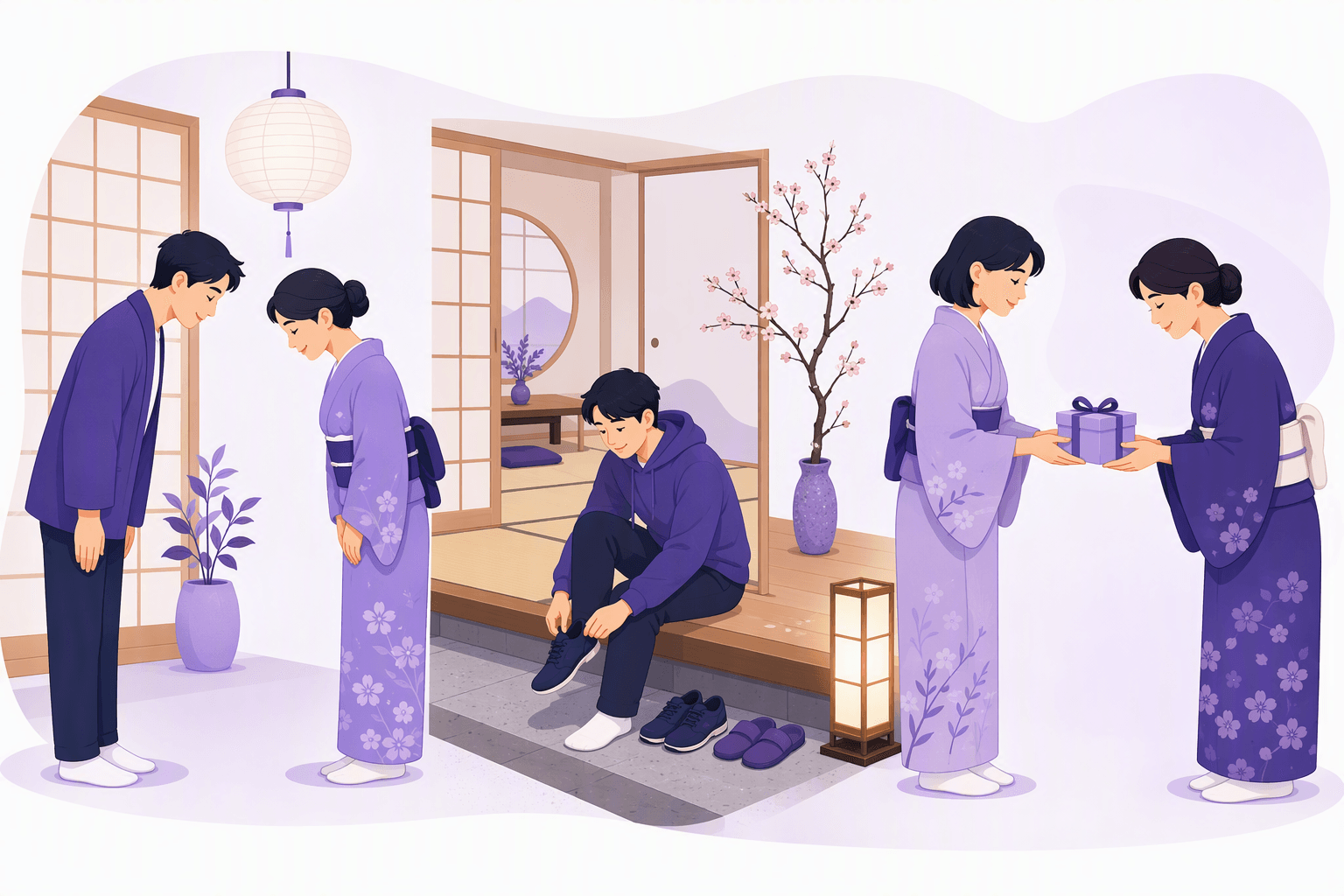
Bowing is a greeting, a thank-you, an apology, and a way to show you recognize someone's status. You do not need to memorize degrees, but you should know the "safe default."
The safe default bow
A small bow with a straight back, eyes down, hands at your sides (or together in front if you are holding a bag). Hold for about one second, then return upright.
Avoid dramatic bows. Over-bowing can make the other person feel they must escalate too, which creates awkwardness.
Handshakes, hugs, and personal space
Handshakes are common in international business contexts, sometimes combined with a bow. Hugs are usually for close friends, and even then less frequent than in many Western cultures.
If someone offers a handshake, take it. If they do not, a bow is enough.
🌍 Why the bow matters in service settings
In many shops and restaurants, staff will bow as part of professional service. Returning a small bow is a quick way to show respect without needing much Japanese.
Shoes, entrances, and the "inside vs outside" boundary
The genkan (entryway) is not just architecture, it is a social boundary. Outside is potentially dirty, inside is protected.
When to remove shoes
- Homes: always.
- Some traditional restaurants: if you see tatami (畳, tah-TAH-mee) or a raised floor, assume shoes off.
- Ryokan (旅館, RYOH-kahn): always, and you usually switch to slippers.
- Temples and some historic buildings: follow posted signs and the shoe racks.
Slippers, toilet slippers, and the one mistake everyone makes
Many homes and ryokan have slippers (スリッパ, soo-REEP-pah). Bathrooms sometimes have separate toilet slippers, which should never leave the bathroom.
If you accidentally walk into the hallway wearing toilet slippers, do not panic. Step back, switch, and move on.
⚠️ Do not step on tatami with slippers
Tatami mats are delicate and culturally "clean." Walk on tatami in socks or bare feet unless the host explicitly says otherwise.
Public behavior: trains, streets, and shared quiet
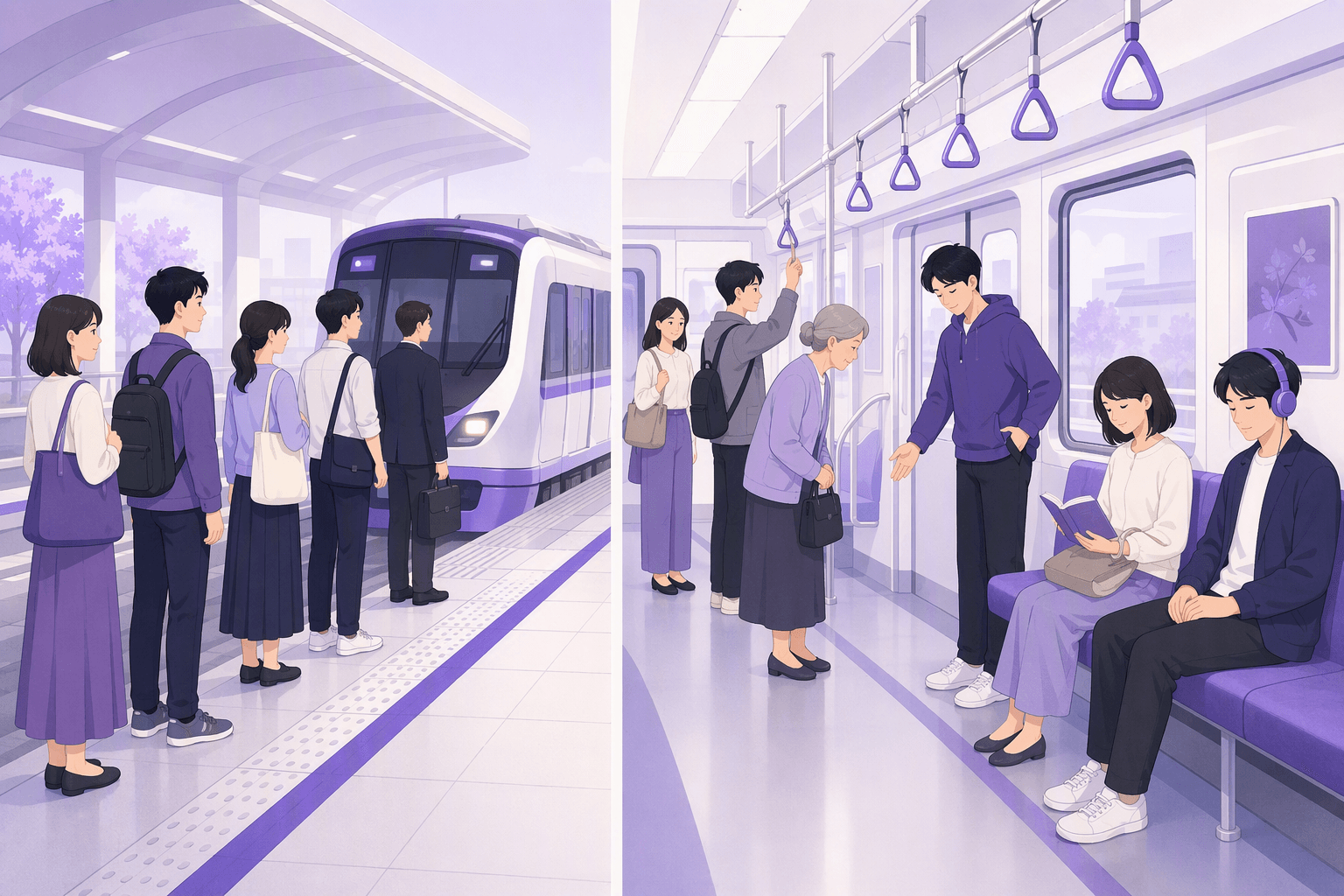
The fastest way to stand out in Japan is not your accent, it is your volume. In dense cities, quiet public behavior is a form of respect.
Trains and buses
- Keep phone calls off public transit. If you must take a call, step off at the next stop.
- Use headphones, and keep audio low.
- Priority seats are for people who need them, even if the car is crowded.
JNTO's visitor guidance emphasizes quiet behavior on public transportation, and it matches what you will see locals doing.
Lines, escalators, and spatial awareness
Japan runs on queues. If there is a line, join it, even if it looks informal.
Escalator standing sides vary by region (for example, Tokyo often stands left, Osaka often stands right). The safest move is to copy the flow in front of you.
Meeting people: introductions, business cards, and names
First impressions in Japan are structured. That structure is helpful, because you can follow it even as a beginner.
はじめまして
はじめまして (hah-jee-MEH-she-teh) is the standard "nice to meet you" for first meetings. It is often followed by a self-introduction and a polite closer.
よろしくお願いします
よろしくお願いします (yoh-roh-SHEH-koo oh-neh-gah-ee shee-MAS) is hard to translate, but it signals goodwill and "please treat me well." You will hear it in introductions, requests, and team settings.
Business cards (名刺, meishi)
In workplaces, business cards are treated like a small extension of the person.
- Offer and receive with two hands when possible.
- Take a moment to look at the card before putting it away.
- Do not write on it in front of the person unless invited.
🌍 Why cards matter
In Japanese corporate culture, meishi exchange quickly establishes roles and hierarchy, which reduces uncertainty. That is the same underlying goal as keigo: making relationships legible.
敬語
敬語 (KAY-goh) is the honorific system. You do not need to master it as a visitor, but you should recognize what is happening so you can choose a safe level of politeness.
The three buckets: 丁寧語, 尊敬語, 謙譲語
A practical way to think about keigo is three "buckets":
| Type | Japanese | Pronunciation | What it does | Beginner-safe move |
|---|---|---|---|---|
| Polite style | 丁寧語 | tei-NAY-go | Makes speech polite | Use です/ます (des/mas) |
| Respectful | 尊敬語 | son-KAY-go | Lifts the other person | Listen, do not imitate yet |
| Humble | 謙譲語 | ken-JOH-go | Lowers yourself | Use set phrases like 申し訳ありません |
Japan's Agency for Cultural Affairs has published guidance on honorific expressions (敬語), and it consistently frames keigo as a social tool, not "extra fancy Japanese."
すみません
すみません (soo-mee-MEHN) is one of the most useful words in Japan. It can mean "excuse me," "sorry," and even "thank you for the trouble."
Use it to get attention politely, to apologize for small inconveniences, and to soften requests.
申し訳ありません
申し訳ありません (moh-shee-WEH-keh ah-ree-MAH-sehn) is a stronger, more formal apology. Use it when you have caused real inconvenience, for example if you are late to a reservation or you bumped into someone hard.
It is formal enough that it can feel "too much" among close friends, but in service settings it is always understood.
Gift culture: omiyage, wrapping, and how to hand things over
Gift-giving in Japan is not only for birthdays. It is also a way to manage relationships and show consideration.
お土産
お土産 (oh-mee-YAH-geh) is a small souvenir gift, often food, brought back from a trip for coworkers, friends, or family. It is common in offices, and it is one reason train-station sweets are so elaborate.
A safe omiyage is individually wrapped snacks that are easy to share.
How to give and receive gifts
- Present with two hands when possible.
- Say a simple phrase like どうぞ (DOH-zoh, "here you go") or よかったら (yoh-KAH-tah-rah, "if you'd like").
- Do not expect the gift to be opened immediately. Many people wait until later.
💡 A visitor-friendly gift rule
If you are invited to a home, bring something small and consumable: sweets, fruit, or a specialty from your country. Avoid very expensive gifts, which can create pressure to reciprocate.
Dining etiquette: chopsticks, phrases, and restaurant behavior
Japanese dining etiquette has a few strict taboos, and many flexible customs. Learn the strict ones first.
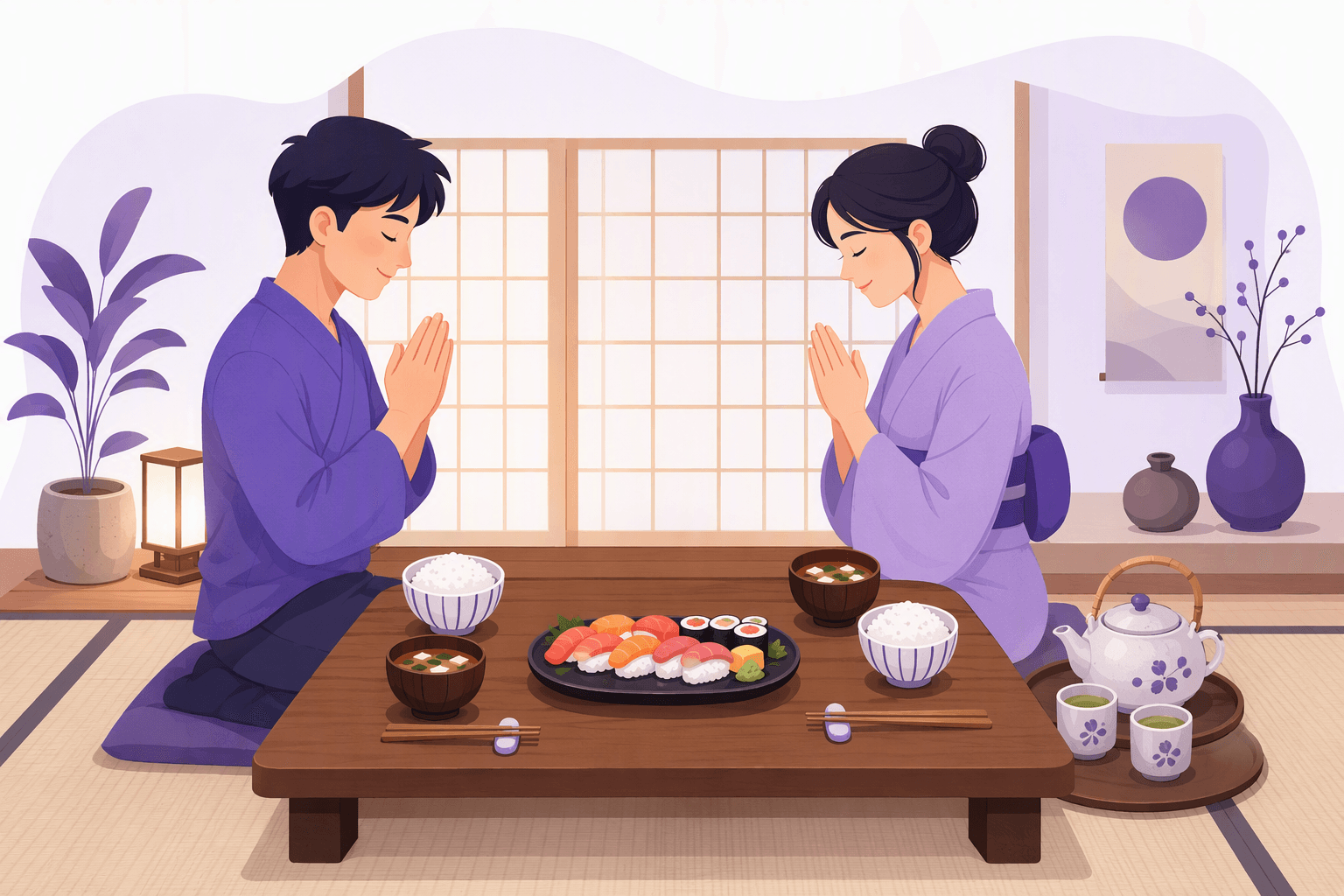
いただきます and ごちそうさまでした
- いただきます (ee-tah-dah-kee-MAS) is said before eating, roughly "I gratefully receive."
- ごちそうさまでした (goh-chee-SOH-sah-mah DEH-shee-tah) is said after, thanking for the meal.
Saying them is not mandatory, but it signals cultural awareness immediately.
Chopstick taboos you should actually memorize
These are the big three:
-
Do not stick chopsticks upright in rice.
This resembles funeral offerings. -
Do not pass food chopstick-to-chopstick.
This resembles a funeral bone-passing ritual. -
Do not spear food as your default.
It is understood for slippery items, but frequent spearing reads as careless.
If you need to set chopsticks down, use the rest (箸置き, hah-SHIO-kee) if provided.
Paying, splitting, and tipping
Tipping is not standard in Japan, and staff may refuse it. If you want to show appreciation, a sincere ありがとうございます (ah-ree-GAH-toh goh-ZAH-ee-mas) is the culturally correct move.
Splitting the bill varies by group and venue. In many casual settings, people pay their own share, but business meals may be treated by the inviter.
Visiting shrines and temples: simple respect without overthinking
Religious sites are common tourist stops, and etiquette is mostly about calm behavior and following signs.
Basic shrine and temple manners
- Speak quietly and move with the flow.
- Do not touch sacred objects unless permitted.
- Photography rules vary, especially indoors, so look for signs.
If there is a purification fountain (手水舎, teh-MEE-zoo-yah), you can follow others, but it is also fine to skip if you are unsure.
🌍 Do not treat sacred spaces like a set
Many conflicts at temples and shrines come from treating the space as a photo backdrop. Slow down, keep your voice low, and you will automatically do most things right.
Common mistakes foreigners make (and how to recover gracefully)
Mistakes are normal. What matters is how you handle them.
Speaking too loudly
If you realize you are loud, lower your voice and continue. You do not need a dramatic apology.
A quick すみません (soo-mee-MEHN) is enough if you interrupted someone.
Blocking flow in tight spaces
In stations and busy sidewalks, stopping suddenly creates friction. Step to the side before checking your phone or map.
Over-apologizing or over-bowing
One clear apology and a small bow is better than repeated apologies that prolong the moment. In Japan, efficiency is part of politeness.
How to learn etiquette faster with real Japanese dialogue
Etiquette is not only rules, it is timing, tone, and what people do not say. That is why watching real scenes helps, you can hear how すみません changes meaning depending on context.
If you are learning Japanese, practice with short, repeatable clips and shadow the rhythm. Wordy is built for this style of learning, using real movie and TV show scenes with interactive subtitles and review.
For more language building blocks that show up in polite situations, read our guide to saying hello in Japanese and guide to saying goodbye in Japanese. If you want a culture-first overview of behavior norms, pair this with Japanese etiquette and customs.
You will progress faster if you combine etiquette with core vocabulary. A practical next step is building your listening base through anime vocabulary, then switching to more realistic workplace and daily-life dramas.
Finally, if you want to understand what not to repeat from edgy subtitles, skim our Japanese swear words guide so you can recognize strong language without accidentally using it.
Frequently Asked Questions
What is the most important rule of Japanese etiquette?
Do I have to bow in Japan, and how deep should I bow?
Is it rude to say 'arigatou' without 'gozaimasu'?
What are common dining etiquette mistakes foreigners make in Japan?
Should I tip in Japan?
Sources & References
- Agency for Cultural Affairs (Japan), Honorific Expressions (敬語) and Japanese Language Guidance, 2007
- National Institute for Japanese Language and Linguistics (NINJAL), Japanese Language Resources and Research Publications, 2010s-2020s
- Japan National Tourism Organization (JNTO), Practical Travel Guide and Manners in Japan, 2020s
- Ethnologue, Japanese (jpn) Language Profile, 27th edition, 2024
- Brown, P. & Levinson, S.C., Politeness: Some Universals in Language Usage, 1987
Start learning with Wordy
Watch real movie clips and build your vocabulary as you go. Free to download.


