Quick Answer
Japanese sentence structure is usually Subject-Object-Verb, with the verb (or copula) at the end and meaning carried by particles like は (wa), が (ga), を (o), and に (ni). You can often drop the subject when it is obvious, and you can reorder phrases for emphasis as long as particles stay attached. Mastering topic vs subject and basic clause order is the fastest path to sounding natural.
Japanese sentence structure is built around one core rule: the verb (or copula) usually comes at the end, and particles mark each phrase’s job, so you can change word order for emphasis without losing meaning. If you learn SOV order, topic vs subject (は vs が), and the basic particle set, you can produce natural Japanese sentences quickly instead of translating English word-for-word.
Japanese is spoken by roughly 123 million people worldwide (Ethnologue, 27th edition, 2024). That means there is a huge amount of real audio to learn from, and you will hear the same sentence patterns repeated constantly in everyday shows and films, especially greetings like those in our how to say hello in Japanese guide.
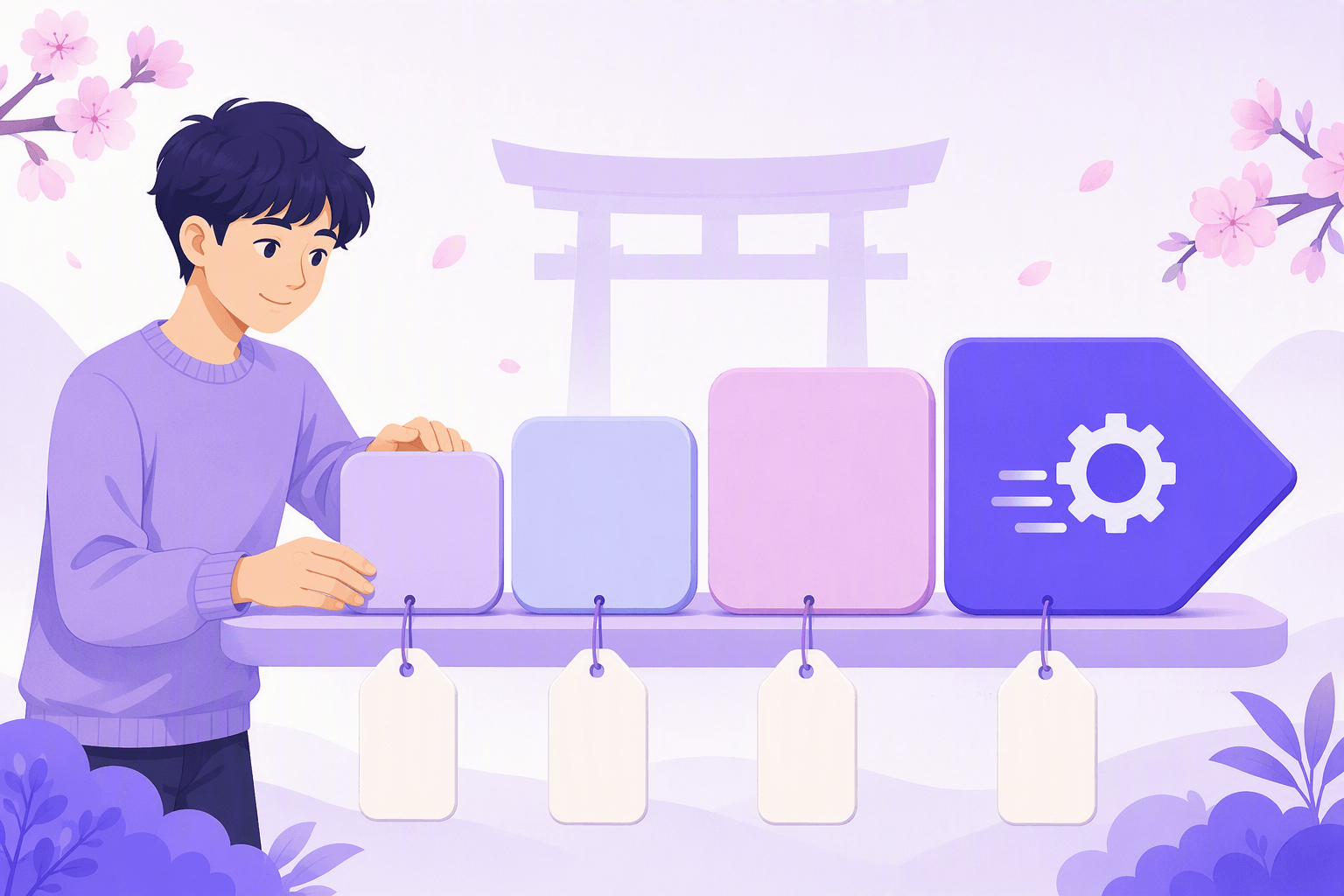
The core idea: Japanese is verb-final
In Japanese, the most important information often arrives at the end. This is why beginner sentences feel “backwards” to English speakers.
A neutral, textbook pattern is:
- (Topic) + (Time) + (Place) + (Object) + Verb
You can think of Japanese as building a sentence by stacking labeled blocks, then finishing with the action.
Why verb-final matters in real listening
Because the verb comes last, Japanese listeners often wait for the end to fully interpret the sentence. This is one reason Japanese dialogue can feel fast even when the words are simple.
It also explains why subtitles are so helpful: once you get used to “holding” the sentence until the verb arrives, your comprehension jumps.
💡 A practical habit
When you watch Japanese clips, train yourself to listen for the final verb first. Ask: is this a 'do' sentence (食べる), a 'be' sentence (です), or a 'go/come' sentence (行く, 来る)? Then fill in the earlier details.
SOV vs “topic-comment”: what Japanese is really doing
People describe Japanese as SOV, but many everyday sentences are better understood as topic-comment: “As for X, (comment about X).”
This is why は (wa) is so central. It does not simply mean “subject.” It frames what the sentence is about.
Linguist Haruo Shirane, in his work on Japanese language and classical grammar, emphasizes how Japanese structure is shaped by information packaging rather than strict word order. In modern learning materials, Tae Kim’s grammar guide also leans on this idea: particles label roles, so you are not trapped in one fixed sequence.
Topic (は) vs subject (が) in one minute
- は (wa) sets the topic: “Speaking of X…”
- が (ga) often marks the grammatical subject, especially when it is new, specific, or answering a question.
Compare:
-
私は学生です。
Watashi wa gakusei desu.
“As for me, I’m a student.” -
私が学生です。
Watashi ga gakusei desu.
“I’m the one who is a student.” (contrastive, like correcting someone)
In real speech, you often drop 私 (watashi) entirely and keep the particle logic in your head.
A common beginner trap: overusing 私は
If you say 私は in every sentence, you sound like a textbook. Japanese conversation usually relies on context, so the topic is often implied.
This is especially noticeable in emotional phrases. In our how to say I love you in Japanese guide, many natural lines omit the subject because the relationship context already supplies it.
Particles: the “labels” that make word order flexible
Particles are short markers that tell you what a word is doing. If English uses word order to show roles, Japanese uses particles.
The fastest way to improve sentence building is to master a small set:
- は (wa): topic
- が (ga): subject (often new or emphasized)
- を (o): direct object
- に (ni): destination, time point, indirect object
- で (de): location of action, means
- へ (e): direction (more “toward” than “to”)
- の (no): possession, linking nouns
- と (to): “and” (with nouns), “with” (quoting), “with” (together)
- も (mo): “also”
- から (kara): from, because
- まで (made): until, up to
Cure Dolly’s explanations are popular because they treat particles as structural operators rather than “translated words,” which helps you stop forcing English logic onto Japanese.
を (o): the object marker
を (o) marks what the verb acts on.
- パンを食べる。
Pan o taberu.
“(I) eat bread.”
Pronunciation note: を is written “wo” historically, but in modern speech it is usually pronounced like “o.”
に (ni) vs で (de): where things happen
This pair causes a lot of confusion.
- に (ni) often marks a destination or a point in time.
- で (de) marks the place where an action happens.
Examples:
-
学校に行く。
Gakkou ni iku.
“Go to school.” -
学校で勉強する。
Gakkou de benkyou suru.
“Study at school.”
If you mix them up, the sentence may still be understandable, but it sounds off.
⚠️ A quick test
If the verb is movement (行く iku, 来る kuru, 帰る kaeru), you usually want に (ni) or へ (e). If the verb is an activity (勉強する, 食べる, 話す), you usually want で (de).
Building sentences the Japanese way: start from the verb
A reliable production method is:
- Choose the verb.
- Add the object with を (o) if needed.
- Add place/time phrases with に (ni) or で (de).
- Add a topic with は (wa) if you want to frame it.
This prevents English word order from hijacking your sentence.
Example: “I watched a movie yesterday at home.”
Verb: 見た (mita, past of 見る miru)
- 昨日、家で映画を見た。
Kinou, ie de eiga o mita.
You can reorder:
- 家で、昨日、映画を見た。
Ie de, kinou, eiga o mita.
Both are grammatical. The nuance changes slightly, but particles keep the roles clear.
Dropping subjects and objects: the “zero pronoun” reality
Japanese frequently omits things that are obvious. This is not laziness, it is a normal grammatical feature.
You will hear:
-
行く。
Iku.
“(I’m) going.” or “(Are you) going?” depending on context. -
もう食べた。
Mou tabeta.
“(I) already ate.”
NINJAL’s work on Japanese language usage and corpora highlights how context-driven omission is routine in spoken Japanese. For learners, the key is to stop panicking when you do not hear a subject.
How to recover missing subjects while listening
Use three clues:
- The situation: who is physically present, what is happening.
- The verb: who can logically do it.
- The politeness level: casual speech often implies closeness, polite speech often implies distance.
This is why watching scenes, not isolated sentences, is so effective. You see who is speaking to whom.
Adjectives, nouns, and the copula: “is” goes at the end too
Japanese does not use a standalone “to be” verb the same way English does. Instead, you often end with です (desu) or だ (da), or you end with an adjective that already functions as a predicate.
-
これは本です。
Kore wa hon desu.
“This is a book.” -
高い。
Takai.
“(It’s) expensive/high.” -
静かだ。
Shizuka da.
“(It’s) quiet.”
The key structural point is the same: the sentence resolves at the end.
Negative and past forms keep the same structure
You still end with the predicate:
-
映画を見ない。
Eiga o minai.
“(I) don’t watch the movie.” -
映画を見なかった。
Eiga o minakatta.
“(I) didn’t watch the movie.”
The earlier blocks can move around, but the ending carries tense and polarity.
Question structure: か, rising intonation, and casual questions
Polite questions often use か (ka):
- 行きますか。
Ikimasu ka.
“Are you going?”
Casual questions often rely on intonation:
- 行く?
Iku?
“You going?”
You will also hear sentence-ending particles like よ (yo), ね (ne), and の (no/ n). These do not change word order, but they change the social feel.
If you are practicing greetings and exits, you will hear these constantly in lines like じゃあね (jaa ne) and またね (mata ne), which show up in our how to say goodbye in Japanese guide.
Modifiers: Japanese stacks details before the noun
Japanese places modifiers before what they modify. This is a major difference from English, especially with relative clauses.
-
赤い車
Akai kuruma
“a red car” -
昨日見た映画
Kinou mita eiga
“the movie (that I) watched yesterday”
There is no relative pronoun like “that” or “which.” The clause just sits in front of the noun.
Why this matters for comprehension
When you hear a long noun phrase, do not wait for a “which.” Instead, assume the noun is coming later.
This is another reason verb-final logic is useful: Japanese often delays the “main point” until the end of a chunk.
Connecting clauses: て-form and から
Japanese uses several common connectors that keep the verb-final feel.
て (te): chaining actions
- 起きて、コーヒーを飲んで、仕事する。
Okite, koohii o nonde, shigoto suru.
“I wake up, drink coffee, and work.”
Pronunciation note: て is “teh.” Small っ (sokuon) creates a doubled consonant, and it counts as its own beat in speech.
から (kara): because, from
- 雨だから、行かない。
Ame da kara, ikanai.
“Because it’s raining, I’m not going.”
This pattern is extremely common in dialogue. You will hear the reason first, then the decision at the end.
Emphasis and contrast: も, は, and word order shifts
Because particles carry roles, Japanese can move phrases earlier to emphasize them.
-
映画は見た。
Eiga wa mita.
“As for the movie, I watched it.” (implies maybe something else was not watched) -
私も行く。
Watashi mo iku.
“I’m going too.”
This is where は becomes more than “topic.” It can mark contrast: “X, at least.”
Cultural insight: Japanese often prefers “soft” disagreement
Instead of directly saying “No, you’re wrong,” speakers may shift topic or use contrastive framing. This is one reason you will hear structures like X は… a lot in polite conversation.
Research on conversation and politeness in Japanese frequently points out that indirectness and face-management are common strategies. If you want a practical example of how tone changes with context, compare everyday speech to the aggressive language cataloged in our Japanese swear words guide. The grammar is still verb-final, but the sentence-ending choices and implied subjects can feel very different.
Common word order patterns you can memorize
These are not strict rules, but they are high-frequency templates.
Pattern 1: Time + place + object + verb
- 今日、駅でコーヒーを買った。
Kyou, eki de koohii o katta.
“Today, I bought coffee at the station.”
Pattern 2: Topic + comment
- 日本語は難しい。
Nihongo wa muzukashii.
“Japanese is difficult.” (as a general statement)
Pattern 3: Person + に + thing + を + give/teach/tell
- 友だちに日本語を教える。
Tomodachi ni nihongo o oshieru.
“Teach Japanese to a friend.”
Once these feel automatic, you can swap vocabulary in and out without rebuilding the grammar each time.
The biggest mistakes English speakers make (and the fixes)
Mistake 1: Forcing “I” into every sentence
Fix: say the verb, then add only what is needed. If the topic is obvious, drop it.
Mistake 2: Treating particles as translations
Fix: treat particles as labels. を does not “mean” anything in English, it marks the object role.
Mistake 3: Putting the verb too early
Fix: hold the verb until the end. If you must plan, plan the verb first, then build leftward.
Mistake 4: Misreading は as “ha”
Fix: remember the pronunciation: は is pronounced “wa” when it is the topic particle. In other contexts, は is “ha.”
How to practice sentence structure with real clips
Textbook drills help at first, but Japanese word order becomes natural when you hear it repeatedly in context.
A good routine:
- Watch a short scene and pause after one line.
- Repeat it out loud, keeping the rhythm and mora timing.
- Swap one element: time, place, or object, and say it again.
If you need a structured way to get lots of repeatable lines, start with greetings and daily phrases, then expand. Our how to say hello in Japanese guide is a good early set because greetings are short, high-frequency, and particle-light.
🌍 Why 'natural' Japanese often sounds short
In Japanese, sounding natural often means saying less, not more. Context does the work, and sentence endings carry social meaning. When learners translate full English sentences, they often add extra pronouns and explanations that Japanese would leave implied.
A simple checklist for writing your own sentences
Before you hit send on a message or speak a line, check:
- Did I put the verb (or です/だ) at the end?
- Did I mark roles with particles (を, に, で) instead of relying on English order?
- Did I add は only when I truly want to set a topic or contrast?
- Can I delete the subject without losing clarity?
If you can answer “yes” to the first two, your sentence is probably structurally sound.
Keep going: learn structure through phrases you actually hear
Japanese sentence structure is not hard because it is complicated, it is hard because it is different. Once verb-final order and particles become automatic, you can focus on vocabulary, nuance, and style.
For more real-world lines that reinforce this structure, browse the Japanese learning page and pair grammar study with short, repeatable dialogue from shows. That combination is where Japanese starts to feel predictable.
Frequently Asked Questions
Is Japanese always SOV (subject-object-verb)?
What is the difference between は (wa) and が (ga)?
Why do Japanese speakers drop 'I' and 'you' so often?
Where do time and place go in a Japanese sentence?
How do I stop translating English word order into Japanese?
Sources & References
- Ethnologue, 27th edition, 2024
- National Institute for Japanese Language and Linguistics (NINJAL), accessed 2026
- Tae Kim, Guide to Japanese Grammar, accessed 2026
- Cure Dolly, Japanese From Scratch (video grammar series), accessed 2026
- Japan Foundation, Japanese-Language Education resources, accessed 2026
Start learning with Wordy
Watch real movie clips and build your vocabulary as you go. Free to download.


