Quick Answer
Japanese business keigo is polite speech used to show respect and professionalism, mainly through three systems: teineigo (です/ます), sonkeigo (raising the other person), and kenjougo (lowering yourself). The fastest way to sound natural is to master a small set of high-frequency verbs (いらっしゃる, 申す, いただく) and a few fixed phrases used in meetings and email.
Japanese business keigo is the set of polite speech patterns that Japanese workplaces use to signal respect, hierarchy, and customer-first professionalism, and you can sound natural fast by mastering です/ます plus a small core of honorific verbs and fixed email and meeting phrases.
Keigo can feel like a wall because it is not just grammar, it is social logic. The good news is that real offices repeat the same patterns every day, especially in greetings, requests, scheduling, and apologies.
If you are also building everyday basics, pair this with how to say hello in Japanese and how to say goodbye in Japanese. Keigo sits on top of those habits.

Why keigo matters in business Japanese
Japanese has about 123 million speakers worldwide (Ethnologue, 27th edition, 2024). A large share of professional communication happens in predictable settings: email, meetings, phone calls, and customer interactions.
Keigo is the default style in those settings because it reduces friction. It helps you avoid sounding pushy, too direct, or too familiar, especially with clients and senior colleagues.
Linguist Haruo Shirane, in his work on Japanese language and culture, emphasizes how social context shapes expression choices in Japanese. In business, that context is often "inside vs outside" (uchi vs soto), which strongly affects keigo.
Keigo is not "extra polite Japanese"
Many learners treat keigo as "add more polite words." That leads to unnatural sentences that feel heavy or performative.
A better mental model is politeness as relationship design. Research on politeness strategies in interaction (Brown and Levinson, Politeness: Some Universals in Language Usage, Cambridge University Press) helps explain why Japanese uses indirectness and deference to protect both sides' "face" in high-stakes situations like work.
The three keigo systems you actually use
Keigo is usually taught as three systems. In real business Japanese, you use all three, but not equally.
Teineigo (です/ます)
Teineigo is your baseline polite style. It is the first thing people notice, because it affects every sentence ending.
- です (DEHSS)
- ます (MAHSS)
In speech, です and ます often sound clipped, especially in fast office talk. You still need to produce the full mora timing: de-su, ma-su, even if the vowel is reduced.
💡 A safe default
If you are unsure, stay in です/ます and use neutral verbs. A consistent polite baseline is better than occasional fancy keigo mixed with casual endings.
Sonkeigo (尊敬語)
Sonkeigo elevates the other person's actions. You use it for clients, customers, and senior people when you describe what they do.
Common patterns:
- Special honorific verbs (いらっしゃる, おっしゃる)
- お/ご + verb stem + になる (お待ちになる)
Kenjougo (謙譲語)
Kenjougo humbles your actions. You use it when you talk about what you do for the other person, especially toward clients.
Common patterns:
- Special humble verbs (伺う, 申す, いただく)
- お/ご + verb stem + する (ご案内する)
Linguist Senko K. Maynard, in her work on Japanese discourse and pragmatics, highlights how Japanese speakers manage stance and interpersonal alignment. Kenjougo is one of the clearest stance markers in business speech.
Quick business keigo phrases you can use today
| English | Japanese | Pronunciation | Formality |
|---|---|---|---|
| Thank you for your continued support. | いつもお世話になっております。 | EE-tsoo-moh oh-SEH-wah nee NAHT-teh oh-ree-MAHSS | formal |
| This is [Name] from [Company]. | 株式会社XのYと申します。 | kah-boosh-kee-gah-ee-shah EHKS noh WAI toh MOH-shee-mahss | formal |
| I am contacting you regarding... | 〜の件でご連絡いたします。 | noh KEHN deh goh-rehn-RAH-koo ee-tah-shee-MAHSS | formal |
| Could you please check? | ご確認いただけますでしょうか。 | goh-kah-KOO-neen ee-tah-dah-keh-MAHSS deh-SHOH-kah | formal |
| Thank you in advance. | よろしくお願いいたします。 | yoh-roh-SHEE-koo oh-neh-GAH-ee ee-tah-shee-MAHSS | formal |
| I apologize. | 申し訳ございません。 | moh-shee-WAH-keh goh-zah-ee-mah-SEN | formal |
| Please wait a moment. | 少々お待ちください。 | SHOH-shoh oh-MAH-chee koo-dah-SAI | polite |
| Excuse me / Sorry (work-safe). | すみません。 | soo-mee-mah-SEN | polite |
These are "safe" because they are common, formulaic, and not tied to a specific industry. They also appear constantly in dramas and workplace scenes, which makes them perfect for clip-based learning.
If you want to hear how keigo sounds when people are stressed, compare it to the opposite extreme in Japanese swear words. The contrast helps your ear catch register shifts.
いらっしゃる
いらっしゃる (ee-rah-SHAH-roo) is the sonkeigo verb for "go/come/be" when talking about the other person. It is one of the highest-frequency honorific verbs in business.
Use it for clients and senior colleagues:
- お客様がいらっしゃいます。 (oh-kyah-koo-sah-mah gah ee-rah-SHAH-ree-mahss)
Avoid using it for yourself. That is a classic learner mistake.
/oh-kyah-koo-sah-mah gah ee-rah-SHAH-ree-mahss/
Literal meaning: The honorable customer exists/is present.
“お客様がいらっしゃいますので、会議室へご案内します。”
The client is here, so I will guide them to the meeting room.
In offices and shops, いらっしゃる is a standard respectful way to refer to a client's presence. Pairing it with ご案内します is a common service-oriented pattern.
伺う
伺う (oo-tah-gah-OO) is a key kenjougo verb. It can mean "to visit/go" or "to ask," but in business it often signals "I will come to you" or "I will ask you" in a humble way.
Typical uses:
- 後ほど伺います。 (ah-toh-doh-koh-roh oo-tah-gah-EE-mahss)
- 伺ってもよろしいでしょうか。 (oo-tah-gah-tteh moh yoh-roh-SHEE deh-SHOH-kah)
⚠️ Do not overuse 伺う
If you use 伺う for every 'ask' in casual team chat, you can sound distant. Save it for clients, senior people, or formal meetings, and use 聞く (KEE-koo) with です/ます for neutral internal talk.
申す
申す (MOH-soo) is the humble version of 言う (to say). In business, it is most visible in self-introductions and phone calls.
You will hear:
- Yと申します。 (toh MOH-shee-mahss)
This is one of the fastest credibility boosts you can learn, because it is short, common, and clearly business-coded.
/tah-NAH-kah toh MOH-shee-mahss/
Literal meaning: I am called Tanaka (humbly).
“株式会社サンプルの田中と申します。本日はお時間をいただきありがとうございます。”
I'm Tanaka from Sample Co. Thank you for taking the time today.
In Japanese business introductions, the company often comes before the name, and 申します marks humility. Adding お時間をいただきありがとうございます is a common respectful follow-up.
いただく
いただく (ee-tah-DAH-koo) is a humble verb meaning "to receive," and it is everywhere in business Japanese because work is full of receiving: time, confirmation, documents, feedback.
Common patterns:
- お時間をいただく (receive your time)
- ご確認いただく (receive your confirmation)
Be careful with 〜させていただきます. It is common, but if you use it for everything, it can sound like you are hiding responsibility.
The uchi vs soto rule that explains most keigo
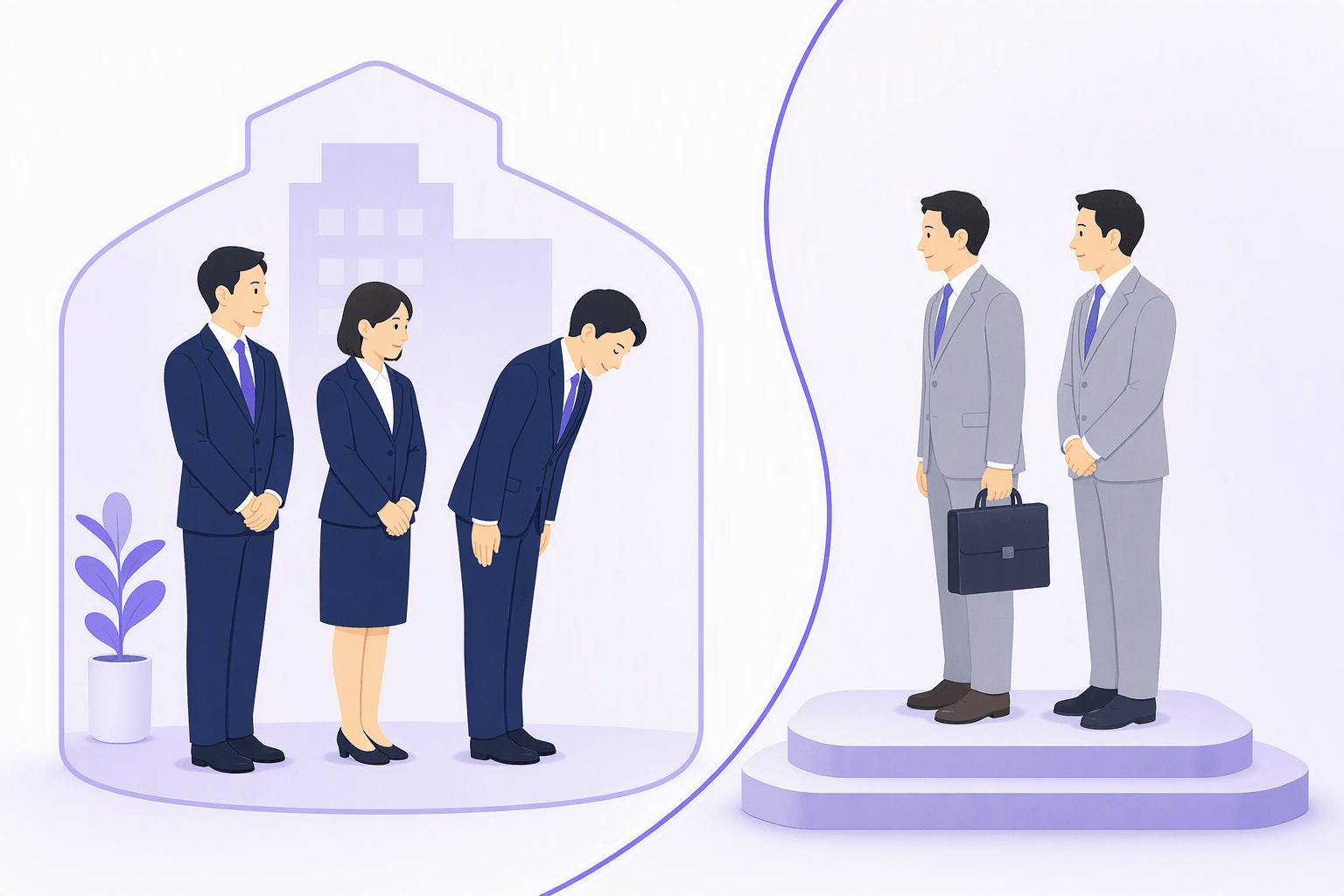
A practical business rule: clients and partner companies are usually soto (outside). Your company and your team are uchi (inside).
That affects how you talk:
- You elevate soto people with sonkeigo.
- You humble uchi actions when addressing soto.
Example logic:
- "Our manager will visit you" becomes "弊社の者が伺います" rather than elevating your manager to the client.
This is one reason keigo feels counterintuitive. In English, you might speak proudly about your boss. In Japanese, you often humble your side when speaking to the outside.
🌍 Why 'humbling your boss' is normal
In many Japanese business contexts, you do not use sonkeigo for your own in-group when talking to outsiders. It is not disrespect, it is a social convention that signals you understand the boundary between your organization and the client.
Meetings: phrases that keep you safe
Meetings are where learners panic because they need to speak live. The trick is to rely on fixed frames.
Starting a meeting
Use short, standard lines:
- 本日はお忙しいところありがとうございます。 (hohn-jee-TSOO wah oh-ee-SOH-gah-shee toh-koh-roh ah-ree-GAH-toh goh-zah-ee-MAHSS)
Asking for confirmation
- ご確認いただけますでしょうか。 (goh-kah-KOO-neen ee-tah-dah-keh-MAHSS deh-SHOH-kah)
This is more indirect than ご確認ください, which can sound like an instruction.
Softening disagreement
Instead of "No," you often use framing:
- 恐れ入りますが (oh-soh-reh-ee-ree-MAHSS gah)
- 申し訳ございませんが (moh-shee-WAH-keh goh-zah-ee-mah-SEN gah)
Then you state the constraint.
If you want a broader base for polite phrasing, build your everyday greeting reflexes first with how to say hello in Japanese. Keigo works best when your basics are automatic.
Phone keigo: the minimum viable set
Phone calls compress everything. You need fast identification, purpose, and polite holds.
Answering and identifying
A common pattern is:
- お電話ありがとうございます。株式会社Xでございます。 (oh-dehn-wah ah-ree-GAH-toh goh-zah-ee-MAHSS kah-boosh-kee-gah-ee-shah EHKS deh goh-zah-ee-MAHSS)
Putting someone on hold
- 少々お待ちください。 (SHOH-shoh oh-MAH-chee koo-dah-SAI)
Asking if someone is available
- Y様はいらっしゃいますでしょうか。 (sah-mah wah ee-rah-SHAH-ee-mahss deh-SHOH-kah)
Email keigo: templates that sound native
Business email is formula-heavy. That is good for learners, because you can reuse lines safely.
A reliable opening
- いつもお世話になっております。 (EE-tsoo-moh oh-SEH-wah nee NAHT-teh oh-ree-MAHSS)
This does not literally mean "thanks for your support" in a direct way. It is a relationship-maintenance opener.
Stating the purpose
- 〜の件でご連絡いたしました。 (noh KEHN deh goh-rehn-RAH-koo ee-tah-shee-MAH-shee-tah)
Closing
- 何卒よろしくお願いいたします。 (nah-nee-toh-zoh yoh-roh-SHEE-koo oh-neh-GAH-ee ee-tah-shee-MAHSS)
Add 何卒 (nah-nee-toh-zoh) when you want a stronger, more formal "please."
💡 Email rhythm tip
Japanese business emails often use short lines and clear paragraph breaks. One sentence per line is common, especially for requests and schedules. It reads as organized, not cold.
Politeness level traps (and how to avoid them)
Trap 1: mixing casual and polite endings
Switching between だ and です in the same thread makes you sound unstable. Pick one register per relationship and channel.
Internal Slack-style chat might use です/ます or casual, depending on company culture. External email should stay です/ます plus keigo.
Trap 2: honorifics for yourself
Do not use sonkeigo verbs for your own actions. If you say 私がいらっしゃいます, it sounds like you are elevating yourself.
Use neutral or humble forms for yourself:
- 行きます (ee-kee-MAHSS) or 伺います (oo-tah-gah-EE-mahss)
Trap 3: overusing 〜させていただきます
This phrase is common in Japanese corporate speech, but it is not a magic politeness button. Overuse can make you sound evasive.
A cleaner alternative is often:
- 〜いたします (ee-tah-shee-MAHSS)
- 〜します (shee-MAHSS) with a softener like 恐れ入りますが
How to practice keigo with real TV and movie dialogue
Textbook keigo is often too perfect. Real speech includes contractions, speed, and set phrases repeated under pressure.
A strong method is:
- Learn the "fixed frames" above.
- Listen for them in context.
- Copy the rhythm, not just the words.
This aligns with what many applied linguists emphasize about formulaic language in fluency development, including Alison Wray's work on formulaic sequences. In business Japanese, sounding natural often means using the same chunks native speakers use.
For a structured approach to learning through scenes, see how to learn a language with movies. Keigo is one of the best payoffs of media-based study because it is so context-bound.
A short, realistic keigo study plan (2 weeks)
Days 1 to 3: baseline stability
Focus only on:
- です/ます endings
- すみません (soo-mee-mah-SEN)
- よろしくお願いいたします (yoh-roh-SHEE-koo oh-neh-GAH-ee ee-tah-shee-MAHSS)
Record yourself. Aim for mora timing, especially in long phrases like お願いいたします: o-ne-gai-i-ta-shi-ma-su.
Days 4 to 7: core verbs
Add:
- 申します (MOH-shee-mahss)
- 伺います (oo-tah-gah-EE-mahss)
- いただきます (ee-tah-dah-kee-MAHSS)
Use them in one-line roleplays: self-introduction, scheduling request, apology.
Days 8 to 14: email and meeting templates
Write three reusable templates:
- Requesting confirmation
- Scheduling a meeting
- Apologizing for a delay
Then listen for the same templates in real dialogue and adjust your phrasing.
If you need a break from formality, it is also useful to learn what not to say. How to say I love you in Japanese shows how Japanese often avoids directness even in emotional language, which is the same cultural pressure that shapes keigo at work.
When keigo is optional (and when it is not)
Keigo is most expected in:
- Customer service
- Sales and client-facing roles
- First meetings
- Apologies and problem resolution
Keigo is often relaxed in:
- Close internal teams
- Peer-to-peer technical discussions
- Informal after-work settings
Still, start more polite and relax later. It is harder to recover from being too casual early than from being slightly too formal.
The bottom line
Business keigo is learnable because it is repetitive. Master a small set of verbs, keep your です/ます consistent, and rely on proven templates for meetings, phone calls, and email.
To keep improving, build listening reps with real scenes and subtitles, then recycle the same phrases until they come out automatically. For more Japanese foundations, browse the Wordy blog and stack keigo on top of everyday greetings and polite basics.
Frequently Asked Questions
What is keigo in Japanese business settings?
Do I need perfect keigo to work in Japan?
What is the difference between sonkeigo and kenjougo?
What keigo mistakes sound most unnatural?
How do I write a polite Japanese business email opening?
Sources & References
- Agency for Cultural Affairs (文化庁), Keigo materials and guidance, accessed 2026
- National Institute for Japanese Language and Linguistics (国立国語研究所), publications on honorifics and language use, accessed 2026
- Japan Foundation (国際交流基金), Japanese language learning resources, accessed 2026
- Ethnologue, 27th edition, 2024
- Cabinet Office, Government of Japan, public opinion and language-related materials, accessed 2026
Start learning with Wordy
Watch real movie clips and build your vocabulary as you go. Free to download.


