Quick Answer
At a Japanese izakaya, greet staff with こんばんは, say 人数です when entering, order with ください, toast with 乾杯, and ask for the bill with お会計お願いします. These practical phrases help you enjoy a relaxed Japanese pub meal politely and confidently.
| English | Japanese | Pronunciation | Formality |
|---|---|---|---|
| Good evening | こんばんは | kohn-BAHN-wah | polite |
| A table for two, please | 二人です | foo-TAH-ree dehss | polite |
| This, please | これをください | koh-reh oh koo-dah-SAI | polite |
| Cheers! | 乾杯! | kahm-PAI | casual |
| Excuse me | すみません | soo-mee-mah-SEN | polite |
| The bill, please | お会計お願いします | oh-kai-KEH oh-neh-gah-ee-shee-mahss | polite |
At a Japanese izakaya, the essential phrases are すみません /sɯ.mi.ma.seɴ/ to get staff attention, これをください /ko.ɾe.o kɯ.da.sa.i/ to order, 乾杯 /kaɴ.pa.i/ to toast, and お会計お願いします /o.ka.i.keː o.ne.ɡa.i.ɕi.ma.sɯ/ to ask for the bill. Use polite Japanese with staff, share food at the table, and remember that an izakaya is designed for lingering over small dishes and conversation, not rushing through one main course.
An izakaya /i.za.ka.ja/ is a casual Japanese pub-restaurant where groups gather for drinks, grilled food, fried snacks, sashimi, and conversation. The name combines 居 /i/, to stay, 酒 /sa.ke/, alcohol, and 屋 /ja/, shop. In practice, it is one of the best places to hear natural, everyday Japanese.
Japanese has roughly 123 million speakers, according to Ethnologue, and the Japan Foundation’s 2021 survey recorded almost 3.8 million Japanese-language learners outside Japan across 142 countries and regions. Learning izakaya language gives those learners practical exposure to polite requests, set phrases, food vocabulary, and the social rhythm behind Japanese meals.
Before your first visit, review the basics in our guide to Japanese travel phrases. An izakaya adds a few customs that make the interaction feel especially Japanese.
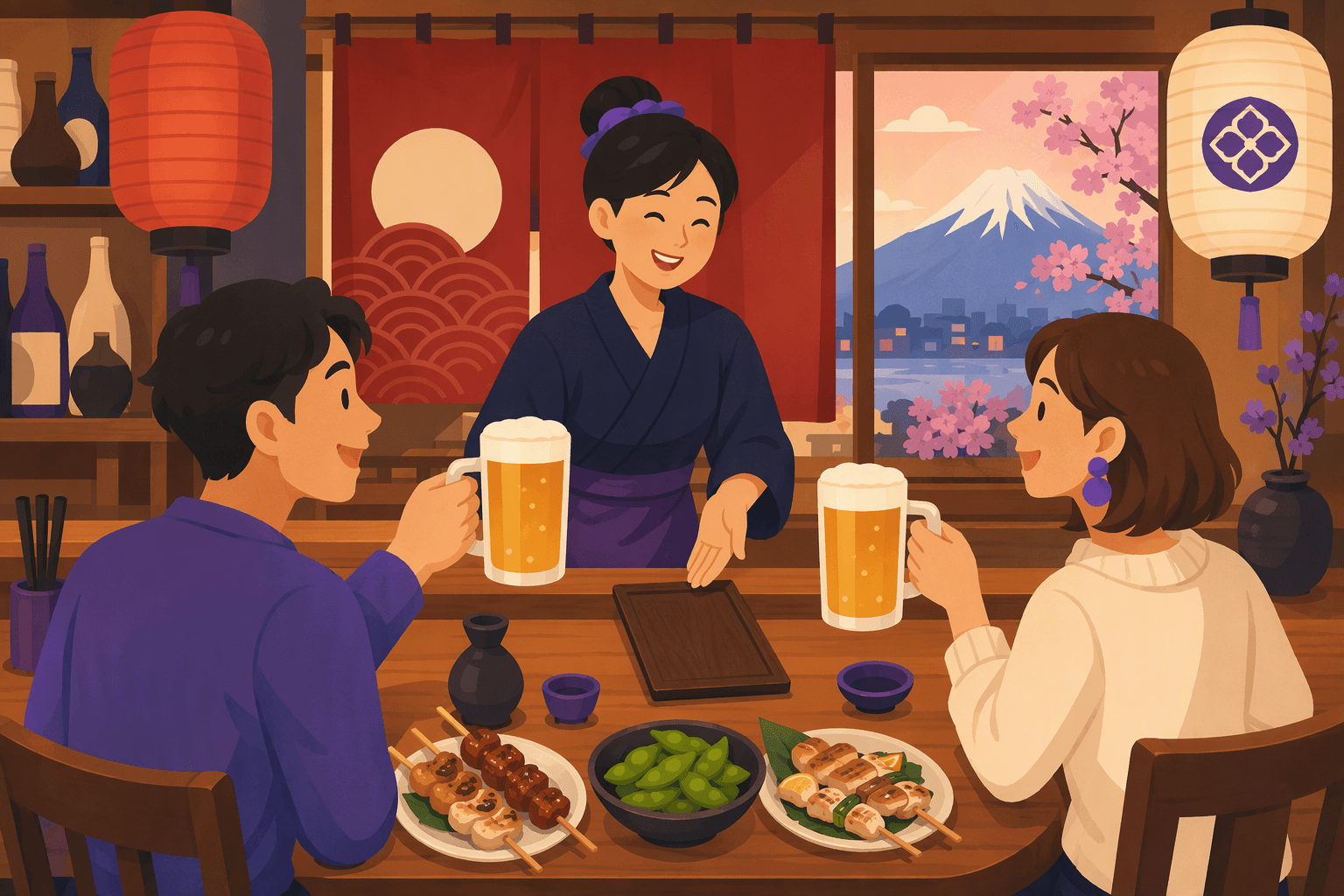
What makes an izakaya different?
An izakaya is not simply a bar and not exactly a standard restaurant. People usually order several small dishes over time, often with drinks first and food added gradually.
The atmosphere ranges from bright and lively chain venues to tiny counter-only neighborhood spots. Some have English menus or tablet ordering, while others rely on calling a server over and ordering aloud.
Joy Hendry’s Understanding Japanese Society describes how group settings can give social rituals extra weight. At an izakaya, this shows up in small actions: waiting for the group toast, pouring attention toward others, and using polite requests with staff.
🌍 The automatic appetizer
Many izakaya serve an お通し /o.toː.ɕi/, a small appetizer and seating charge, soon after you sit down. It is normally not optional, even if you did not order it. Ask about the price if you need to manage a budget, but do not mistake it for a free snack.
Entering and getting a table
When you walk in, staff may call いらっしゃいませ /i.ɾaʔ.ɕa.i.ma.se/, a fixed welcome used in shops and restaurants. You do not need to reply with the same phrase. A smile, nod, or こんばんは /koɴ.baɴ.wa/, good evening, is enough.
Say how many people are with you
The counter 人 /nin/ counts people. You can state your number and add です /de.sɯ/ for a polite, compact answer.
| English | Japanese | IPA |
|---|---|---|
| One person | 一人です | /ɦi.to.ɾi de.sɯ/ |
| Two people | 二人です | /ɸɯ.ta.ɾi de.sɯ/ |
| Three people | 三人です | /saɴ.nin de.sɯ/ |
| Four people | 四人です | /jo.nin de.sɯ/ |
If you want to be more explicit, say 二人お願いします /ɸɯ.ta.ɾi o.ne.ɡa.i.ɕi.ma.sɯ/, meaning a table for two, please.
For a reservation, say 予約しています /jo.ja.kɯ ɕi.te.i.ma.sɯ/, I have a reservation. Add your name after the phrase: 予約しています、スミスです /jo.ja.kɯ ɕi.te.i.ma.sɯ, sɯ.mi.sɯ de.sɯ/.
Counter or table?
Staff may ask カウンターでいいですか /ka.ɯɴ.taː de iː de.sɯ ka/, asking whether counter seating is okay. Say はい /ha.i/, yes, if it is. To request a table, say テーブル席がいいです /teː.bɯ.ɾɯ se.ki ɡa iː de.sɯ/.
In compact city izakaya, accepting counter seating can be the fastest way in. It can also be a rewarding choice: you may watch food being prepared and hear short, authentic exchanges between staff and regulars.
Calling staff and ordering politely
The key phrase is すみません /sɯ.mi.ma.seɴ/. It can mean excuse me, sorry, or get your attention, depending on context. Say it clearly but do not shout across a quiet room.
/soo-mee-mah-SEN/
Literal meaning: A flexible polite apology and attention-getter.
“すみません、注文いいですか。”
Excuse me, may I order?
Use this to call a server, apologize for a minor inconvenience, or politely begin a request.
The most reliable ordering pattern is noun plus お願いします /o.ne.ɡa.i.ɕi.ma.sɯ/, please. You can also use ください /kɯ.da.sa.i/, please give me.
For example, 生ビールお願いします /na.ma biː.ɾɯ o.ne.ɡa.i.ɕi.ma.sɯ/ means draft beer, please. The word 生 /na.ma/ literally means raw or fresh, but in this context it refers to draft beer.
Pointing is completely normal
If reading the menu feels difficult, point and say これをください /ko.ɾe.o kɯ.da.sa.i/, this one, please. For several items, use これとこれをください /ko.ɾe to ko.ɾe.o kɯ.da.sa.i/, these two, please.
/koh-reh oh koo-dah-SAI/
Literal meaning: Please give me this.
“これを二つください。”
Two of these, please.
Pointing at the menu is expected and helpful. Add 二つ for two items, or use one finger and then two fingers if needed.
Yoko Hasegawa’s Japanese: A Linguistic Introduction emphasizes that Japanese frequently leaves information unstated when context makes it clear. At an izakaya, you rarely need to construct a full sentence such as I would like to order this dish. The menu, gesture, and ください /kɯ.da.sa.i/ do the work.
Drinks you will see and hear
The first order in many groups is a drink order. You can say とりあえずビール /to.ɾi.a.e.zɯ biː.ɾɯ/, literally beer for now, but this is a casual group expression, not an obligation. Ask for what you actually want.
| English | Japanese | Pronunciation | Note |
|---|---|---|---|
| Draft beer | 生ビール | nah-mah BEE-roo | A common first order. 生 means draft in this setting. |
| Bottled beer | 瓶ビール | been BEE-roo | Often shared and poured into small glasses. |
| Japanese rice wine | 日本酒 | nee-HOHN-shoo | Can be served chilled or warm. |
| Shochu | 焼酎 | shoh-CHOO | A distilled spirit, often mixed with water, soda, or tea. |
| Highball | ハイボール | hai-BOH-roo | Usually whisky and soda water. |
| Oolong tea | ウーロン茶 | oo-ROHN-chah | A common non-alcoholic option. |
| Water | お水 | oh-MEE-zoo | Useful if you want plain water. |
For Japanese sake, say 日本酒 /ni.hoɴ.ɕɯ/. For shochu, say 焼酎 /ɕoː.tɕɯː/. They are different: sake is brewed from rice, while shochu is distilled and can be made from ingredients such as barley, sweet potato, or rice.
If you do not drink alcohol, simply say お酒は飲みません /o.sa.ke wa no.mi.ma.seɴ/, I do not drink alcohol, or ask for ソフトドリンク /so.ɸɯ.to do.ɾiɴ.kɯ/, a soft drink. This is ordinary and does not require an apology.
The toast: 乾杯
Wait until everyone has a drink before saying 乾杯 /kaɴ.pa.i/, cheers. Raise your glass, make a brief toast, and take a sip. You do not have to clink glasses, especially in a crowded space.
/kahm-PAI/
Literal meaning: Dry cup.
“みんなそろった? じゃあ、乾杯!”
Is everyone here? Okay then, cheers!
Wait until the group is ready before drinking. In a work setting, a senior person may initiate the first toast.
The literal meaning of 乾杯 /kaɴ.pa.i/ is dry cup, but no one expects you to empty your glass. It is simply the standard toast.
In some groups, people notice whether another person’s glass is empty and offer a refill. This is more common in formal work gatherings than among close friends. You can accept with ありがとうございます /a.ɾi.ɡa.toː ɡo.za.i.ma.sɯ/, thank you, or decline gently with 大丈夫です /da.i.dʑoː.bɯ de.sɯ/, I am okay.
For more everyday social language, see our guide to how to say hello in Japanese. Izakaya conversation often begins with the same relaxed greetings, then shifts quickly to food, work, travel, or shared friends.
Ordering food and sharing dishes
Izakaya food is intended for sharing. Common categories include 焼き鳥 /ja.ki.to.ɾi/, grilled chicken skewers, 刺身 /sa.ɕi.mi/, raw fish slices, 唐揚げ /ka.ɾa.a.ɡe/, Japanese fried chicken, and 枝豆 /e.da.ma.me/, salted young soybeans.
When you want another item, say 追加でお願いします /tsɯ.i.ka de o.ne.ɡa.i.ɕi.ma.sɯ/, additionally, please. To ask for a recommendation, say おすすめは何ですか /o.sɯ.sɯ.me wa naɴ de.sɯ ka/, what do you recommend?
Specify dietary needs directly
Japanese restaurant menus increasingly label allergens, but it is still wise to ask. Say これは豚肉が入っていますか /ko.ɾe wa bɯ.ta.ni.kɯ ɡa ha.iʔ.te.i.ma.sɯ ka/, does this contain pork? For a food allergy, say アレルギーがあります /a.ɾe.ɾɯ.ɡiː ɡa a.ɾi.ma.sɯ/.
Vegetarian dining can require extra clarification because dashi /da.ɕi/, stock often made with fish, appears in many sauces and side dishes. Ask だしが入っていますか /da.ɕi ɡa ha.iʔ.te.i.ma.sɯ ka/, does it contain dashi?
💡 Useful ordering rhythm
Order one or two drinks first, then choose a few dishes to share. Add more later with 追加でお願いします /tsɯ.i.ka de o.ne.ɡa.i.ɕi.ma.sɯ/. This fits the izakaya style better than trying to order every dish at once.
Paying and leaving
When you are ready, make eye contact with a server and say お会計お願いします /o.ka.i.keː o.ne.ɡa.i.ɕi.ma.sɯ/. Another widely used word is お勘定 /o.kaɴ.dʑoː/, also meaning the bill.
/oh-kai-KEH oh-neh-gah-ee-shee-mahss/
Literal meaning: Please handle the payment.
“すみません、お会計お願いします。”
Excuse me, the bill, please.
Many izakaya have you pay at a register near the exit. The server may point you there after you ask.
To split the bill, ask 別々にできますか /be.tsɯ.be.tsɯ ni de.ki.ma.sɯ ka/, can we pay separately? Some venues can do this, but many groups use 割り勘 /wa.ɾi.kaɴ/, splitting the total evenly, especially among friends.
Do not tip. Japan National Tourism Organization guidance explains that tipping is generally not part of Japanese dining practice. Pay the displayed total, say ありがとうございます /a.ɾi.ɡa.toː ɡo.za.i.ma.sɯ/, and leave with ごちそうさまでした /ɡo.tɕi.soː.sa.ma de.ɕi.ta/, a polite expression of thanks after a meal.
Why ごちそうさまでした matters
The phrase ごちそうさまでした /ɡo.tɕi.soː.sa.ma de.ɕi.ta/ recognizes the meal and the effort behind it. It is appropriate whether you ate a cheap bowl of noodles, shared a long izakaya dinner, or were treated by a friend.
Haru Yamada’s Different Games, Different Rules examines how interactional expectations vary between Japanese and American contexts. This phrase is a useful example: it is short, conventional, and socially meaningful without needing a long explanation of gratitude.
For a final farewell as you walk out, say ありがとうございました /a.ɾi.ɡa.toː ɡo.za.i.ma.ɕi.ta/, thank you very much. You can also use the natural goodbyes in our guide to saying goodbye in Japanese.
A simple izakaya script to memorize
Here is a realistic sequence for a first visit:
- Enter and say こんばんは /koɴ.baɴ.wa/.
- Tell staff 二人です /ɸɯ.ta.ɾi de.sɯ/.
- Get their attention with すみません /sɯ.mi.ma.seɴ/.
- Order with 生ビールお願いします /na.ma biː.ɾɯ o.ne.ɡa.i.ɕi.ma.sɯ/ and これをください /ko.ɾe.o kɯ.da.sa.i/.
- Wait for everyone, then say 乾杯 /kaɴ.pa.i/.
- Add food with 追加でお願いします /tsɯ.i.ka de o.ne.ɡa.i.ɕi.ma.sɯ/.
- Finish with お会計お願いします /o.ka.i.keː o.ne.ɡa.i.ɕi.ma.sɯ/.
- Leave with ごちそうさまでした /ɡo.tɕi.soː.sa.ma de.ɕi.ta/ and ありがとうございました /a.ɾi.ɡa.toː ɡo.za.i.ma.ɕi.ta/.
Learn the phrases from real scenes
Izakaya Japanese is fast, repetitive, and highly contextual, which makes it ideal listening practice. Notice how servers shorten routine phrases, how friends call すみません /sɯ.mi.ma.seɴ/, and how orders arrive in small bursts rather than textbook-perfect sentences.
Watching Japanese film and TV clips helps connect these phrases to facial expressions, timing, and register. Build your foundation with Japanese greetings for every level, then listen for these izakaya expressions in scenes involving after-work meals, reunions, and group celebrations.
Frequently Asked Questions
What should I say when entering an izakaya in Japan?
Is it rude to start drinking before everyone says kanpai?
Do I need to tip at a Japanese izakaya?
How do I ask for the bill in Japanese?
Can I use casual Japanese with izakaya staff?
Sources & References
- The Japan Foundation, Survey Report on Japanese-Language Education Abroad, 2021
- Ethnologue, Japanese language entry, 27th edition, 2024
- National Institute for Japanese Language and Linguistics, Japanese Language Research Resources, accessed 2026
- Agency for Cultural Affairs, Japanese Language and Culture Resources, accessed 2026
- Japan National Tourism Organization, Dining and Etiquette Information, accessed 2026
Start learning with Wordy
Watch real movie clips and build your vocabulary as you go. Free to download.


