Quick Answer
Japanese house vocabulary includes 家 for house, 部屋 for room, 玄関 for the entrance area, 台所 for kitchen, and お風呂 for bath. Learn the words by room, then connect them to Japanese home customs such as removing shoes at the genkan and sleeping on futons.
Japanese house vocabulary starts with 家 /ie/, meaning house or home, and expands to useful room words such as 部屋 /heja/, 玄関 /ɡeŋkaɴ/, 台所 /daidokoɾo/, and 寝室 /ɕiɴɕitɕɯ/. Learning these words also helps you understand daily Japanese life, from taking off shoes at the entrance to the difference between a bathing room and a toilet.
Japanese is spoken by roughly 123 million people, primarily in Japan, according to Ethnologue. Home vocabulary is especially useful because homes appear constantly in anime, dramas, apartment tours, family conversations, and real estate listings.
This guide teaches essential Japanese words for rooms, furniture, household objects, and home routines. Pair it with our Japanese greetings guide so you can politely greet someone when entering their home.
| English | Japanese | Pronunciation | Note |
|---|---|---|---|
| house, home | 家 | EH-eh | Can mean a house, household, or family. |
| home, my place | うち | OO-chee | Often more personal and conversational than 家. |
| room | 部屋 | heh-YAH | A general word for a room. |
| entrance area | 玄関 | gehn-KAHN | Where shoes are removed. |
| living room | 居間 | EE-mah | Traditional Japanese word for living room. |
| living room | リビング | ree-BEEN-goo | Modern loanword used in many homes. |
| kitchen | 台所 | dye-DOH-koh-roh | Literally a place for a stand or table. |
| kitchen | キッチン | KEET-cheen | Loanword, common in modern speech. |
| bedroom | 寝室 | sheen-SHEE-tsoo | A formal and practical room label. |
| toilet, restroom | トイレ | toh-EE-reh | Usually a separate room from the bath. |
| bath | お風呂 | oh-FOO-roh | Can mean the bath or bathing time. |
| bathroom, bathing room | 浴室 | yoh-SHEE-tsoo | The physical room containing the bath. |
| hallway | 廊下 | roh-KAH | A corridor inside a home. |
| garden | 庭 | nee-WAH | Can be a small yard or landscaped garden. |
| balcony | ベランダ | beh-RAHN-dah | Often used for drying laundry. |
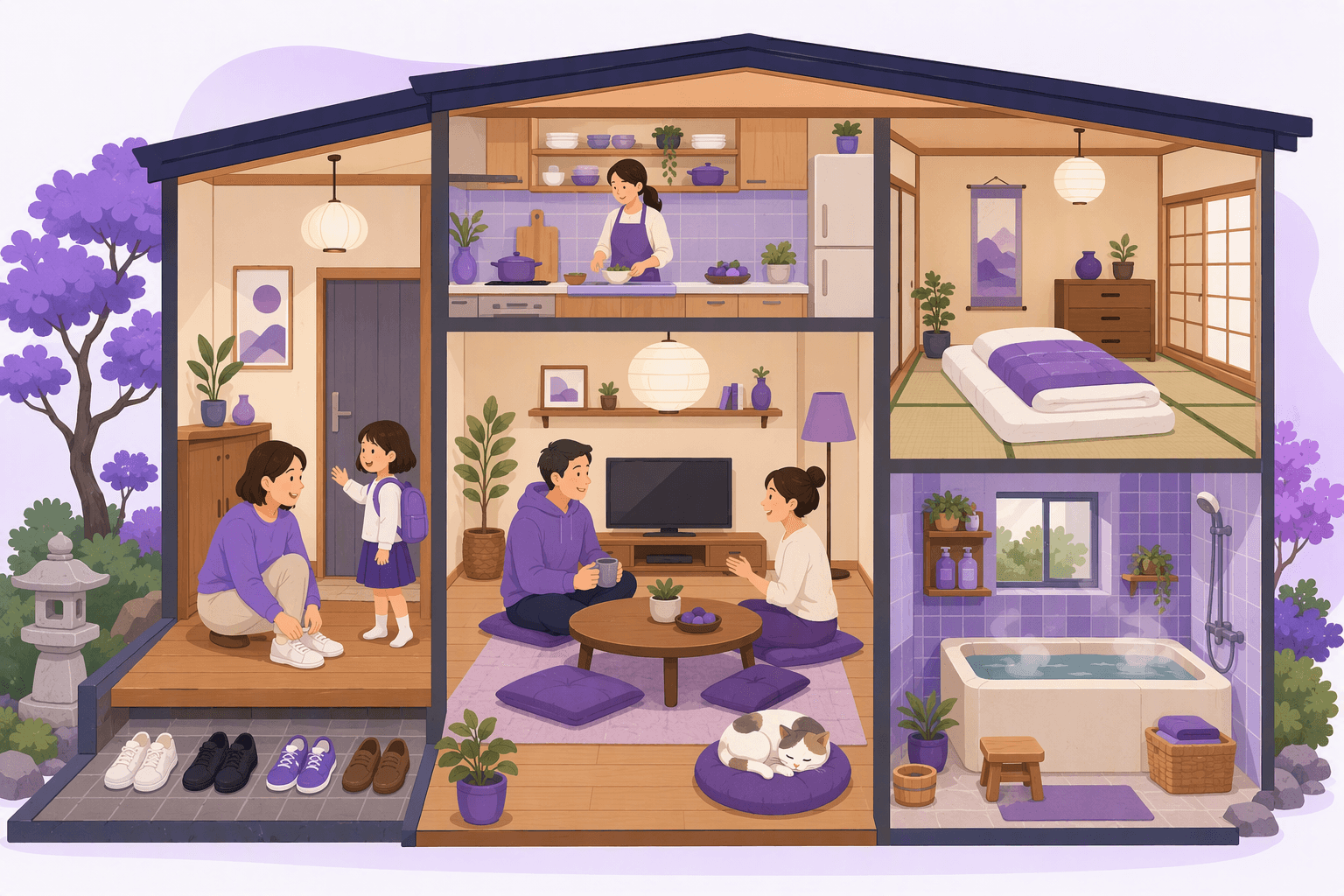
The core words for a Japanese home
The broad word for a house is 家 /ie/. You can use it when talking about someone else's house, your family home, or the idea of a household. For example, 田中さんの家 /tanaka saɴ no ie/ means Tanaka's house.
In everyday conversation, うち /utɕi/ often sounds warmer and more personal. It can mean my home, our home, or even my family. A speaker might say うちに来る? /utɕi ni kɯɾɯ/, meaning “Want to come over to my place?”
A room is 部屋 /heja/. This is one of the first words to learn because it combines with other vocabulary easily. 自分の部屋 /ʑibɯɴ no heja/ means one's own room, and 部屋番号 /heja baŋɡoː/ means room number.
玄関
The 玄関 /ɡeŋkaɴ/ is not simply a hallway. It is the entrance zone where outdoor space ends and the clean interior of the home begins.
Most homes have a lowered 玄関 /ɡeŋkaɴ/ floor, called たたき /tataki/. Remove your shoes there and step up onto the raised interior floor in socks or slippers. This physical change in floor level makes the boundary visible.
🌍 Shoes are part of home etiquette
When visiting a Japanese home, take off shoes at the 玄関 /ɡeŋkaɴ/ and place them neatly with the toes pointing toward the door. Avoid stepping onto tatami /tatami/ mats with slippers unless your host clearly does so. Toilet slippers, when provided, stay inside the toilet room only.
The cultural importance of inside and outside is reflected in language as well. Japanese has the social concepts 内 /utɕi/, inside or one's group, and 外 /soto/, outside or outsiders. Chie Nakane's Japanese Society examines how group boundaries shape social relationships, and the 玄関 /ɡeŋkaɴ/ provides a very practical everyday example.
居間 and リビング
居間 /ima/ is the traditional word for a living room. The first character relates to being or staying, and the second means room. It is the space where people spend time together.
Many people now say リビング /ɾibiŋɡɯ/, a Japanese adaptation of “living room.” Apartment advertisements may use LDK /eɾɯ diː kei/, short for living, dining, kitchen, to describe an open shared area.
For instance, a 1LDK /waɴ eɾɯ diː kei/ apartment has one separate bedroom plus a combined living, dining, and kitchen area. A 2DK /tsuː diː kei/ has two rooms plus a dining-kitchen area, but not necessarily a separate living room.
台所 and キッチン
台所 /daidokoɾo/ is the traditional Japanese word for kitchen. In modern homes, キッチン /kitɕiɴ/ is equally common, especially when discussing appliances, layouts, or newer apartments.
The difference is not usually a strict one. 台所 /daidokoɾo/ can feel slightly more traditional or domestic, while キッチン /kitɕiɴ/ appears frequently in advertisements, television, and casual speech.
Furniture and household objects in Japanese
| English | Japanese | Pronunciation | Note |
|---|---|---|---|
| table | テーブル | TAY-boo-roo | A Western-style table. |
| low table | ちゃぶ台 | chah-boo-DYE | Traditional low dining table. |
| chair | 椅子 | EE-soo | Often used with Western-style tables. |
| sofa | ソファ | SOH-fah | A common modern loanword. |
| bed | ベッド | BEHD-doh | The small ッ doubles the d sound. |
| futon | 布団 | foo-TOHN | Bedding placed on the floor or tatami. |
| tatami mat | 畳 | tah-TAH-mee | Traditional woven floor mat. |
| closet | 押し入れ | oh-shee-EE-reh | Built-in storage, often for bedding. |
| curtain | カーテン | KAH-ten | The long vowel is held slightly longer. |
| lamp, light | 電気 | DEHN-kee | Also means electricity. |
| refrigerator | 冷蔵庫 | reh-zoh-KOH | Commonly shortened to 冷蔵庫 in daily speech. |
| washing machine | 洗濯機 | sehn-TAHK-kee | Literally washing machine. |
| air conditioner | エアコン | eh-ah-KOHN | Shortened from air conditioner. |
| television | テレビ | TEH-reh-bee | A familiar loanword. |
| remote control | リモコン | ree-moh-KOHN | Shortened from remote control. |
畳
畳 /tatami/ are traditional woven floor mats, usually made with a soft rush covering over a compressed core. A room with this style of flooring is a 和室 /waɕitsɯ/, a Japanese-style room.
Tatami rooms can function flexibly. The same space may be a sitting room during the day and a sleeping area at night, when 布団 /hɯtoɴ/ bedding is laid out. This differs from the fixed bed-and-bedroom arrangement common in many countries.
The standard size of a tatami mat varies by region, so apartment listings often use 畳 /tatami/ as a rough measure rather than an exact universal unit. A six-tatami room, written as 6畳 /ɾokɯdʑoː/, is a familiar description in Japanese housing.
布団
A 布団 /hɯtoɴ/ is a set of bedding, usually a mattress-like pad called 敷布団 /ɕikibɯtoɴ/ and a quilt called 掛け布団 /kakebɯtoɴ/. It is not merely a thin blanket.
Many homes use beds today, but futons remain practical in smaller spaces because they can be folded and stored in an 押し入れ /oɕiiɾe/, a deep built-in closet. They also appear often in family dramas and scenes involving guests staying overnight.
押し入れ
The 押し入れ /oɕiiɾe/ is a traditional storage closet, often divided by a shelf into upper and lower sections. It is designed for folded futons, blankets, seasonal clothing, and household supplies.
Do not confuse it with a modern closet called クローゼット /kɯɾoːzetto/. The latter is generally designed for Western-style clothing storage, including hanging garments.
💡 Learn rooms through scenes
Watch a scene set in a home and pause when a character enters the 玄関 /ɡeŋkaɴ/, opens the 冷蔵庫 /ɾeːzoːko/, or lays out a 布団 /hɯtoɴ/. Attach each word to a visible action, not an isolated translation. This makes household vocabulary much easier to recall.
For listening practice, domestic scenes in Japanese dramas are useful because family members repeat high-frequency verbs and object names. Our guide to learning Japanese with anime explains how to use short scenes actively rather than just watching passively.
Home actions and practical phrases
| English | Japanese | Pronunciation | Note |
|---|---|---|---|
| to return home | 帰る | kah-EH-roo | Used when going back home. |
| to enter | 入る | hah-EE-roo | Can mean enter a room, building, or bath. |
| to open | 開ける | ah-KEH-roo | Used for doors, windows, and containers. |
| to close | 閉める | shee-MEH-roo | Used for doors, windows, and curtains. |
| to clean | 掃除する | soh-JEE-soo-roo | A common household verb. |
| to wash clothes | 洗濯する | sehn-TAHK-soo-roo | Used for doing laundry. |
| to cook | 料理する | ryoh-REE-soo-roo | Also relates to cuisine and cooking. |
| to take a bath | お風呂に入る | oh-FOO-roh nee hah-EE-roo | Literally enter the bath. |
| I'm home | ただいま | tah-dye-MAH | Said on returning home. |
| welcome home | おかえり | oh-kah-EH-ree | Reply to someone returning home. |
The daily phrases you hear at home
When someone returns home, they commonly say ただいま /tadaima/, literally expressing that they have returned. The person already at home responds おかえり /okaeri/, meaning welcome back.
These are not formal greetings for any location. They belong to the routine of returning to a shared home. You may hear longer polite versions, ただいま帰りました /tadaima kaeɾimaɕita/ and おかえりなさい /okaeri nasai/, especially in families, workplaces, or more polite settings.
Another useful phrase is お風呂に入る /ofɯɾo ni haiɾɯ/, to take a bath. The literal structure is “enter the bath.” In a Japanese bath routine, people typically wash their body before soaking, so the bathwater remains clean for soaking rather than washing.
The Statistics Bureau of Japan reported approximately 65 million dwellings in its 2023 Housing and Land Survey, including roughly 9 million vacant homes. That figure illustrates a major housing issue in Japan, where 空き家 /akija/, vacant houses, have become a visible topic in news reports, local government policy, and rural travel programs.
Japanese home culture that vocabulary alone cannot show
Japanese homes vary enormously by region, generation, budget, and city. A compact Tokyo apartment may have a unit bath, while a larger detached home may contain a separate toilet, washroom, and bathing room.
The word 脱衣所 /datsuijo/, pronounced /datsɯiʑo/, refers to the changing area near the bath. It commonly contains a sink, washing machine, laundry basket, and space to undress. This separation helps explain why 浴室 /joːɕitsɯ/ and トイレ /toiɾe/ are often distinct rooms.
The Japan Foundation's language resources emphasize that vocabulary is inseparable from context. In this case, learning 玄関 /ɡeŋkaɴ/, 畳 /tatami/, 布団 /hɯtoɴ/, and お風呂 /ofɯɾo/ gives you more than labels: it gives you a map of daily customs.
🌍 Bathing is not the same as using the toilet
In many Japanese homes, the toilet is a separate トイレ /toiɾe/, while the bathing room is the 浴室 /joːɕitɕɯ/. Do not wear toilet slippers into other rooms. This small detail is a clear sign that you understand the household's hygiene boundary.
How to remember Japanese house vocabulary
Start with the room you use most. Label your actual door as ドア /doa/, your window as 窓 /mado/, your table as テーブル /teːbɯɾɯ/, and your refrigerator as 冷蔵庫 /ɾeːzoːko/. Seeing the word in its real setting builds stronger recall than a long word list alone.
Then create short sentences. Say 私の部屋 /watashi no heja/, my room, or 台所で料理する /daidokoɾo de ɾjoːɾi sɯɾɯ/, I cook in the kitchen. Japanese sentence patterns become easier when the nouns are already familiar.
Finally, listen for domestic vocabulary in media. A character saying ただいま /tadaima/ at the door or asking whether someone has taken a bath gives the vocabulary emotion, timing, and social meaning. When you are ready for relationship language heard in home scenes, see our guide to saying I love you in Japanese, and learn natural Japanese goodbye phrases for leaving someone's home politely.
Frequently Asked Questions
What is house in Japanese?
What is a Japanese genkan?
What is the Japanese word for living room?
What is the difference between ofuro and yokushitsu?
Why do Japanese homes have separate toilet rooms?
Sources & References
- Agency for Cultural Affairs, Japanese Language and Culture Resources, accessed 2026
- The Japan Foundation, Japanese-Language Education Resources, accessed 2026
- Statistics Bureau of Japan, 2023 Housing and Land Survey
- Ethnologue, Japanese, 27th edition, 2024
- Chie Nakane, Japanese Society, University of California Press
Start learning with Wordy
Watch real movie clips and build your vocabulary as you go. Free to download.


