Quick Answer
In an emergency in Japan, call 119 for an ambulance or fire, and 110 for police. Say 助けてください for help, state your location clearly, and use short phrases such as 救急車をお願いします to request urgent assistance.
In Japan, call 119 for an ambulance or fire emergency and 110 for police. The most useful Japanese emergency phrase is 助けてください /tasukete kudasai/, “please help me,” followed by your location and a short description of what happened. Learn these phrases before a trip, save both numbers, and practice saying your hotel address out loud.
Japanese has about 123 million first-language speakers according to Ethnologue, and emergencies can happen far from English-speaking tourist centers. Japan welcomed roughly 36.9 million international visitors in 2024, according to the Japan National Tourism Organization, so emergency systems increasingly encounter travelers, but you should not assume immediate English support.
For practical travel language beyond emergencies, keep a separate list of essential Japanese travel phrases. In a crisis, however, short, specific Japanese is more useful than a long grammatically perfect explanation.
| English | Japanese | Pronunciation | Formality |
|---|---|---|---|
| Help! | 助けて! | tah-soo-KEH-teh | casual |
| Please help me. | 助けてください。 | tah-soo-KEH-teh koo-dah-SAH-ee | polite |
| Please send an ambulance. | 救急車をお願いします。 | kyoo-KYOO-shah oh oh-neh-GAH-ee-shee-mahss | formal |
| Call the police, please. | 警察を呼んでください。 | KAY-sah-tsoo oh YOHN-deh koo-dah-SAH-ee | polite |
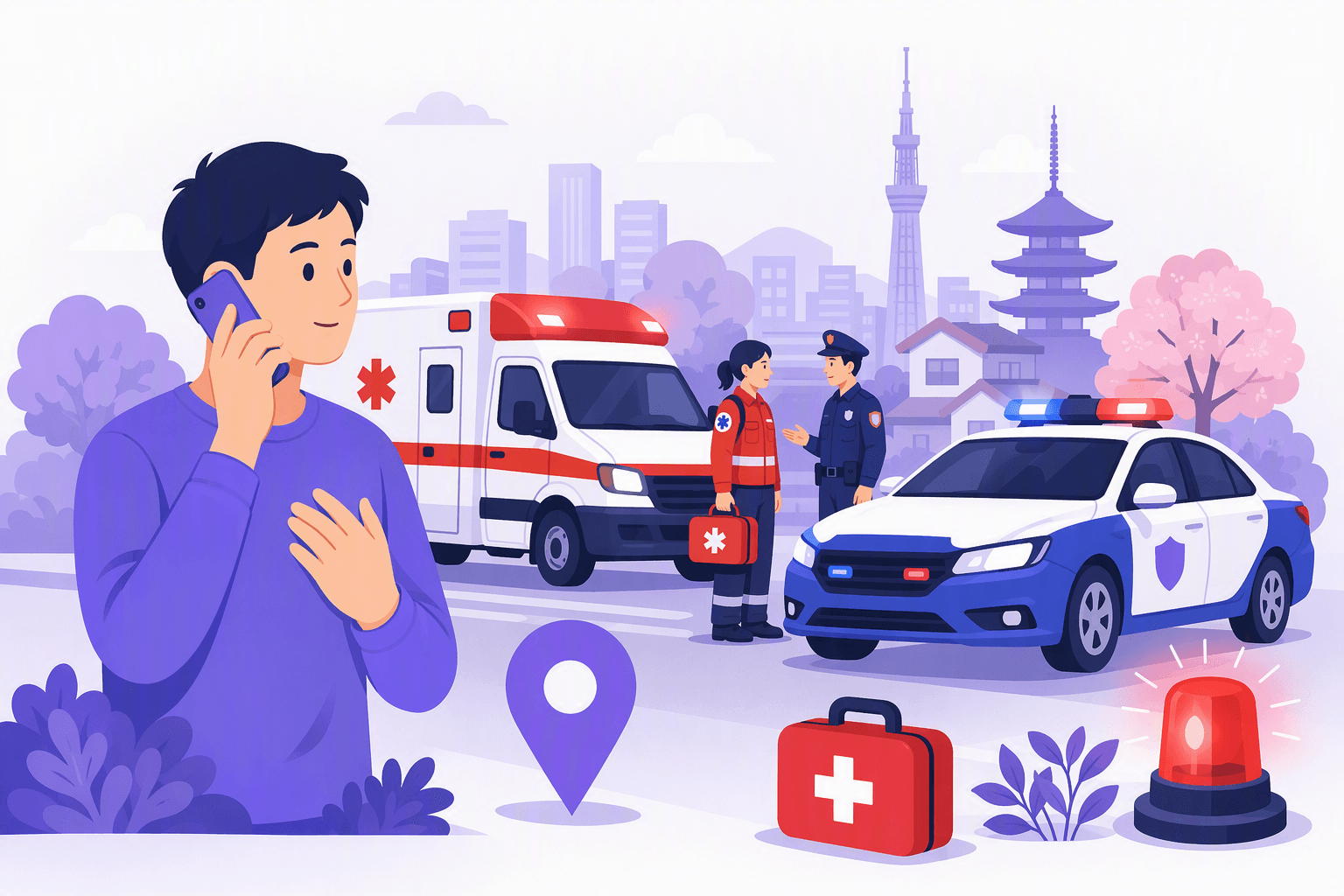
Know the emergency numbers first
The Fire and Disaster Management Agency directs people to call 119 for fires and emergency medical transport. Call 110 to report a crime, threat, traffic collision requiring police, or other police emergency.
Do not call either number for ordinary information, lost property without danger, or booking a clinic visit. Japan also has local non-emergency police boxes, called 交番 /koːban/, where officers can help with directions and some lost-property issues.
| Situation | Number | Japanese service name | What to say first |
|---|---|---|---|
| Ambulance or fire | 119 | 消防 /ɕoːboː/ | Your location and what happened |
| Police emergency | 110 | 警察 /keːsatsu/ | Your location and whether there is danger |
| Medical advice, non-emergency | Local service | Depends on prefecture | Ask your hotel, clinic, or local information desk |
A dispatcher needs three things quickly: where you are, what happened, and how many people need help. If you can only manage one sentence, give your location first.
⚠️ Call the correct service
For a life-threatening medical issue, fire, serious crime, or immediate danger, call 119 or 110 right away. Do not spend several minutes searching for the perfect phrase. Speak slowly, repeat your location, and ask a nearby person for help if possible.
The phrases that get help fastest
助けてください
助けてください /tasukete kudasai/ means “please help me.” Its pronunciation is tah-soo-KEH-teh koo-dah-SAH-ee. This is the best general phrase when you need help but cannot yet explain the entire situation.
The verb 助ける /tasukeru/ means “to help” or “to rescue.” Adding ください /kudasai/ makes the request polite, which is appropriate with strangers, staff, police officers, and emergency workers.
/tah-soo-KEH-teh koo-dah-SAH-ee/
Literal meaning: Please help.
“助けてください。友達が倒れました。”
Please help me. My friend collapsed.
Use this with strangers, station staff, police, or medical personnel. In immediate danger, speaking loudly is more important than sounding perfectly polite.
If you are in immediate danger and need to attract attention, use the shorter 助けて /tasukete/, pronounced tah-soo-KEH-teh. It is direct and urgent, not rude in an emergency.
救急車をお願いします
救急車をお願いします /kʲɯːkʲɯːɕa o oneɡai ɕimasɯ/ means “an ambulance, please.” Say it as kyoo-KYOO-shah oh oh-neh-GAH-ee-shee-mahss.
The word 救急車 /kʲɯːkʲɯːɕa/ is an ambulance. Japanese is mora-timed, so keep the two long vowels audible: kyoo-KYOO-shah, not a compressed one-beat version.
/kyoo-KYOO-shah oh oh-neh-GAH-ee-shee-mahss/
Literal meaning: An ambulance, please.
“救急車をお願いします。人が意識を失っています。”
Please send an ambulance. A person is unconscious.
This is concise and appropriate on a 119 call. Give the location immediately after making the request.
You may also hear 救急です /kʲɯːkʲɯː desɯ/, “it is an emergency.” It can help a bystander understand the urgency, although requesting 救急車 /kʲɯːkʲɯːɕa/ is clearer.
警察を呼んでください
警察を呼んでください /keːsatsu o jonde kudasai/ means “please call the police.” Pronounce it KAY-sah-tsoo oh YOHN-deh koo-dah-SAH-ee.
Use it if someone is threatening you, a crime is occurring, you witness violence, or you need police after a serious collision. 呼んでください /jonde kudasai/ literally asks someone to “call” or “summon” the police.
/KAY-sah-tsoo oh YOHN-deh koo-dah-SAH-ee/
Literal meaning: Please call the police.
“危ないです。警察を呼んでください。”
It is dangerous. Please call the police.
Use this with a shop employee, station staff member, security guard, or bystander. For a direct police emergency, call 110 yourself if it is safe to do so.
The National Police Agency identifies 110 as Japan’s police emergency number. If you are reporting an ongoing threat, do not confront the person to collect more details. Move toward a staffed place such as a station office, shop, hotel desk, or 交番 /koːban/ if you can do so safely.
火事です
火事です /kadʑi desɯ/ means “there is a fire.” Pronounce it KAH-jee dehss. Shout 火事だ /kadʑi da/ in an immediate situation, but 火事です /kadʑi desɯ/ is clear when speaking to staff or a dispatcher.
/KAH-jee dehss. hyah-koo JOO-kyoo-bahn nee dehn-wah shee-teh koo-dah-SAH-ee/
Literal meaning: It is a fire. Please call number 119.
“火事です!煙が出ています。”
There is a fire! Smoke is coming out.
State the fire clearly and leave the building if it is safe. Do not use an elevator during a fire evacuation.
The term 119番 /hʲakɯ dʑɯː kʲɯː ban/ means “number 119.” In ordinary speech, people often simply say ひゃくじゅうきゅう /hʲakɯ dʑɯː kʲɯː/ when referring to the emergency number.
Explain the medical problem
A dispatcher or bystander may ask what is wrong. You do not need a detailed diagnosis. State the most visible issue: pain, bleeding, unconsciousness, difficulty breathing, or an accident.
| English | Japanese | Pronunciation | Note |
|---|---|---|---|
| I am hurt | けがをしています | keh-GAH oh shee-teh ee-mahss | Use for an injury. |
| It hurts | 痛いです | ee-TAH-ee dehss | Point to the painful area. |
| I cannot breathe | 息ができません | ee-KEE gah deh-kee-mah-SEN | State this immediately. |
| I am bleeding | 血が出ています | chee gah deh-teh ee-mahss | Useful for visible bleeding. |
| They are unconscious | 意識がありません | ee-SHEE-kee gah ah-ree-mah-SEN | Use for another person. |
| There was an accident | 事故がありました | jee-KOH gah ah-ree-mah-shee-tah | Useful after a crash or fall. |
Say けがをしています /keɡa o ɕite imasɯ/, “I am injured,” if you have been hurt. For pain, say 痛いです /itai desɯ/, “it hurts,” and point to the affected area.
For breathing trouble, say 息ができません /iki ɡa dekimasen/, “I cannot breathe.” For bleeding, 血が出ています /tɕi ɡa dete imasɯ/ means “I am bleeding.” These phrases are intentionally simple, and simplicity is an advantage under stress.
Makino and Tsutsui’s A Dictionary of Basic Japanese Grammar explains how Japanese frequently omits subjects when context makes them obvious. That is useful here: you do not need to say “I” in every sentence. 痛いです /itai desɯ/ is enough when you are visibly the injured person.
Give your location in Japanese
The Japanese phrase ここは /koko wa/ means “this is” or “where I am is.” Combine it with a place name:
- ここは東京駅です /koko wa toːkʲoː eki desɯ/, “I am at Tokyo Station.”
- ホテルの前です /hoterɯ no mae desɯ/, “I am in front of the hotel.”
- コンビニの近くです /kombini no tɕikakɯ desɯ/, “I am near a convenience store.”
- 住所は分かりません /dʑɯːɕo wa wakarimasen/, “I do not know the address.”
For phone calls, the Japan National Tourism Organization advises travelers to know their accommodation name and address. Take a screenshot of the hotel’s Japanese address before you leave, especially if you plan to use rural trains, hiking routes, or late-night transport.
🌍 Why landmarks matter in Japan
Japanese addresses are precise, but they can be hard for visitors to read aloud. A station exit, hotel name, convenience store, temple, large intersection, or building sign can help responders locate you. Show the address on your phone to a bystander and say ここです /koko desɯ/, meaning “here.”
If you are in a train station, look for a uniformed staff member or the 駅員 /ekiin/, station attendant. In a department store, hotel, or large venue, staff can often call emergency services and communicate your location more efficiently than you can.
Ask someone nearby to make the call
Sometimes calling is impossible because you are injured, panicked, or do not have signal. Use these direct requests:
- 119番に電話してください /hʲakɯ dʑɯː kʲɯː ban ni denwa ɕite kudasai/, “please call 119.”
- 110番に電話してください /hʲakɯ toː ban ni denwa ɕite kudasai/, “please call 110.”
- 英語を話せますか /eːɡo o hanasemasɯ ka/, “can you speak English?”
- 日本語があまり話せません /nʲihoŋɡo ɡa amari hanasemasen/, “I do not speak much Japanese.”
The polite request form してください /ɕite kudasai/ is worth memorizing. It means “please do,” and you can attach it to many urgent requests. Your usual Japanese greetings matter for everyday politeness, but emergencies are one of the few contexts where concise speech is completely appropriate.
Haruko Minegishi Cook’s work on Japanese interaction shows that social meaning comes from context as well as grammar. In an emergency, a short request, urgent tone, and clear physical signals are understood as situationally appropriate. You do not need elaborate honorific language.
A practical emergency script
Memorize this short sequence for a 119 call:
- 救急車をお願いします /kʲɯːkʲɯːɕa o oneɡai ɕimasɯ/, “please send an ambulance.”
- ここは [place name] です /koko wa [place name] desɯ/, “I am at [place name].”
- 友達が倒れました /tomodatɕi ɡa taoremashita/, “my friend collapsed.”
- 意識がありません /iɕiki ɡa arimasen/, “they are unconscious.”
- 英語を話せますか /eːɡo o hanasemasɯ ka/, “can you speak English?”
Replace the third and fourth lines with what you can honestly observe. Do not guess a medical condition. “They are unconscious,” “they are bleeding,” or “they cannot breathe” gives responders more useful information than an uncertain diagnosis.
Practice before you need it
Emergency vocabulary is not pleasant study material, but it is high-value language. Save 119 and 110, add your hotel address to your notes app, and repeat the four core phrases aloud until they are automatic.
Watch Japanese scenes with hospitals, police, or station staff to hear how urgency changes rhythm and volume. Pair this with the sound guidance in our Japanese pronunciation guide, since a clear long vowel in 救急車 /kʲɯːkʲɯːɕa/ can make your message easier to understand.
For normal arrivals and departures, learn how to say goodbye in Japanese. For emergencies, remember the priority: get to safety, call the right number, state your location, and ask for help clearly.
Frequently Asked Questions
What number do I call for an ambulance in Japan?
What is the Japanese phrase for help me?
Can I call 911 in Japan?
Will Japanese emergency operators speak English?
How do I say I need a doctor in Japanese?
Sources & References
- Fire and Disaster Management Agency, 119 Emergency Call Guidance, accessed 2026
- National Police Agency of Japan, 110 Emergency Number, accessed 2026
- Japan National Tourism Organization, Safety Tips for Travelers, accessed 2026
- Ethnologue, Japanese, 27th edition, 2024
- Makino and Tsutsui, A Dictionary of Basic Japanese Grammar, The Japan Times
Start learning with Wordy
Watch real movie clips and build your vocabulary as you go. Free to download.


