Quick Answer
At a hotel in Japan, start with polite phrases such as チェックインをお願いします for check-in and 予約しています to say you have a reservation. This guide gives you practical Japanese for the front desk, room requests, problems, breakfast, luggage, and check-out.
| English | Japanese | Pronunciation | Formality |
|---|---|---|---|
| I'd like to check in. | チェックインをお願いします | CHEK-koo-in oh oh-neh-GAH-ee shee-mahss | polite |
| I have a reservation. | 予約しています | yoh-YAH-koo shee-teh ee-MAHSS | polite |
| The reservation name is... | 予約名は...です | yoh-YAH-koo-may wah ... dehss | formal |
| Can I leave my luggage? | 荷物を預けられますか | nee-MOH-tsoo oh ah-zoo-keh-rah-reh-MAHSS kah | polite |
| Could I have towels, please? | タオルをお願いします | TAH-oh-roo oh oh-neh-GAH-ee shee-mahss | polite |
| There is a problem with my room. | 部屋に問題があります | heh-YAH nee mond-DYE ah-ree-MAHSS | formal |
| What time is check-out? | チェックアウトは何時ですか | CHEK-koo-ow-toh wah NAN-jee dehss kah | polite |
| Thank you very much. | どうもありがとうございました | DOH-moh ah-ree-gah-TOH goh-zah-ee-MAH-shee-tah | formal |
At a hotel in Japan, the most useful Japanese phrase is チェックインをお願いします /tɕekːɯ in o oneɡai ɕimasɯ/, meaning “I would like to check in.” Pair it with 予約しています /jojaːkɯ ɕite imasɯ/, “I have a reservation,” and you can handle the essential arrival conversation politely. For everything else, short requests ending in お願いします /oneɡai ɕimasɯ/ will carry you a long way.
Japanese has roughly 123 million speakers worldwide, according to Ethnologue. Most are in Japan, where hotel staff in major cities often support visitors in English, Chinese, Korean, and other languages. Still, even simple Japanese signals respect, prevents misunderstandings, and helps greatly at smaller hotels, traditional inns, and regional destinations.
Before your trip, learn a few Japanese greetings. A warm こんにちは /koɲɲitɕiwa/ at the front desk and a clear reservation name create an easy start.
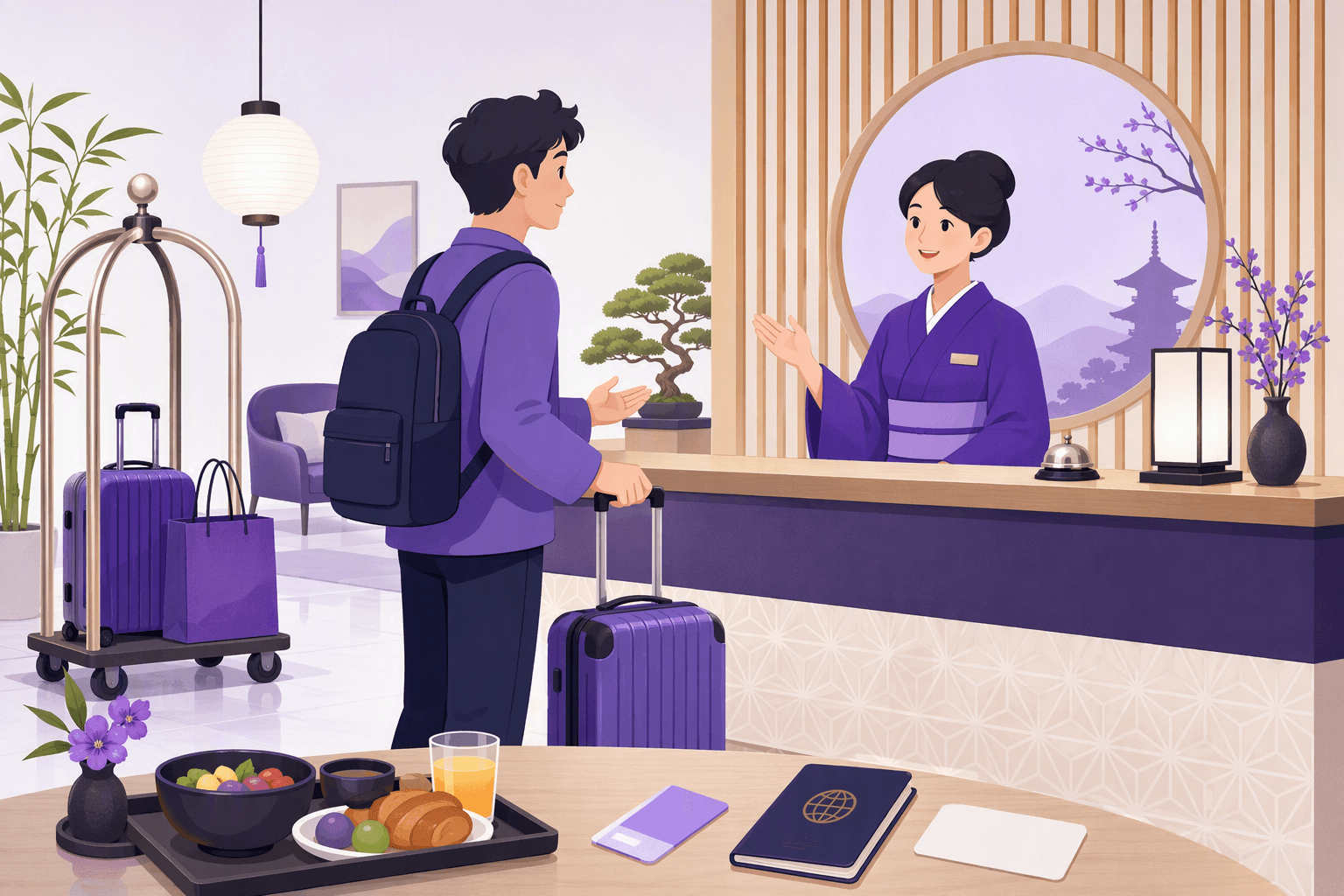
The hotel interaction: what to expect in Japan
Japanese hotels range from large international chains to compact business hotels, family-run minshuku /miɲɕɯkɯ/, and traditional ryokan /ɾjokan/. The language needed changes slightly, but the standard pattern remains the same: greet staff, state your purpose, provide your name, and respond politely to practical questions.
At check-in, staff may ask for your reservation confirmation, passport, address, payment method, and anticipated departure time. Foreign visitors who do not reside in Japan are normally asked to present a passport, as noted in visitor guidance from the Japan National Tourism Organization.
The Agency for Cultural Affairs frames practical language learning around tasks people must complete in daily life. A hotel check-in is exactly that kind of task: you do not need perfect grammar, but you do need a reliable opening, your booking details, and a way to ask for help.
💡 The safest polite ending
Use お願いします /oneɡai ɕimasɯ/ after an item or service you want. It is suitable for towels, an extra key, a taxi request, a wake-up call, and many other hotel needs.
Checking in and confirming your reservation
チェックインをお願いします
チェックインをお願いします /tɕekːɯ in o oneɡai ɕimasɯ/ literally combines “check-in” with a polite request. It is the cleanest phrase to use when you arrive at the front desk.
/CHEK-koo-in oh oh-neh-GAH-ee shee-mahss/
Literal meaning: Check-in, please.
“チェックインをお願いします。”
I'd like to check in, please.
A direct but polite opening for hotel reception. Say it after a greeting, then offer your name or passport.
Japanese uses many English-derived hotel words, including チェックイン /tɕekːɯ in/ and チェックアウト /tɕekːɯ auto/. Their pronunciation is adapted to Japanese rhythm, so each vowel and beat is heard clearly.
予約しています
予約しています /jojaːkɯ ɕite imasɯ/ means “I have a reservation.” Use it immediately after saying you want to check in, especially if staff have not already found your booking.
/yoh-YAH-koo shee-teh ee-MAHSS/
Literal meaning: I am reserved.
“予約しています。”
I have a reservation.
This is a standard front-desk phrase. Keep your booking email open on your phone in case staff need to verify the reservation.
To give the name on the booking, say 予約名はサンダーです /jojaːkɯmei wa sandaː desɯ/, “The reservation name is Sandor.” Replace サンダー /sandaː/ with the katakana version of your own name if you know it, but saying your name slowly in the Roman alphabet is also fine.
If you booked under another person’s name, use 予約は友達の名前です /jojaːkɯ wa tomodatɕi no namae desɯ/, meaning “The reservation is under my friend’s name.” Show the confirmation rather than struggling to spell a long foreign name aloud.
パスポートです
パスポートです /pasɯpoːto desɯ/ means “Here is my passport.” Staff may say パスポートをお願いします /pasɯpoːto o oneɡai ɕimasɯ/, “Passport, please.”
/pah-soo-POH-toh dehss/
Literal meaning: It is my passport.
“はい、パスポートです。”
Yes, here is my passport.
Presenting a passport at check-in is routine for many overseas visitors. Hand it over calmly and wait for staff to return it.
In a formal service interaction, はい /hai/ before your response makes it sound attentive. It is a simple “yes,” but here it functions like an acknowledgment.
Asking about your room and hotel services
Hotel rooms in Japan can be compact, particularly in central Tokyo, Osaka, and Kyoto. Confirming room basics before you go upstairs can save a return trip to reception.
部屋はどこですか
部屋はどこですか /heja wa doko desɯ ka/ means “Where is my room?” It is useful if you missed the room number or want help locating an elevator.
You can ask 朝食は何時ですか /tɕoːɕokɯ wa naɲdʑi desɯ ka/ for “What time is breakfast?” The word 朝食 /tɕoːɕokɯ/ is a formal hotel and restaurant word for breakfast. Many hotel staff will also understand the more familiar English-based term モーニング /moːniŋɡɯ/ in certain contexts, but 朝食 is clearer.
For Wi-Fi, ask Wi-Fiのパスワードは何ですか /waifiː no pasɯwaːdo wa nan desɯ ka/. This means “What is the Wi-Fi password?” Look for Wi-Fi /waifiː/ written on the welcome card, television screen, or desk information sheet before asking.
荷物を預けられますか
荷物を預けられますか /nimotsɯ o azɯkeraremasɯ ka/ means “Can I leave my luggage?” It is useful both before check-in and after check-out.
/nee-MOH-tsoo oh ah-zoo-keh-rah-reh-MAHSS kah/
Literal meaning: Can I entrust my luggage?
“チェックアウト後、荷物を預けられますか。”
Can I leave my luggage after check-out?
Many Japanese hotels will hold luggage on the same day without charge. Confirm when you need to collect it, especially if the front desk closes overnight.
The verb 預ける /azɯkerɯ/ means to entrust or leave something in someone’s care. You may hear staff reply はい、できます /hai dekimasɯ/, meaning “Yes, you can.”
🌍 Luggage forwarding is common
Japan has a widely used luggage-delivery service called 宅配便 /takɯhaibiɴ/. Hotels can often arrange to send suitcases to your next hotel or airport for a fee. Ask 荷物を送れますか /nimotsɯ o okɯremasɯ ka/, meaning “Can I send my luggage?”
Reporting room problems politely
A problem does not require advanced Japanese. Begin with すみません /sɯmimasen/, then name the issue. This word can mean “excuse me,” “sorry,” or “thank you for the trouble,” depending on context.
Senko K. Maynard’s Japanese Communication: Language and Thought in Context examines how Japanese speakers use context and interpersonal consideration to shape communication. At a hotel, a calm opener such as すみません /sɯmimasen/ helps frame even a complaint as a request for assistance rather than a confrontation.
部屋に問題があります
部屋に問題があります /heja ni mondai ga aɾimasɯ/ means “There is a problem with my room.” It is a helpful all-purpose sentence when you need staff to come and assess an issue.
/heh-YAH nee mond-DYE ah-ree-MAHSS/
Literal meaning: There is a problem in the room.
“すみません、部屋に問題があります。”
Excuse me, there is a problem with my room.
Use this general phrase first, then point to the issue or show a photo if useful. Hotel staff will usually ask a short follow-up question.
For no hot water, say お湯が出ません /ojɯ ga demasen/, “Hot water does not come out.” For an air conditioner problem, say エアコンが動きません /eakoɴ ga ɯɡokimasen/, “The air conditioner does not work.”
If your key card fails, say カードキーが使えません /kaːdokiː ga tsɯkaemasen/. This means “I cannot use the key card.” Avoid using the word 壊れた /koːɾeta/, “broken,” unless you are certain it is broken. The softer statement that it cannot be used lets staff diagnose the issue.
タオルをお願いします
タオルをお願いします /taoɾɯ o oneɡai ɕimasɯ/ means “Towels, please.” It is short, natural, and enough when you need fresh towels.
/TAH-oh-roo oh oh-neh-GAH-ee shee-mahss/
Literal meaning: Towels, please.
“タオルを二枚お願いします。”
Two towels, please.
Hold up fingers if you need a specific number. Hotel staff are used to simple requests from international visitors.
You can swap タオル /taoɾɯ/ for other useful nouns: 水 /mɯdzu/ for water, 毛布 /moːfɯ/ for a blanket, or 充電器 /dʑɯːdeɴki/ for a charger. The pattern stays the same.
Breakfast, baths, and ryokan etiquette
Hotels that include breakfast may give you a ticket or tell you the meal time at check-in. If you are unsure whether breakfast is included, ask 朝食はありますか /tɕoːɕokɯ wa aɾimasɯ ka/, “Is breakfast available?”
At a ryokan /ɾjokan/, you may find a shared bath, called 大浴場 /daijoɯbaː/. Ask 大浴場はどこですか /daijoɯbaː wa doko desɯ ka/, “Where is the large public bath?” Read the posted rules carefully, as bathing practices differ from country to country.
Japanese bathing culture generally requires washing your body before entering a shared bath. Towels do not go into the bathwater. Tattoo policies vary by property, particularly where public bathing facilities are involved, so ask before assuming access.
Naomi McGloin’s work in Japanese phonetics emphasizes the importance of timing and vowel length. That matters in hotel speech too: 大浴場 /daijoɯbaː/ contains a long final vowel, while 朝食 /tɕoːɕokɯ/ has two distinct beats in its opening sound. Clear rhythm makes basic requests easier for staff to understand.
For more practical vocabulary before your trip, see these Japanese travel phrases and this guide to Japanese restaurant phrases.
Checking out and saying goodbye
チェックアウトをお願いします
チェックアウトをお願いします /tɕekːɯ auto o oneɡai ɕimasɯ/ means “I would like to check out.” Say it at reception when leaving.
Ask チェックアウトは何時ですか /tɕekːɯ auto wa nan dʑi desɯ ka/ if you need to confirm the deadline. In Japanese hotels, punctual check-out matters because rooms are often cleaned on a tight schedule.
If you need a receipt, say 領収書をお願いします /ɾjoːɕɯːɕo o oneɡai ɕimasɯ/. This means “A receipt, please.” It is especially useful for work travel.
Finish with どうもありがとうございました /doːmo aɾiɡatoː ɡodzaimaɕita/, “Thank you very much.” The past form ありがとうございました /aɾiɡatoː ɡodzaimaɕita/ fits because the service interaction is ending.
A small nod, a clear thank-you, and a polite farewell are enough. For more ways to leave naturally, review our guide on how to say goodbye in Japanese.
A simple hotel script to practice
Here is a complete mini-conversation. Practice it aloud before your trip, then adapt the name and requests.
You: こんにちは。チェックインをお願いします。
こんにちは /koɲɲitɕiwa/. チェックインをお願いします /tɕekːɯ in o oneɡai ɕimasɯ/.
Hello. I would like to check in.
Staff: お名前をお願いします。
お名前をお願いします /onamae o oneɡai ɕimasɯ/.
Your name, please.
You: 予約しています。予約名はサンダーです。
予約しています /jojaːkɯ ɕite imasɯ/. 予約名はサンダーです /jojaːkɯmei wa sandaː desɯ/.
I have a reservation. The reservation name is Sandor.
Staff: パスポートをお願いします。
パスポートをお願いします /pasɯpoːto o oneɡai ɕimasɯ/.
Your passport, please.
You: はい、パスポートです。
はい /hai/、パスポートです /pasɯpoːto desɯ/.
Yes, here is my passport.
You later: すみません、Wi-Fiのパスワードは何ですか。
すみません /sɯmimasen/、Wi-Fiのパスワードは何ですか /waifiː no pasɯwaːdo wa nan desɯ ka/.
Excuse me, what is the Wi-Fi password?
The National Institute for Japanese Language and Linguistics collects real everyday conversation data, a useful reminder that successful communication is not about long textbook sentences. At a hotel, a short phrase, a polite tone, and a visible reservation confirmation usually work better than a complicated speech.
Watch short scenes with arrivals, customer-service exchanges, and travel problems to hear these phrases at natural speed. That context helps you recognize reduced sounds, pauses, and the service language that guidebooks cannot fully capture.
Frequently Asked Questions
How do I say I have a reservation at a hotel in Japanese?
Is English spoken at hotels in Japan?
What is the polite way to ask for help at a Japanese hotel?
Do hotels in Japan require a passport at check-in?
How do I ask to leave my luggage at a Japanese hotel?
Sources & References
- Japan Foundation, Marugoto Japanese Language and Culture, accessed 2026
- Agency for Cultural Affairs, Japanese Language Education Reference Framework, accessed 2026
- National Institute for Japanese Language and Linguistics, Corpus of Everyday Japanese Conversation, accessed 2026
- Japan National Tourism Organization, Travel Japan visitor information, accessed 2026
- Ethnologue, Japanese, 27th edition, 2024
Start learning with Wordy
Watch real movie clips and build your vocabulary as you go. Free to download.


