Quick Answer
Use すみません for polite attention, パスポートです when handing over your passport, and 荷物が出てきません if your baggage does not arrive. These Japanese airport phrases cover check-in, security, immigration, transfers, delays, and luggage problems.
If you are traveling through Japan, start with すみません /sɯ.mi.ma.seɴ/ for excuse me, これはどこですか /ko.ɾe wa do.ko de.sɯ ka/ for where is this, and 英語は話せますか /eː.ɡo wa ha.na.se.ma.sɯ ka/ for can you speak English? These phrases will carry you through check-in, immigration, baggage claim, airport transfers, and unexpected delays.
Japan’s major international airports are highly accessible for English-speaking visitors, but a short polite Japanese opener makes it easier to get help. Pair these phrases with the Japanese travel phrases guide for hotels, restaurants, trains, and everyday sightseeing.
Japanese has roughly 123 million first-language speakers, according to Ethnologue’s 27th edition. It is used primarily in Japan, but airport Japanese also matters in overseas Japanese communities and on Japanese airlines. At airports, clear speech, a calm tone, and a visible document often matter more than perfect grammar.
| English | Japanese | Pronunciation | Formality |
|---|---|---|---|
| Excuse me | すみません | soo-mee-mah-SEN | polite |
| Can you speak English? | 英語は話せますか? | EH-go wah hah-nah-seh-mahss kah | polite |
| Where is the check-in counter? | チェックインカウンターはどこですか? | chehk-koo-een kah-oon-TAH wah doh-koh dehss kah | polite |
| I have a reservation | 予約しています | yoh-yah-koo shee-teh ee-mahss | polite |
| My baggage has not arrived | 荷物が出てきません | nee-moh-tsoo gah deh-teh kee-mah-SEN | formal |
| Thank you very much | ありがとうございます | ah-ree-GAH-toh goh-zah-ee-MAHSS | formal |
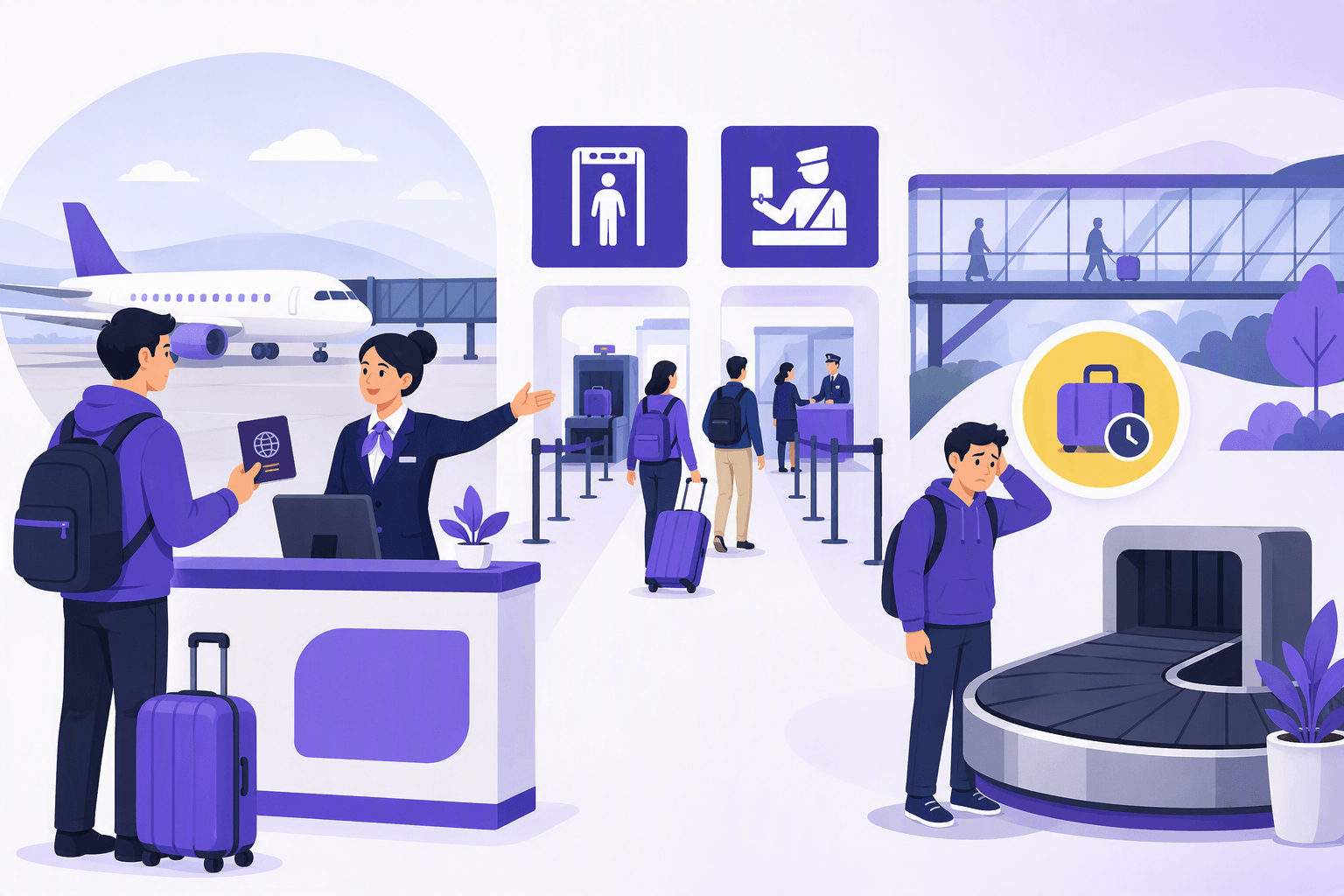
The airport phrases to learn first
At a busy airport, you do not need long sentences. Learn one phrase for getting attention, one for English help, one for directions, and one for a problem.
Japanese politeness is not just about sounding formal. Linguist Sachiko Ide’s work on Japanese honorific behavior explains how politeness is often shaped by the situation itself. In an airport, speaking to staff you do not know, polite forms are the safe default.
すみません
すみません /sɯ.mi.ma.seɴ/ means excuse me, sorry, or thank you for the trouble. It is the best phrase to use before asking any airport employee for help.
/soo-mee-mah-SEN/
Literal meaning: A polite apology or attention-getter
“すみません、チェックインカウンターはどこですか?”
Excuse me, where is the check-in counter?
Use this before approaching staff, especially when they are helping another traveler. It is polite, neutral, and useful in nearly every airport situation.
Do not confuse すみません /sɯ.mi.ma.seɴ/ with a dramatic apology. At an airport it often functions like excuse me in English, simply opening an interaction without demanding attention.
英語は話せますか
英語は話せますか /eː.ɡo wa ha.na.se.ma.sɯ ka/ means can you speak English? It is more useful than asking whether someone understands English because it invites them to choose the language they can use.
/EH-go wah hah-nah-seh-mahss kah/
Literal meaning: As for English, can you speak it?
“すみません、英語は話せますか?”
Excuse me, can you speak English?
Use this after getting someone's attention. Many airport employees can help in English, especially at international counters, but asking politely avoids assumptions.
You can also say 日本語がわかりません /ɲi.hoɴ.ɡo ɡa wa.ka.ɾi.ma.seɴ/, meaning I do not understand Japanese. For more detailed help with this essential sentence, read how to say I do not understand in Japanese.
Check-in and boarding in Japanese
Airline check-in counters usually have screens, signs, and staff who can guide international passengers. Still, knowing your destination, flight number, and basic baggage vocabulary reduces stress when a kiosk cannot process your booking.
Checking in
Use チェックインをお願いします /tɕek.kɯ.iɴ o o.ne.ɡa.i ɕi.ma.sɯ/ to say I would like to check in. The phrase お願いします /o.ne.ɡa.i ɕi.ma.sɯ/ means please and makes many requests sound courteous.
/chehk-koo-een oh oh-neh-GAH-ee shee-mahss/
Literal meaning: Check-in, please
“チェックインをお願いします。パスポートです。”
I would like to check in. Here is my passport.
Hand over your passport only when requested. At Japanese service counters, placing documents neatly on the tray is often preferable to pushing them directly toward staff.
The word パスポート /pa.sɯ.poː.to/ means passport. Say パスポートです /pa.sɯ.poː.to de.sɯ/ when you are presenting it, or simply hold it out after the staff member asks.
Seats, boarding passes, and gates
窓側の席 /ma.do.ɡa.wa no se.ki/ means a window seat, while 通路側の席 /tsɯː.ɾo.ɡa.wa no se.ki/ means an aisle seat. Ask 窓側の席はありますか /ma.do.ɡa.wa no se.ki wa a.ɾi.ma.sɯ ka/ if you would like a window seat.
Your boarding pass is 搭乗券 /toː.dʑoː.keɴ/, though staff may also use the English-based term ボーディングパス /boː.di.ɴ.ɡɯ pa.sɯ/. Your gate is 搭乗口 /toː.dʑoː.ɡɯ.tɕi/.
| English | Japanese | IPA |
|---|---|---|
| boarding pass | 搭乗券 | /toː.dʑoː.keɴ/ |
| gate | 搭乗口 | /toː.dʑoː.ɡɯ.tɕi/ |
| departure time | 出発時間 | /ɕɯp.patsu dʑi.kaɴ/ |
| delayed | 遅れています | /o.kɯ.ɾe.te i.ma.sɯ/ |
| cancelled | 欠航です | /kek.koː de.sɯ/ |
If you hear ただいま /ta.da.i.ma/, it often signals an announcement happening now. Airport announcements can be fast, so listen especially for your flight number, destination, and gate.
Security and immigration phrases
Security and immigration procedures depend on your passport, visa status, and arrival airport. Japan’s official arrival guidance changes occasionally, so check the Japan National Tourism Organization and your airline before departure.
At the counter, short factual answers are best. You do not need to produce perfect Japanese, but understanding common questions keeps the process calm.
What is the purpose of your visit?
You may hear 旅行ですか /ɾjoː.koː de.sɯ ka/, meaning are you traveling for tourism? For business, the relevant word is 仕事 /ɕi.ɡo.to/.
Say 観光です /kaɴ.koː de.sɯ/ for tourism or sightseeing. Say 仕事です /ɕi.ɡo.to de.sɯ/ for work.
/kahn-KOH dehss/
Literal meaning: It is sightseeing
“観光です。七日間滞在します。”
I am here for tourism. I will stay for seven days.
Japanese often omits the subject when context is clear. A short answer is entirely natural at immigration and avoids unnecessary detail.
七日間滞在します /na.no.ka.kaɴ ta.i.dza.i ɕi.ma.sɯ/ means I will stay for seven days. Change the number as needed. For dates and counters, review Japanese numbers for travel.
Declarations and restricted items
A customs officer may ask about 申告するもの /ɕiɴ.ko.kɯ sɯ.ɾɯ mo.no/, items to declare. If you are uncertain, use 申告するものがあります /ɕiɴ.ko.kɯ sɯ.ɾɯ mo.no ɡa a.ɾi.ma.sɯ/, meaning I have something to declare.
Do not guess when questions involve medication, food, animal products, or cash. Show the item or document and ask これは大丈夫ですか /ko.ɾe wa da.i.dʑoː.bɯ de.sɯ ka/, meaning is this okay? Airport staff can direct you to the appropriate inspection point.
⚠️ Customs rules are not language practice
Food, medicine, plant material, and animal products may be restricted even when they are legal at home. Use Japanese phrases to ask for help, but rely on current official customs and quarantine guidance for the actual rules.
Baggage claim and lost luggage
After immigration, follow signs for 手荷物受取所 /te.ni.mo.tsɯ ɯ.ke.to.ɾi.dʑo/, the baggage claim area. The everyday word for luggage is 荷物 /ni.mo.tsɯ/.
If your suitcase does not appear, go to your airline’s baggage service counter with your passport, boarding pass, and baggage tag. The phrase 荷物が出てきません /ni.mo.tsɯ ɡa de.te ki.ma.seɴ/ clearly explains the issue.
/nee-moh-tsoo gah deh-teh kee-mah-SEN/
Literal meaning: My baggage does not come out
“荷物が出てきません。これが荷物タグです。”
My baggage has not arrived. This is my baggage tag.
Keep your baggage tag until you have your suitcase. Staff will use its number to create a delayed-baggage report and arrange delivery if possible.
For damaged luggage, say 荷物が壊れています /ni.mo.tsɯ ɡa ko.wa.ɾe.te i.ma.sɯ/, meaning my luggage is damaged. Photograph the damage before leaving the airport, since airline procedures often require a report promptly.
Finding trains, buses, and transfers
Japanese airports are built around public transport connections. Narita, Haneda, Kansai, and other major airports provide rail and bus links, but platforms and ticket offices can be far from arrivals.
Ask 駅はどこですか /e.ki wa do.ko de.sɯ ka/ for where is the station? Ask バス乗り場はどこですか /ba.sɯ no.ɾi.ba wa do.ko de.sɯ ka/ for where is the bus stop?
The word for transfer
乗り換え /no.ɾi.ka.e/ means transfer or change of trains. Ask 東京駅までどう行きますか /toː.kjoː e.ki ma.de doː i.ki.ma.sɯ ka/ to ask how to get to Tokyo Station.
Japanese railway systems may have multiple operators, ticket gates, and platforms in the same airport complex. Showing your destination written in Japanese is often faster than attempting a long spoken explanation.
🌍 Why staff may point rather than explain at length
Japanese airport staff often use maps, signs, printed route cards, or a gesture toward the next counter. This is not dismissive. It is an efficient service style in a crowded multilingual setting, where visual information avoids misunderstandings.
The Japan Foundation’s learning resources emphasize context-based communication, and airports are a perfect example. A phrase, your ticket, and a map together communicate more reliably than memorizing an entire dialogue.
How to sound polite without sounding stiff
At airports, use the polite です /de.sɯ/ and ます /ma.sɯ/ endings. You do not need advanced honorific Japanese, known as 敬語 /keː.ɡo/, to be respectful.
Linguist Haruko Minegishi Cook’s research on Japanese social interaction shows that speakers adjust their language to relationships and setting. Airport staff are strangers performing a professional role, so polite short phrases are ideal.
Start requests with すみません /sɯ.mi.ma.seɴ/ and end them with お願いします /o.ne.ɡa.i ɕi.ma.sɯ/. Finish with ありがとうございます /a.ɾi.ɡa.toː ɡo.za.i.ma.sɯ/ for thank you very much. The canonical pronunciation is ah-ree-GAH-toh goh-zah-ee-MAHSS.
Avoid casual words such as やばい /ja.ba.i/ or slang you may have learned from anime. Casual language is not automatically offensive, but it can be unclear or inappropriate in a formal travel problem. If you are curious about words to avoid, see the guide to Japanese swear words.
A simple airport survival plan
Before boarding your flight to Japan, save these phrases offline, take screenshots of your hotel address in Japanese, and keep your flight, rail, and accommodation details easy to show. Written Japanese is especially useful when names contain unfamiliar sounds.
When you arrive, use this sequence:
- Get attention with すみません /sɯ.mi.ma.seɴ/.
- Ask 英語は話せますか /eː.ɡo wa ha.na.se.ma.sɯ ka/.
- Show your document, ticket, photo, or destination.
- Use one short phrase describing the problem.
- End with ありがとうございます /a.ɾi.ɡa.toː ɡo.za.i.ma.sɯ/.
A polite hello also gives every interaction a better start. Learn the most natural options in how to say hello in Japanese, then practice airport phrases aloud before your trip. A few prepared sentences can turn a confusing arrival into a routine conversation.
Frequently Asked Questions
Do I need to speak Japanese at airports in Japan?
What is the most useful Japanese phrase at an airport?
How do I say that I do not understand Japanese?
What should I say if my luggage is missing in Japan?
Is it rude to use English first at a Japanese airport?
Sources & References
- Japan National Tourism Organization, Travel Japan: Airports and Arrival Information, accessed 2026
- Japan Foundation, Japanese-Language Education Resources, accessed 2026
- National Institute for Japanese Language and Linguistics, Japanese Language Research Resources, accessed 2026
- Ethnologue, Japanese, 27th edition, 2024
- Agency for Cultural Affairs, Japanese Language and Culture Resources, accessed 2026
Start learning with Wordy
Watch real movie clips and build your vocabulary as you go. Free to download.


