Quick Answer
Japanese adjectives fall mainly into two groups: い-adjectives, which conjugate directly, and な-adjectives, which use な before nouns. Learn the core patterns for present, past, negative, adverb, and linking forms so you can describe people, places, feelings, and everyday situations naturally.
Japanese adjectives are mainly divided into い-adjectives and な-adjectives. The essential rule is simple: い-adjectives change their own endings, while な-adjectives use な before a noun and rely on forms such as じゃない and だった for many other meanings. Once you know which group an adjective belongs to, you can describe things naturally in the present, past, negative, and connected forms.
Japanese has roughly 123 million first-language speakers according to Ethnologue, concentrated primarily in Japan. It is also widely studied abroad: the Japan Foundation’s 2022 survey counted nearly 3.8 million Japanese-language learners worldwide. Adjectives matter early because they appear constantly in food reactions, anime dialogue, travel conversations, compliments, and ordinary small talk.
A greeting such as こんにちは may be short, but the next sentence often needs an adjective: a place is nice, food is delicious, a person is kind, or a movie is interesting. Japanese lets adjectives do more grammatical work than English learners often expect.
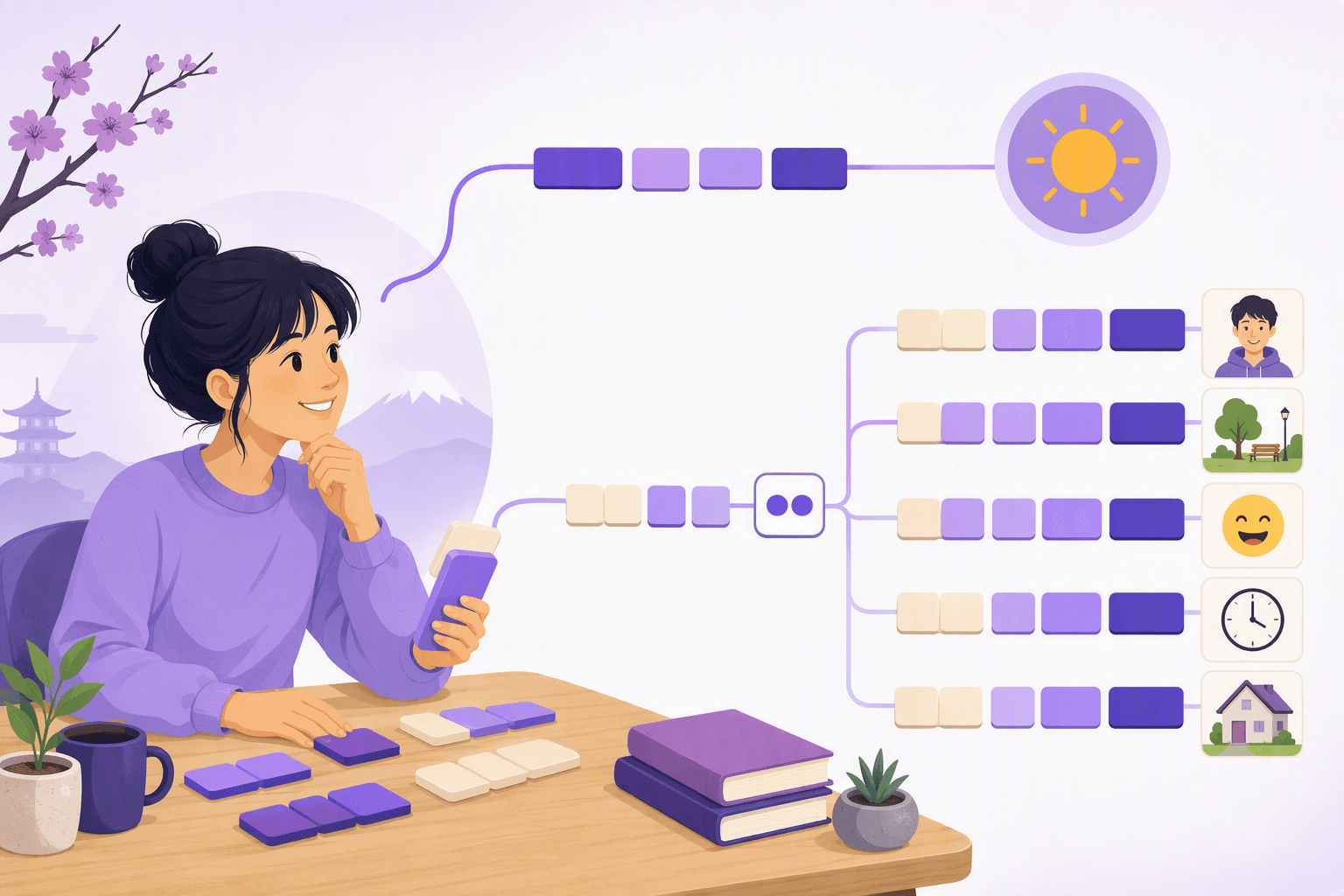
The two main types of Japanese adjectives
Japanese grammar traditionally distinguishes 形容詞 /keːjoːɕi/, descriptive words, from 形容動詞 /keːjoːdoːɕi/, words that function adjectivally with a copular element. In learner-friendly terms, these are called い-adjectives and な-adjectives.
Masayoshi Shibatani’s work on Japanese grammar emphasizes that these groups have distinct inflectional behavior. That distinction is more useful than translating both groups simply as adjectives, because the endings tell you how to build a sentence.
| Type | Dictionary form | Before a noun | Basic meaning |
|---|---|---|---|
| い-adjective | 高い /takai/ | 高い店 /takai mise/ | expensive, high |
| い-adjective | 面白い /omoɕiɾoi/ | 面白い映画 /omoɕiɾoi eːɡa/ | interesting |
| な-adjective | 静か /ɕizɯka/ | 静かな部屋 /ɕizɯka na heja/ | quiet |
| な-adjective | 元気 /ɡeŋki/ | 元気な人 /ɡeŋki na hito/ | well, energetic |
The labels refer to what happens before a noun. An い-adjective attaches directly to the noun. A な-adjective requires な /na/ in that position.
い-adjectives: the changing-ending group
Most い-adjectives end in the hiragana い /i/. They can describe a noun, but they can also finish a sentence by themselves. Their final い changes to express negative meaning, past time, conditions, and connections.
高い
高い /takai/ means high or expensive. Context makes the intended meaning clear.
-
高い山。 /takai jama/
A high mountain. -
この店は高い。 /kono mise wa takai/
This shop is expensive. -
空が高い。 /soɾa ɡa takai/
The sky is high.
The sentence-final form can feel unusual to English speakers because no separate word equivalent to is is required in casual Japanese. 高い /takai/ already functions as a complete predicate.
い-adjective conjugation
Remove the final い /i/ and attach the relevant ending. The following pattern works for a large number of common adjectives.
| Meaning | 高い form | IPA | Example meaning |
|---|---|---|---|
| Present affirmative | 高い | /takai/ | is expensive |
| Present negative | 高くない | /takakɯnai/ | is not expensive |
| Past affirmative | 高かった | /takakatta/ | was expensive |
| Past negative | 高くなかった | /takakɯnakatta/ | was not expensive |
| Polite present | 高いです | /takai desɯ/ | is expensive |
| Polite past | 高かったです | /takakatta desɯ/ | was expensive |
Here are the same patterns with 面白い /omoɕiɾoi/, meaning interesting or funny:
-
面白い。 /omoɕiɾoi/
It is interesting. -
面白くない。 /omoɕiɾokɯnai/
It is not interesting. -
面白かった。 /omoɕiɾokatta/
It was interesting. -
面白くなかった。 /omoɕiɾokɯnakatta/
It was not interesting.
In a polite conversation, add です /desɯ/ after the adjective: 面白いです /omoɕiɾoi desɯ/. Do not treat です as the part that creates tense. The adjective ending, especially かった /katta/, is doing that work.
いい and its irregular forms
いい /iː/ means good, but its conjugation comes from the older form よい /joi/. This makes it a famous exception.
| Meaning | Form | IPA |
|---|---|---|
| Good | いい | /iː/ |
| Not good | よくない | /jokɯnai/ |
| Was good | よかった | /jokatta/ |
| Was not good | よくなかった | /jokɯnakatta/ |
You will hear いい /iː/ constantly in conversation, including in phrases for approval, comfort, and permission.
-
この映画はよかった。 /kono eːɡa wa jokatta/
This movie was good. -
今日はあまりよくない。 /kjoː wa amaɾi jokɯnai/
Today is not very good.
The pronunciation of 今日 /kjoː/ has a long vowel. It has two morae, /kjoː/, rather than a short one-beat sound.
な-adjectives: the な-before-a-noun group
な-adjectives do not conjugate by replacing a final い /i/. Instead, they use な /na/ when directly modifying a noun. When they end a sentence, they often pair with だ /da/ or the polite です /desɯ/.
静か
静か /ɕizɯka/ means quiet. It is a な-adjective.
-
静かな部屋。 /ɕizɯka na heja/
A quiet room. -
この部屋は静かだ。 /kono heja wa ɕizɯka da/
This room is quiet. -
この部屋は静かです。 /kono heja wa ɕizɯka desɯ/
This room is quiet.
The な /na/ appears only before the noun. Do not say 静かい部屋 /ɕizɯkai heja/. That incorrectly treats 静か /ɕizɯka/ like an い-adjective.
な-adjective conjugation
For casual speech, these are the essential endings to learn.
| Meaning | 静か form | IPA | Example meaning |
|---|---|---|---|
| Present affirmative | 静かだ | /ɕizɯka da/ | is quiet |
| Present negative | 静かじゃない | /ɕizɯka dʑanai/ | is not quiet |
| Past affirmative | 静かだった | /ɕizɯka datta/ | was quiet |
| Past negative | 静かじゃなかった | /ɕizɯka dʑanakatta/ | was not quiet |
| Before a noun | 静かな | /ɕizɯka na/ | quiet, before a noun |
In polite speech, 静かです /ɕizɯka desɯ/ is the usual affirmative form. For a polite negative, 静かではありません /ɕizɯka dewa aɾimasen/ is formal, while 静かじゃないです /ɕizɯka dʑanai desɯ/ is common in everyday polite conversation.
Natsuko Tsujimura’s introduction to Japanese linguistics is useful here because it treats these forms as part of a broader predicate system. That explains why the words feel adjective-like in English but behave partly like noun-plus-copula structures in Japanese.
きれい
きれい /kiɾeː/ means pretty, clean, or beautiful, depending on context. Although it ends in the sound い /i/, it is a な-adjective.
-
きれいな花。 /kiɾeː na hana/
A beautiful flower. -
部屋がきれいです。 /heja ɡa kiɾeː desɯ/
The room is clean. -
海がきれいだった。 /ɯmi ɡa kiɾeː datta/
The sea was beautiful.
The long vowel in きれい /kiɾeː/ matters. Say it with a sustained final vowel, not as a rushed short ending.
Other common な-adjectives include:
| Japanese | IPA | Meaning |
|---|---|---|
| 好き | /sɯki/ | liked, fond of |
| 嫌い | /kiɾai/ | disliked |
| 便利 | /beɰ̃ɾi/ | convenient |
| 大変 | /taiheŋ/ | difficult, serious |
| 有名 | /jɯːmeː/ | famous |
| 大丈夫 | /daidʑoːbɯ/ | okay, all right |
好き /sɯki/ is particularly important. Japanese often expresses preference with 好きだ /sɯki da/, literally closer to “is liked” than the English verb like.
- 私は猫が好きです。 /wataɕi wa neko ɡa sɯki desɯ/
I like cats.
For romantic language, the same grammar appears in phrases discussed in our guide to saying I love you in Japanese. 好き /sɯki/ can be affectionate, but the relationship, tone, and context determine how strong it sounds.
How to modify nouns, verbs, and other adjectives
Japanese adjectives have three high-frequency jobs: modifying a noun, ending a sentence, and modifying a verb.
Before a noun
Use the plain adjective directly for い-adjectives and add な /na/ for な-adjectives.
| Type | Pattern | Example | Meaning |
|---|---|---|---|
| い-adjective | adjective + noun | 新しい本 /ataɾaɕiː hoŋ/ | a new book |
| な-adjective | adjective + な + noun | 有名な歌手 /jɯːmeː na kaɕɯ/ | a famous singer |
As an adverb
To describe how an action happens, change an い-adjective to く /kɯ/ and a な-adjective to に /ni/.
-
早く話してください。 /hajakɯ hanaɕite kɯdasai/
Please speak quickly. -
静かに座ってください。 /ɕizɯka ni sɯwatte kɯdasai/
Please sit quietly.
The small っ /Q/ in 座って /sɯwatte/ creates a doubled consonant. It needs its own beat, so do not compress it into a single quick consonant.
Connecting descriptions
Use て /te/ after い-adjectives and で /de/ after な-adjectives to link qualities.
-
この店は安くておいしい。 /kono mise wa jasɯkɯte oiɕiː/
This shop is cheap and delicious. -
この町は便利で静かです。 /kono matɕi wa beɰ̃ɾi de ɕizɯka desɯ/
This town is convenient and quiet.
This pattern is useful when describing restaurants, neighborhoods, characters, and travel experiences. For practical conversation contexts, see our Japanese restaurant phrase guide.
Comparisons and degree words
Japanese often uses adverbs rather than changing the adjective itself for degree. The word とても /totemo/ means very, while あまり /amaɾi/ is usually used with a negative expression to mean not very.
-
とても面白い。 /totemo omoɕiɾoi/
It is very interesting. -
あまり高くない。 /amaɾi takakɯnai/
It is not very expensive. -
ちょっと難しい。 /tɕotto mɯzɯkaɕiː/
It is a little difficult.
The phrase ちょっと /tɕotto/ is culturally useful because it can soften a negative response. Saying ちょっと難しい /tɕotto mɯzɯkaɕiː/ may mean “That is a bit difficult,” but it can also politely imply reluctance or refusal depending on the situation.
🌍 Softness is part of the meaning
Japanese speakers often avoid bluntly negative descriptions when social harmony matters. A direct adjective such as 悪い /waɾɯi/, meaning bad, may be softened with ちょっと /tɕotto/, a pause, or an indirect phrase. Grammar provides the form, but tone and relationship shape the message.
For comparisons, use より /joɾi/, meaning than, and the pattern A は B より adjective.
-
東京は大阪より大きい。 /toːkjoː wa oːsaka joɾi oːkiː/
Tokyo is bigger than Osaka. -
この映画のほうが面白い。 /kono eːɡa no hoː ɡa omoɕiɾoi/
This movie is more interesting.
The phrase のほう /no hoː/ helps identify the preferred option. Its long vowel should be held for two morae.
Common mistakes with Japanese adjectives
Adding な after every adjective
Do not add な /na/ to い-adjectives before a noun.
- Correct: 高いビル /takai biɾɯ/
- Incorrect: 高いなビル /takaina biɾɯ/
A useful habit is to memorize each adjective with a noun. Learn 高い店 /takai mise/ and 静かな店 /ɕizɯka na mise/, not isolated dictionary translations.
Treating きれい like an い-adjective
Because きれい /kiɾeː/ ends in an い-like sound, learners sometimes create forms such as きれくない /kiɾekɯnai/. Use きれいじゃない /kiɾeː dʑanai/ instead.
The same warning applies to 有名 /jɯːmeː/, 嫌い /kiɾai/, and 便利 /beɰ̃ɾi/. They are all な-adjectives.
Using です to make an adjective negative
Avoid 高いですない /takai desɯnai/. The negative belongs on the adjective itself: 高くないです /takakɯnai desɯ/.
Similarly, the past form is 高かったです /takakatta desɯ/, not 高いでした /takai deɕita/.
💡 Learn whole contrast sets
Memorize four forms at once: 高い /takai/, 高くない /takakɯnai/, 高かった /takakatta/, and 高くなかった /takakɯnakatta/. Hearing the full pattern repeatedly in scenes and conversations is more effective than trying to translate each ending during speech.
A practical way to learn adjectives through scenes
Start with adjectives you can attach to visible situations: big, small, hot, cold, delicious, scary, cute, difficult, and quiet. Film and television scenes make their meaning clear through facial expression, setting, and reaction.
When a character says 怖い /kowai/, meaning scary, notice what triggered it. When someone calls food おいしい /oiɕiː/, connect the sound to the visual response. This is especially effective for adjectives because their meaning is often visible rather than abstract.
The National Institute for Japanese Language and Linguistics, known as NINJAL, provides research resources that reflect how grammar works in real usage rather than only in textbook sentences. Real dialogue also reveals that speakers frequently omit subjects, so adjective endings carry substantial meaning on their own.
As you build your vocabulary, pair each new adjective with one positive, one negative, and one past-tense sentence. Then listen for it again in media. You can also reinforce natural social phrasing through guides to Japanese goodbyes and everyday expressions, where politeness level changes how descriptive language lands.
The essential rule to remember
If an adjective is an い-adjective, change its ending: 高い /takai/, 高くない /takakɯnai/, 高かった /takakatta/. If it is a な-adjective, use な /na/ before a noun and forms such as じゃない /dʑanai/ or だった /datta/ elsewhere: 静かな /ɕizɯka na/, 静かじゃない /ɕizɯka dʑanai/, 静かだった /ɕizɯka datta/.
That one distinction unlocks a large part of everyday Japanese description. Practice it with scenes you enjoy, repeat full sentences aloud, and focus on the rhythm of each mora rather than translating word by word.
Frequently Asked Questions
What is the difference between い-adjectives and な-adjectives in Japanese?
Do all Japanese adjectives ending in い belong to the い-adjective group?
Can Japanese adjectives be used without a verb?
Why do Japanese adjectives have past tense forms?
Should I use です after every Japanese adjective?
Sources & References
- National Institute for Japanese Language and Linguistics, Japanese Language Research Resources, accessed 2026
- The Japan Foundation, Survey Report on Japanese-Language Education Abroad, 2022
- Ethnologue, 27th edition, 2024
- Masayoshi Shibatani, The Languages of Japan, Cambridge University Press
- Natsuko Tsujimura, An Introduction to Japanese Linguistics, Wiley-Blackwell
Start learning with Wordy
Watch real movie clips and build your vocabulary as you go. Free to download.


