Quick Answer
Italian etiquette is less about rigid rules and more about showing respect through greetings, titles, table manners, and social warmth. Use a proper hello, choose Lei vs tu carefully, follow simple dining customs, and avoid a few high-risk gestures. This guide explains what Italians actually expect, with practical phrases and cultural context.
Italian etiquette and customs are best understood as a simple goal: show respect and warmth through greetings, titles, and table behavior, while avoiding a few high-risk gestures and overly direct communication. If you greet properly, choose Lei vs tu carefully, follow basic dining norms, and keep your tone friendly, you will come across as polite in almost any Italian setting.
Italy is also a language and culture that travels. Ethnologue estimates roughly 68 million Italian speakers worldwide (Ethnologue, 27th ed., 2024), and large Italian-speaking communities shape everyday norms in places like Switzerland and diaspora cities. That means you will hear variation, but the core politeness patterns stay recognizable.
If you want phrase-by-phrase help for first impressions, pair this guide with how to say hello in Italian and how to say goodbye in Italian. For the cultural edge cases, also see Italian swear words, because “joking” insults can land badly across regions.
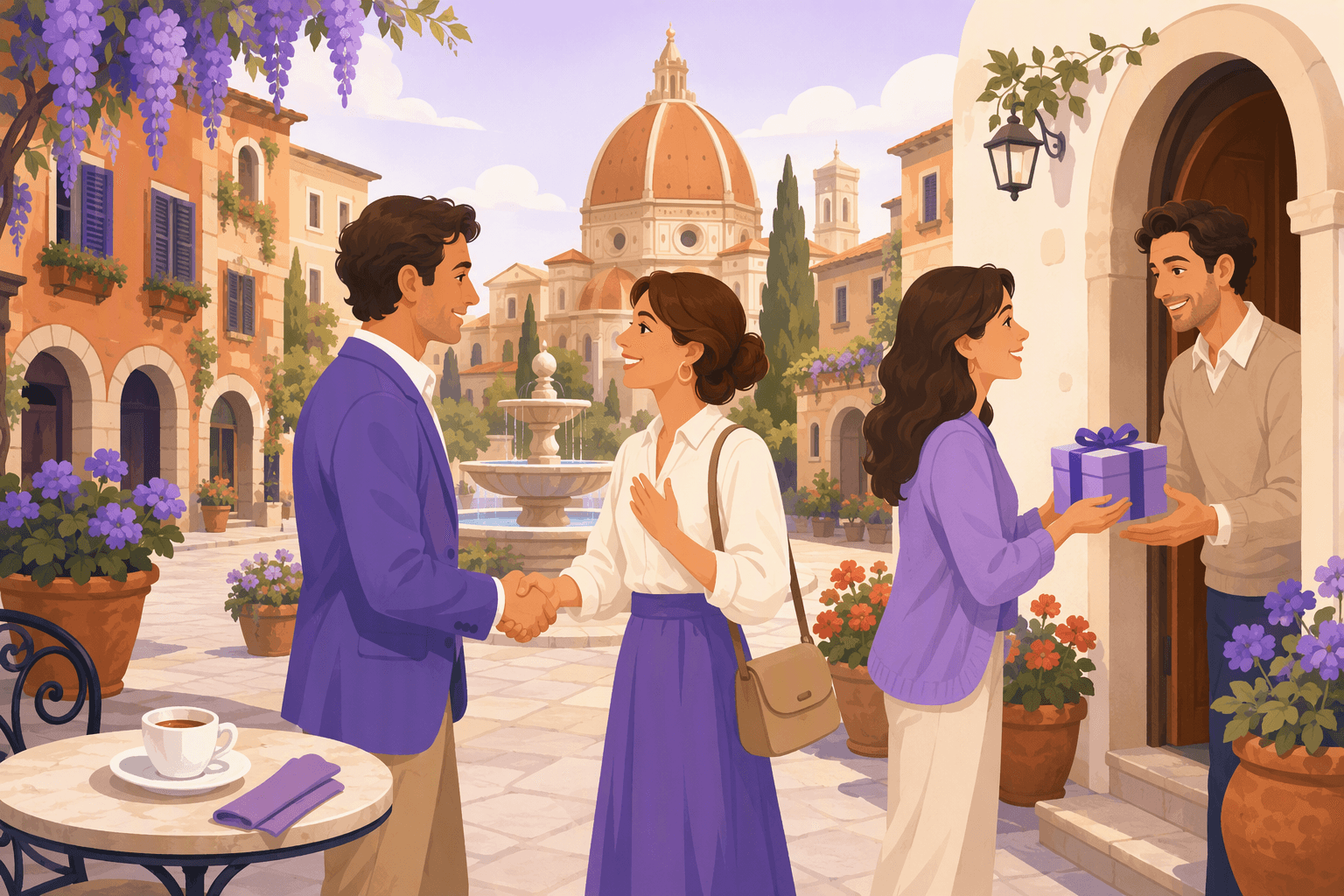
The big idea: Italian politeness is relational
Italian politeness often focuses on relationship management, not just “being formal.” You can be very polite while sounding warm and expressive, and you can be “grammatically polite” while sounding distant.
Linguist Penelope Brown’s work on politeness strategies (with Stephen Levinson, Politeness: Some Universals in Language Usage, Cambridge University Press) is useful here: people protect each other’s “face” through small rituals. In Italy, greetings, titles, and leave-taking are those rituals.
What Italians notice first
Italians tend to notice three things quickly:
- Did you greet people properly when you arrived?
- Did you choose the right level of address (tu vs Lei)?
- Did you behave appropriately at the table?
Get those right and minor mistakes in grammar or accent are usually forgiven.
Greetings: always greet, even when you are “just browsing”
In many Italian contexts, silence on entry feels abrupt. A greeting is a social handshake.
In a small shop, a bar, a waiting room, or an elevator in a residential building, a quick Buongiorno (bwohn-JOR-noh) or Buonasera (bwoh-nah-SEH-rah) is the default.
💡 A practical rule
If you make eye contact, greet. If you enter a small space where people clearly notice you, greet.
Handshakes, cheek kisses, and personal space
A handshake is common in professional settings and first meetings. Among friends and friends-of-friends, cheek kisses can happen, but the exact pattern varies by region and familiarity.
If you are unsure, start with a handshake and follow the other person’s lead. Italians generally stand closer than many Northern Europeans, but personal space still exists, especially in formal contexts.
Titles and names: Dottore is not just for doctors
Italy uses titles more than many English-speaking cultures. You will hear people addressed as Dottore/Dottoressa in professional contexts, even when they are not medical doctors, because it can be used for someone with a university degree.
You will also hear Ingegnere, Avvocato, Professore, and similar professional titles. Treccani’s usage notes on forms of address are a good reference point for how these titles function in real Italian (Treccani, accessed 2026).
Tu vs Lei: the politeness choice that changes everything
The choice between tu (TOO) and Lei (LAY) is one of the most important etiquette decisions in Italian. It signals distance, respect, and social boundaries.
As a safe default:
- Use Lei with strangers in professional settings, older adults, officials, and service encounters when you want to be clearly polite.
- Use tu with peers, classmates, teammates, and in relaxed social contexts, especially when everyone else does.
Accademia della Crusca has clear public-facing guidance on how address forms reflect social relationships in Italian (Accademia della Crusca, accessed 2026). The key is that switching too early can feel pushy.
How the switch happens naturally
It is common for an Italian to explicitly invite the switch:
- Diamoci del tu. (dee-AH-moh-chee dehl TOO)
“Let’s use tu with each other.”
If they say this, it is a green light. If they keep using Lei forms, mirror them.
A subtle point: Lei is grammar, but also tone
Even with Lei, you can sound warm. Add softeners like:
- Per favore (pehr fah-VOH-reh)
- Mi scusi (mee SKOO-zee)
- Grazie (GRAHT-syeh)
If you want more on greeting tone, how to say hello in Italian breaks down what sounds natural in different situations.
Conversation style: warmth, overlap, and indirect “no”
Italian conversation can be energetic. People may overlap slightly, use more hand movement, and show engagement through quick reactions.
This does not necessarily mean conflict. It often means involvement.
Saying “no” without sounding harsh
Direct refusals can feel blunt. Italians often cushion “no” with context:
- Magari un’altra volta. (mah-GAH-ree oon-AHL-trah VOHL-tah)
“Maybe another time.” - Vediamo. (veh-DYAH-moh)
“We’ll see.”
Claire Kramsch’s work (Language and Culture, Oxford University Press) is helpful for learners here: pragmatic meaning is cultural, not just lexical. In Italy, a softened refusal can preserve harmony while still communicating a boundary.
Compliments: accept them, but do not overdo it
Compliments are common, especially about food, clothing, and hospitality. A simple Grazie is enough. Over-explaining can feel awkward.
If someone compliments your Italian, a modest response works:
- Grazie, sto imparando. (GRAHT-syeh, stoh eem-pah-RAHN-doh)
“Thanks, I’m learning.”
Visiting someone’s home: small gifts and good timing
If you are invited to someone’s home, bring something small. Typical choices include pastries, wine, or chocolates.
Avoid extremely expensive gifts unless you have a close relationship, because it can create obligation.
Shoes inside the house
Italy is mixed on shoes indoors. Some households keep shoes on, others prefer you to remove them.
If you want to be polite without guessing, ask:
- Preferisci che mi tolga le scarpe? (preh-feh-REE-shee keh mee TOHL-gah leh SKAHR-peh)
“Do you prefer that I take my shoes off?”
Arrival time: do not be extremely early
For a dinner invitation, arriving exactly on the dot can be fine, but arriving early can disrupt preparation. In many social contexts, 10 to 20 minutes late is normal.
For business, medical appointments, and reservations, be on time.
ISTAT’s demographic reporting highlights how urban life and commuting shape daily routines (ISTAT, accessed 2026). In large cities, delays happen, but communicating is still expected.
Dining etiquette: the rules that actually come up
Italian dining etiquette is not about perfection. It is about respecting the meal, the host, and the shared rhythm of eating.
UNESCO’s listing of the Mediterranean diet as intangible cultural heritage emphasizes the social dimension of meals, not just ingredients (UNESCO, accessed 2026). That social dimension is exactly where etiquette lives.
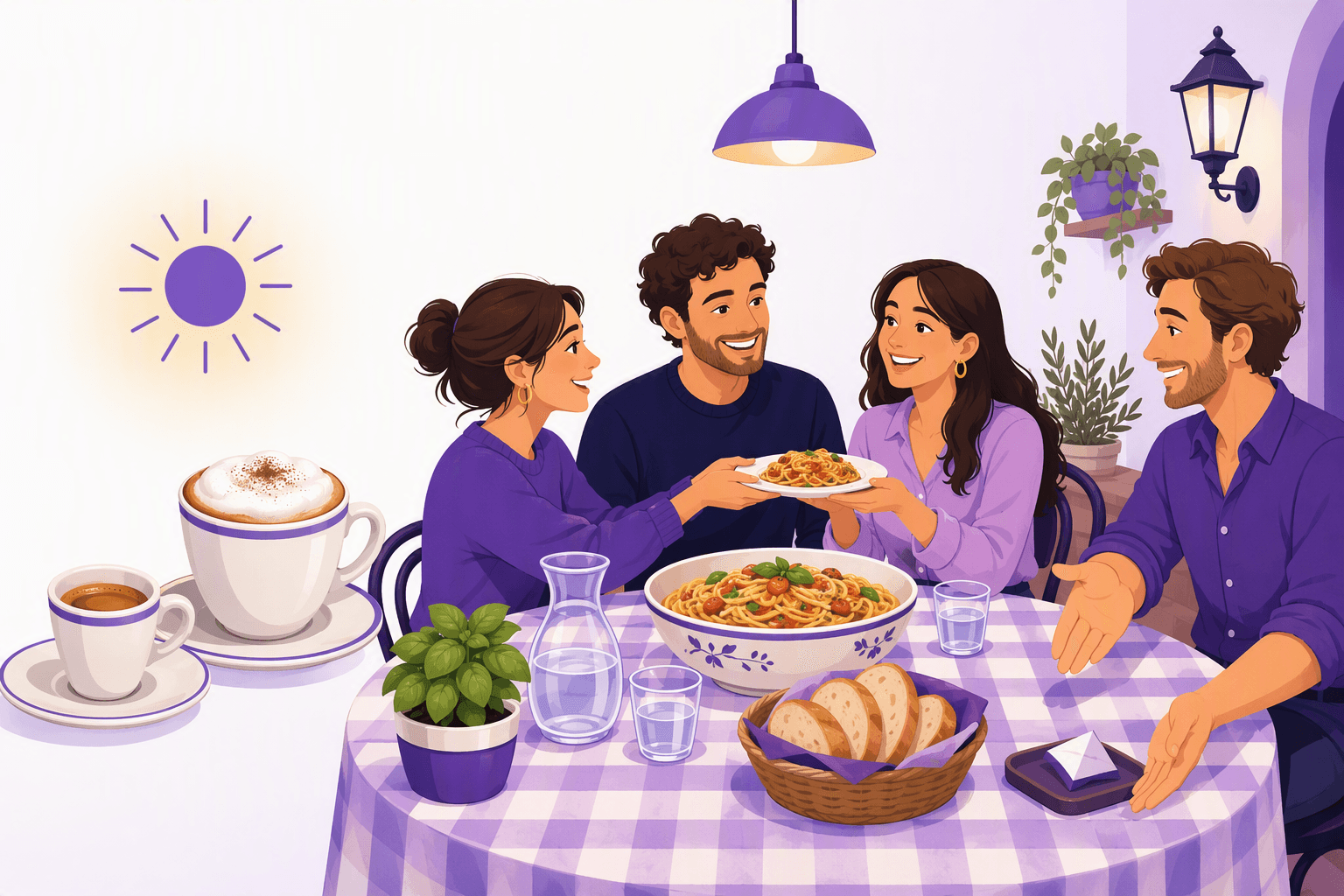
Coffee culture: cappuccino timing and what “un caffè” means
In many places, un caffè means espresso by default. Cappuccino is strongly associated with breakfast.
If you order cappuccino after lunch, you will still get it, but it can mark you as outside local habits. If you want a post-meal coffee, order:
- Un caffè, per favore. (oon kahf-FEH, pehr fah-VOH-reh)
For more food-and-ordering language, at the restaurant in Italian is the most practical companion piece.
Bread, pasta, and “scarpetta”
Bread is often used to accompany the meal, and in some contexts people do fare la scarpetta, using bread to mop up sauce. It is common in informal settings and among family.
In more formal meals, follow the host’s lead.
Splitting the bill: what to expect
Italy varies by group and region. Among friends, splitting evenly is common, but so is one person offering to pay and others insisting.
If you want to be polite, offer once. If they refuse firmly, accept.
A useful phrase:
- Offro io. (OHF-froh EE-oh)
“It’s on me.”
Tipping: not the same as in the US
Tipping exists, but it is usually smaller than in the US. In some restaurants, a service charge or coperto may already be included.
If you are unsure, check the receipt and follow local practice.
⚠️ Avoid the 'big tip to be safe' mistake
Overtipping can create awkwardness. In many places it is better to leave a modest amount or round up, especially if service charges are already included.
Gestures: expressive, but a few are risky
Italian gestures are famous, but learners often overuse them or copy the wrong ones.
A safe guideline: use gestures naturally if you already gesture in your own culture. Do not perform “Italian gestures” as a gimmick.
The high-risk gestures to avoid
Some gestures are insulting or obscene. Because meaning can shift by region and context, it is safer to avoid any gesture you are not confident about.
If you want a structured guide to what is safe vs risky, Italian gestures guide goes deeper into the common ones and when not to use them.
Public behavior: lines, volume, and everyday courtesy
Italy can feel louder and more animated than some cultures, especially in bars and family settings. That said, courtesy norms still apply.
Queues and turn-taking
In busy bars, “the line” can be less visible. People often position themselves near the counter and wait their turn.
A polite strategy is to make eye contact with the barista and wait. If someone cuts in front, Italians may correct it directly, but you can also simply say:
- Scusi, ero prima io. (SKOO-zee, EH-roh PREE-mah EE-oh)
“Excuse me, I was before.”
On public transport
Offer seats to elderly people, pregnant people, and anyone who clearly needs it. Keep bags off seats when crowded.
Small courtesies matter more than perfect language.
Work and business etiquette: polite language, clear roles
Italian business culture varies by industry and region, but a few patterns are common:
- Start formal, then relax if invited.
- Use titles and surnames until told otherwise.
- Expect relationship-building to matter.
Email and messaging tone
Italian professional emails often include polite openings and closings. Even a short message can include:
- Buongiorno (bwohn-JOR-noh)
- Cordiali saluti (kor-dee-AH-lee sah-LOO-tee)
“Kind regards”
If you are learning Italian for work, also build core vocabulary. The 100 most common Italian words list is a good base for reading and listening.
Regional differences: one country, many micro-cultures
Italy has strong regional identities. Food, rhythm of the day, and social expectations can shift between North and South, and between big cities and small towns.
A simple way to stay polite across regions is to be slightly more formal at first, then mirror the other person’s style.
The “campanilismo” factor
Local pride can be intense. Complimenting a city, a local dish, or a tradition is usually welcome.
Comparing regions in a competitive way can backfire unless you know the group well.
Romance and affection: what is sweet vs too much
Italian can sound romantic even in neutral contexts because of intonation and expressive vocabulary. Still, some phrases are much stronger than learners expect.
If you are dating or talking to a partner, how to say I love you in Italian explains the difference between Ti voglio bene and Ti amo, which is one of the most important “customs” in emotional etiquette.
🌍 Affection is graded
Many Italians reserve 'Ti amo' for serious romantic love. 'Ti voglio bene' is common for family, close friends, and sometimes partners, depending on the relationship.
Swearing and humor: do not copy movie lines blindly
Italian films and TV can make insults sound playful, but real-life tone is harder. Some expressions are regionally loaded, and some words that sound “funny” to learners are genuinely offensive.
If you want to understand intensity and context, use Italian swear words as a safety guide. The goal is not to swear more, it is to avoid accidental escalation.
How to learn etiquette fast with movie and TV clips
Etiquette is mostly timing: when to greet, how long to chat, how to soften a request, and how to leave. That is exactly what scripted dialogue and real performances teach well.
A practical method:
- Watch short scenes with greetings, requests, and leave-taking.
- Repeat the line with the same rhythm and politeness markers.
- Swap one detail (name, time of day, request) and keep the structure.
If you want a structured approach, how to learn a language with movies explains how to turn scenes into repeatable practice without memorizing entire scripts.
A quick “do this, avoid that” checklist
Do
- Greet when entering small spaces.
- Start with Lei when unsure.
- Use titles in professional contexts.
- Bring a small gift to someone’s home.
- Follow the host’s rhythm at the table.
Avoid
- Skipping greetings because you are in a hurry.
- Switching to tu too early in formal contexts.
- Performing gestures you do not understand.
- Copying aggressive slang from movies into real life.
- Overtipping to “be safe” without checking the bill.
Closing: the etiquette that makes Italians feel respected
Italian etiquette is not about acting like someone you are not. It is about doing a few visible, culturally meaningful things: greet, choose the right address form, respect the meal, and keep your tone warm.
If you want to practice the exact lines you will use most, start with how to say hello in Italian and how to say goodbye in Italian, then build confidence by listening to real scenes in Italian on /learn/italian.
Frequently Asked Questions
Is it rude not to say hello when entering a shop in Italy?
Should I use tu or Lei with Italians I just met?
How strict is punctuality in Italy?
Do Italians really avoid cappuccino after lunch?
What is the safest small talk topic in Italy?
Sources & References
- Ethnologue, 27th edition, 2024
- ISTAT, Italian population and demographic indicators, accessed 2026
- Treccani, Vocabolario online (entries on Lei/tu usage and forms of address), accessed 2026
- Accademia della Crusca, language and usage notes on forms of address, accessed 2026
- UNESCO, Intangible Cultural Heritage: Mediterranean diet, accessed 2026
Start learning with Wordy
Watch real movie clips and build your vocabulary as you go. Free to download.


