Quick Answer
Italian gestures are a real part of everyday communication: they add emphasis, clarify emotion, and sometimes replace words entirely. The safest approach is to recognize the most common gestures, copy them only after you see locals use them in the same situation, and avoid the rude or ambiguous ones until you understand tone and region.
Italian gestures are a real, learnable system of communication, not just a tourist stereotype: Italians use hand and facial movements to add emphasis, signal attitude, and sometimes replace a whole sentence. If you want to use them well, focus on recognition first, then copy only the neutral gestures after you have seen locals use them in the same situation, with the same tone.
Italy is also a great place to train your ear and eye together. Italian has about 67 million speakers worldwide (Ethnologue, 27th edition, 2024), and you will hear many regional accents, plus see different nonverbal styles from north to south.
If you are building everyday conversation basics alongside culture, pair this with how to say hello in Italian and how to say goodbye in Italian so your words and body language match.
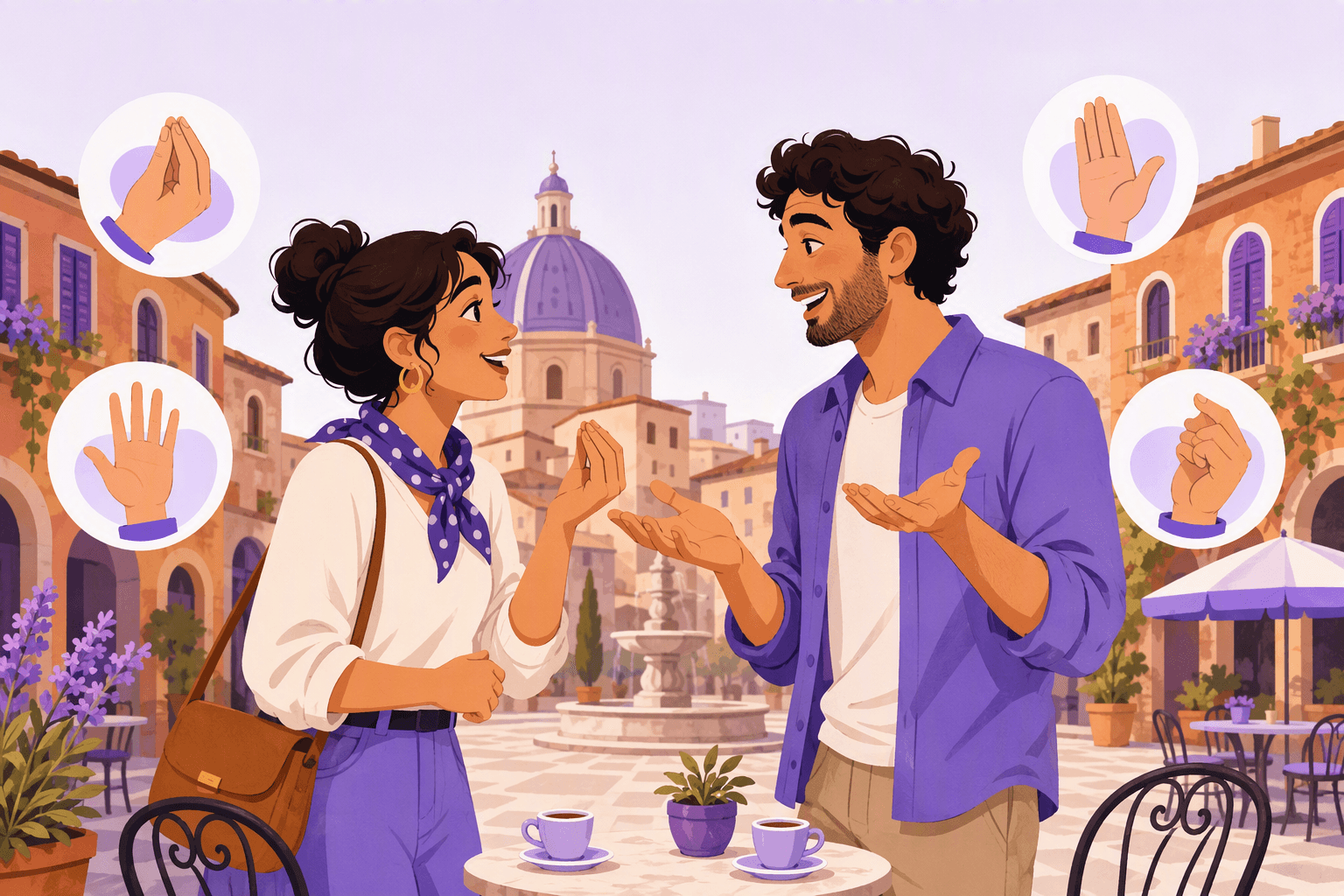
Why gestures matter in Italian communication
Gestures in Italy work like an extra layer of meaning. They can soften a request, sharpen a complaint, or show irony without changing the words.
Linguist Adam Kendon, in Gesture: Visible Action as Utterance, treats gesture as part of the utterance itself, not decoration. That is a useful mindset for learners: you are not memorizing random hand signs, you are learning how meaning is packaged.
Gestures are not universal
A gesture that means "perfect" in one country can mean something rude in another. Even within Italy, the same movement can feel playful in one region and aggressive in another.
The Accademia della Crusca often highlights how Italian usage varies by region, and that idea applies to nonverbal habits too. Treat online lists as starting points, not rules.
Context beats the dictionary definition
Treccani defines gesto as a meaningful movement, but in real life, the meaning is carried by timing, face, and voice. A gesture can flip from funny to insulting with a small change in expression.
💡 A safe learner rule
Recognize first, imitate later. If you have not seen an Italian use a gesture in the exact situation you are in, skip it and say the words instead.
How to read an Italian gesture like a native
Most misunderstandings come from copying the hand shape but missing the "package": posture, eyebrows, distance, and volume.
Anthropologist Edward T. Hall, in The Hidden Dimension, describes how cultures use space differently. In Italy, closer conversational distance and more expressive delivery can be normal, but it still depends on relationship and setting.
Look for these three cues
First, check the face: is the person smiling, frowning, or raising eyebrows. Second, listen for intonation: calm, teasing, angry, incredulous.
Third, watch repetition. Many Italian gestures repeat in small pulses, synchronized with syllables, like visual stress.
When gestures replace words
In fast conversation, someone might gesture instead of saying ma che vuoi? or basta. That is why learning gestures through real clips is effective: you see what words get dropped.
If you like learning through scenes, you can combine this cultural layer with phrase practice like how to say I love you in Italian, because romance in Italian is often communicated as much by tone and timing as by the sentence.
17 Italian gestures you will actually see (with usage notes)
These are described in words so you can recognize them. For each one, you will also get a common Italian phrase that often appears with it, plus a pronunciation cue.
1) Dita a borsa
Hand shape: fingertips pressed together, pointing upward, moving up and down from the wrist.
Common meaning: "What do you mean?" "What are you doing?" "Seriously?"
Often said with: Ma che vuoi? (mah keh vwoi)
Pronunciation: ma che vuoi? = mah keh vwoi
Use caution: this is the classic meme gesture, but it can sound annoyed. It is safer as recognition-only until you can control tone.
2) Boh
Hand shape: palms up, elbows bent, shoulders slightly raised.
Common meaning: "I don't know." "Who knows."
Often said with: Boh. (boh)
Pronunciation: boh = boh
This one is safe and extremely common. It is also a good example of gesture plus sound working as one unit.
3) Perfetto
Hand shape: fingertips pinched (like holding a tiny object), then a small twist or bounce, sometimes with a satisfied face.
Common meaning: "Perfect." "Exactly."
Often said with: Perfetto. (pehr-FEHT-toh)
Pronunciation: pehr-FEHT-toh
This is usually positive, but can be sarcastic if the voice is flat.
4) Basta
Hand shape: one hand slicing downward, or palm forward like "stop."
Common meaning: "Enough." "Stop it." "That's it."
Often said with: Basta! (BAH-stah)
Pronunciation: BAH-stah
Neutral in emergencies, but can feel harsh socially. Use it carefully with strangers.
5) Che buono
Hand shape: fingertips gathered and brought toward the lips, sometimes with a kiss-like motion.
Common meaning: "So tasty." "Delicious."
Often said with: Che buono! (keh BWOH-noh)
Pronunciation: keh BWOH-noh
This is a friendly, safe gesture in food contexts, especially at home or in casual restaurants.
For more food-related Italian culture, you might also enjoy Italian coffee culture, because ordering habits and nonverbal cues go together.
6) Non mi interessa
Hand shape: back of fingers brushing under the chin outward (the chin flick).
Common meaning: "I don't care." "Whatever." "Get lost."
Often said with: Non mi interessa. (nohn mee een-teh-REHS-sah)
Pronunciation: nohn mee een-teh-REHS-sah
This can be dismissive and rude. Tourists often use it as a joke and misfire.
⚠️ High-risk gesture
The chin flick is easy to misunderstand and easy to offend with. Treat it as recognition-only unless you are very comfortable with Italian pragmatics and the relationship is close.
7) Vieni qui
Hand shape: palm up, fingers curling toward yourself repeatedly.
Common meaning: "Come here."
Often said with: Vieni qui. (VYEH-nee kwee)
Pronunciation: VYEH-nee kwee
In some cultures, this gesture is rude. In Italy it can be normal, but still avoid using it with service staff in a commanding way.
8) Piano piano
Hand shape: palm down, moving gently downward as if calming the air.
Common meaning: "Slowly." "Easy." "Calm down."
Often said with: Piano, piano. (PYAH-noh PYAH-noh)
Pronunciation: PYAH-noh
This is useful when someone is rushing, driving aggressively, or getting too intense.
9) Andiamo
Hand shape: hand sweeping forward, or a quick flick outward as if pushing the group into motion.
Common meaning: "Let's go."
Often said with: Andiamo. (ahn-DYAH-moh)
Pronunciation: ahn-DYAH-moh
This is common among friends. In formal contexts, you might just say andiamo without the gesture.
10) Soldi
Hand shape: rubbing thumb against index and middle finger.
Common meaning: "Money." "It's expensive." "Pay up."
Often said with: Quanto costa? (KWAHN-toh KOH-stah)
Pronunciation: KWAHN-toh KOH-stah
It can be neutral when discussing prices, but it can also imply someone is greedy. Watch the face.
11) Ho fame
Hand shape: tapping or rubbing the stomach.
Common meaning: "I'm hungry."
Often said with: Ho fame. (oh FAH-meh)
Pronunciation: oh FAH-meh
Safe and universal enough to use. It also helps when your Italian is basic.
12) Che palle
Hand shape: hand limp at the wrist, shaking slightly, or a downward motion showing frustration.
Common meaning: "What a pain." "So boring." "This sucks."
Often said with: Che palle. (keh PAHL-leh)
Pronunciation: keh PAHL-leh
This is vulgar-ish and not for formal settings. If you want to understand the register and avoid awkward moments, see Italian swear words.
13) Occhio
Hand shape: pointing to the eye with index finger, sometimes with a quick head tilt.
Common meaning: "Watch out." "Be careful." "Pay attention."
Often said with: Occhio! (OHK-kyoh)
Pronunciation: OHK-kyoh
Very useful in daily life, especially in cities, traffic, or crowded places.
14) Sei matto
Hand shape: tapping the temple with a finger, or rotating a finger near the temple.
Common meaning: "Are you crazy?" "That's insane."
Often said with: Sei matto? (say MAHT-toh)
Pronunciation: say MAHT-toh
This can be playful among friends, but insulting if used toward strangers.
15) Che figura
Hand shape: open hand moving down the face, or covering part of the face briefly.
Common meaning: "How embarrassing." "What a bad look."
Often said with: Che figura. (keh FEE-goo-rah)
Pronunciation: keh FEE-goo-rah
This connects to a real cultural theme: social presentation and embarrassment are often talked about explicitly in Italian.
16) Ti giuro
Hand shape: hand on chest, sometimes with a small forward lean.
Common meaning: "I swear." "Honestly."
Often said with: Ti giuro. (tee JOO-roh)
Pronunciation: tee JOO-roh
Common in emotional storytelling. It can add sincerity, but overuse can sound dramatic.
17) Corna
Hand shape: index and pinky extended (horns), other fingers folded.
Common meaning: depends heavily on context. It can be protective against bad luck in some settings, but it can also imply someone is being cheated on.
Often said with: sometimes nothing, or a quick tocca ferro (TOHK-kah FEHR-roh, "touch iron") in superstition contexts.
Pronunciation: TOHK-kah FEHR-roh
This is a classic tourist trap gesture. Avoid using it unless you are sure which meaning is intended.
🌍 Why 'corna' is tricky
In Italy, the same hand shape can be superstition, teasing, or an insult. The difference is context, relationship, and whether it is directed at a person. If it is pointed at someone, it can be taken as offensive.
What movies and TV get right (and wrong) about Italian gestures
Films exaggerate gestures to make characters readable. That helps learners notice patterns, but it can also teach you a "louder" Italy than everyday life.
A good strategy is to watch a scene twice. First for meaning, second for timing: when does the gesture start, and does it land on a stressed syllable.
If you want a structured way to do that, read how to learn a language with movies. The same method works for gestures: repetition plus context beats memorizing lists.
A practical clip routine (10 minutes)
Pick one short scene with an argument, a negotiation, or a family dinner. Those are gesture-rich.
Write down two gestures you see and the exact words around them. Then rewatch and copy only the rhythm, not the intensity.
Common mistakes learners make (and how to avoid them)
Overusing the meme gesture
Dita a borsa is not a general-purpose "Italian mode." If you do it every time you speak, it looks like parody.
Use it only when you are genuinely expressing confusion or disbelief, and even then, keep it small.
Using rude gestures with a smile
In many cultures, smiling softens a message. In Italy, a smile can also read as mocking if the gesture is dismissive.
If the gesture is potentially insulting, do not do it, even as a joke.
Copying gestures without copying register
A gesture that is normal with friends can be inappropriate with a teacher, a boss, or a stranger. This is similar to choosing ciao vs buongiorno.
If you are still learning greeting levels, start with how to say hello in Italian and match your gestures to the same formality.
Regional variation: what changes across Italy
Italy is one country, but it has strong regional identities. You will notice differences in speed, volume, and how much people "perform" emotion in public.
Northern cities can feel more restrained in public spaces, while some southern contexts can feel more expressive, especially in family settings. These are tendencies, not rules, and individual personality matters more than geography.
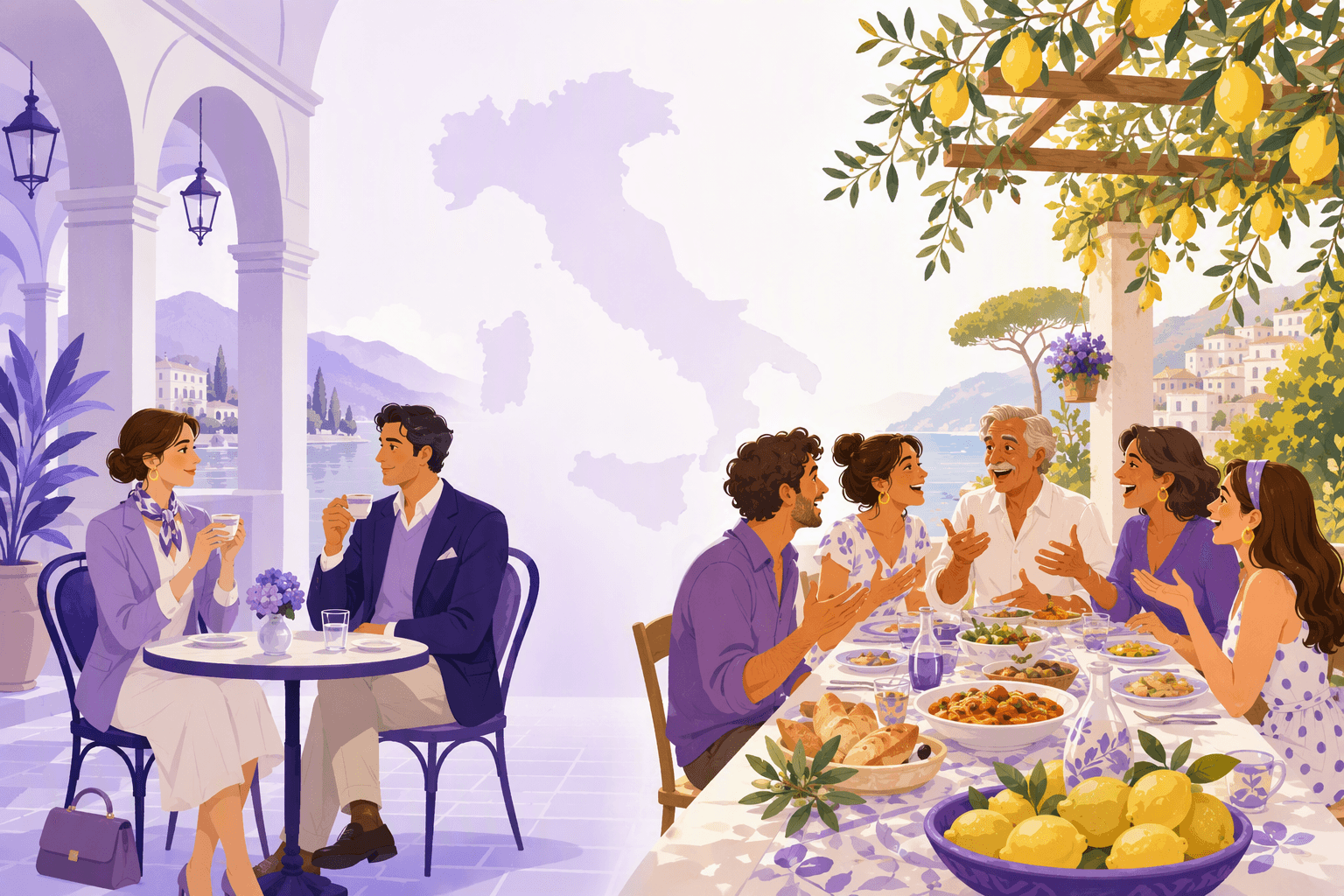
The safe learner move is to adapt to the room. In a quiet cafe, keep your hands calmer. In a loud family lunch, you can be more animated.
A respectful way to practice (without feeling fake)
Start with gestures that match universal needs: confusion (boh), caution (occhio), calm down (piano piano), delicious (che buono). These are low-risk and easy to read.
Then practice with people you trust. Ask, Si dice cosi? (see DEE-cheh koh-SEE, "Do you say it like this?") and let them correct you.
💡 Gesture practice that actually sticks
Record yourself repeating one short Italian line plus the gesture, then compare it to a native clip. You are training timing and intensity, not just hand shape.
Bringing it all together in real conversation
Gestures work best when they support clear language. If your words are correct but your gesture is aggressive, you can sound rude.
If your gesture is friendly but your words are too formal, you can sound distant. That is why pairing cultural knowledge with phrase guides matters, especially for emotional topics like how to say I love you in Italian.
If you want to build this skill fast, learn from short, repeatable scenes where you can hear the line and see the gesture in sync. Wordy is designed for that style of practice: you get real clips, natural delivery, and repetition without guessing what is happening.
For more Italian learning resources, browse the Wordy blog and combine culture articles with targeted phrase guides so you sound natural, not scripted.
Frequently Asked Questions
Do Italians really use hand gestures that much?
What is the most common Italian hand gesture?
Are Italian gestures the same everywhere in Italy?
Which Italian gestures should tourists avoid?
How can I learn Italian gestures safely?
Sources & References
- Treccani, 'gesto' (definition and usage notes), accessed 2026
- Accademia della Crusca, articles on Italian regional variation and usage, accessed 2026
- Ethnologue, 27th edition, 2024
- Hall, E. T., The Hidden Dimension, Doubleday
- Kendon, A., Gesture: Visible Action as Utterance, Cambridge University Press
Start learning with Wordy
Watch real movie clips and build your vocabulary as you go. Free to download.


