Italian Coffee Culture: What to Order, When to Drink It, and How to Sound Local
Quick Answer
Italian coffee culture is fast, social, and rule-driven: you usually drink espresso standing at the bar, order 'un caffè' for espresso, and avoid cappuccino after late morning. Knowing a few key phrases and the logic behind milk, timing, and bar etiquette helps you order confidently and blend in anywhere in Italy.
Italian coffee culture is built around espresso, speed, and shared routines: you order at the bar, drink quickly (often standing), and use a small set of words like caffè, macchiato, and cornetto with surprisingly strict timing norms, especially for milk drinks.
If you also want the basics for greeting the barista naturally, start with our how to say hello in Italian guide, then come back here for the coffee rules.
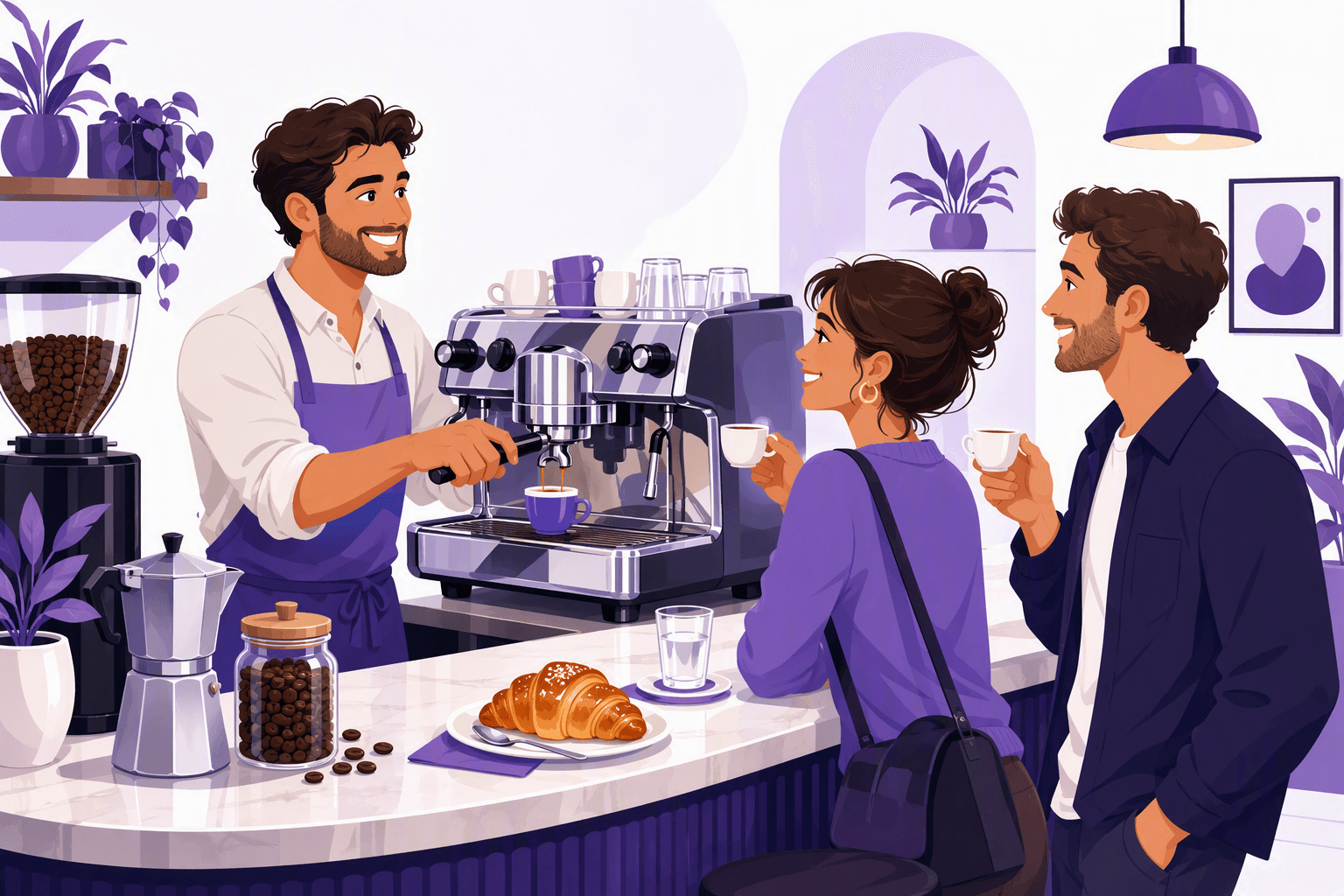
| English | Italian | Pronunciation | Formality |
|---|---|---|---|
| An espresso, please. | Un caffè, per favore. | oon kahf-FEH, pehr fah-VOH-reh | polite |
| A cappuccino, please. | Un cappuccino, per favore. | oon kahp-poo-CHEE-noh, pehr fah-VOH-reh | polite |
| A macchiato, please. | Un caffè macchiato, per favore. | oon kahf-FEH mahk-KYAH-toh, pehr fah-VOH-reh | polite |
| One at the counter. | Uno al banco. | OO-noh ahl BAHN-koh | casual |
| One at the table. | Uno al tavolo. | OO-noh ahl TAH-voh-loh | casual |
| Can I pay? | Posso pagare? | POHS-soh pah-GAH-reh | polite |
| Do I pay before or after? | Pago prima o dopo? | PAH-goh PREE-mah oh DOH-poh | polite |
| The receipt, please. | Lo scontrino, per favore. | loh skohn-TREE-noh, pehr fah-VOH-reh | polite |
| No sugar. | Senza zucchero. | SEHN-tsah DZOOK-keh-roh | casual |
| With a little milk. | Con un po' di latte. | kohn oon poh dee LAHT-teh | casual |
| To go / takeaway. | Da portare via. | dah por-TAH-reh VEE-ah | casual |
| Just a glass of water, thanks. | Solo un bicchiere d'acqua, grazie. | SOH-loh oon beek-KYEH-reh DAHK-kwah, GRAHT-syeh | polite |
Why Italian coffee feels different (and why it matters)
Italian coffee culture is less about customizing a drink and more about participating in a shared script. The script is short, efficient, and surprisingly consistent across regions.
That consistency matters because Italian is spoken by about 67 million people worldwide (Ethnologue, 27th edition, 2024). Italy’s population is about 59 million (ISTAT, accessed 2026), so a large share of speakers live in the country where these routines developed.
The bar is not a bar
In English, “bar” suggests alcohol. In Italy, bar is the everyday cafe: coffee, pastries, quick lunches, and a lot of standing.
Treccani’s dictionary entries for bar and caffè are useful here because they reflect how Italians categorize the place and the product (Treccani, accessed 2026). If you treat the bar as a fast service counter, you will instantly look less lost.
Espresso is the default, not a special order
If you say un caffè, you are almost always ordering a single espresso. You do not need to say “espresso” unless you are clarifying for a tourist-facing context.
This “default meaning” is a good example of what linguist John Sinclair (in his work on idiom principle and habitual phrasing) highlighted: fluent speech relies heavily on prefabricated patterns, not word-by-word assembly. Coffee orders are one of the clearest real-life places to see that.
The daily rhythm: what Italians drink, and when
The famous “no cappuccino after noon” idea is a simplification, but it points to a real pattern. Italians often match coffee type to time of day and meal.
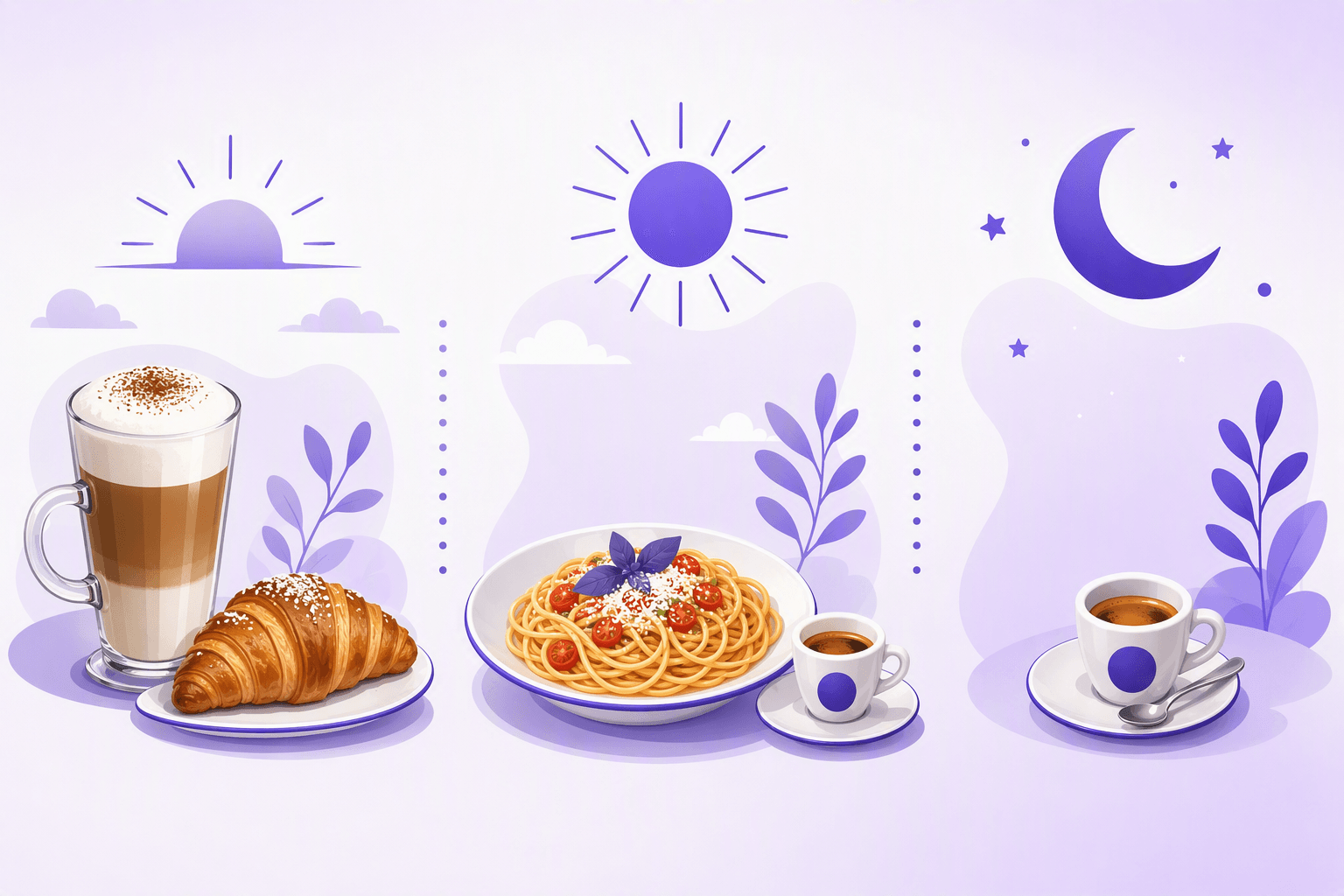
Breakfast: sweet + milk coffee
A classic breakfast is cappuccino plus a cornetto (in many regions) or brioche (often said in the North and also in Sicily, where brioche col tuppo is its own thing). The key is that breakfast is usually sweet, quick, and taken at the bar.
Milk coffee at breakfast is also practical. It is more filling than espresso, and it pairs well with pastries.
After lunch: espresso as punctuation
After lunch, caffè is common and fast. It functions like a period at the end of the meal.
If you want to sound natural, you can shorten your language too: Un caffè. Then add per favore if you want to be extra polite.
Afternoon: a second espresso, sometimes decaf
Mid-afternoon espresso is normal, especially during workdays. If caffeine is a problem, ask for decaffeinato (deh-kahf-feh-ee-NAH-toh) or just un deca (OON DEH-kah) in some bars.
Evening: espresso still happens, but context matters
Many Italians still drink espresso after dinner. Others switch to decaf, or choose a digestivo instead.
If you are sensitive to caffeine, you can ask directly: È decaffeinato? (eh deh-kahf-feh-ee-NAH-toh).
The big etiquette rules (that tourists usually miss)
Italian coffee etiquette is mostly about flow: where you stand, how you pay, and how long you occupy space.
Standing at the counter vs sitting at a table
Many bars have two price logics: al banco (at the counter) and al tavolo (table service). Table service costs more because it includes service and time.
If you want the local experience and the lower price, say Uno al banco (OO-noh ahl BAHN-koh). If you want to sit, say Uno al tavolo (OO-noh ahl TAH-voh-loh).
💡 A simple rule that works everywhere
If you are unsure, order first, then mirror the locals: if everyone is standing, stand. If people are sitting with menus, table service is normal in that place.
Paying first (sometimes) and the scontrino
In many bars you pay at the register, get a receipt (scontrino), then take it to the barista. In others, you order first and pay after.
This is not “one true rule,” it is a local workflow. The polite fix is a single sentence: Pago prima o dopo? (PAH-goh PREE-mah oh DOH-poh).
Water with coffee is normal
A small glass of water often comes with espresso. Some people drink it before coffee to reset the palate, others after.
If it is not offered and you want it, ask: Un bicchiere d'acqua, per favore. (oon beek-KYEH-reh DAHK-kwah, pehr fah-VOH-reh)
What to order: the core drinks you will actually hear
You can order dozens of variations, but daily Italian life runs on a small set. Learn these and you will understand most cafe scenes in films and TV.
caffè
Pronunciation: kahf-FEH
In Italy, caffè usually means a single espresso. If you want a double, ask for doppio (DOHP-pyoh), though not every bar emphasizes “double” the way specialty coffee does.
A natural order is: Un caffè, per favore. (oon kahf-FEH, pehr fah-VOH-reh)
espresso
Pronunciation: eh-SPREHS-soh
You can say espresso, and you will be understood. It just sounds slightly tourist-coded in many everyday bars, because locals do not need the extra label.
Use it when clarity matters, like in very international areas or when you are comparing styles.
cappuccino
Pronunciation: kahp-poo-CHEE-noh
A cappuccino is espresso with steamed milk and foam. It is strongly associated with morning, especially with a pastry.
If you order it later, you will still get it, but you may get a look that says “interesting choice.”
macchiato
Pronunciation: mahk-KYAH-toh
Macchiato means “stained.” In coffee context, it is espresso “stained” with a bit of milk or foam.
If you want the espresso-first version, say caffè macchiato. If you want the milk-first version, say latte macchiato.
latte
Pronunciation: LAHT-teh
This is the classic trap: latte means milk. If you order un latte, you might receive a glass of milk.
If you want a latte-style drink, ask for caffè latte (kahf-FEH LAHT-teh) or latte macchiato depending on what you mean.
americano
Pronunciation: ah-meh-ree-KAH-noh
A caffè americano is espresso diluted with hot water. It is the closest common cafe option to a longer cup, though it is not the same as drip coffee.
If you want it less strong, you can add: Un po' più lungo, per favore. (oon poh pyoo LOON-goh, pehr fah-VOH-reh)
corretto
Pronunciation: koh-REHT-toh
Caffè corretto is espresso “corrected” with a splash of liquor, often grappa or sambuca. This is more common in some contexts than others, and it is not an all-day default.
If you are unsure, listen first. If you hear it, it is fair game.
🌍 Coffee and food culture connect
UNESCO lists the Mediterranean diet as Intangible Cultural Heritage, emphasizing shared meals, social practices, and local knowledge (UNESCO, accessed 2026). Italian coffee culture fits that same idea: it is less about a beverage and more about a daily social ritual.
How to order in Italian without sounding stiff
Ordering well is mostly about rhythm and small words. You do not need perfect grammar, you need the right chunks.
The two-sentence order that always works
Say the drink, then add politeness if you want it.
- Un caffè. (oon kahf-FEH)
- Per favore. (pehr fah-VOH-reh)
If you want to be extra smooth, combine them: Un caffè, per favore.
Add-ons: sugar, milk, temperature
Italian bars often have sugar packets at the counter. If you want no sugar, say Senza zucchero (SEHN-tsah DZOOK-keh-roh).
If you want a little milk, say Con un po' di latte (kohn oon poh dee LAHT-teh). Keep it small, because too much milk changes the drink category in many people’s minds.
Takeaway language
Takeaway is increasingly common, especially in cities. The phrase you will hear is da portare via (dah por-TAH-reh VEE-ah).
If you are in a hurry, you can also say da asporto (dah ah-SPOR-toh), though asporto is more common with food.
Regional and social variation: what changes across Italy
Italy has strong regional identities, and coffee vocabulary can reflect that. The core script stays stable, but details shift.
Cornetto vs brioche
In many parts of central and southern Italy, the default pastry word is cornetto. In parts of the North, you may hear brioche used for similar items.
If you want to avoid choosing sides, point and say: Quello, per favore. (KWEHL-loh, pehr fah-VOH-reh)
Caffè and identity
Coffee talk can signal more than taste. Choosing ristretto (rees-TREHT-toh) vs lungo (LOON-goh) can index preference, habit, even personality stereotypes.
This is a good moment to remember what sociolinguist Penelope Eckert argues in her work on style and social meaning: small linguistic choices can function as identity cues. In Italy, coffee choices often work the same way.
Coffee in movies and TV: what to listen for
Italian dialogue often uses coffee as a scene tool: a quick meet-up, a tense conversation, a favor, a flirtation. The language is short and routine-heavy.
Listen for these patterns:
- Ci prendiamo un caffè? (chee prehn-DYAH-moh oon kahf-FEH) meaning “Shall we grab a coffee?”
- Offro io. (OHF-froh EE-oh) meaning “It’s on me.”
- Al volo. (ahl VOH-loh) meaning “quickly.”
If you want more everyday Italian openers for these scenes, pair this with how to say goodbye in Italian so you can handle the whole interaction, not just the order.
Common mistakes (and the easy fixes)
Mistake 1: Ordering “a latte”
Fix: say caffè latte or latte macchiato. If you truly want milk, then latte is correct.
Mistake 2: Over-explaining your drink
Fix: keep it short. Italian bar culture rewards speed and clarity. If you want to customize heavily, do it politely and accept that it is not the default mode.
Mistake 3: Sitting down and being surprised by the price
Fix: decide first: al banco or al tavolo. If you sit, assume table pricing.
Mistake 4: Treating the barista like a waiter
Fix: order at the counter, be ready, and move aside after you receive your coffee. The social norm is to keep the line flowing.
⚠️ A language note about tone
In Italian, you can sound abrupt without meaning to. Adding 'per favore' and using a calm voice does more than adding extra words. If you are frustrated, save the strong language for private, our Italian swear words guide explains what not to say in public.
A mini phrasebook for coffee dates and flirting
Coffee is also social. It is a low-commitment invitation that can be friendly or romantic depending on tone and context.
Ci prendiamo un caffè?
Pronunciation: chee prehn-DYAH-moh oon kahf-FEH
This is the classic “grab a coffee?” line. It is neutral and flexible, and it can be used with friends, coworkers, or someone you are interested in.
If the vibe is romantic, you might later need the language from how to say I love you in Italian, but coffee is often the first step, not the last.
Offro io
Pronunciation: OHF-froh EE-oh
This means “I’m paying.” It is common, simple, and it can be a polite gesture without turning into a negotiation.
Andiamo?
Pronunciation: ahn-DYAH-moh
A quick “shall we go?” that you will hear constantly. In coffee contexts, it often means “let’s go in and do this fast.”
How to practice Italian coffee culture with real listening
The fastest way to internalize coffee language is to hear it in context, repeatedly. Scripted textbook dialogues rarely capture the speed and overlap of a real bar.
Use short clips where characters enter a bar, greet, order, pay, and exit. You are training timing as much as vocabulary.
If you want a broader base of everyday words that show up in these scenes, our 100 most common Italian words list helps you stop getting stuck on the small connecting words.
Quick cultural takeaways you can use tomorrow
- Caffè usually equals espresso.
- Standing at the counter is normal and often cheaper.
- Milk drinks are breakfast-coded for many Italians.
- The “right” order is short, not elaborate.
- Watch the payment flow, then mirror it.
When you treat the bar as a shared routine instead of a personalized service experience, Italy makes more sense fast.
If you want to keep building real-world Italian that matches how people actually speak, browse the Wordy language blog and focus on guides tied to everyday scenes, not isolated word lists.
Frequently Asked Questions
Why do Italians say 'caffè' when they mean espresso?
Is it really wrong to order a cappuccino after noon in Italy?
Do you have to pay before ordering at an Italian bar?
What is the difference between 'macchiato' and 'latte' in Italy?
How much coffee do Italians actually drink?
Sources & References
- International Coffee Organization (ICO), Coffee Market Report, accessed 2026
- Istituto Nazionale di Statistica (ISTAT), Italy population and demographic indicators, accessed 2026
- Ethnologue, 27th edition, 2024
- Treccani, Vocabolario online (entries for 'caffè', 'bar', 'macchiato'), accessed 2026
- UNESCO, Intangible Cultural Heritage: Mediterranean diet, accessed 2026
Start learning with Wordy
Watch real movie clips and build your vocabulary as you go. Free to download.


