Quick Answer
Italian gestures are a real part of everyday communication: they add emphasis, show emotion, and sometimes replace words entirely. The safest approach is to learn a small set of common, non-offensive gestures, copy the intensity of locals, and avoid gestures that can be insulting or regionally misunderstood.
Italian gestures are a practical part of communication in Italy: they add emphasis, signal emotion, manage turn-taking, and sometimes replace a whole sentence. If you learn a small set of common gestures and the situations where they are safe, you will understand conversations better and avoid the few gestures that can come off as rude or vulgar.
Italy is also a great place to learn how speech and body language work together. Italian has about 68 million speakers worldwide (Ethnologue, 27th edition, 2024), and you will hear it across Italy plus communities abroad. In daily life, especially in fast group talk, gestures help listeners track attitude and intent when words alone are ambiguous.
If you are also learning what to say out loud, pair this guide with how to say hello in Italian and how to say goodbye in Italian. Gestures feel most natural when they match the phrase and the tone.
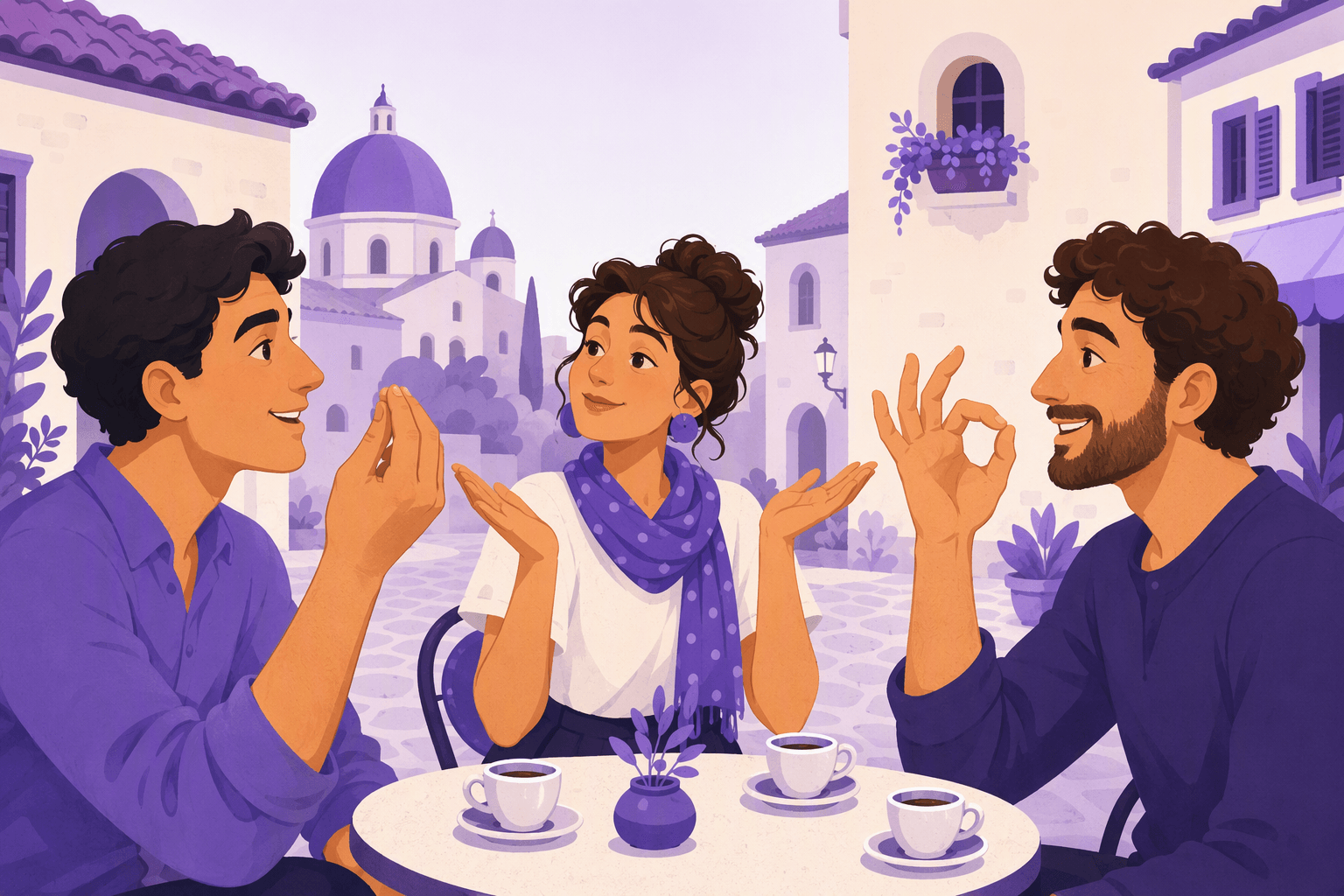
🌍 A quick mindset shift
Treat gestures like vocabulary: meaning depends on context, relationship, and tone. A gesture that looks funny on the internet can be sharp or even insulting in real life.
Why Italians gesture: what learners should understand first
Gestures in Italy are not random decoration. They are part of a broader communication style where rhythm, emphasis, and interpersonal distance matter.
Edward T. Hall’s work on proxemics in The Hidden Dimension is useful here: cultures differ in how they use space and nonverbal signals to manage social interaction. In Italy, conversations often include closer distance, more eye contact, and more visible hand movement than many learners expect, especially compared with Northern Europe.
From a linguistics angle, gesture research by David McNeill (known for linking gesture and speech in a single system) helps explain why gestures appear exactly on stressed words or key ideas. You can watch this in Italian dialogue: the hands often “hit” the important point at the same time the voice does.
Finally, politeness matters. Research on face and politeness in interaction (Brown and Levinson, Politeness: Some Universals in Language Usage, Cambridge University Press) helps explain why some gestures feel aggressive: they threaten the other person’s “face” if used with the wrong intensity.
How to use this guide (so you do not overdo it)
Start with the “safe” gestures first. These are gestures that are common, mild, and unlikely to offend.
Then learn the “high-risk” gestures. You do not need to perform them, but recognizing them helps you understand tone in movies, TV, and street conversations.
If you are practicing with clips, focus on three things:
- Hand shape (fingers together vs open)
- Movement (up, down, forward, repeated)
- Face (smile, frown, raised eyebrows)
That last part matters more than learners think. In Italian interaction, the face often carries the politeness signal, while the hands carry the emphasis.
17 Italian gestures you will actually see (with meaning and usage)
Below are 17 gestures you are likely to encounter. For each one, you will get a plain-English label, a “when to use it” rule, and a safe alternative if you are unsure.
1) The pinched fingers: “Ma che vuoi?”
What it looks like: fingertips pressed together (all fingers), pointing upward, moving up and down slightly.
Typical meaning: “What do you want?” “What are you saying?” “What is this?” It can also mean “Come on, explain.”
When it is safe: with friends, in playful confusion, or when you are clearly joking. In a tense situation, it can sound like irritation.
Safer alternative: open palm up with a small shrug.
2) The chin flick: “Non me ne frega”
What it looks like: back of fingers flicked outward from under the chin.
Typical meaning: “I don’t care.” “Whatever.” It can be dismissive.
When it is safe: usually not safe with strangers. It can be rude, especially if combined with a hard stare.
Safer alternative: say it politely instead, or avoid the sentiment.
⚠️ Avoid copying dismissive gestures
Dismissive gestures can escalate conflict fast because they signal contempt. If you are not sure, keep your hands neutral.
3) The “OK” circle (Italian version): “Perfetto”
What it looks like: thumb and index finger form a circle, other fingers extended. Often held still, sometimes with a small nod.
Typical meaning: “Perfect.” “Exactly.” “All good.”
When it is safe: very safe, especially with a smile. Be aware that the same shape can carry different meanings in other countries, but in Italy it is commonly positive.
Safer alternative: thumbs up, but use it lightly.
4) The fingers-to-lips kiss: “Che buono!”
What it looks like: fingertips gathered, touch lips, then move outward as if sending a kiss.
Typical meaning: “Delicious.” “So good.” Often about food, sometimes about something impressive.
When it is safe: safe and friendly. It is common at the table.
Pair it with: “Buonissimo!” (bwoh-NEE-see-moh) or “Che buono!” (keh BWOH-noh).
If you want restaurant language, see at the restaurant in Italian.
5) The hand wave “go away”: “Vai via”
What it looks like: palm facing outward, pushing motion away from the body.
Typical meaning: “Go away.” “Move.” “Stop bothering me.”
When it is safe: only with people you know well, and usually as a joke. With strangers it can be harsh.
Safer alternative: a small step back and a polite phrase.
6) The “come here” curl: “Vieni qua”
What it looks like: palm down, fingers curling toward you repeatedly.
Typical meaning: “Come here.”
When it is safe: safe with friends and family. In service contexts, it can feel too commanding, so soften it with a smile.
Safer alternative: point with an open hand (not a single finger) plus eye contact.
7) The “what can I do?” shrug: “Boh”
What it looks like: shoulders up, palms up, eyebrows raised.
Typical meaning: “I don’t know.” “What can you do?” “It is what it is.”
When it is safe: very safe. It is one of the best gestures for learners because it is universal and mild.
Pair it with: “Boh” (boh) or “Non lo so” (nohn loh soh).
8) The “enough” cut: “Basta”
What it looks like: one hand flat, moving across the other hand or cutting across the air like a line.
Typical meaning: “Enough.” “Stop.” “That’s it.”
When it is safe: safe when you are setting a boundary, but keep it calm. If you do it sharply, it can look aggressive.
Pair it with: “Basta, grazie” (BAH-stah, GRAHT-syeh).
9) The “money” rub: “Soldi”
What it looks like: rubbing thumb against index and middle finger.
Typical meaning: “Money.” “It costs.” “Pay.”
When it is safe: safe, but it can imply someone is greedy if aimed at a person.
Use case: negotiating prices, talking about bills, or joking about being broke.
10) The “tiny bit” pinch: “Un pochino”
What it looks like: thumb and index finger close together, showing a small gap.
Typical meaning: “A little.” “Just a bit.”
When it is safe: very safe.
Pair it with: “Un pochino” (oon poh-KEE-noh) or “Solo un po’” (SOH-loh oon poh).
11) The “so-so” wobble: “Così così”
What it looks like: flat hand, palm down, wobbling side to side.
Typical meaning: “So-so.” “Not great, not terrible.”
When it is safe: safe and common.
Pair it with: “Così così” (koh-ZEE koh-ZEE).
12) The “watch it” point: “Occhio”
What it looks like: two fingers pointing toward your eyes, then outward toward the situation.
Typical meaning: “Watch out.” “Be careful.” “Keep an eye on it.”
When it is safe: safe, especially as a warning.
Pair it with: “Occhio” (OH-kyoh) or “Attento/Attenta” (ah-TTEHN-toh / ah-TTEHN-tah).
13) The “crazy” temple circle: “Sei matto?”
What it looks like: index finger circling near the temple.
Typical meaning: “You’re crazy.” “Are you out of your mind?” It can be teasing or insulting.
When it is safe: only with close friends, and only when your tone is clearly playful.
Safer alternative: laugh and use words, or avoid labeling the person.
14) The “I swear” gesture: “Te lo giuro”
What it looks like: hand on chest, sometimes with a small forward lean.
Typical meaning: “I swear.” “Believe me.”
When it is safe: safe. It signals sincerity.
Pair it with: “Te lo giuro” (teh loh JOO-roh).
15) The “no” finger wag: “No”
What it looks like: index finger wagging side to side.
Typical meaning: “No.” “Don’t do that.”
When it is safe: safe, but it can feel parental if exaggerated.
Safer alternative: a small head shake plus “No, grazie” (noh, GRAHT-syeh).
16) The “I’m watching you” two-finger point: “Ti tengo d’occhio”
What it looks like: two fingers from eyes toward the other person.
Typical meaning: “I’m watching you.” It can be joking, flirtatious, or mildly threatening depending on face and context.
When it is safe: mostly as a joke among friends. Avoid in formal settings.
17) The “horns” hand: “Corna”
What it looks like: index and pinky extended, other fingers folded.
Typical meaning: This is culturally loaded. It can be used to ward off bad luck in some contexts, but it can also imply someone is being cheated on (a serious insult) if directed at a person.
When it is safe: do not point it at someone. If you see it, read the room first.
Safer alternative: none, just avoid using it unless you are very sure of the context.
🌍 Gestures and superstition are intertwined
Some gestures connect to older beliefs about luck and protection. You will still see these in everyday life, especially in emotionally charged moments like near-misses, bad news, or heated sports talk.
Gestures Italians expect from foreigners (and the ones they do not)
Italians generally do not expect learners to “perform” Italian body language. They expect clarity, politeness, and a normal conversational rhythm.
What helps most is not a specific gesture, but timing. If you speak Italian with a flat, rushed tone, adding gestures will not fix it. If you speak with a clear stress pattern and pause at natural points, even small hand movements will look natural.
If you want a simple speaking baseline, learn a few everyday phrases and match them with calm body language:
- Greeting: see how to say hello in Italian
- Parting: see how to say goodbye in Italian
- Affection: see how to say I love you in Italian
Regional and situational variation: Italy is not one “gesture culture”
Italy has strong regional identities, and that shows up in nonverbal style too. A gesture might be frequent in Naples and less common in Milan, or it might be performed with different intensity.
This is similar to how vocabulary varies by region, which the Accademia della Crusca often highlights in its public-facing resources on usage and variation (accessed 2026). Treccani’s encyclopedia entries are also useful for cultural context and historical background (accessed 2026).
Situations matter as much as geography:
- In a family lunch, gestures are larger and faster.
- In a workplace meeting, gestures are smaller and more controlled.
- In tourist-facing service, staff may reduce gestures to avoid misunderstandings.
💡 The safest rule for learners
Mirror the smallest version of what you see. If locals are using big gestures, you can use medium gestures. If locals are calm, keep your hands calm too.
Gestures, swearing, and “heat”: how intensity changes meaning
A key difference learners miss is that meaning is not just the hand shape. Intensity can flip the message.
The pinched-fingers gesture can be playful curiosity or sharp annoyance. The temple circle can be affectionate teasing or an insult. This is why gesture and profanity often travel together: both are tools for emotional intensity.
If you want to understand the taboo side of Italian expression without guessing, read Italian swear words. Even if you never use them, recognizing them helps you interpret scenes in movies and TV.
How to practice Italian gestures with movie and TV clips
Gestures are easier to learn from real dialogue than from still images. In clips, you can see the full package: words, timing, facial expression, and reaction.
Use a three-pass method:
- First watch for meaning only: what is the emotion, what is the social situation?
- Second watch for timing: which word triggers the gesture?
- Third watch and shadow: repeat the line with the same pause and stress, then add a small version of the gesture.
This method fits well with clip-based learning because you are not memorizing a gesture in isolation. You are learning it as part of a communicative move, which is closer to how native speakers acquire it.
For a broader approach to learning through authentic media, see how to learn a language with movies.
Common mistakes foreigners make (and how to avoid them)
Doing gestures “at” people instead of “with” them
Some gestures become insulting when aimed directly at a person. If you are not sure, keep the gesture closer to your own body and avoid pointing.
Overacting because of stereotypes
The internet exaggerates Italian gestures for comedy. In real life, many Italians gesture subtly, especially in professional contexts.
Mixing a rude gesture with a polite phrase
If you say “Per favore” (pehr fah-VOH-reh) but your hand motion is dismissive, the gesture wins. Nonverbal cues often carry more weight than learners expect.
Copying gestures without copying the face
A smile, soft eyes, and relaxed eyebrows can turn a gesture from aggressive to playful. Without that, the same movement can look confrontational.
A practical “safe set” to start using today
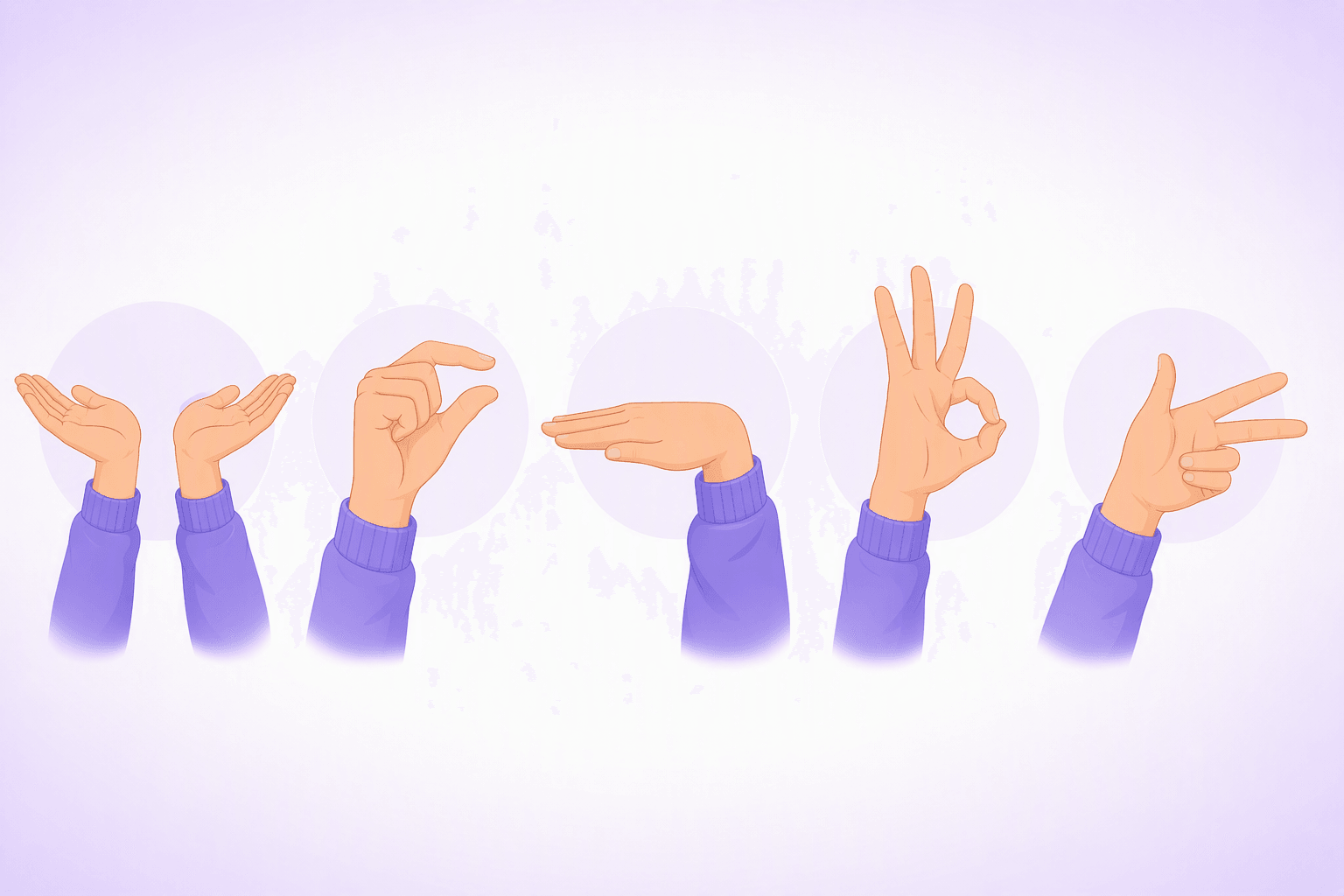
If you want five gestures you can use with low risk, start here:
- Palms-up shrug for “I don’t know”
- “Tiny bit” pinch for “a little”
- “So-so” wobble for “okay, not great”
- “Perfect” OK circle for “exactly”
- “Watch out” eye-to-situation gesture for warnings
These work because they communicate information, not judgment. They also scale well: you can do them small and still be understood.
Final takeaway: learn gestures as part of politeness, not performance
Italian gestures are worth learning because they improve comprehension and help you read tone, not because you need to “act Italian.” Learn the safe gestures, recognize the risky ones, and focus on matching intensity to the relationship and setting.
If you want to build the spoken side alongside body language, start with greetings and everyday phrases, then add expressive tools gradually. A good next step is revisiting how to say hello in Italian and practicing the lines with natural timing and a small, relaxed gesture.
Frequently Asked Questions
Do Italians really use hand gestures that much?
What is the most common Italian hand gesture?
Are any Italian gestures offensive?
Do Italian gestures mean the same thing everywhere in Italy?
Should I use gestures when speaking Italian as a learner?
Sources & References
- Accademia della Crusca, resources on Italian language and culture, accessed 2026
- Treccani, Enciclopedia and language usage entries, accessed 2026
- Ethnologue, 27th edition, 2024
- ISTAT, population and language context resources, accessed 2026
- Hall, E.T., The Hidden Dimension, Doubleday
Start learning with Wordy
Watch real movie clips and build your vocabulary as you go. Free to download.


