Quick Answer
The usual polite way to ask 'How old are you?' in Japanese is おいくつですか, especially when speaking to children or asking respectfully. For friends, 何歳? is common, but asking an adult's age directly can feel too personal, so context matters as much as vocabulary.
The most natural polite way to say “How old are you?” in Japanese is おいくつですか, pronounced /o.i.kɯ.tsɯ desɯ ka/. Use it mainly with children, or when you have a clear, friendly reason to ask. With adults, age can be private in Japan, so the more important skill is knowing when not to ask directly. Start with Japanese hello phrases, then use the age questions below when the situation makes sense.
Japanese is spoken by roughly 125 million people, overwhelmingly in Japan, according to language data collected by Ethnologue and national language institutions. Age matters in Japanese interaction because it can shape honorific choices, workplace relationships, and how people position themselves socially.
This guide gives you natural questions, answers, pronunciation, and the cultural judgment that a literal translation app cannot provide.
| English | Japanese | Pronunciation | Formality |
|---|---|---|---|
| How old are you? (polite) | おいくつですか | oh-EE-koo-tsoo dess-kah | polite |
| How old are you? (neutral) | 何歳ですか | nahn-SYE dess-kah | polite |
| How old are you? (casual) | 何歳? | nahn-SYE | casual |
| May I ask your age? (formal) | 年齢を伺ってもよろしいですか | nehn-RAY oh oo-kah-GAHT-teh moh yoh-roh-SHEE dess-kah | formal |
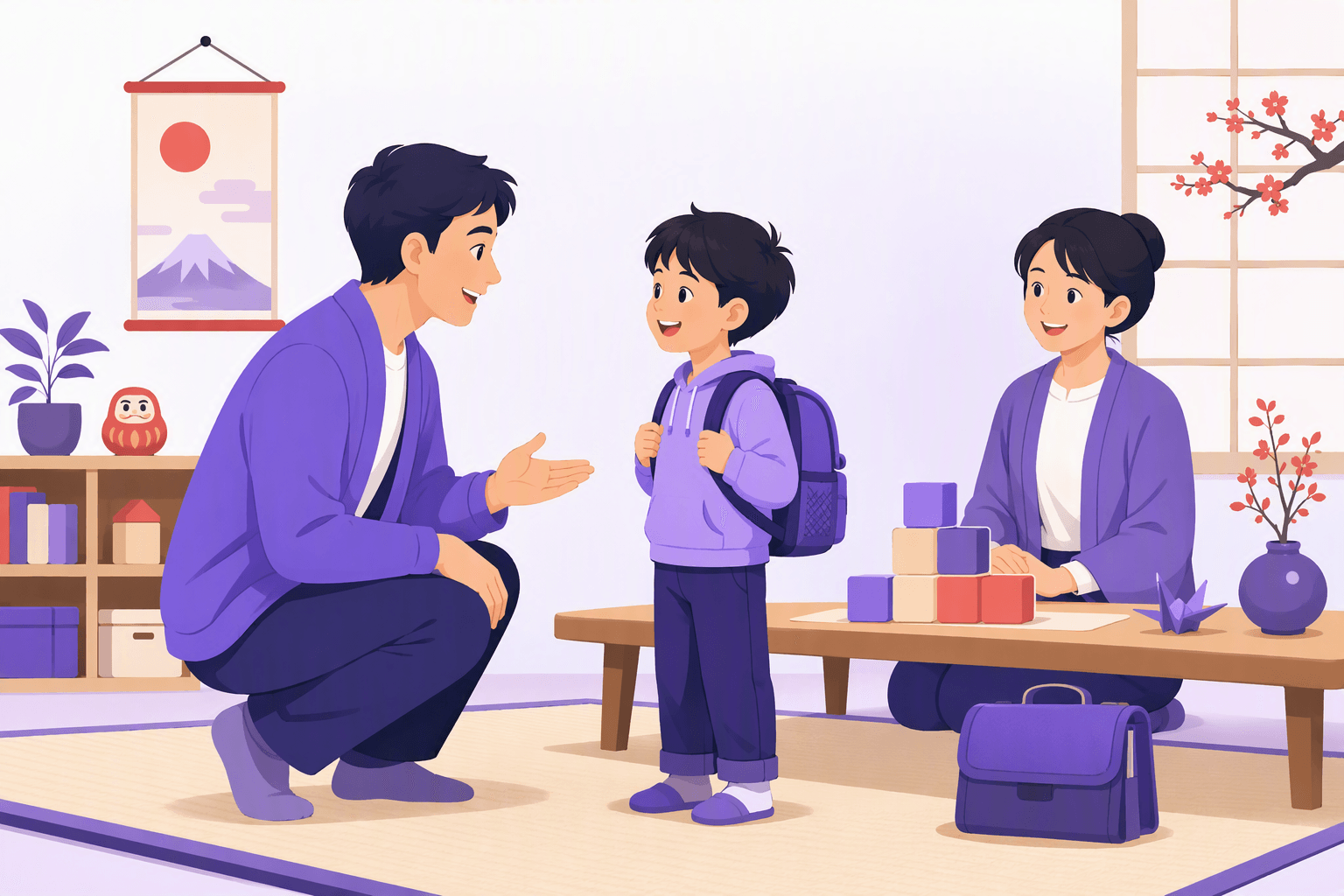
The key phrase: おいくつですか
おいくつですか
おいくつですか /o.i.kɯ.tsɯ desɯ ka/ is the standard polite question for a child’s age. The word おいくつ /o.i.kɯ.tsɯ/ is an honorific version of いくつ /i.kɯ.tsɯ/, meaning “how many” or, in this setting, “how old.”
You might hear it from a teacher, a doctor, a family friend, or a shop worker speaking warmly to a child. It is respectful without being stiff.
/oh-EE-koo-tsoo dess-kah/
Literal meaning: Honorific 'how many' plus a polite question ending
“おいくつですか。”
How old are you?
Most natural when asking a child. With an unfamiliar adult, the question can still feel personal despite its polite grammar.
The initial お /o/ marks politeness. It appears in many everyday Japanese words connected to another person, including お名前 /o.na.ma.e/, “name,” and お仕事 /o.ɕi.ɡo.to/, “work.”
Do not assume that a polite ending automatically makes every question socially safe. Japanese politeness is shaped by relationship, setting, and purpose, not only by grammar. This is a major theme in Jorden and Noda’s Japanese: The Spoken Language, which treats speaking patterns as social choices rather than isolated sentence formulas.
何歳ですか: the direct everyday question
何歳ですか
何歳ですか /naɰ̃.sa.i desɯ ka/ means “How old are you?” more directly. The first part, 何 /naɰ̃/, means “what” or “how many,” while 歳 /sa.i/ is the counter for years of age.
This is a normal question in many situations. Parents ask it of children, classmates ask one another, and staff may ask it when age affects eligibility, tickets, consent, or medical care.
/nahn-SYE dess-kah/
Literal meaning: 'What age' plus a polite question ending
“失礼ですが、何歳ですか。”
Excuse me, but how old are you?
Polite grammar, but still direct. Use it only when age is relevant or the relationship is already comfortable.
The phrase 失礼ですが /ɕi.tsɯ.ɾeː de.sɯ ɡa/, roughly “excuse me, but,” softens a question. It does not erase the personal nature of age, but it signals awareness that you are asking for private information.
For an adult you barely know, a better approach is often to avoid the subject entirely. If the person needs to disclose their age, they will usually do so through a form, official process, or a conversation where age is clearly relevant.
The casual version: 何歳?
何歳?
With a friend, sibling, classmate, or someone younger, you can say 何歳? /naɰ̃.sa.i/. The sentence-ending ですか /desɯ ka/ disappears, making the question short and casual.
/nahn-SYE/
Literal meaning: 'What age?'
“えっ、何歳?”
Wait, how old are you?
Use only with peers, friends, children, or people you already speak to casually. Do not use it with a teacher, boss, customer, or older stranger.
In fast dialogue, especially in anime and dramas, you may hear 何歳なの? /naɰ̃.sa.i na.no/ or 何歳なんですか /naɰ̃.sa.i naɰ̃ de.sɯ ka/. The first feels conversational and casual. The second is polite but has a more explanatory, interested tone.
Real screen dialogue is useful here because it shows what grammar books cannot fully capture: whether a character is asking playfully, suspiciously, formally, or romantically. For age-related expressions in everyday scenes, learning Japanese with anime can help you notice these shifts in context.
How to answer with your age
The basic response is:
私は [number] 歳です。
In Japanese, this is /wa.ta.ɕi wa [number] sa.i desɯ/. It literally means “As for me, I am [number] years old.” In ordinary conversation, however, speakers usually omit 私 /wa.ta.ɕi/, meaning “I,” because the topic is obvious.
You can simply say:
二十五歳です。
/ni.dʑɯː.ɡo.sa.i de.sɯ/
“I am 25 years old.”
The counter 歳 /sa.i/ comes after the number. It is often written with the simpler character 才 /sa.i/ in casual handwriting or informal online text, but 歳 /sa.i/ is the standard form for age.
Common age readings
Japanese numbers are generally regular with 歳 /sa.i/, but several ages have special sound changes. These are worth learning because they appear constantly in introductions, forms, TV dialogue, and birthdays.
| Age | Japanese | IPA | Natural pronunciation |
|---|---|---|---|
| 1 year old | 一歳 | /is.sai/ | ees-SYE |
| 2 years old | 二歳 | /ni.sai/ | nee-SYE |
| 3 years old | 三歳 | /san.sai/ | sahn-SYE |
| 4 years old | 四歳 | /jon.sai/ | yohn-SYE |
| 8 years old | 八歳 | /has.sai/ | hahss-SYE |
| 10 years old | 十歳 | /dʑis.sai/ | jeess-SYE |
| 20 years old | 二十歳 | /ha.ta.tɕi/ | hah-TAH-chee |
| 21 years old | 二十一歳 | /ni.dʑɯː.is.sai/ | nee-joo-ees-SYE |
The most important exception is 二十歳 /ha.ta.tɕi/, “20 years old.” It is read はたち /ha.ta.tɕi/, not にじゅっさい /ni.dʑɯs.sai/. You will see the standard numeric reading in some technical contexts, but はたち /ha.ta.tɕi/ is the ordinary age word.
💡 A natural short answer
When someone has already asked your age, answer with the number plus 歳 /sa.i/: 二十五歳です /ni.dʑɯː.ɡo.sa.i de.sɯ/. With friends, 二十五 /ni.dʑɯː.ɡo/ alone may be enough. Japanese often omits words that both speakers already understand.
When asking age is appropriate in Japan
Age is not forbidden conversational territory. Japanese people ask about it, especially among young people, in school, dating contexts, hobby groups, and workplaces where seniority is relevant. But the question carries more social weight than it often does in casual English conversation.
A person’s age can influence whether another speaker uses a casual form, polite form, title, or honorific language. The National Institute for Japanese Language and Linguistics documents how Japanese varies according to social relationships and communicative setting. Age is one of several signals, alongside role, familiarity, and institutional hierarchy.
Children and young people
Asking a child おいくつですか /o.i.kɯ.tsɯ desɯ ka/ is completely ordinary. Adults frequently use it as friendly small talk, and children are accustomed to answering with an age plus 歳 /sa.i/.
Teenagers and university students may also ask 何歳? /naɰ̃.sa.i/ when meeting casually. The tone is usually curious rather than intrusive, particularly when everyone is near the same age.
Adults you have just met
With adults, a direct age question can feel abrupt. This is especially true in professional settings, formal social events, and interactions with women, although sensitivity is not limited to any one gender.
If you need the information for a genuine reason, explain why. For example, an event organizer, medical worker, or administrator may ask for an age or birth date as part of a standard process.
Workplaces and hierarchy
In Japanese workplaces, people may know one another’s age indirectly through hiring year, school graduation year, role, or company records. Asking 何歳ですか /naɰ̃.sa.i desɯ ka/ at a first meeting can be unnecessary if the professional relationship does not require it.
Shibatani’s The Languages of Japan describes Japanese social language as deeply connected to relative status and group relationships. That does not mean every conversation is rigid. It means a successful speaker notices the social purpose of a question before choosing the grammar.
🌍 Age, school year, and seniority
Japanese speakers may refer to 学年 /ɡa.kɯ.neː/, “school year,” or use 先輩 /seɰ̃.pa.i/, “senior,” and 後輩 /koː.ha.i/, “junior,” rather than focusing on an exact age. These labels describe a relationship within a school, club, or workplace and can matter more than the number itself.
A very formal alternative
年齢を伺ってもよろしいですか
年齢を伺ってもよろしいですか /neɰ̃.ɾeː o ɯ.ka.ɡat.te mo jo.ɾo.ɕiː de.sɯ ka/ means “May I ask your age?” It is highly formal and suitable only where a polite, official reason exists.
The verb 伺う /ɯ.ka.ɡa.ɯ/ is a humble verb for asking or visiting. It lowers the speaker’s position, which makes the sentence respectful, but it would sound excessive among friends.
/nehn-RAY oh oo-kah-GAHT-teh moh yoh-roh-SHEE dess-kah/
Literal meaning: May I humbly ask your age?
“差し支えなければ、年齢を伺ってもよろしいですか。”
If you do not mind, may I ask your age?
Appropriate for formal interviews, surveys, or administrative contexts. It is too formal for ordinary small talk.
You can soften it further with 差し支えなければ /sa.ɕi.tsɯ.ka.e na.ke.ɾe.ba/, meaning “if you do not mind” or “if it is not inconvenient.” This phrase gives the listener a clear path not to answer.
That option matters. Japanese interaction frequently values indirectness when a request could impose on another person. Makino and Tsutsui’s A Dictionary of Basic Japanese Grammar is useful for understanding these layered polite structures and the meanings carried by sentence endings.
Useful responses beyond a number
Sometimes you do not want to share your exact age. Here are polite and natural options.
秘密です。
/hi.mi.tsɯ de.sɯ/
“It’s a secret.”
ご想像にお任せします。
/ɡo.soː.zoː ni o.ma.ka.se ɕi.ma.sɯ/
“I’ll leave it to your imagination.”
年齢は内緒です。
/neɰ̃.ɾeː wa na.i.ɕo de.sɯ/
“My age is private.”
The first response is light and often playful. The second is more polished, while the third clearly sets a boundary without sounding hostile.
🌍 A polite refusal is normal
If someone declines to state their age, do not repeat the question or guess. A brief reply such as そうですか /soː de.sɯ ka/, “I see,” lets the conversation move on comfortably.
Practice with a natural mini-dialogue
Here is a friendly adult-to-child exchange:
A: おいくつですか。
/o.i.kɯ.tsɯ de.sɯ ka/
How old are you?
B: 六歳です。
/ɾok.kɯ.sa.i de.sɯ/
I am six years old.
A casual conversation between peers might sound like this:
A: 何歳?
/naɰ̃.sa.i/
How old are you?
B: 二十二歳。そっちは?
/ni.dʑɯː.ni.sa.i. sot.tɕi wa/
Twenty-two. What about you?
そっち /sot.tɕi/ means “you” or “your side” in a casual reciprocal question. It is natural between peers, but not appropriate in formal settings.
As you practice, connect age questions with other introductory phrases. Learn how to ask what someone’s name is in Japanese, then add age only if the conversation and relationship make it welcome.
The phrase to remember
For a child or a clearly appropriate polite situation, use おいくつですか /o.i.kɯ.tsɯ desɯ ka/. For close friends, 何歳? /naɰ̃.sa.i/ works naturally. For unfamiliar adults, do not treat “How old are you?” as automatic small talk.
That cultural judgment will make your Japanese sound more considerate than perfect grammar alone. Once you are ready to build fuller introductions and relationships, see our guide to how to say I love you in Japanese and learn when direct words carry extra weight in Japanese.
Frequently Asked Questions
What is the most polite way to ask how old someone is in Japanese?
Is 何歳ですか rude in Japanese?
How do you say I am 20 years old in Japanese?
Why do Japanese people sometimes avoid asking age?
Do I need to use 歳 every time I state my age in Japanese?
Sources & References
- The Japan Foundation, Japanese Language Education resources, accessed 2026
- National Institute for Japanese Language and Linguistics, Japanese language resources, accessed 2026
- Makino and Tsutsui, A Dictionary of Basic Japanese Grammar, The Japan Times
- Shibatani, The Languages of Japan, Cambridge University Press
- Jorden and Noda, Japanese: The Spoken Language, Yale University Press
Start learning with Wordy
Watch real movie clips and build your vocabulary as you go. Free to download.


