How to Say Happy New Year in Japanese: 12 Natural Phrases for Cards, Texts, and In-Person
Quick Answer
To say Happy New Year in Japanese, the standard phrase is あけましておめでとうございます (ah-keh-MAHSH-teh oh-meh-deh-TOH goh-zah-ee-MAHSS), used from Jan 1 onward. Before New Year’s Day, Japanese speakers usually say よいお年を (yoh-ee oh-TOH-shee oh) meaning 'have a good New Year.' The right choice depends on timing, formality, and whether you’re speaking or writing.
| English | Japanese | Pronunciation | Formality |
|---|---|---|---|
| Happy New Year! (polite) | あけましておめでとうございます | ah-keh-MAHSH-teh oh-meh-deh-TOH goh-zah-ee-MAHSS | formal |
| Happy New Year! (casual) | あけましておめでとう | ah-keh-MAHSH-teh oh-meh-deh-TOH | casual |
| Have a good New Year (said before Jan 1) | よいお年を | yoh-ee oh-TOH-shee oh | polite |
| Happy New Year (very casual, text) | あけおめ | ah-keh-OH-meh | slang |
| This year too, please be kind to me (polite) | 今年もよろしくお願いします | koh-TOH-shee moh yoh-roh-SHEE-koo oh-neh-GAH-ee-shee-mahss | polite |
| This year too, please be kind to me (more formal) | 本年もよろしくお願いいたします | hohn-NEHN moh yoh-roh-SHEE-koo oh-neh-GAH-ee ee-tah-shee-MAHSS | formal |
| Happy New Year (set phrase for cards) | 謹賀新年 | keen-gah sheen-NEHN | formal |
| Happy New Year (set phrase for cards) | 賀正 | gah-SHOH | formal |
| Happy New Year (set phrase for cards) | 迎春 | geh-ee-SHOO | formal |
| Happy New Year (casual, text) | ことよろ | koh-toh-YOH-roh | slang |
| Thanks for everything this year (end of year) | 今年もお世話になりました | koh-TOH-shee moh oh-SEH-wah nee nah-ree-mah-SHEE-tah | polite |
| Please take care of me (polite, often paired) | よろしくお願いします | yoh-roh-SHEE-koo oh-neh-GAH-ee-shee-mahss | polite |
To say Happy New Year in Japanese, use あけましておめでとうございます (ah-keh-MAHSH-teh oh-meh-deh-TOH goh-zah-ee-MAHSS) from January 1 onward, and use よいお年を (yoh-ee oh-TOH-shee oh) in late December before the New Year begins. The difference is mostly about timing, plus how formal you need to be.
Japanese is spoken by about 123 million people worldwide, according to Ethnologue (2024). Most speakers live in Japan, but New Year greetings travel widely through anime, games, and Japanese communities abroad, which is why getting the timing right matters as much as the words.
If you’re learning greetings more broadly, pair this with how to say hello in Japanese and how to say goodbye in Japanese so you can handle the whole seasonal conversation, not just the first line.
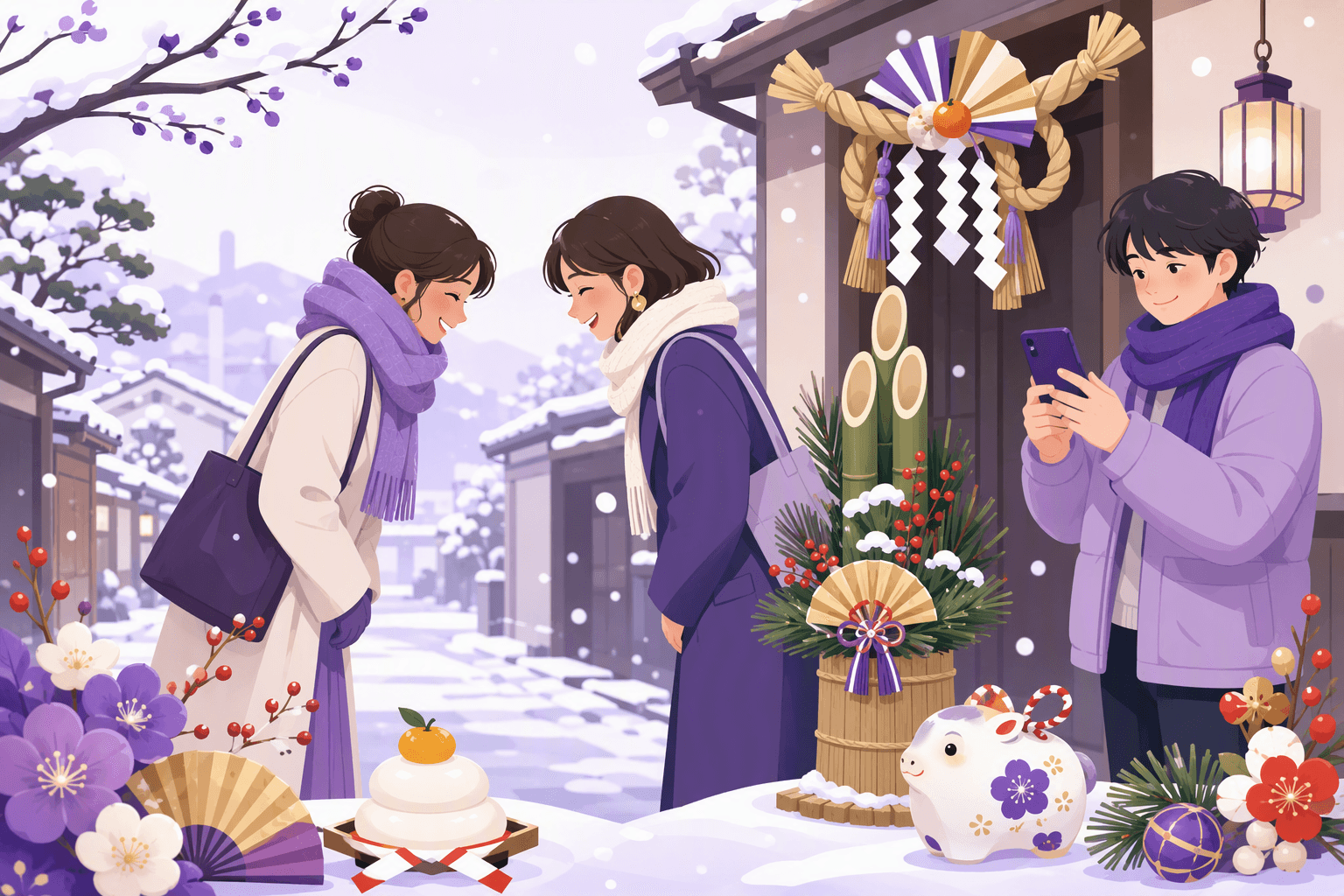
The timing rule: before Jan 1 vs after Jan 1
Japanese New Year language is unusually strict about the calendar. People often avoid saying “congratulations” before the New Year actually arrives.
Before January 1: wrap up the year
In the last days of December, you’ll hear phrases that close the year politely. The most common is よいお年を, which is basically “have a good New Year” said before it starts.
You’ll also hear end-of-year gratitude in workplaces and formal relationships. This is where Japanese politeness routines shine, a topic discussed in Haruo Shirane’s work on Japanese culture and classical seasonal customs, where the New Year functions as a social reset as much as a date change.
From January 1 onward: celebrate the new year
Once it’s January 1, あけましておめでとうございます becomes the default. It’s used in person, in messages, and on calls.
A common follow-up is 今年もよろしくお願いします, which signals “let’s have a good relationship this year too.” In pragmatic terms, it’s a relationship-maintenance line, the kind of formulaic social language that linguist Senko K. Maynard analyzes in her work on Japanese discourse and how meaning is built through routine expressions.
The core phrase you actually need
あけましておめでとうございます
Pronunciation: ah-keh-MAHSH-teh oh-meh-deh-TOH goh-zah-ee-MAHSS
This is the safest, most standard “Happy New Year” in Japanese. Use it with coworkers, neighbors, teachers, clients, and anyone you would normally speak to politely.
It’s also the best choice if you’re unsure about age, status, or distance. Japanese has clear politeness levels, and New Year greetings are one of the moments when people default upward.
/ah-keh-MAHSH-teh oh-meh-deh-TOH goh-zah-ee-MAHSS/
Literal meaning: Roughly: 'Congratulations on the opening (of the year)'.
“あけましておめでとうございます。本年もよろしくお願いいたします。”
Happy New Year. I look forward to your continued support this year.
Common from Jan 1 onward. In business and formal writing, it is often paired with 本年もよろしくお願いいたします to set a respectful tone for the year.
⚠️ Avoid this common timing mistake
Do not use あけましておめでとうございます in mid-December as a generic seasonal greeting. In Japanese, it can sound like you are jumping ahead of the calendar. In late December, よいお年を is the natural choice.
The casual version for friends and family
あけましておめでとう
Pronunciation: ah-keh-MAHSH-teh oh-meh-deh-TOH
This is the casual version without ございます. Use it with close friends, siblings, or people you normally speak to in casual style.
In texts, it often appears with emojis or stickers, but the phrase itself is already friendly. If you’re meeting someone’s parents or speaking to a professor, keep the polite version.
/ah-keh-MAHSH-teh oh-meh-deh-TOH/
Literal meaning: Same greeting, without the polite ending.
“あけましておめでとう!今年もいっぱい遊ぼう。”
Happy New Year! Let's hang out a lot this year too.
Very common among friends. If you are not sure whether casual is appropriate, choose the polite version instead.
What to say before New Year’s Day
よいお年を
Pronunciation: yoh-ee oh-TOH-shee oh
This is the phrase you use in the final days of December when you won’t see someone again before January 1. Think of it as “take care, and have a good New Year.”
You can say it to coworkers when leaving the office for the last time that year, to neighbors, or even to a store clerk you see regularly.
/yoh-ee oh-TOH-shee oh/
Literal meaning: Literally: 'a good year' (with an implied 'have').
“今年もお世話になりました。よいお年を。”
Thank you for everything this year. Have a good New Year.
A classic end-of-year line. It fits naturally with end-of-year gratitude, especially in workplaces and service relationships.
今年もお世話になりました
Pronunciation: koh-TOH-shee moh oh-SEH-wah nee nah-ree-mah-SHEE-tah
This is a polite end-of-year thank you, common at work and in formal relationships. It’s often said in the last week of December, sometimes in emails too.
If you only memorize one “December” phrase besides よいお年を, make it this one. It helps you sound socially aware even with limited Japanese.
The follow-up phrase that makes you sound natural
今年もよろしくお願いします
Pronunciation: koh-TOH-shee moh yoh-roh-SHEE-koo oh-neh-GAH-ee-shee-mahss
This is the standard add-on after Happy New Year. It’s not exactly “nice to meet you,” but it has that same relationship-setting function.
In many New Year exchanges, the greeting plus よろしく is the full package. If you say only あけましておめでとうございます and stop, you won’t be wrong, but you may sound a bit abrupt.
/koh-TOH-shee moh yoh-roh-SHEE-koo oh-neh-GAH-ee-shee-mahss/
Literal meaning: Literally: 'Please treat me well this year too.'
“あけましておめでとうございます。今年もよろしくお願いします。”
Happy New Year. Please take care of me this year too.
Extremely common in Japan because it frames the new year as a renewal of social ties. It works at work, with neighbors, and with acquaintances.
本年もよろしくお願いいたします
Pronunciation: hohn-NEHN moh yoh-roh-SHEE-koo oh-neh-GAH-ee ee-tah-shee-MAHSS
This is a more formal variant used in business writing and formal greetings. 本年 is a more formal “this year” than 今年.
If you’re writing a New Year email to clients or a formal card, this is a strong choice. It also aligns with the formal set phrases you see on 年賀状.
Texting slang: use carefully
あけおめ
Pronunciation: ah-keh-OH-meh
This is a clipped, casual “Happy New Year” used in texts and casual chats. It’s fine among close friends, but it can sound careless in formal relationships.
If you’re unsure, don’t use it. The polite full phrase is never strange, even in a text.
ことよろ
Pronunciation: koh-toh-YOH-roh
This is a shorthand for 今年もよろしく. You’ll see it in group chats, especially among younger speakers.
It’s not “bad Japanese,” it’s just context-bound. If you wouldn’t use slang with that person in English, don’t use this in Japanese.
💡 A safe text template
If you want one message that works almost everywhere, send: あけましておめでとうございます。今年もよろしくお願いします。 It’s polite, normal, and not stiff.
New Year card phrases you’ll see (and what they’re for)
Japan has a specific New Year card tradition called 年賀状, and Japan Post publishes guidance about how they’re used and delivered around the New Year (accessed 2026). Even if you never send one, these phrases show up in images, templates, and dramas.
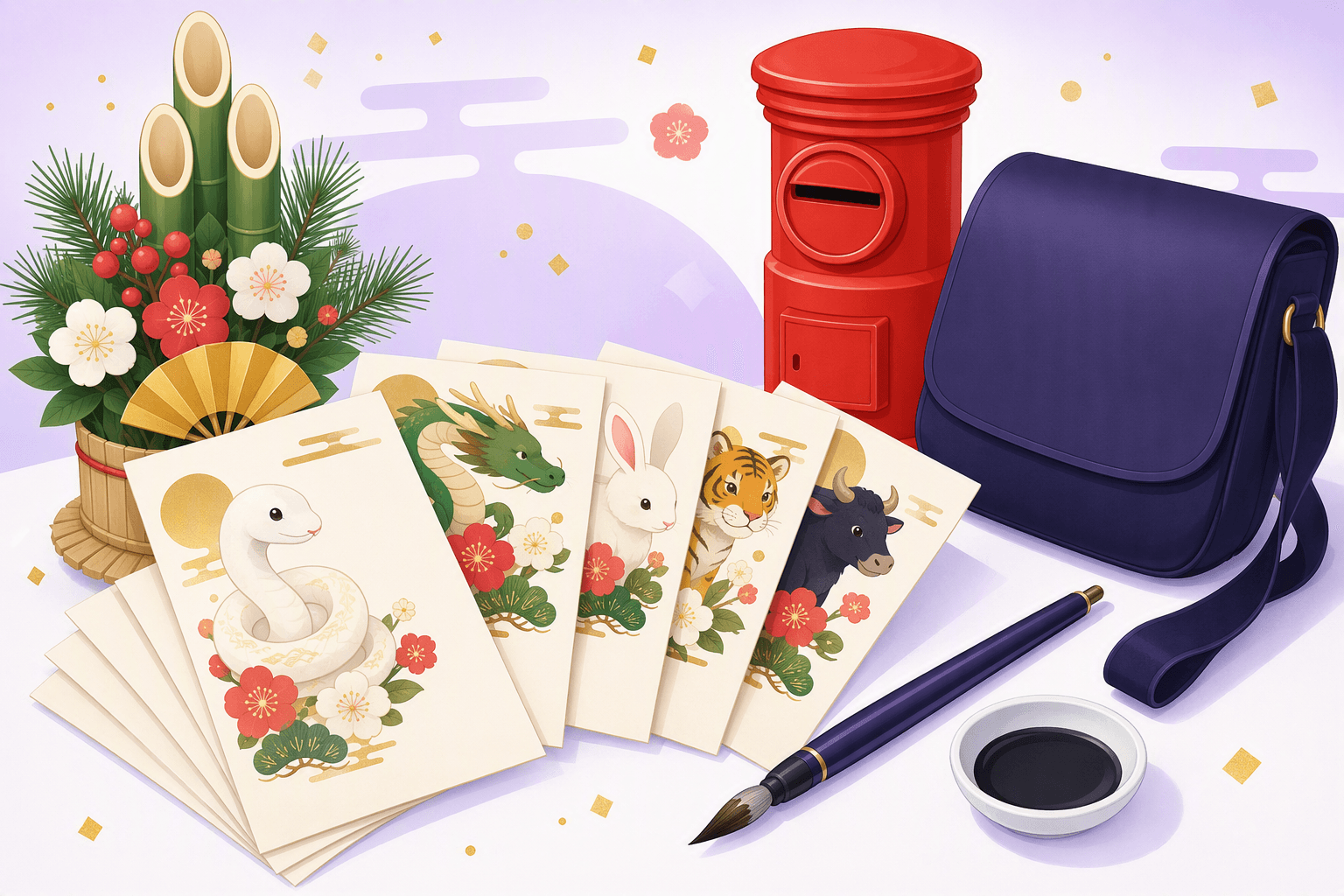
謹賀新年
Pronunciation: keen-gah sheen-NEHN
This is a formal “Happy New Year” set phrase used mainly in writing. It’s not something you typically say out loud in conversation.
It’s common on business cards, formal 年賀状, and printed greetings. Think of it as a headline.
賀正
Pronunciation: gah-SHOH
A short, formal New Year greeting used in writing. Because it’s short, it often appears in designs where space is limited.
You’ll see it on postcards and decorative banners. In speech, stick to あけましておめでとうございます.
迎春
Pronunciation: geh-ee-SHOO
Another written set phrase meaning “welcoming spring,” tied to the traditional seasonal framing of the New Year. It’s common in decorative contexts.
This is a good example of how Japanese seasonal language compresses cultural meaning into a couple of characters, a theme you also see in classical poetry and seasonal references discussed in Japanese literature scholarship.
🌍 Why 'spring' appears in New Year language
In the traditional lunisolar calendar, the New Year aligned more closely with the beginning of spring, so greetings like 迎春 make cultural sense even today. You still see the New Year treated as a seasonal turning point, not just a date, in decorations, food, and TV programming.
How to respond (and how to keep it going)
A New Year exchange is often two turns: the greeting, then the relationship line.
Here are natural response patterns:
- If someone says あけましておめでとうございます, you can say it back, then add 今年もよろしくお願いします.
- If someone says よいお年を in December, you can reply よいお年を (or よいお年をお迎えください in more formal contexts, though it can feel stiff in casual speech).
If you want more everyday relationship phrases, how to say I love you in Japanese is useful because it explains how Japanese often signals closeness indirectly, not only through direct declarations.
Pronunciation checkpoints (so you don’t blur morae)
Japanese is mora-timed, so the rhythm matters. If you compress syllables, you can still be understood, but you will sound less clear.
Key spots learners blur:
- あけまして: keep it as a-ke-ma-shi-te, not “akmashte.”
- おめでとう: keep the long “toh” feeling at the end, oh-me-de-TOH.
- おねがいします: keep the beats, oh-neh-GAH-ee-shee-mahss.
If you want a broader foundation, build your ear with how to learn a language with movies, then practice these greetings in real clips so the rhythm sticks.
When not to overdo it (especially in work settings)
New Year greetings are normal in Japan, but the tone should match the relationship. In a workplace, polite and brief is better than overly emotional.
Also avoid mixing registers, like using あけおめ with a manager and then switching to formal Japanese in the next sentence. Consistency reads as competence.
If you’re curious how register shifts work in Japanese media language, it’s worth comparing polite greetings to rough speech in dramas, and then contrasting that with what you see in lists like Japanese swear words, which are context-heavy and easy to misuse.
Practice with real dialogue (the fastest way to make it automatic)
New Year greetings show up constantly in January episodes, family scenes, and workplace reopenings. You’ll hear the same phrases repeated with small variations, which is ideal for learning.
To train it, listen for three things:
- The exact timing word choice (よいお年を vs あけましておめでとう).
- The politeness ending (ございます vs none).
- The follow-up (今年もよろしく).
For more Japanese listening ideas, browse the Wordy blog and combine seasonal phrases with your everyday core vocabulary from 100 most common Japanese words.
The bottom line
Use よいお年を (yoh-ee oh-TOH-shee oh) in late December, and switch to あけましておめでとうございます (ah-keh-MAHSH-teh oh-meh-deh-TOH goh-zah-ee-MAHSS) from January 1 onward. Add 今年もよろしくお願いします to sound natural and relationship-aware.
If you want to lock in the rhythm fast, learn these lines through short, repeatable scenes, then reuse them in your own texts and introductions inside Wordy’s clip practice.
Frequently Asked Questions
What is the most correct way to say Happy New Year in Japanese?
Can I say あけましておめでとう before January 1?
What do Japanese people write on New Year cards?
How do I reply to Happy New Year in Japanese?
Is あけおめ rude?
Sources & References
- Agency for Cultural Affairs (Japan), information on Japanese language and culture, accessed 2026
- NHK Broadcasting Culture Research Institute, Japanese language usage resources, accessed 2026
- Japan Post, 年賀状 (New Year's cards) guidance, accessed 2026
- Ethnologue: Languages of the World, Japanese language entry (2024)
Start learning with Wordy
Watch real movie clips and build your vocabulary as you go. Free to download.


