Quick Answer
The most useful way to say 'Can you repeat that?' in Japanese is もう一度お願いします, meaning 'one more time, please.' Use もう一度言ってください when you need someone to repeat their words, and use shorter casual versions only with friends.
How to Say “Can You Repeat That?” in Japanese
The safest way to say “Can you repeat that?” in Japanese is もう一度お願いします /moː itɕido oneɡaiɕimasɯ/, pronounced moh ee-chee-doh oh-neh-GAH-ee-shee-mahss. It politely means “one more time, please” and works in shops, classrooms, workplaces, and daily conversations. If you specifically want someone to repeat their words, say もう一度言ってください /moː itɕido itːe kɯdasai/.
Japanese has roughly 123 million first-language speakers, overwhelmingly in Japan, according to Ethnologue's 27th edition. That means learners encounter many regional accents and speech speeds, so a confident clarification phrase is not a failure, it is an essential conversation skill.
For other basic conversation starters, begin with how to say hello in Japanese. Then keep the phrases below ready for the moment a train announcement, shop clerk, or fast-talking friend becomes hard to follow.
| English | Japanese | Pronunciation | Formality |
|---|---|---|---|
| Could you repeat that, please? | もう一度お願いします | moh ee-chee-doh oh-neh-GAH-ee-shee-mahss | polite |
| Please say that one more time. | もう一度言ってください | moh ee-chee-doh EET-teh koo-dah-SAI | polite |
| Sorry, could you repeat that? | すみません、もう一度お願いします | soo-mee-mah-SEN moh ee-chee-doh oh-neh-GAH-ee-shee-mahss | formal |
| Say that again. | もう一回言って | moh ee-KKAI EET-teh | casual |
| I couldn't catch that. | 聞き取れませんでした | kee-kee-toh-reh-mah-SEN dee-shee-tah | polite |
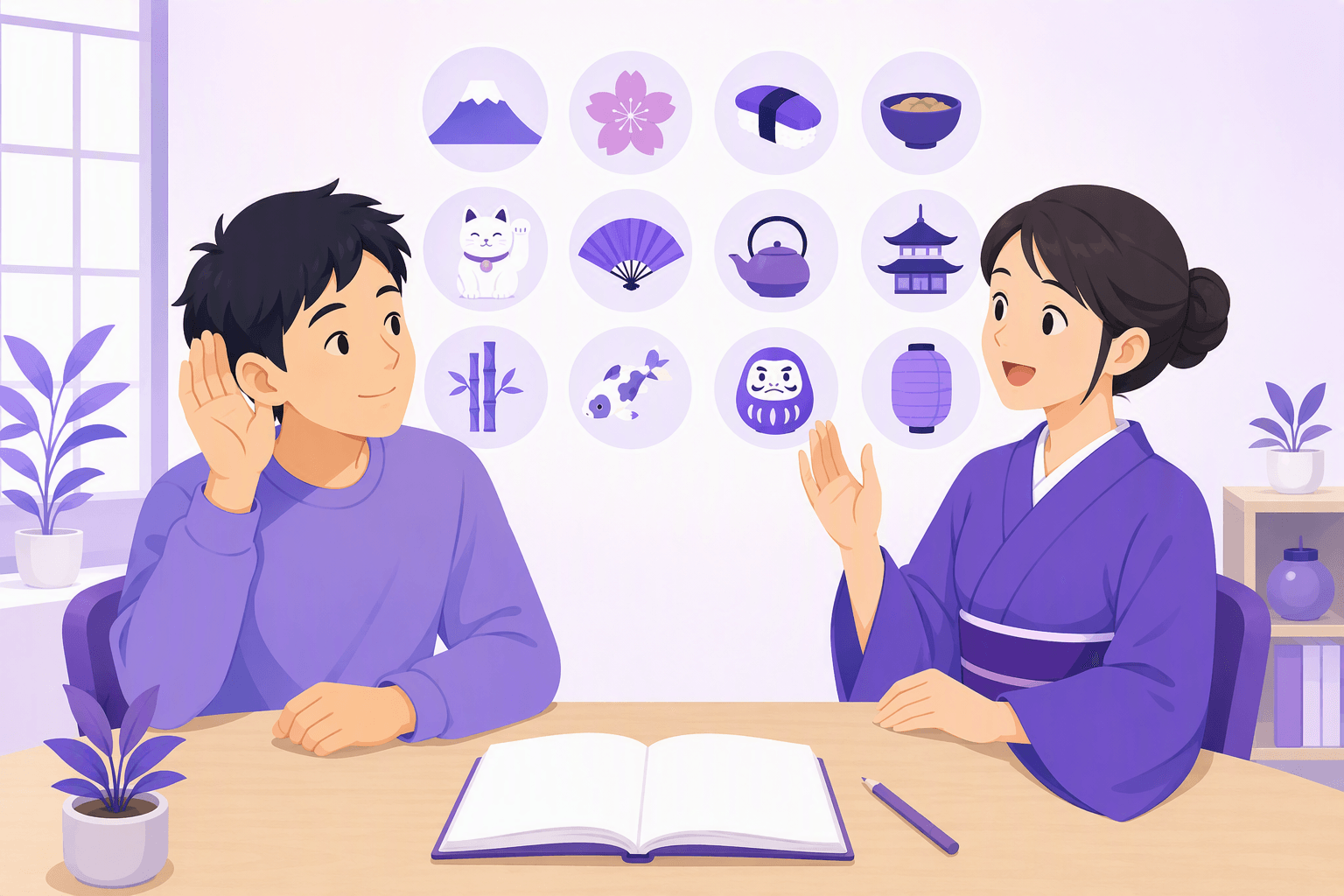
The best all-purpose phrase
もう一度お願いします
もう一度お願いします /moː itɕido oneɡaiɕimasɯ/ is the best default phrase for “Can you repeat that?” It is polite without sounding stiff, and Japanese speakers understand the missing object from context: you are asking them to repeat what they just said.
The phrase consists of もう一度 /moː itɕido/, “one more time,” and お願いします /oneɡaiɕimasɯ/, a polite request. You do not need to say “you” or “say” because Japanese commonly omits words that are obvious in the situation.
/moh ee-chee-doh oh-neh-GAH-ee-shee-mahss/
Literal meaning: One more time, please.
“すみません、もう一度お願いします。”
Excuse me, could you repeat that, please?
A safe request with strangers, staff, teachers, and colleagues. Japanese speakers often use the phrase without stating exactly what should be repeated.
Use it after a question you did not hear, a direction you missed, or an unfamiliar word. A slight rising intonation at the end makes it feel especially natural as a request.
Phrases for different situations
もう一度言ってください
もう一度言ってください /moː itɕido itːe kɯdasai/ means “Please say it one more time.” Unlike the first phrase, it names the action directly: 言ってください /itːe kɯdasai/ means “please say.”
This version is useful when the speaker gave a verbal answer, rather than an instruction involving an action. It is polite enough for teachers, acquaintances, and most service interactions.
/moh ee-chee-doh EET-teh koo-dah-SAI/
Literal meaning: Please say it one more time.
“その名前をもう一度言ってください。”
Please say that name one more time.
Use this when the thing you missed was spoken language, such as a name, a price, or a question.
Notice the small っ in 言って /itːe/. It creates a held consonant sound, so say EET-teh, not a single smooth ee-teh. Japanese timing is mora-based, and that tiny pause matters for clear pronunciation.
すみません、もう一度お願いします
For a more respectful opening, say すみません、もう一度お願いします /sɯmimasẽɴ moː itɕido oneɡaiɕimasɯ/. The opening すみません /sɯmimasẽɴ/ means “excuse me” or “sorry” in this context.
Use it with someone you have just met, an older person, a staff member, or a supervisor. It also softens the interruption when another person is busy.
/soo-mee-mah-SEN moh ee-chee-doh oh-neh-GAH-ee-shee-mahss/
Literal meaning: Excuse me, one more time, please.
“すみません、駅の名前をもう一度お願いします。”
Excuse me, could you say the station name one more time?
Adding すみません signals consideration for the speaker. It is especially helpful in public-facing situations where you are asking a stranger to pause.
The Japanese language has many ways to calibrate politeness through grammar, vocabulary, and indirectness. Seiichi Makino and Michio Tsutsui's A Dictionary of Basic Japanese Grammar highlights how request forms encode social distance. Here, the polite request ending does most of the work, so you do not need ornate formal language.
もう一回言って
With close friends, siblings, or classmates, もう一回言って /moː ikːai itːe/ is natural. It means “Say that again,” and the shorter もう一回 /moː ikːai/ has a casual everyday feel.
Do not use this exact version with a professor, customer, manager, or stranger. It is not an insult, but the missing polite ending can sound too direct when the relationship requires distance.
/moh ee-KKAI EET-teh/
Literal meaning: Say it one more time.
“今の、もう一回言って。”
Say that again.
Best among friends. The short form works because close relationships allow plain request forms.
The doubled consonant in 一回 /ikːai/ matters too. Keep a brief pause before KAI: ee-KKAI. That rhythm will make your speech easier to understand.
When you heard it but could not understand it
聞き取れませんでした
Sometimes you heard a sentence but could not separate the sounds into words. In that case, say 聞き取れませんでした /kʲikitoɾemasen deɕita/, “I could not catch it.”
This phrase is more precise than saying you do not understand Japanese. It tells the speaker that speed, noise, pronunciation, or an unfamiliar word caused the problem.
/kee-kee-toh-reh-mah-SEN dee-shee-tah/
Literal meaning: I was not able to hear and take it in.
“少し早くて、聞き取れませんでした。”
It was a little fast, so I couldn't catch it.
A considerate explanation that avoids making the other person feel they spoke incorrectly. Follow it with もう一度お願いします.
A highly useful combination is:
すみません、少し早くて聞き取れませんでした。もう一度お願いします。
/sɯmimasẽɴ soɕi hajakɯte kʲikitoɾemasen deɕita moː itɕido oneɡaiɕimasɯ/
“Sorry, it was a little fast and I could not catch it. Could you repeat that?”
わかりませんでした
わかりませんでした /wakaɾimasen deɕita/ means “I did not understand.” Use it when you heard the words but their meaning was unclear.
This distinction is valuable. 聞き取れませんでした /kʲikitoɾemasen deɕita/ is an audio problem, while わかりませんでした /wakaɾimasen deɕita/ is a meaning problem.
You can ask for a simpler explanation:
もう少し簡単に説明していただけますか。
/moː soɕi kantan ni setsɯmeː ɕite itadakemasɯ ka/
“Could you explain it a little more simply?”
That is a formal, considerate phrase for a teacher, guide, or workplace conversation.
Ask someone to speak more slowly
もう少しゆっくり話してください
When the issue is pace, say もう少しゆっくり話してください /moː soɕi jɯkːɯɾi hanaɕite kɯdasai/. It means “Please speak a little more slowly.”
This is better than repeatedly asking for individual repetitions. It gives the other speaker a clear, helpful adjustment to make.
💡 A practical two-step request
Start with もう一度お願いします /moː itɕido oneɡaiɕimasɯ/. If you still cannot follow the next answer, switch to もう少しゆっくり話してください /moː soɕi jɯkːɯɾi hanaɕite kɯdasai/. Most people will naturally slow down once they know you are learning.
The Japan Foundation supports Japanese education in many countries, and its teaching materials emphasize communication strategies, not only memorized grammar. A simple repair phrase lets a conversation continue even when your vocabulary is incomplete.
Key words to recognize
| English | Japanese | Pronunciation | Note |
|---|---|---|---|
| one more time | もう一度 | moh ee-chee-doh | Polite and widely useful. |
| once more | もう一回 | moh ee-KKAI | More conversational. |
| please | お願いします | oh-neh-GAH-ee-shee-mahss | A request ending used in many contexts. |
| to say | 言う | ee-OO | Dictionary form of the verb. |
| to hear and understand | 聞き取る | kee-kee-TOH-roo | Useful when speech was unclear. |
| slowly | ゆっくり | yook-KOO-ree | Often used to ask speakers to slow down. |
Learning these chunks helps you adapt your own request. For example, you can replace “one more time” with “more slowly” while keeping the polite request ending.
ゆっくりお願いします /jɯkːɯɾi oneɡaiɕimasɯ/ is a short request meaning “slowly, please.” It works, but もう少しゆっくり話してください /moː soɕi jɯkːɯɾi hanaɕite kɯdasai/ is clearer because it explicitly asks the person to speak slowly.
Japanese politeness and the value of indirect requests
Japanese requests often sound less direct than their English equivalents because the listener’s effort is acknowledged. Saying お願いします /oneɡaiɕimasɯ/ frames your sentence as a request rather than a command.
Sachiko Ide's work on Japanese politeness distinguishes between deliberate consideration and socially expected respectful behavior. In a real interaction, adding すみません /sɯmimasẽɴ/ before your request is not empty decoration. It recognizes that you are asking the other person to take another turn.
🌍 Repeating is normal, not rude
In Japan, asking someone to repeat themselves is common in shops, stations, offices, and classrooms. What matters is the form you choose. A brief apology plus a polite request is usually more natural than pretending you understood and then acting on the wrong information.
This is especially useful with names and numbers. Japanese names, addresses, platform numbers, and prices may contain unfamiliar sound patterns. Asking again protects you from mistakes and signals that you are paying attention.
Common mistakes to avoid
Using 何? with strangers
何? /nani/ means “What?” It can be fine among close friends, especially with a surprised tone. With strangers or people above you in a workplace or school hierarchy, it can sound abrupt.
Choose もう一度お願いします /moː itɕido oneɡaiɕimasɯ/ instead. You will sound calm and respectful even if you are nervous.
Saying もう一度ください
Learners sometimes combine もう一度 /moː itɕido/ with ください /kɯdasai/ and say もう一度ください /moː itɕido kɯdasai/. This is incomplete for asking someone to repeat speech.
Use もう一度お願いします /moː itɕido oneɡaiɕimasɯ/ or もう一度言ってください /moː itɕido itːe kɯdasai/. The first is idiomatic because お願いします /oneɡaiɕimasɯ/ can stand in for the requested action.
Overusing すみません
すみません /sɯmimasẽɴ/ is polite and useful, but you only need it once. Say the complete request clearly rather than apologizing several times.
A relaxed smile and a short phrase are enough. Clear communication matters more than perfect grammar.
Practice with real Japanese dialogue
Short scenes are ideal for mastering clarification phrases because you can hear the speed, intonation, and social relationship before you respond. A cashier speaks differently from a friend, and a school drama uses different levels of politeness from a workplace series.
Try watching a short Japanese clip once without subtitles. When you miss a line, pause and say 聞き取れませんでした /kʲikitoɾemasen deɕita/, then replay it. When you recognize the sound but not the meaning, say わかりませんでした /wakaɾimasen deɕita/ and look up the key expression.
For more listening-oriented study, see our guide to learning Japanese with anime and the practical Japanese pronunciation guide. You can also build your basic interactions with Japanese travel phrases.
The phrase to remember
If you memorize only one sentence, make it すみません、もう一度お願いします /sɯmimasẽɴ moː itɕido oneɡaiɕimasɯ/. It is polite, flexible, and useful at every beginner level.
As your listening improves, add 聞き取れませんでした /kʲikitoɾemasen deɕita/ for unclear audio and もう少しゆっくり話してください /moː soɕi jɯkːɯɾi hanaɕite kɯdasai/ for fast speech. These phrases turn a confusing moment into a real exchange, which is exactly where listening skills grow.
Frequently Asked Questions
What is the most polite way to say can you repeat that in Japanese?
Can I say もう一回言ってください in Japanese?
How do I say I did not catch that in Japanese?
Is もう一度お願いします enough by itself?
What should I say if someone is speaking too fast in Japanese?
Sources & References
- National Institute for Japanese Language and Linguistics, Japanese Language Resources, accessed 2026
- The Japan Foundation, Japanese-Language Education, accessed 2026
- Agency for Cultural Affairs, Japan, Japanese Language Policy Materials, accessed 2026
- Ethnologue, Japanese, 27th edition, 2024
- Makino, Seiichi and Tsutsui, Michio, A Dictionary of Basic Japanese Grammar, The Japan Times
Start learning with Wordy
Watch real movie clips and build your vocabulary as you go. Free to download.


