Quick Answer
To learn Spanish fast, focus on the highest-frequency words and phrases, get daily listening input you can mostly understand, and speak from week one using short, repeatable scripts. The fastest progress comes from combining comprehensible input with deliberate practice: targeted vocabulary review, shadowing, and regular conversation.
Learning Spanish fast is realistic if you stop trying to learn everything and instead train the few skills that create quick, visible progress: high-frequency vocabulary, daily listening you can mostly understand, and speaking from week one with repeatable scripts.
Spanish is also a high-return language: Ethnologue estimates hundreds of millions of native speakers, and Instituto Cervantes reports Spanish is one of the world’s most widely used languages across multiple continents. That means you have endless input, from music to sports to TV, and you can find conversation partners almost anywhere.
If you want a warm-up before the plan, learn a few core openers from how to say hello in Spanish and how to say goodbye in Spanish. Those two skills alone make your first conversations feel much less stressful.
What "fast" actually means for Spanish
Fast does not mean effortless, it means efficient: you spend your time on what shows up constantly in real speech.

For most learners, “fast” looks like this:
- Week 1 to 2: you understand simple greetings and can introduce yourself.
- Month 1: you can handle predictable situations (ordering, directions, small talk).
- Month 3: you can hold a basic conversation with pauses and mistakes.
- Month 6: you can follow simpler shows with support and talk about daily life.
A useful way to think about speed is hours, not calendar time. Someone doing 60 minutes daily will usually beat someone doing 3 hours on Saturday, even if the weekend learner feels more “serious.”
The three levers that speed up Spanish
1) Frequency: learn what you will hear again tomorrow
The fastest vocabulary is the vocabulary that repeats. Function words, common verbs, and everyday nouns appear constantly, so every minute invested compounds.
If you have not already, use a frequency-based list like 100 most common Spanish words to anchor your first month. You are not trying to “finish” Spanish, you are trying to unlock understanding.
2) Comprehensible input: understand most of what you hear
Stephen Krashen’s work on input-based acquisition is popular for a reason: people improve when they get lots of language they can mostly understand, with a small stretch beyond their current level.
For Spanish, this is especially powerful because pronunciation is consistent and word boundaries are often clearer than in languages with heavy reduction. Your listening improves quickly if you train it daily.
3) Output with constraints: speak early, but keep it simple
Speaking helps you notice gaps, build automaticity, and reduce fear. The trick is to speak with constraints: short scripts, limited topics, and lots of repetition.
This aligns with what many classroom learners miss: they “know” grammar but cannot produce it under time pressure. Your goal is usable Spanish, not perfect Spanish.
A realistic daily plan (45 to 90 minutes)
This is a plan you can actually sustain. If you can do more, add time to listening first.
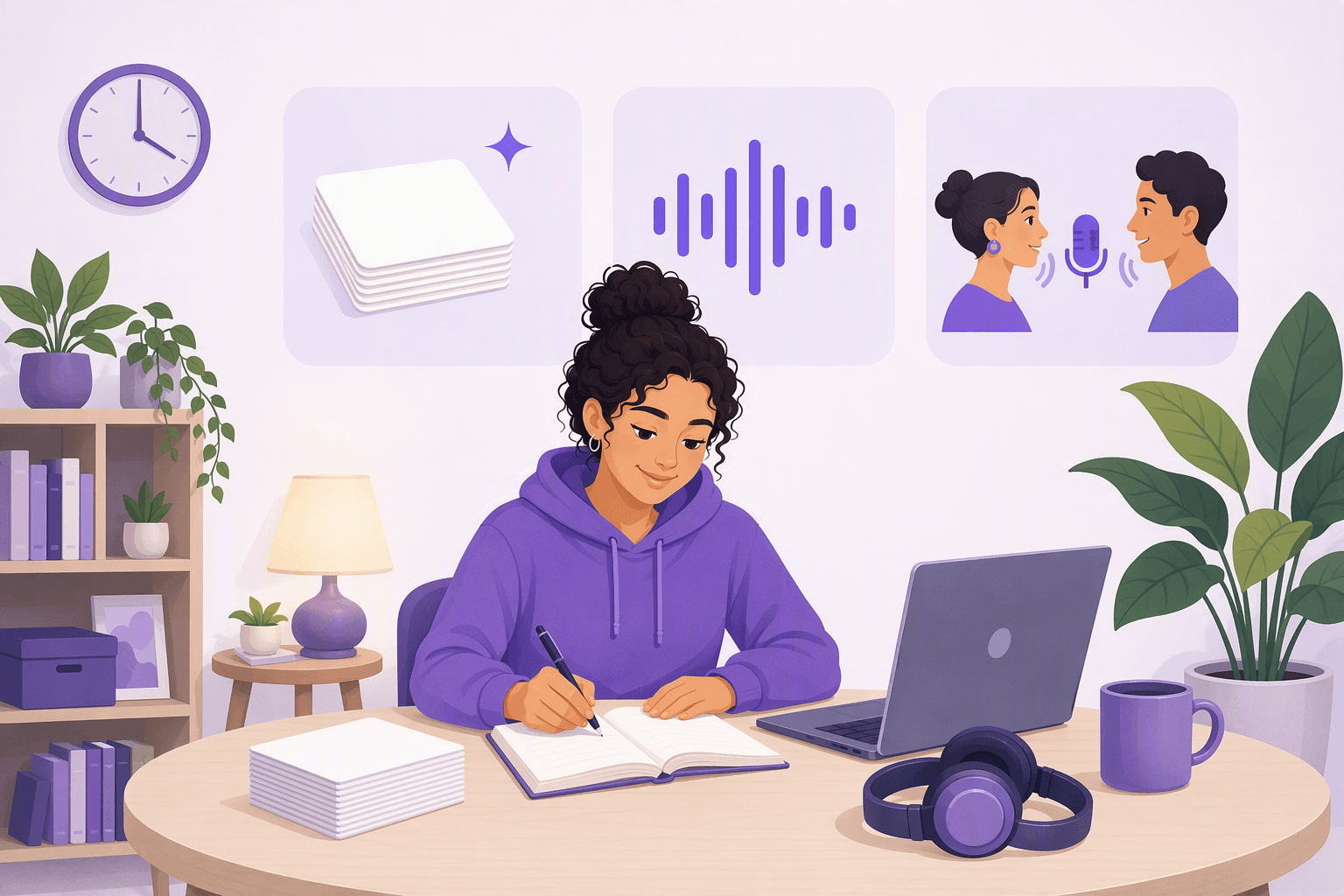
The 45-minute version (minimum effective dose)
1) Vocabulary review (15 minutes)
Use spaced repetition, but keep the deck small. Add words you actually encountered, not random lists.
2) Listening with support (20 minutes)
Use short clips or short podcast segments with a transcript. Replay the same segment until it feels easy.
3) Speaking or shadowing (10 minutes)
Read aloud, shadow a clip, or do a short self-talk routine. Record yourself once a week.
💡 The fastest habit for Spanish pronunciation
Spanish rewards clear vowels and steady rhythm. Spend 2 minutes a day on five words you keep mispronouncing, and say them in a full sentence. For example: "gracias" (GRAH-syahs), "por favor" (por fah-BOR), "buenos días" (BWEH-nohs DEE-ahs).
The 90-minute version (aggressive but sustainable)
1) Vocabulary and phrases (20 minutes)
Focus on verbs and chunks, not isolated nouns.
2) Listening (45 minutes)
Split into 15 minutes easy, 30 minutes stretch. “Easy” means you understand most without pausing.
3) Speaking (25 minutes)
Do 10 minutes shadowing plus 15 minutes conversation or tutor time.
The 14-day jumpstart: what to do first
The first two weeks decide whether you feel momentum. Your job is to build a small set of phrases you can reuse everywhere.
Days 1 to 3: build your survival scripts
Write and practice:
- A greeting + name + where you are from.
- A “sorry, I’m learning” line.
- A “can you repeat?” line.
- A simple preference line (I like, I don’t like).
Keep it short, and say it out loud. If you only study silently, you will feel “stuck” the first time you speak.
Days 4 to 7: train listening with tiny clips
Pick 30 to 60 seconds of audio you can replay. A sitcom scene, a vlog segment, or a learner podcast works.
Your routine:
- Listen once without reading.
- Listen again with Spanish subtitles or transcript.
- Mark 5 useful words or phrases.
- Replay until you can follow the gist without reading.
If you want a structured way to do this with entertainment, read dual subtitles first. It helps you avoid the trap of reading English and ignoring Spanish audio.
Days 8 to 14: start real conversations, but control the topic
Do 3 short conversations in week two. Keep them to 15 minutes and use a topic you prepared, like “my job,” “my city,” or “my weekend.”
Your goal is not to impress anyone. Your goal is to repeat your core phrases until they become automatic.
The Spanish you should learn first (and what to delay)
Learn these early
High-utility verbs in the present tense
ser, estar, tener, ir, querer, poder, hacer, decir. These verbs power a huge share of daily speech.
Time phrases
hoy, mañana, esta semana, el fin de semana. They let you talk about real life immediately.
Polite basics
hola (OH-lah), gracias (GRAH-syahs), por favor (por fah-BOR). Politeness is not optional, it is social glue.
Research on politeness (Brown & Levinson, Politeness: Some Universals in Language Usage, Cambridge University Press) frames everyday interaction as face-management. In Spanish, small polite moves often matter more than grammatical perfection.
Delay these until you have momentum
Rare verb tenses and literary forms
You do not need to master the full subjunctive system in week two. You need to understand and be understood.
Low-frequency vocabulary lists
If you are memorizing “types of birds” before you can order coffee, you are not learning fast, you are procrastinating with flashcards.
Listening: the skill that makes everything else easier
Listening is the bottleneck for most Spanish learners. The good news is that it improves quickly when you train it correctly.
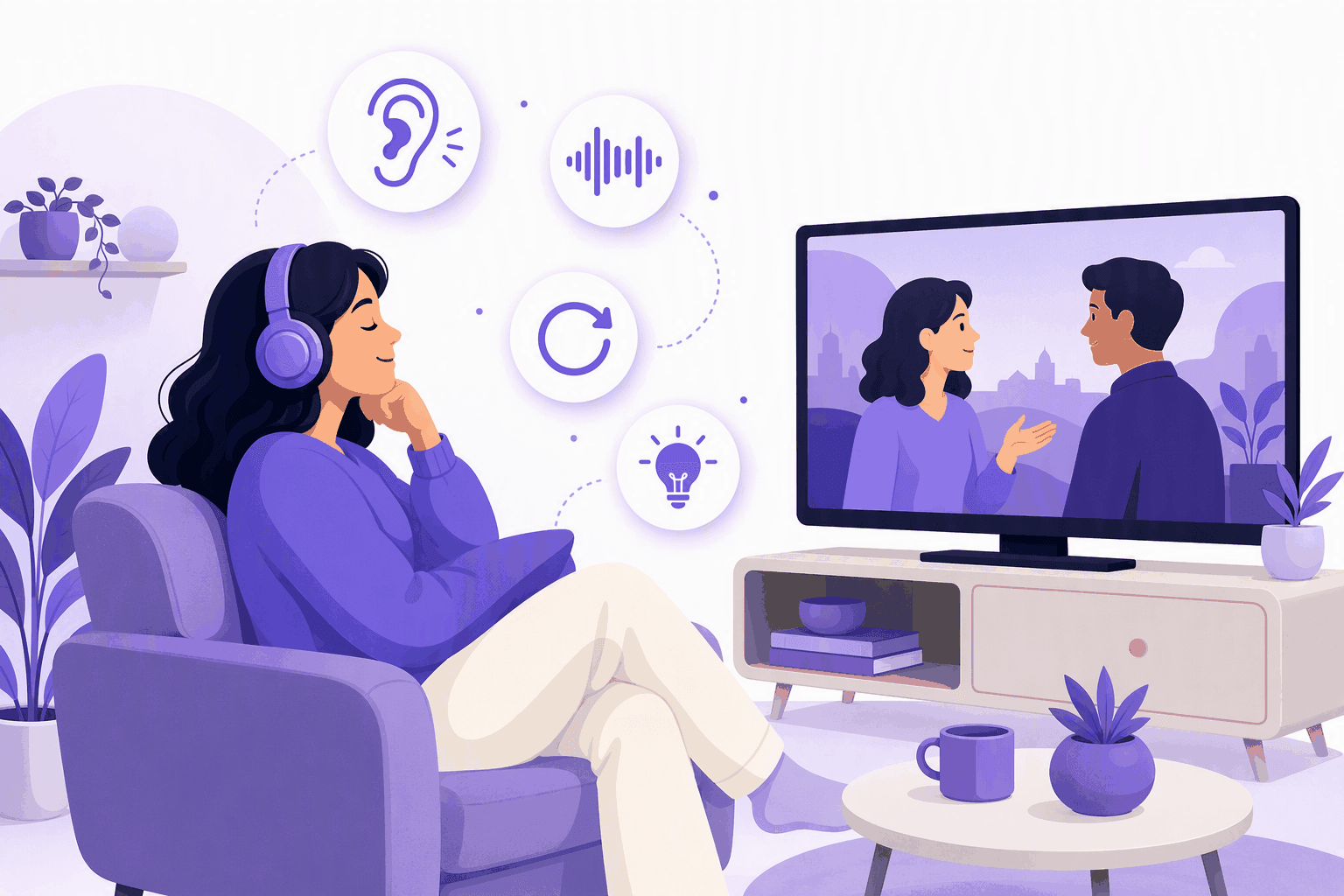
Why TV and movies work, if you use them right
Movies and shows give you connected speech, accents, emotion, and repetition of everyday situations. But you need enough comprehension to learn from it.
Research on lexical coverage in movies (Webb & Rodgers, The Lexical Coverage of Movies, Applied Linguistics) is often cited in discussions of how many words you need to follow video content. The practical takeaway is simple: the more core vocabulary you know, the more video becomes learnable instead of noise.
If you want a Spanish-specific watchlist, start with best movies to learn Spanish. Choose something you would watch anyway, because you will replay scenes.
A simple clip method (repeatable)
- Pick a 20 to 60 second clip with clear dialogue.
- Watch with Spanish subtitles first, not English.
- Write down 3 phrases you would actually say.
- Shadow the clip, matching rhythm and pauses.
- Use one phrase in a message or conversation that day.
This is how you turn input into output.
Want to try the method right now? This Friends scene dubbed in Latin American Spanish is a good practice clip: clear everyday dialogue about plans and ages, full of time phrases and numbers you can shadow.
Speaking fast without sounding rude
Many learners avoid speaking because they fear mistakes. In Spanish, the bigger risk is sounding abrupt, not incorrect.
Use softeners and polite framing
These phrases buy you time and make you sound respectful:
- “Perdón” (pehr-DON): quick “sorry.”
- “Disculpa” (dees-KOOL-pah): casual “excuse me.”
- “¿Me puedes repetir?” (meh PWEH-dehs reh-peh-TEER): “Can you repeat?”
You do not need to be perfect, but you should be socially safe.
🌍 Why Spanish small talk feels 'fast'
In many Spanish-speaking contexts, greetings are longer than in English. It is common to greet, ask a quick check-in, and only then get to the point. If you jump straight to your request, you can sound cold even with correct grammar. A simple "Hola, ¿qué tal?" buys you warmth.
Build a weekly speaking routine
- 3 days per week: 10 minutes shadowing.
- 2 days per week: 15 to 30 minutes conversation.
- 1 day per week: record a 60-second summary of your week.
This is enough to create steady improvement without burning out.
Vocabulary: how to memorize less and remember more
Use spaced repetition, but feed it the right words
Spaced repetition works best when the content is personal and frequent. Add words you encountered in listening, reading, or conversation.
If you want a practical system, see Anki for language learning. The key is not the app, it is the discipline of adding only what you will reuse.
Learn chunks, not single words
Spanish is full of reusable chunks:
- “No sé” (noh SEH): “I don’t know.”
- “Creo que…” (KREH-oh keh): “I think that…”
- “Tengo que…” (TEHN-goh keh): “I have to…”
Chunks reduce grammar load. You can speak earlier because you are not building every sentence from scratch.
⚠️ A common 'fast Spanish' trap
If you only memorize translations, you will freeze in real conversation. Spanish often chooses different structures than English. Train full phrases with a subject, a verb, and a real context. You want language you can deploy under pressure, not trivia you can recognize on a test.
Grammar: the minimum you need to move quickly
Grammar matters, but the order matters more.
The high-impact sequence
- Present tense of common verbs
- Gender and articles (el/la, un/una)
- Ser vs estar (core uses)
- Simple past for completed actions
- Near future (ir a + infinitive)
- Object pronouns (basic)
- Subjunctive (later, in chunks)
If ser vs estar confuses you, do not brute-force it. Use a clear rule set and lots of examples, like in ser vs estar in Spanish.
Pronunciation and accent marks are part of speed
Spanish spelling is consistent, but accent marks change stress and sometimes meaning. Learning them early prevents fossilized mistakes.
If you want a clean explanation, use Spanish accent marks. It is one of the highest ROI grammar-adjacent topics in Spanish.
Choose your Spanish: region, accent, and what matters
Spanish is spoken across many countries, and accents vary. The fastest path is consistency, not perfection.
What stays the same
Core grammar, most high-frequency vocabulary, and the basic sound system are shared widely. If you learn standard forms, you will be understood.
What changes (and how to handle it)
- Pronunciation of c and z in Spain vs most of Latin America.
- Vocabulary choices (computadora vs ordenador, for example).
- Some pronoun usage (vosotros in Spain, ustedes in most of Latin America).
If you are curious about broader differences, Latin American vs Spain Spanish is a good orientation. For fast learning, pick one input stream and stick to it for a while.
Motivation: how to keep speed without burnout
Speed is not about intensity, it is about consistency.
Use a simple scoreboard
Track only three numbers:
- Minutes listened today
- New phrases used this week
- Conversations completed this month
If you hit those, you are learning fast, even if you feel messy.
Make your Spanish socially real
Add one Spanish touchpoint that is not “study”:
- Follow a Spanish-speaking creator.
- Join a hobby group chat.
- Watch sports commentary in Spanish.
When Spanish becomes part of your identity, you stop negotiating with yourself every day.
A practical 30-day plan you can repeat
Week 1: foundation
- 7 days of short listening with transcript (15 to 20 minutes).
- 30 core phrases practiced out loud.
- One short conversation, even if it is awkward.
Week 2: comprehension
- Increase listening to 25 to 35 minutes daily.
- Start shadowing 3 days.
- Learn the present tense of 10 common verbs in context.
Week 3: output
- Two conversations.
- Record one 60-second monologue.
- Add 20 to 30 phrases from your listening.
Week 4: consolidation
- Rewatch the same content and notice how much more you understand.
- Clean your flashcards, delete low-value cards.
- Do a longer conversation (30 minutes) on a prepared topic.
Repeat the cycle with new content. Your Spanish will feel “fast” because you are building automaticity, not just knowledge.
A note on slang and swearing
Learners often ask for “real Spanish,” and that includes slang. But slang is regional, and swearing can backfire socially.
If you want to understand what you hear without using it, read Spanish swear words for context and severity. Treat it as listening comprehension, not a speaking goal.
If you want a fun goal: learn love language early
A surprising motivation hack is learning a few affectionate phrases, because you will actually want to use them. If that fits your life, how to say I love you in Spanish gives you options beyond one textbook line.
Just keep it culturally appropriate. Romance language is high-stakes language.
Final checklist: the fastest Spanish habits
- Learn high-frequency words first, not random lists.
- Listen daily to Spanish you mostly understand.
- Shadow short clips to train rhythm and pronunciation.
- Speak from week one using scripts and repetition.
- Review with spaced repetition, but only what you encounter.
- Stay consistent with one regional input stream for a few months.
If you want to train Spanish with real dialogue you can replay and shadow, Wordy’s movie and TV clips are built for this style of practice. Start with short scenes, track the phrases you actually use, and keep the daily streak small enough to sustain.
Frequently Asked Questions
What is the fastest way to learn Spanish?
How long does it take to become conversational in Spanish?
Can I learn Spanish by watching TV shows?
Should I learn Spain Spanish or Latin American Spanish first?
Do I need to memorize verb conjugations to learn Spanish fast?
Sources & References
- Instituto Cervantes, El español: una lengua viva (annual report, accessed 2026)
- Ethnologue, 27th edition, 2024
- Krashen, S., The Input Hypothesis: Issues and Implications, Longman
- Brown, P. & Levinson, S. C., Politeness: Some Universals in Language Usage, Cambridge University Press
- Webb, S. & Rodgers, M.P.H., The Lexical Coverage of Movies, Applied Linguistics
Start learning with Wordy
Watch real movie clips and build your vocabulary as you go. Free to download.


