Quick Answer
To learn German fast, study every day with a focused mix of understandable listening, high-frequency vocabulary, short speaking practice, and targeted grammar. A consistent 60 to 90 minutes per day can build a useful A2-level foundation in about 90 days, especially when you learn language from real conversations rather than isolated word lists.
To learn German fast, make German part of every day: listen to material you can mostly follow, collect high-frequency phrases from real scenes, speak aloud from day one, and study grammar only when it helps you say something better. With 60 to 90 focused minutes daily for 90 days, you can realistically reach a solid beginner level for introductions, travel, daily routines, and basic conversations.
German is not a niche skill. It has roughly 130 million speakers worldwide and is an official or co-official language in Germany, Austria, Switzerland, Liechtenstein, Belgium, and Luxembourg. The Goethe-Institut has also reported more than 15 million people learning German globally, so there is an enormous amount of learner material, media, and conversation practice available.
The fastest route is not memorizing every rule before you speak. It is building a system in which you hear, recognize, recall, and use the same useful German repeatedly. Start by learning how to say hello in German, then use that language in real exchanges immediately.
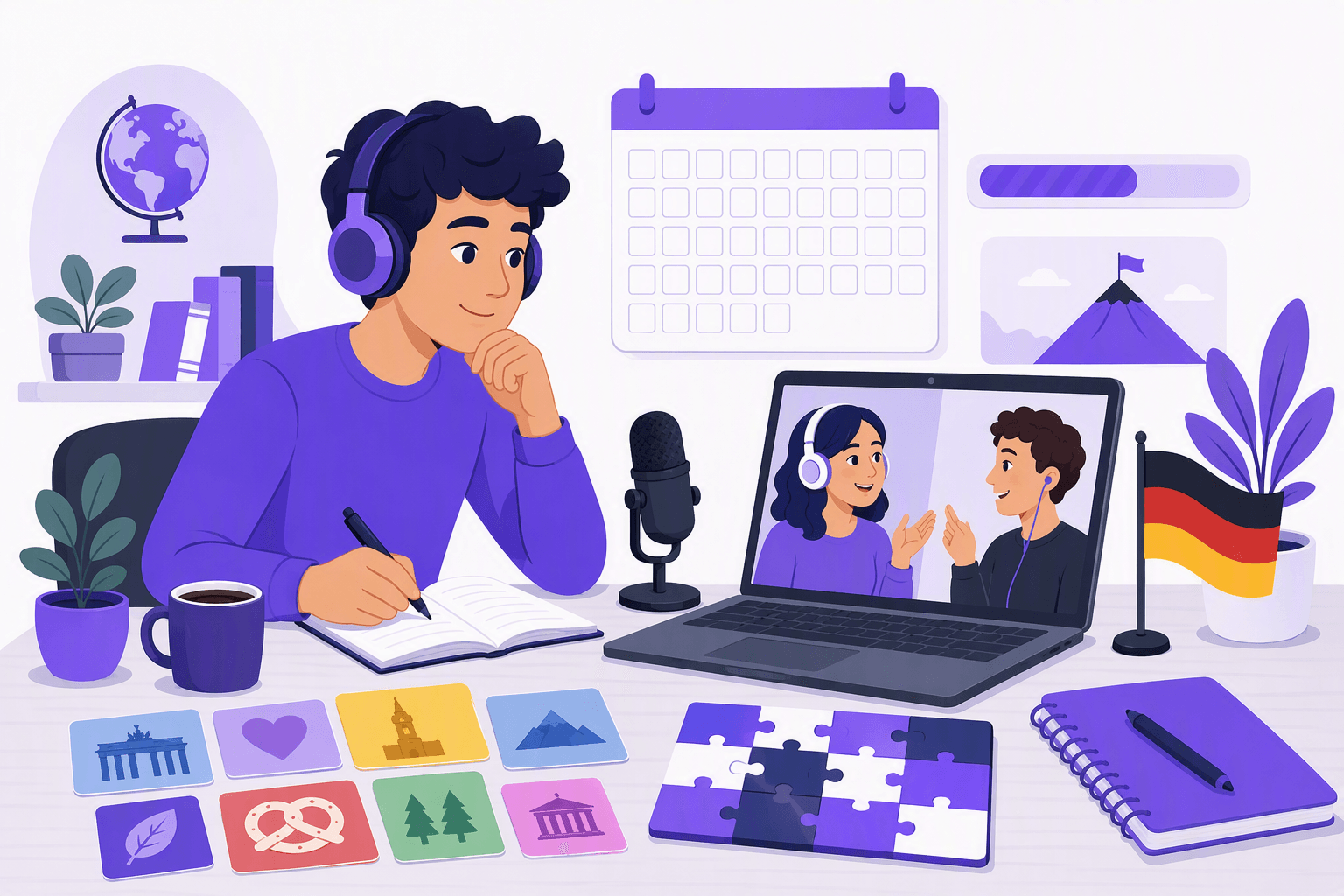
What “fast” German learning actually means
Fast does not mean fluent in a few weeks. It means avoiding low-return activities and putting your time into language you will hear and use repeatedly.
The CEFR describes A1 learners as people who can handle familiar expressions and basic interactions. At A2, learners can manage routine tasks and describe simple aspects of their background and needs. These are realistic 90-day goals if you study consistently and actively.
The U.S. Foreign Service Institute groups German among languages that are relatively accessible for English speakers, though its professional training timeline is still substantial. German and English share roots, which gives you useful recognition advantages with words such as Haus /haʊs/, Hand /hant/, Wasser /ˈvasɐ/, and Name /ˈnaːmə/.
The difficult areas are predictable: grammatical gender, four cases, verb position, plural forms, and pronunciation. A plan that meets these challenges early is much faster than pretending they do not exist.
💡 Your 90-day target
Aim to understand slow, everyday German, introduce yourself naturally, ask and answer basic questions, order food, make plans, describe your day, and follow the main point of familiar scenes. That is useful progress, not a vague promise of instant fluency.
Build your German around high-frequency language
The first words you need are not necessarily the most interesting words. They are the words that let you ask questions, react, connect ideas, and keep an interaction moving.
Start with pronouns, common verbs, question words, connectors, everyday nouns, and polite expressions. A phrase such as Ich weiß nicht /ɪç vaɪs nɪçt/, meaning “I do not know,” is more useful early on than ten isolated animal names.
Learn chunks, not dictionary entries
German nouns should almost never be memorized alone. Learn the article, noun, plural, and a short phrase together.
For example, do not write only Tisch /tɪʃ/, meaning “table.” Learn der Tisch /deːɐ̯ tɪʃ/, die Tische /diː ˈtɪʃə/, and Der Tisch ist frei /deːɐ̯ tɪʃ ɪst fʁaɪ/, meaning “The table is free.”
This approach matters because the article tells you the noun’s gender, while the plural prevents you from learning an incomplete form. The grammar resource Grammis from the Institut für Deutsche Sprache is clear on a central fact of German: articles and endings carry grammatical information that English often expresses through word order.
Start with useful sentence frames
Build dozens of sentences from a small number of adaptable frames:
| German frame | Meaning | Example |
|---|---|---|
| Ich möchte ... /ɪç ˈmœçtə/ | I would like ... | Ich möchte einen Kaffee. /ɪç ˈmœçtə ˈaɪnən ˈkafeː/ |
| Ich habe ... /ɪç ˈhaːbə/ | I have ... | Ich habe Zeit. /ɪç ˈhaːbə tsaɪt/ |
| Ich brauche ... /ɪç ˈbʁaʊxə/ | I need ... | Ich brauche Hilfe. /ɪç ˈbʁaʊxə ˈhɪlfə/ |
| Wo ist ...? /voː ɪst/ | Where is ...? | Wo ist der Bahnhof? /voː ɪst deːɐ̯ ˈbaːnhoːf/ |
| Kann ich ...? /kan ɪç/ | Can I ...? | Kann ich bezahlen? /kan ɪç bəˈtsaːlən/ |
| Ich glaube, dass ... /ɪç ˈɡlaʊbə das/ | I think that ... | Ich glaube, dass es regnet. /ɪç ˈɡlaʊbə das ɛs ˈʁeːɡnət/ |
Learn a frame, then replace one part at a time. That gives you usable flexibility without forcing you to invent every sentence from scratch.
For a broader frequency base, use our list of the 100 most common German words. Treat it as raw material, then turn each familiar word into a phrase you could actually say.
Use listening as your main engine
Beginners often treat listening as a reward for later. That slows them down. Listening is where you learn speed, rhythm, reduced sounds, common reactions, and the little words that grammar exercises rarely make memorable.
Research presented by Susan Gass and Alison Mackey in Input, Interaction, and Output in Second Language Acquisition emphasizes the complementary roles of exposure, interaction, and producing language. You need to hear German, notice gaps in what you understand, and try to respond.
Watch short scenes repeatedly
A 30-second scene can be better than a two-hour film watched passively. Choose a scene where speakers are discussing one clear topic, such as ordering food, arriving home, making plans, or solving a small problem.
Use this four-pass method:
- Watch once with German subtitles if available.
- Watch again and identify phrases you recognize.
- Pause after short lines, repeat them aloud, and copy the speaker’s rhythm.
- Watch without pausing and see what is now automatic.
This works especially well with dialogue-heavy content. If you need a practical viewing method, read our guide on learning a language with movies.
Listen for whole sounds, not individual letters
German spelling is more predictable than English spelling, but learners still need training with sounds. Pay particular attention to ch /ç/ or /x/, r /ʁ/, long versus short vowels, and word-final consonants.
For instance, ich /ɪç/ is not pronounced with an English “ch” sound. The sound is made with the tongue near the hard palate and air moving through a narrow space. In Bach /bax/, the ch is farther back in the mouth.
Do not aim for a dramatic imitation of a regional accent. Aim for clear vowels, steady word stress, and distinctions that affect comprehension. Our German pronunciation guide gives you targeted practice for the sounds learners most often confuse.
Speak from day one, even when you are alone
You do not need to wait until you feel ready to speak. Read dialogue aloud, shadow short clips, describe objects around you, and answer questions about your day.
Active recall is essential. If you only recognize Wie geht es dir? /viː ɡeːt ɛs diːɐ̯/, meaning “How are you?”, you may understand it in a scene but freeze when someone asks you. Practice answering with Mir geht es gut /miːɐ̯ ɡeːt ɛs ɡuːt/, meaning “I am well,” or Nicht so gut /nɪçt zoː ɡuːt/, meaning “Not so well.”
Shadowing: copy timing, not just words
Shadowing means speaking just after or along with a recording. Use a clip of five to 15 seconds, listen once, then repeat it several times.
Copy the pause pattern and stress. German gives strong prominence to the stressed syllable, while small grammatical words often receive less emphasis. In Ich kann das nicht machen /ɪç kan das nɪçt ˈmaxən/, the key information sits in kann /kan/, nicht /nɪçt/, and machen /ˈmaxən/.
Record yourself once a week. You will hear recurring problems far more clearly in a recording than while you are concentrating on speaking.
Have tiny conversations, not perfect monologues
Set a simple weekly speaking goal:
- Week 1: introduce yourself for 30 seconds.
- Week 2: order a drink and ask the price.
- Week 3: describe your routine.
- Week 4: talk about a recent weekend.
- Week 5 onward: respond to short everyday questions without translating first.
Questions are especially valuable because they create interaction. Learn Was machst du? /vas maxst du/, Wo wohnst du? /voː voːnst du/, and Was meinst du? /vas maɪnst du/ early. For more natural question patterns, see the German question words guide.
Study grammar in the order that unlocks speech
German grammar becomes manageable when you learn it in layers. Do not try to master every case table during your first weekend.
First month: present tense and basic word order
Start with personal pronouns and the present tense of high-frequency verbs such as sein /zaɪn/, haben /ˈhaːbən/, gehen /ˈɡeːən/, kommen /ˈkɔmən/, machen /ˈmaxən/, and wollen /ˈvɔlən/.
Learn the central main-clause pattern: the conjugated verb usually comes in second position.
| Sentence part | Verb | Rest of sentence |
|---|---|---|
| Ich /ɪç/ | lerne /ˈlɛʁnə/ | Deutsch. /dɔɪtʃ/ |
| Heute /ˈhɔʏtə/ | lerne /ˈlɛʁnə/ | ich Deutsch. /ɪç dɔɪtʃ/ |
| Am Abend /am ˈaːbənt/ | sehe /ˈzeːə/ | ich einen Film. /ɪç ˈaɪnən fɪlm/ |
Notice that changing what comes first does not remove the verb from second position. This is one of the most important German patterns to internalize through examples.
Second month: cases through useful phrases
Do not approach cases as four abstract labels only. Learn them through common combinations.
The accusative appears in phrases such as Ich sehe den Mann /ɪç ˈzeːə deːn man/, meaning “I see the man.” The dative appears in Ich helfe dem Mann /ɪç ˈhɛlfə deːm man/, meaning “I help the man.”
You do need case awareness, but verbs and prepositions will teach you much of it through repetition. Learn mit dem /mɪt deːm/, für den /fyːɐ̯ deːn/, bei der /baɪ deːɐ̯/, and in die /ɪn diː/ as chunks.
Third month: past tense and subordinate clauses
For conversation, focus first on the Perfekt /pɛʁˈfɛkt/, the common spoken past. You will hear forms such as Ich habe gearbeitet /ɪç ˈhaːbə ɡəˈaʁbaɪtət/, meaning “I worked,” and Wir sind gegangen /viːɐ̯ zɪnt ɡəˈɡaŋən/, meaning “We went.”
Then start noticing that in clauses with dass /das/, the verb often moves toward the end: Ich glaube, dass er heute kommt /ɪç ˈɡlaʊbə das eːɐ̯ ˈhɔʏtə kɔmt/. This pattern is easier to absorb through repeated examples than through a single long rule sheet.
Follow this 90-day German routine
A good study plan makes decisions for you before motivation disappears.
Daily 60-minute version
| Time | Activity | Purpose |
|---|---|---|
| 15 minutes | Review phrases with spaced repetition | Keep essential vocabulary available |
| 15 minutes | Watch or listen to a short German scene | Build comprehension and rhythm |
| 10 minutes | Shadow 5 to 10 lines aloud | Improve pronunciation and automaticity |
| 10 minutes | Grammar from examples | Fix one useful pattern at a time |
| 10 minutes | Write or say a mini diary entry | Turn recognition into active German |
If you can study 90 minutes, add 15 minutes of reading and 15 minutes of live conversation or self-recording.
Spaced repetition is useful because it brings material back before it fully disappears from memory. But your cards should contain meaningful language. A card with Guten Morgen /ˈɡuːtən ˈmɔʁɡn̩/ and an audio clip is more valuable than a card with a disconnected translation.
⚠️ Avoid the translation trap
Do not build every sentence in English and translate word by word. German word order will feel slow and unnatural if English remains the blueprint. Memorize complete German patterns, then adapt them to your own life.
Make German part of your environment
Your fastest gains come when German appears outside formal study. Change one low-stakes part of your day into German: a playlist, a short news clip, a phone reminder, a recipe video, or a favorite series scene.
Germany’s media culture has an important practical advantage for learners: dubbed television and films are widely available. This gives you familiar stories with German dialogue, consistent voice actors, and a large range of accessible material. Begin with content you already know, because plot familiarity reduces the cognitive load.
🌍 German directness is not automatically rudeness
German conversations often value clarity and specificity. A concise Nein, danke /naɪn ˈdaŋkə/, meaning “No, thank you,” can be perfectly polite. Learn polite markers such as bitte /ˈbɪtə/, danke /ˈdaŋkə/, and Entschuldigung /ɛntˈʃʊldɪɡʊŋ/, but do not assume that a direct answer signals hostility.
You should also learn the difference between informal du /duː/ and formal Sie /ziː/. Use Sie with strangers, service workers, older people in formal contexts, and professional contacts unless invited to switch. The choice carries social meaning, so it is worth practicing from the beginning.
Measure progress by what you can do
Do not measure progress only by the number of words in an app. Test yourself with real tasks every two weeks.
Can you understand the basic point of a short scene? Can you ask for clarification? Can you explain what you did yesterday? Can you write a short message without looking up every word?
Keep a list called “I can now.” Add concrete abilities such as:
- Ich kann mich vorstellen. /ɪç kan mɪç foːɐ̯ˈʃtɛlən/, “I can introduce myself.”
- Ich kann im Café bestellen. /ɪç kan ɪm kaˈfeː bəˈʃtɛlən/, “I can order in a café.”
- Ich kann nach dem Weg fragen. /ɪç kan naːx deːm veːk ˈfʁaːɡn̩/, “I can ask for directions.”
- Ich kann eine kurze Nachricht schreiben. /ɪç kan ˈaɪnə ˈkʊʁtsə ˈnaːxʁɪçt ˈʃʁaɪbən/, “I can write a short message.”
These are the kind of action-based targets used in the CEFR framework. They make progress visible and expose the next skill you need.
The fastest German learners are consistent, not frantic
You do not need a perfect textbook, a flawless accent, or eight-hour study days. You need a repeatable routine that puts useful German in your ears and mouth every day.
Begin with greetings, essential reactions, and phrases tied to your life. Practice them through scenes, repeat them aloud, and reuse them in your own messages. Once your first exchanges feel natural, expand toward travel, relationships, work, and media you genuinely enjoy.
When you are ready to add more personality to your German, learn natural farewells through our German goodbye guide, then build toward warmer everyday language with ways to say “I love you” in German.
Frequently Asked Questions
Can I learn German in 3 months?
How many hours a day should I study German?
Is German hard for English speakers to learn?
Should I learn German grammar before speaking?
What is the fastest way to remember German vocabulary?
Sources & References
- Goethe-Institut, Deutsch als Fremdsprache weltweit, 2020
- Council of Europe, Common European Framework of Reference for Languages: Companion Volume, 2020
- Institut für Deutsche Sprache, Grammis: Grammar Information System, accessed 2026
- U.S. Department of State, Foreign Service Institute Language Difficulty Rankings, accessed 2026
- Gass and Mackey, Input, Interaction, and Output in Second Language Acquisition, Routledge
Start learning with Wordy
Watch real movie clips and build your vocabulary as you go. Free to download.


