Quick Answer
The most natural way to say Happy Halloween in Japanese is ハッピーハロウィン, pronounced /hap.piː ha.ɾo.win/. It is widely used in party invitations, social posts, store displays, and casual conversations, while longer phrases can sound warmer or more polite.
To say Happy Halloween in Japanese, say ハッピーハロウィン, pronounced /hap.piː ha.ɾo.win/. It is the phrase you will see on party invitations, café signs, costume posts, and seasonal packaging in Japan. For a friend, you can also say ハロウィン楽しんでね /ha.ɾo.win ta.no.ɕin.de ne/, meaning “Enjoy Halloween.”
Japanese has roughly 123 million first-language speakers according to Ethnologue, and Halloween vocabulary has become highly recognizable through media, retail, schools, and urban events. Still, Japanese Halloween culture does not work exactly like Halloween in the United States or Canada: costumes, themed food, and photo-friendly gatherings are often more central than neighborhood trick-or-treating.
If you are learning greetings for everyday conversation, start with how to say hello in Japanese. For Halloween, though, these phrases will help you sound cheerful without using an unnatural literal translation.
| English | Japanese | Pronunciation | Formality |
|---|---|---|---|
| Happy Halloween! | ハッピーハロウィン! | HAHP-pee hah-roh-WEEN | casual |
| Enjoy Halloween! | ハロウィン楽しんでね | hah-roh-WEEN tah-noh-SHEEN-deh neh | casual |
| Have a fun Halloween! | 楽しいハロウィンを! | tah-noh-SHEE hah-roh-WEEN oh | polite |
| Please enjoy Halloween. | ハロウィンをお楽しみください | hah-roh-WEEN oh oh-tah-noh-SHEE-mee koo-dah-SYE | formal |
| Trick or treat! | トリック・オア・トリート! | toh-REEK-koo oh-ah toh-REE-toh | slang |
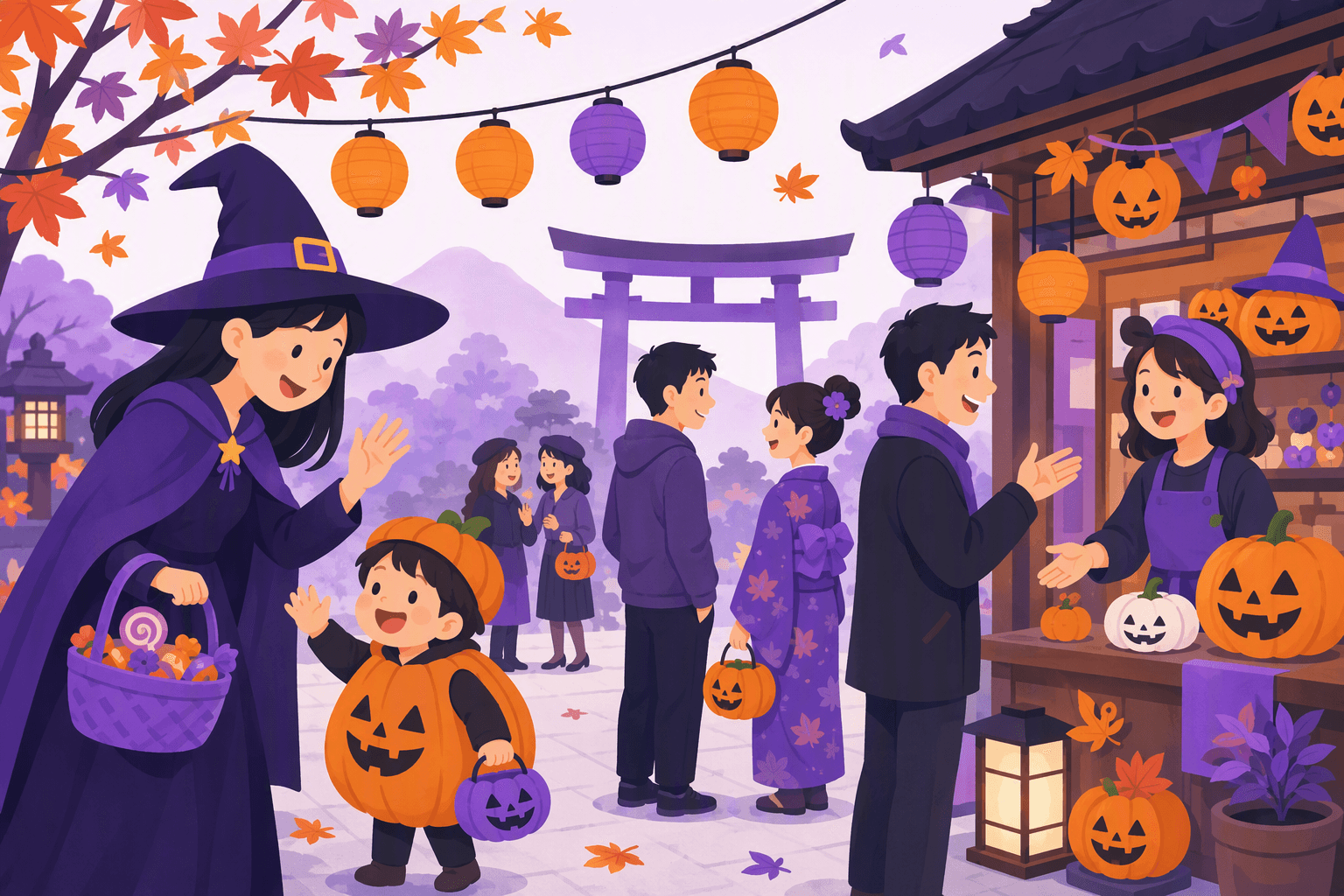
The standard phrase: ハッピーハロウィン
ハッピーハロウィン
ハッピーハロウィン /hap.piː ha.ɾo.win/ is the Japanese version of “Happy Halloween.” It is written in katakana because it is a borrowing from English, like many modern event and pop-culture words in Japanese.
The small ッ /Q/ in ハッピー /hap.piː/ matters. It creates a short pause and doubles the following consonant, so avoid flattening the word into a single smooth sound. The long vowel in ピー /piː/ should also last slightly longer than a short vowel.
/HAHP-pee hah-roh-WEEN/
Literal meaning: A Japanese katakana version of 'Happy Halloween'
“ハッピーハロウィン!その仮装、すごく似合ってるよ。”
Happy Halloween! That costume really suits you.
Use this at a costume party, in a text, on a social post, or when greeting friends at a Halloween event. It is upbeat and widely understood.
Unlike a phrase such as 明けましておめでとうございます /a.ke.ma.ɕi.te o.me.de.toː go.za.i.ma.sɯ/ for New Year, Halloween greetings do not have a long-established traditional Japanese formula. ハッピーハロウィン is therefore the safest and most idiomatic choice.
More natural Japanese Halloween greetings
ハロウィン楽しんでね
ハロウィン楽しんでね /ha.ɾo.win ta.no.ɕin.de ne/ means “Enjoy Halloween!” The final ね /ne/ makes the line friendly and inviting, so it fits texts, captions, and conversations with friends.
Use it when the other person is headed to a party, a theme park, or a costume event. It communicates more personal warmth than simply writing ハッピーハロウィン /hap.piː ha.ɾo.win/.
/hah-roh-WEEN tah-noh-SHEEN-deh neh/
Literal meaning: Halloween, enjoy it, okay?
“คืนนี้はパーティーだよね。ハロウィン楽しんでね!”
You have a party tonight, right? Enjoy Halloween!
Best for friends, classmates, siblings, or social-media messages. Do not use it with a client or a senior colleague unless your relationship is clearly informal.
The example above includes 今夜 /kon.ya/, meaning “tonight,” although the Japanese in the card is intentionally casual and conversation-like. Japanese often leaves out subjects when the context makes them obvious.
楽しいハロウィンを
楽しいハロウィンを /ta.no.ɕiː ha.ɾo.win o/ means something close to “Have a fun Halloween.” It is short, warm, and useful in cards, comments, or messages to people you do not know especially well.
The phrase ends with the object marker を /o/, which can seem unfinished to learners. In greetings and written wishes, Japanese often omits an expected verb such as 過ごしてください /sɯ.go.ɕi.te kɯ.da.sa.i/, “please spend [it],” because the intended meaning is clear.
/tah-noh-SHEE hah-roh-WEEN oh/
Literal meaning: A fun Halloween
“みなさん、楽しいハロウィンを!”
Everyone, have a fun Halloween!
A good all-purpose seasonal wish for a group message, a school notice, or a friendly business social post. It is warmer than a plain announcement.
ハロウィンをお楽しみください
ハロウィンをお楽しみください /ha.ɾo.win o o.ta.no.ɕi.mi kɯ.da.sa.i/ is a polite expression meaning “Please enjoy Halloween.” The honorific お /o/ before 楽しみ /ta.no.ɕi.mi/ raises the level of politeness.
You might read it in a hotel lobby, department store, restaurant promotion, museum event listing, or family-oriented activity notice. It is respectful but not stiff.
/hah-roh-WEEN oh oh-tah-noh-SHEE-mee koo-dah-SYE/
Literal meaning: Please enjoy Halloween
“今年もハロウィンをお楽しみください。”
Please enjoy Halloween again this year.
Appropriate for customers, guests, event attendees, and public notices. It is not the phrase most friends would use in a casual chat.
💡 Use a phrase that matches the relationship
For friends, write ハッピーハロウィン /hap.piː ha.ɾo.win/ or ハロウィン楽しんでね /ha.ɾo.win ta.no.ɕin.de ne/. For guests or customers, choose ハロウィンをお楽しみください /ha.ɾo.win o o.ta.no.ɕi.mi kɯ.da.sa.i/.
How to say trick or treat in Japanese
トリック・オア・トリート
The phrase トリック・オア・トリート /to.ɾik.ku o.a to.ɾiː.to/ is the direct Japanese borrowing of “trick or treat.” It appears at school events, shopping-center activities, English classes, and family Halloween celebrations.
Japanese speakers usually recognize it, but it does not carry the same automatic door-to-door cultural expectation it has in North America. In many Japanese neighborhoods, children need to attend an organized event rather than knock on strangers’ doors.
/toh-REEK-koo oh-ah toh-REE-toh/
Literal meaning: A Japanese rendering of 'trick or treat'
“トリック・オア・トリート!お菓子をください!”
Trick or treat! Please give me some candy!
Common at children's events and English-learning activities. It is playful rather than rude, but say it only in a Halloween context.
A more fully Japanese, playful version is お菓子をくれないといたずらするぞ /o.ka.ɕi o kɯ.ɾe.na.i to i.ta.zɯ.ɾa sɯ.ɾɯ zo/. It means, approximately, “If you do not give me sweets, I will play a prank!”
This sounds deliberately dramatic, like a child acting out a Halloween line. The ending ぞ /zo/ can sound forceful in ordinary conversation, but here it is part of a familiar playful performance.
Halloween culture in Japan
Halloween, written ハロウィン /ha.ɾo.win/, grew quickly in Japan through commercial events, theme parks, retail campaigns, and social media. The Japan National Tourism Organization regularly highlights seasonal attractions, and October events frequently include costumes, illuminations, themed menus, and character parades.
Tokyo’s Shibuya, written 渋谷 /ɕi.bɯ.ja/, became internationally associated with large Halloween crowds during the 2010s. That visibility can mislead visitors into thinking that every Japanese city celebrates in the same way. In reality, local Halloween ranges from a quiet café display to a school event, family activity, theme-park festival, or private party.
🌍 Costumes matter more than doorstep visits
Japanese Halloween is often a costume-and-event occasion rather than a neighborhood candy-collection ritual. Many people dress as anime characters, game characters, movie figures, seasonal ghosts, or humorous everyday objects. The question is often not where you will trick-or-treat, but what costume you will wear.
Scholar Jack Santino’s work on Halloween treats the holiday as a festival shaped by changing local customs rather than a fixed set of rituals. That framework helps explain Japanese Halloween well: the holiday retains its costumes, playful fright, sweets, and seasonal language, while its public forms have adapted to Japanese urban life and commercial culture.
The writing system also tells a cultural story. The Agency for Cultural Affairs describes katakana as a core part of Japanese writing, particularly relevant to foreign-origin vocabulary. Writing ハロウィン /ha.ɾo.win/ in katakana signals that Halloween is a recognizable imported event, not an indigenous religious observance.
What not to say
ハロウィンおめでとう
Avoid ハロウィンおめでとう /ha.ɾo.win o.me.de.toː/ as your default greeting. It is understandable, but it sounds unusual because おめでとう /o.me.de.toː/ is used for congratulations, birthdays, weddings, and New Year celebrations.
Halloween is not normally framed as something a person has achieved or a milestone requiring congratulations. Choose ハッピーハロウィン /hap.piː ha.ɾo.win/ instead.
Happy Halloween in English only
English “Happy Halloween” is likely to be understood in Japan, especially at international events. But ハッピーハロウィン /hap.piː ha.ɾo.win/ looks and sounds more natural in Japanese messages.
If you are writing to a close Japanese friend, adding an emoji such as 🎃 or 👻 is common. Keep the wording brief, since Japanese seasonal posts often rely on the image, costume, or event context to supply the mood.
A simple Halloween message you can copy
For a friend:
ハッピーハロウィン!仮装楽しんでね。
/hap.piː ha.ɾo.win ka.soː ta.no.ɕin.de ne/
This means: “Happy Halloween! Enjoy your costume.”
For a group chat:
みんな、楽しいハロウィンを!
/min.na ta.no.ɕiː ha.ɾo.win o/
This means: “Everyone, have a fun Halloween!”
For guests or customers:
素敵なハロウィンをお過ごしください。
/sɯ.te.ki na ha.ɾo.win o o.sɯ.go.ɕi kɯ.da.sa.i/
This means: “Please have a lovely Halloween.”
The adjective 素敵 /sɯ.te.ki/ means lovely, wonderful, or nice. This final version is more polished than a casual text and works well for invitations, signs, and professional messages.
Practice the phrase with real Japanese
The quickest phrase to memorize is ハッピーハロウィン /hap.piː ha.ɾo.win/. Say it in four beats: hap + pī + ha + ro-win. Keep the doubled consonant in ハッピー /hap.piː/ and the long vowel in トリート /to.ɾiː.to/ when practicing the Halloween vocabulary.
The National Institute for Japanese Language and Linguistics emphasizes the importance of sound patterns and real usage in Japanese research. For learners, that means hearing the phrases in context is more useful than memorizing isolated translations. Watch seasonal clips, listen for 仮装 /ka.soː/, “costume,” and repeat short lines aloud.
You can also build your everyday confidence with Japanese goodbye phrases, then add warmer personal language through Japanese ways to say I love you. If you encounter rough Halloween banter in a horror film, our Japanese swear words guide explains what to recognize and what to avoid repeating.
For Halloween, keep it simple: ハッピーハロウィン! /hap.piː ha.ɾo.win/ is natural, cheerful, and right for almost every casual situation.
Frequently Asked Questions
How do you say Happy Halloween in Japanese?
Do Japanese people celebrate Halloween?
What is trick or treat in Japanese?
Is ハロウィンおめでとう natural in Japanese?
How do you write Halloween in Japanese?
Sources & References
- Japan National Tourism Organization, Seasonal Events and Travel Information, accessed 2026
- Agency for Cultural Affairs, Japanese Writing System Resources, accessed 2026
- National Institute for Japanese Language and Linguistics, Japanese Language Research Resources, accessed 2026
- Ethnologue, Japanese, 27th edition, 2024
- Jack Santino, Halloween and Other Festivals of Death and Life, University of Tennessee Press
Start learning with Wordy
Watch real movie clips and build your vocabulary as you go. Free to download.


