Oktoberfest in Germany: A Practical Guide to Beer Tents, Etiquette, and Useful German
Quick Answer
Oktoberfest is Munich’s annual folk festival centered on Bavarian beer tents, traditional food, music, and parades, usually running from mid-September into early October. To enjoy it smoothly, you need to understand how tent seating and service work, basic etiquette (especially around tables and toasts), and a handful of German phrases that help you order, pay, and stay polite in loud crowds.
| English | German | Pronunciation | Formality |
|---|---|---|---|
| Hello | Hallo! | HAH-loh | casual |
| Good day (polite hello) | Guten Tag! | GOO-ten TAHK | polite |
| Excuse me (getting attention) | Entschuldigung! | ent-SHOOL-dee-goong | polite |
| One beer, please. | Ein Bier, bitte. | ine BEER, BIT-tuh | polite |
| Two beers, please. | Zwei Bier, bitte. | TSVY BEER, BIT-tuh | polite |
| A liter (a Maß), please. | Eine Maß, bitte. | EYE-nuh MAHSS, BIT-tuh | polite |
| Cheers! | Prost! | PROHST | casual |
| Cheers! (more formal) | Zum Wohl! | tsoom VOHL | polite |
| Where is the restroom? | Wo ist die Toilette? | voh ist dee toy-LET-tuh | polite |
| How much is it? | Wie viel kostet das? | vee FEEL KOSS-tet dahss | polite |
| Can I pay by card? | Kann ich mit Karte zahlen? | kahn ikh mit KAR-tuh TSAH-len | polite |
| Thank you. | Danke. | DAHN-kuh | polite |
| Goodbye. | Auf Wiedersehen. | owf VEE-der-zayn | formal |
Oktoberfest in Germany, especially the Munich original, is a huge folk festival where you spend most of your time inside beer tents (Bierzelte), sharing long tables, eating hearty Bavarian food, and following a few key etiquette rules around seating, service, and toasts. If you understand how the tents work, what “a Maß” really means, and a dozen practical German phrases, you can avoid the classic first-timer mistakes and enjoy the festival like a respectful guest.
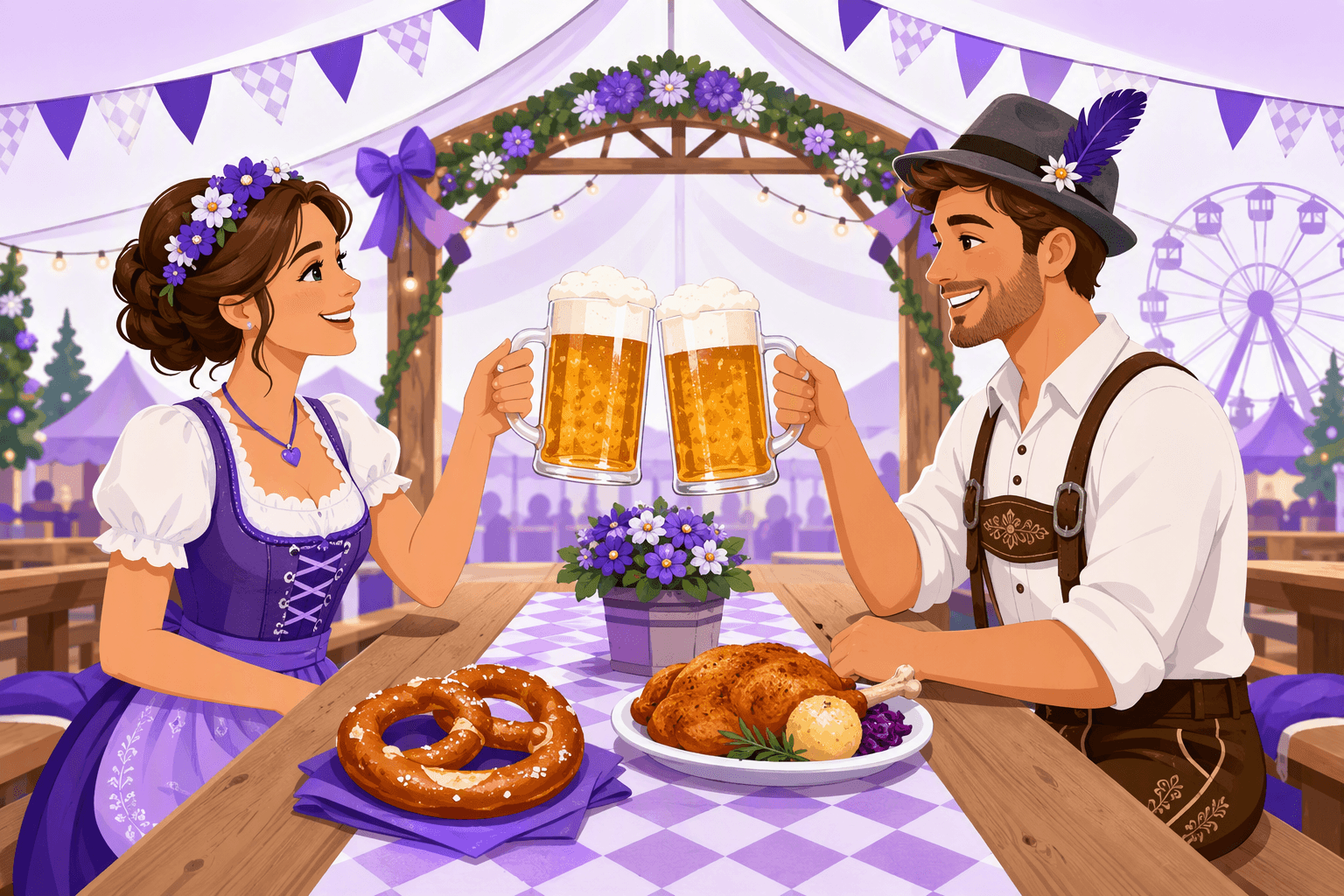
What Oktoberfest is, and why it matters in Germany
Oktoberfest is not just “a beer party.” It is a modern version of a Bavarian Volksfest, a public festival with rides, food stalls, parades, music, and a strong local identity tied to Munich and Bavaria.
The official festival site is run by the City of Munich, and it frames Oktoberfest as a civic event with rules, safety planning, and a long historical narrative (Landeshauptstadt München, accessed 2026). That matters because many visitor expectations come from marketing, not from how the festival actually functions on the ground.
The scale: why planning matters
Munich’s Oktoberfest is one of the world’s largest public festivals, drawing millions of visitors in a typical year. That scale changes everything: transport, crowd flow, and even the way you order food.
Language also matters more in loud, crowded spaces. Even if many staff speak English, short German phrases reduce friction, especially when you need something quickly.
A quick language reality check
German is a major world language, with tens of millions of native speakers and wide second-language study across Europe. Ethnologue (27th edition, 2024) lists German among the most widely spoken languages globally, and it is an official language in multiple countries.
If you want a broader foundation before your trip, start with our 100 most common German words. It will make every sign, menu, and announcement feel less overwhelming.
Oktoberfest basics: dates, location, and the “Wiesn” concept
Oktoberfest takes place on the Theresienwiese, a large open area in Munich. Locals often call the festival “die Wiesn” (VEE-zn), which is why you will see “Wiesn” everywhere on signage and souvenirs.
Despite the name, it usually begins in September and ends in early October. The exact dates vary, so always confirm on the official Munich site before booking.
Munich is the original, but not the only one
Many German cities run their own autumn festivals, sometimes also called Oktoberfest, sometimes with different names. Munich’s is the reference point, but the “beer tent plus fairground” model exists across Germany.
If you want a calmer version, a smaller city festival can be easier. The tradeoff is that the atmosphere is more regional, and you might hear stronger dialect features.
How the beer tents work (and why first-timers get confused)
Most Oktoberfest “action” happens in tents, but tents are not casual bars. They are structured spaces with assigned staff, table zones, and rules about standing, aisles, and capacity.
A useful mental model is: you are joining a temporary dining hall with music, not entering a nightclub.
Seating: the real rule is “table logic”
In many tents, you do not line up at a bar. You find a seat at a table, and the server for that section takes your order.
If you are in a small group, you can often join an open spot at a table. A quick polite check helps: “Ist hier frei?” (ist heer fry), meaning “Is this free?” You will hear it constantly.
💡 A practical seating strategy
Go early if you want flexibility. Midday tends to be easier for finding seats, while evenings and weekends can hit capacity quickly. If you see a table with half-finished food and coats on benches, assume it is occupied and ask before sitting.
Service: your server is your lifeline
Once you have a seat, stay visible and be concise. Servers carry heavy loads and move fast, and they prioritize clear orders.
This is where short phrases matter. “Entschuldigung!” (ent-SHOOL-dee-goong) is the standard way to get attention politely.
What “eine Maß” actually is
A Maß (MAHSS) is a one-liter mug, and at Oktoberfest it is also shorthand for the typical beer serving size. If you order “ein Bier,” you might still be served a Maß, depending on the tent and context.
The Bavarian Brewers Association discusses Oktoberfestbier as a specific tradition tied to local brewing and festival practice (Bayerischer Brauerbund, accessed 2026). In other words, the beer culture is not random, it is regulated and identity-linked.
What to wear: Tracht, comfort, and avoiding costume mistakes
You do not need a Dirndl or Lederhosen to attend. Plenty of locals wear normal clothes, especially on weekdays or after work.
That said, Tracht is common, and wearing it respectfully can be fun if you do it right.
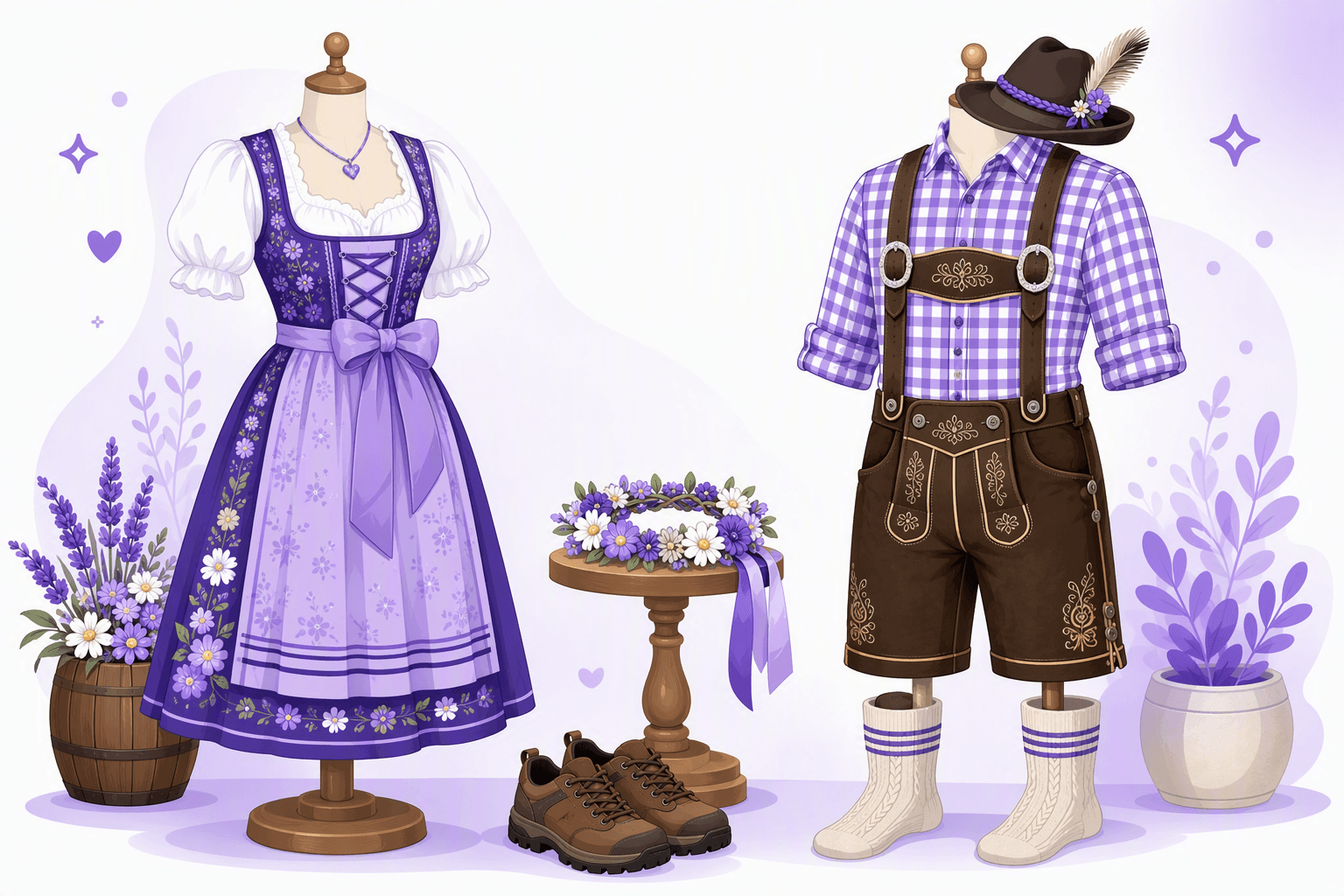
Dirndl and Lederhosen: fit beats “theme”
If you buy Tracht, avoid cheap costume versions that look like a party outfit. In Munich, people notice the difference, and it can read as “tourist costume” rather than participation.
Focus on fit, fabric, and shoes you can walk in. Oktoberfest involves a lot of standing, and blisters ruin the day faster than any language mistake.
The Dirndl bow myth, handled carefully
You will hear claims that the Dirndl bow position “always” signals relationship status. In practice, it is inconsistent: some people follow it, many do not, and fashion choices muddy the signal.
Treat it as trivia, not a social code. If you want to avoid awkwardness, place it where it feels comfortable and do not assume meanings about others.
Oktoberfest etiquette that locals actually care about
Etiquette at Oktoberfest is less about being formal and more about not disrupting shared space. Think: table manners for a crowded room.
Research on politeness in interaction, like the framework in Brown and Levinson’s Politeness: Some Universals in Language Usage (Cambridge University Press), is useful here because Oktoberfest is a “face” environment. You are constantly negotiating space, attention, and small favors with strangers.
Toasting: eye contact and the right word
The standard toast is “Prost!” (PROHST). You will also hear “Zum Wohl!” (tsoom VOHL), which can feel a bit more formal.
Make eye contact when clinking, and do not cross arms over others. If you cannot reach, lift your mug and nod instead.
Standing on benches: follow the room
In many tents, people stand on benches to sing. Standing on tables is a different level and is often discouraged or actively stopped.
Look around, follow staff cues, and do not assume “anything goes.” The festival has rules, and enforcement is real.
Keep aisles clear and do not block staff
Aisles are working corridors. If you stop for photos in a narrow passage, you are not just annoying, you are creating a safety problem.
If you need to step out, say “Entschuldigung” and move decisively.
Useful German for Oktoberfest: phrases you will actually say
You do not need advanced German. You need short, high-frequency phrases that cut through noise.
If you want broader basics for greetings, pair this guide with how to say hello in German and how to say goodbye in German. Those phrases show up constantly in real interactions, even at a festival.
Food and drink: what to order, and how to sound normal doing it
Oktoberfest food is designed for sharing, drinking, and long sessions at the table. You will see classics like Brezn (pretzels), Hendl (roast chicken), and many Wurst varieties.
Use simple ordering patterns:
- “Ein Hendl, bitte.” (ine HEN-dl, BIT-tuh)
- “Zwei Brezn, bitte.” (TSVY BREHT-sn, BIT-tuh)
Paying and tipping: what is expected
Cash is common, and sometimes faster. Card acceptance varies, so “Kann ich mit Karte zahlen?” (kahn ikh mit KAR-tuh TSAH-len) is worth memorizing.
Tipping, Trinkgeld (TRINK-gelt), is usually done by rounding up. If the total is 18, you might hand over 20 and say “Stimmt so” (shtimt zoh), meaning “Keep the change.”
⚠️ Avoid the loud English math problem
In a loud tent, negotiating exact change in English can slow everything down. If you can, carry small bills and coins, and round up cleanly. It is smoother for you and for staff.
Safety, rules, and the “fun but managed” reality
Oktoberfest is festive, but it is also tightly managed. There are security checks, capacity controls, and rules about glass, bags, and behavior.
Treat it like a major sports event. Plan meeting points, keep your phone charged, and know how you are getting home.
Restrooms and emergencies: the phrases that matter
“Wo ist die Toilette?” (voh ist dee toy-LET-tuh) is obvious, but it is also the most useful sentence in a crowded festival.
If you need help, “Ich brauche Hilfe” (ikh BROW-khuh HIL-fuh) is direct and clear. Even if you do not say it perfectly, staff will understand.
Cultural context: why beer culture is a heritage topic
Bavarian beer culture is tied to regional identity, craft, and public ritual. UNESCO’s Intangible Cultural Heritage framing of beer-related traditions (UNESCO, accessed 2026) is a useful reminder that what looks like “just drinking” can also be a community practice with norms.
That is why etiquette matters. You are stepping into a local tradition that is simultaneously commercial, civic, and cultural.
A note on dialect: why you might hear “Brezn” and “Wiesn”
At Oktoberfest, you are in Bavaria, and Bavarian speech features show up in vocabulary and pronunciation. You will see spellings like “Wiesn” and “Brezn” that reflect local usage.
If you want to build listening confidence for real-world German, the Goethe-Institut’s guidance on learning German emphasizes exposure to authentic input and regional variation (Goethe-Institut, accessed 2026). Oktoberfest is exactly that, authentic, fast, and sometimes dialect-colored.
Mini vocab list for signs, menus, and tent talk
| English | German | Pronunciation | Note |
|---|---|---|---|
| festival grounds | Wiesn | VEE-zn | Munich nickname for Oktoberfest, from 'Theresienwiese'. |
| beer tent | Bierzelt | BEER-tselt | Large tent with seating, music, and table service. |
| a liter beer mug | Maß | MAHSS | One-liter mug, also used as shorthand for the beer itself. |
| traditional clothing | Tracht | TRAHKHT | Umbrella term for Dirndl and Lederhosen. |
| dirndl dress | Dirndl | DEER-ndl | Traditional dress, especially common for women at Oktoberfest. |
| lederhosen | Lederhosen | LAY-der-hoh-zen | Traditional leather shorts or trousers. |
| pretzel | Brezn | BREHT-sn | Bavarian form of 'Brezel'. |
| roast chicken | Hendl | HEN-dl | Classic tent food, especially 'Hendl' stands. |
| sausage | Wurst | voorst | General word, many types at the festival. |
| cash | Bargeld | BAR-gelt | Still widely used in tents. |
| tip | Trinkgeld | TRINK-gelt | Often given by rounding up. |
| table | Tisch | tish | Seating is organized by tables, not a bar line. |
Use these words as recognition targets. Even if you do not produce them perfectly, spotting them on signs helps you orient quickly.
Social boundaries: friendliness, flirting, and what not to assume
Oktoberfest is social, but German social boundaries are still German social boundaries. People can be warm and chatty at the table, then very direct about space or rules.
If you are traveling with a partner and want romantic language that does not sound like a joke, see how to say I love you in German. It is more nuanced than learners expect, and Oktoberfest is not the place to experiment with intense phrases on strangers.
Swearing and “beer German”
You will hear swearing, especially later in the day. Understanding it can help you interpret tone, but copying it is risky.
If you are curious, read our guide to German swear words for context and severity. Treat it as comprehension training, not a script.
A realistic Oktoberfest plan for first-timers
A good first visit is about pacing and logistics, not maximizing beer.
Step 1: Pick a time window that matches your goal
If you want photos, easier seating, and calmer conversation, go earlier in the day. If you want peak singing energy, evenings are louder and more crowded.
Weekdays are generally easier than weekends.
Step 2: Decide your “must do” list
Choose one or two tents you care about, plus one parade or fairground activity. Too many goals create stress.
Build in breaks. The festival is physically demanding.
Step 3: Use language as a tool, not a performance
Your goal is not perfect grammar. Your goal is smooth interactions: seating, ordering, paying, and exiting politely.
A small set of phrases, said clearly, beats a long sentence said nervously.
Learning German through Oktoberfest clips (and why it works)
Festival language is repetitive: greetings, orders, numbers, and short social routines. That repetition is exactly what helps vocabulary stick.
If you like learning through real scenes, you can also practice with movie and TV dialogue where people speak over noise, interrupt each other, and use natural fillers. For broader strategy, see how to learn a language with movies and the immersion method language learning guide.
🌍 A useful mindset shift
At Oktoberfest, you will hear imperfect, emotional, and fast German. That is not a failure of your learning, it is the real target. Train your ear to catch keywords like 'bitte', 'danke', and numbers, and you will feel in control quickly.
Closing: the simplest way to have a great Oktoberfest
Oktoberfest goes best when you treat it as a shared public tradition: arrive early, respect table space, keep orders short, tip cleanly, and use a handful of German phrases to stay polite in the noise. If you want to keep building practical German beyond the festival, browse the Wordy language learning blog and focus on phrases you can actually say out loud in real situations.
Frequently Asked Questions
When is Oktoberfest in Munich actually held?
Do you need tickets or reservations for Oktoberfest tents?
What should you wear to Oktoberfest if you do not own Tracht?
How do you order and pay in a beer tent?
Is Oktoberfest only in Munich, or is it celebrated elsewhere in Germany?
Sources & References
- Landeshauptstadt München, Official Oktoberfest Website (accessed 2026)
- Bayerischer Brauerbund, Information on Oktoberfestbier and Bavarian brewing (accessed 2026)
- UNESCO, Bavarian beer culture and related traditions, Intangible Cultural Heritage (accessed 2026)
- Ethnologue, 27th edition, 2024
- Goethe-Institut, German language facts and learning resources (accessed 2026)
Start learning with Wordy
Watch real movie clips and build your vocabulary as you go. Free to download.


