Quick Answer
The most difficult German sounds for many learners are ch (ich vs ach), the German r, umlauts (ü/ö/ä), final consonant devoicing, and long vs short vowels. You can fix them by training mouth position first, then drilling minimal pairs, then practicing in fast, real speech, the way you hear it in movies and TV.
German’s most difficult sounds are usually the ones English spelling never trained you to produce: the two German ch sounds, the German r, the umlauts ä/ö/ü, and “hidden” rules like final consonant devoicing and long vs short vowels. The fastest path is: learn the mouth position, drill minimal pairs, then practice in real-speed dialogue so your tongue can keep up.
German is also a high-value language to pronounce clearly: it has about 132 million speakers worldwide (L1 plus L2, Ethnologue 27th ed.). It is an official language in six countries (Germany, Austria, Switzerland, Belgium, Luxembourg, Liechtenstein), and you will hear noticeable accent variation across them.
If you want a warm-up set of real greetings to practice these sounds in context, start with how to say hello in German and how to say goodbye in German, then come back here and target the sounds you keep missing.
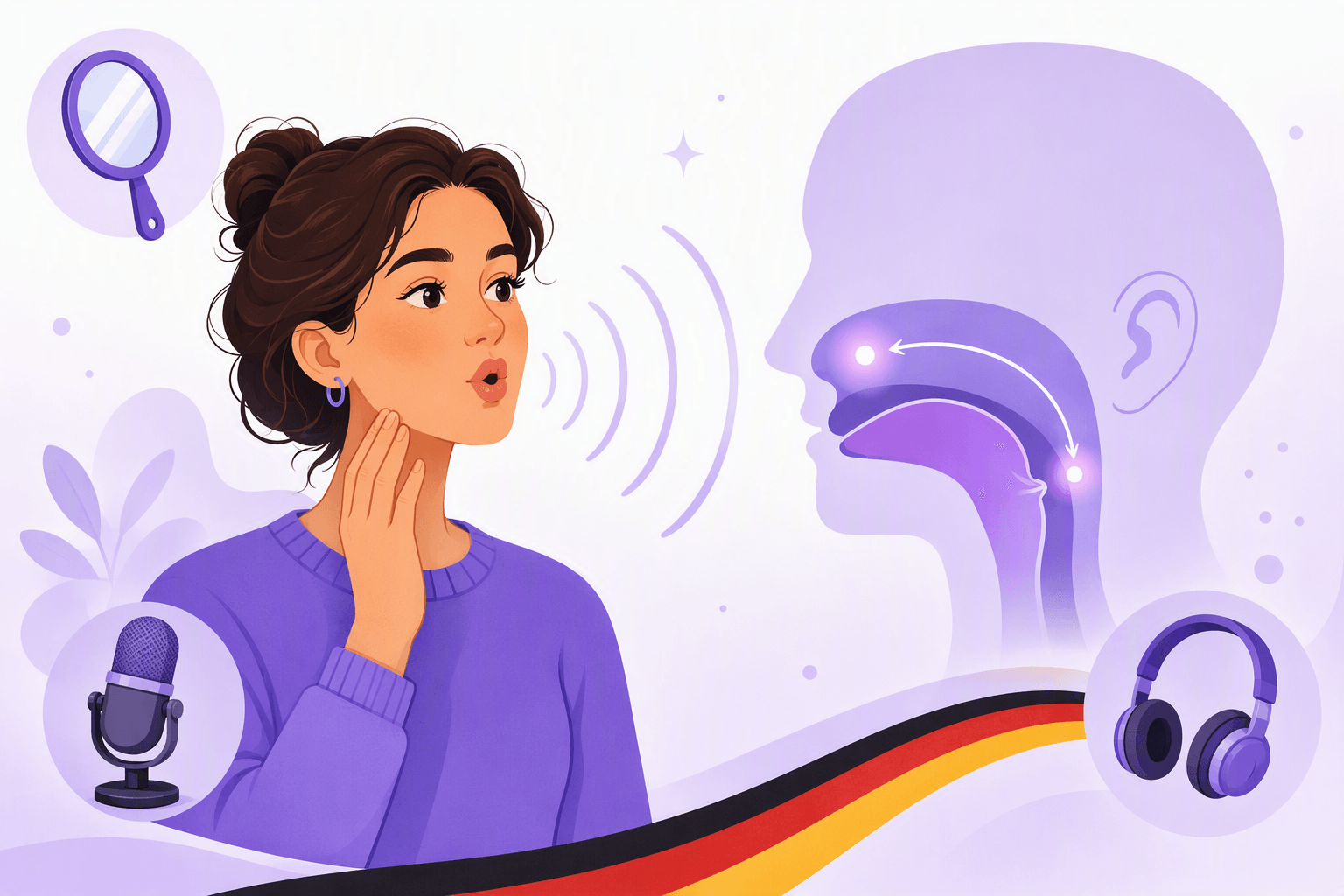
Why German pronunciation feels hard (even when the grammar is going well)
German pronunciation is “honest” in one way: letters often map to sounds more consistently than English. But the hard parts are not the letters, they are the sound categories.
If your native language does not distinguish long vs short vowels, or does not have front-rounded vowels like ü and ö, your brain literally tries to “snap” German into the closest familiar bucket. That is why learners say schon when they mean schön, or ich with an English “sh”.
Phoneticians describe this as category perception: you hear what your system is ready to hear. That is also why minimal pairs work so well, they force your brain to build a new category.
How to practice: a 3-step method that actually changes your accent
Step 1: Mouth position first, volume second
For tricky consonants like ch and r, start by whispering. Whispering removes voicing, so you can focus on airflow and friction.
For vowels like ü/ö, start with a familiar vowel and change only one thing (usually lip rounding). Small, controlled changes beat “trying harder.”
Step 2: Minimal pairs, not word lists
A long vocabulary list lets you “cheat” with context. Minimal pairs remove context, so your ear has to do the work.
You do not need 100 pairs. You need 10 pairs you can say cleanly at speed.
Step 3: Real speech, not isolated words
German in movies is full of reductions, linking, and rhythm. If you only practice slow dictionary forms, you will still freeze when someone speaks quickly.
This is where clip-based practice helps: you hear the sound inside emotion, speed, and background noise. If you are building an immersion routine, pair this article with how to learn a language with movies.
💡 A simple daily routine (8 minutes)
2 minutes: one sound target (like ü) with mouth-position drills. 3 minutes: 5 to 10 minimal pairs, slow then fast. 3 minutes: one short movie clip, shadow the line three times, record once.
The 12 most difficult German sounds (and how to fix each one)
1) ich-Laut: the front ch in ich
What it is: The “ich” sound is a soft, hissy friction sound made toward the front of the mouth. Many learners replace it with English “sh” or “k.”
How it should feel: Tongue high and forward, close to the hard palate, with air squeezing through. Lips relaxed.
English approximation: There is no perfect English match. A useful starting point is to say “hee” and then keep the tongue position while you exhale a soft hiss.
Practice words: ich, nicht, richtig, Milch.
Common mistake: Saying isch (too much “sh”) or ik (too hard).
2) ach-Laut: the back ch in Bach
What it is: The “ach” sound is produced farther back, with the tongue lowered and the throat doing more of the work.
How it should feel: Like a gentle “h” with friction in the back of the mouth. No voicing.
English approximation: Similar to the “ch” in Scottish “loch,” if you know it.
Practice words: Bach, Nacht, machen, lachen.
Quick rule of thumb: After back vowels (a, o, u, au) you usually get the ach-Laut. After front vowels (i, e, ä, ö, ü) you usually get the ich-Laut.
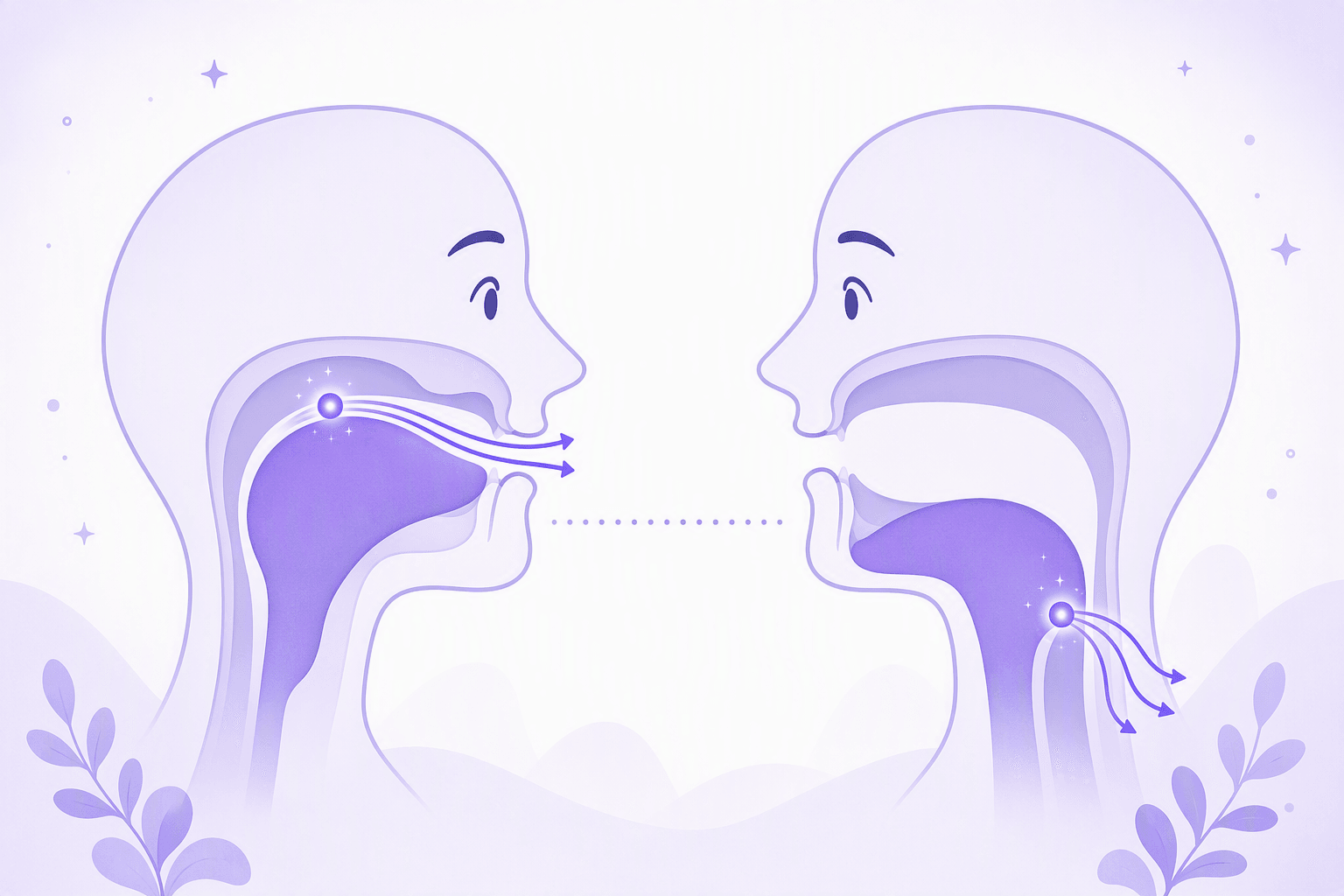
3) r: the German R (uvular vs rolled)
What it is: Standard German commonly uses a uvular “r” made in the back of the throat, not the English tongue-tip “r.”
How it should feel: A light vibration or friction near the uvula. Do not overdo it, a harsh gargle sounds theatrical.
English approximation: Think of a very light “gargle” position, but with less force.
Practice words: rot, richtig, drei, Straße.
Regional reality: German has legitimate variation. The IDS documents regional phonetic differences, including r-realizations, across the German-speaking area. Your goal is intelligibility and consistency, not copying one city perfectly.
4) r in endings: -er in Wasser, Lehrer
What it is: In many accents, -er is reduced, often sounding like “uh” (a schwa-like vowel) rather than a strong “r.”
How it should feel: Relaxed jaw, quick ending, no heavy tongue curl.
English approximation: “uh” as in “sofa,” but shorter.
Practice words: Wasser, Lehrer, besser, später.
Listening tip: This reduction is one reason learners struggle to hear word boundaries. Training your ear here improves comprehension fast.
5) ü: the front-rounded vowel in müde
What it is: ü is a front vowel (tongue forward) with rounded lips. English has rounding, and English has front vowels, but rarely both together.
How it should feel: Start with “ee” (as in “see”), keep the tongue exactly there, then round your lips as if you are going to whistle.
English approximation: “ee” plus rounded lips.
Practice words: müde, über, fünf, Tür.
Minimal pairs to drill: u vs ü like musste vs müsste (meaning changes).
6) ö: the front-rounded vowel in schön
What it is: ö is similar logic: front tongue position, rounded lips.
How it should feel: Start with “eh” (as in “bed” for many speakers), then round the lips without moving the tongue back.
English approximation: “eh” with rounded lips.
Practice words: schön, hören, können, Köln.
If you want a phrase that forces ö in a natural emotional context, romantic lines often contain it. Pair this with how to say I love you in German and listen for how vowels stay clear even when the line is spoken softly.
7) ä: not always “eh,” and sometimes it is
What it is: ä varies by word and region. In many standard pronunciations, long ä can be close to “eh,” while short ä can be more open.
How it should feel: More open than e, less open than a, depending on the word.
English approximation: Somewhere between “eh” and “ah.”
Practice words: Mädchen, spät, Väter, hätte.
Tip: Use a reliable pronunciation reference like Duden’s pronunciation guidance when you are unsure, because spelling alone will not always save you.
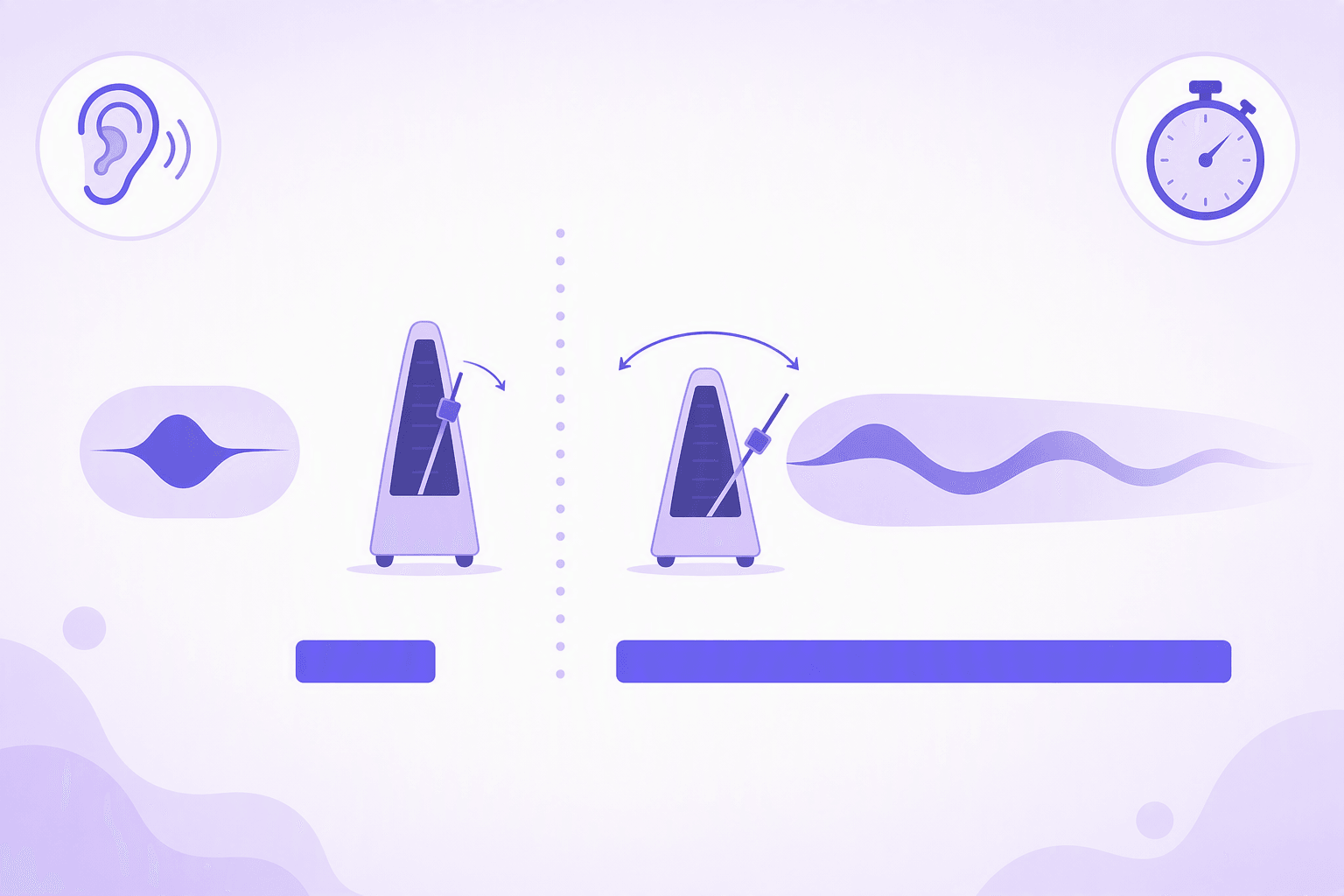
8) Long vs short vowels: bieten vs bitten
What it is: German uses vowel length contrast that changes meaning. This is one of the biggest “I sound foreign” markers when it is off.
How it should feel: Long vowels are held longer and are often tenser. Short vowels are clipped.
English approximation: English has length differences, but they are less systematic. In German, length is a real signal.
Practice minimal pairs:
- bieten vs bitten
- Staat vs Stadt
- Ofen vs offen
Fix: Use a metronome-like count: short = 1 beat, long = 2 beats. Then bring it back to normal speed.
9) Final consonant devoicing: Tag ends like “tahk”
What it is: Many voiced consonants become voiceless at the end of a word. So b becomes p, d becomes t, g becomes k.
How it should feel: Stop voicing at the end. The mouth position is similar, but the vocal cords are off.
English approximation: Think “cap” vs “cab” contrast, but German pushes toward the voiceless end in final position.
Practice words: Tag, Hund, lieb, Weg.
Why it matters: This rule helps both speaking and listening. Once you expect it, you stop “searching” for a voiced ending that is not there.
10) s vs ß vs z: the “surprise” sounds
What it is: German letter-sound mapping here is not what English learners expect:
- s at the start of a word before a vowel is often like “z.”
- ß is like a sharp “s.”
- z is “ts.”
English approximation: z = “ts” as in “cats” ending, but at the start.
Practice words: Sonne (starts like “ZON-neh”), Straße (SHTRAH-suh), Zeit (“tsайт” feel, but say “TSYTE”).
Cultural note: Street names and surnames contain these constantly. If you can say Straße and Zeit cleanly, you will feel more confident reading signs out loud.
11) sch and sp/st at the start: Schule, sprechen, Straße
What it is: sch is “sh.” But sp and st at the start of a word often become “shp” and “sht.”
English approximation: “shp” and “sht” clusters.
Practice words: sprechen, Sport, Straße, stehen.
Fix: Do not insert a vowel. English speakers often say “suh-prechen.” Keep it tight: “SHPREH-khen” style, with your chosen r.
12) ng and final -ig: hängen, König, richtig
ng What it is: ng is usually like “ng” in “sing,” not “n-g” separately.
Practice words: singen, lang, hängen.
-ig What it is: In many standard pronunciations, word-final -ig is closer to an ich-Laut-like sound, not a hard “g.”
Practice words: richtig, fertig, König.
Fix: End it softly. If you slam a hard “g,” it sounds non-native fast.
⚠️ Do not trust English spelling instincts
German spelling is more consistent than English, but it is not a pronunciation script. The hard parts are phonological rules (like devoicing) and new vowel categories (like ü/ö). Use audio, record yourself, and compare. Your ear is the real teacher.
Minimal-pair drills you can run without a teacher
Below are drill sets you can do alone. Say A, then B, then A again. Record once.
Vowel length
- bieten (BEE-ten) vs bitten (BIH-ten)
- Staat (SHTAHT) vs Stadt (SHTAHT with shorter vowel and clearer t)
Umlauts
- schon (shohn) vs schön (shurn)
- musste (MOOS-tuh) vs müsste (MIUHS-tuh)
ch contrast
- ich (ikh with soft front ch) vs ach (ahkh with back ch)
- Licht vs lacht
If you want more everyday vocabulary to plug into these drills, use the core list in 100 most common German words and swap in words that contain your target sound.
What movies and TV reveal about German pronunciation
Textbook audio is clean. Real dialogue is messy, emotional, and fast, which is exactly why it is useful.
In casual speech you will hear:
- Reduced endings, especially -er.
- Clear vowel length even when consonants blur.
- Regional hints, like a more rolled r in some speakers.
This is also why learners sometimes pick up “swear words pronunciation” earlier than polite speech: swearing is emotional, repeated, and rhythmically strong. If you are curious, our guide to German swear words can be a listening exercise, even if you choose not to use the words yourself.
🌍 A pronunciation reality check: German is not one accent
Germany, Austria, and Switzerland share a standard written language, but everyday speech varies a lot. Swiss German dialects can differ strongly from Standard German, and Austrian German has its own vowel color and rhythm. Aim for clear Standard German pronunciation first, then treat regional accents as listening expansion, not as 'mistakes.'
A quick self-test: which sound is your bottleneck?
If people often ask you to repeat:
- Words with ü/ö: you are probably un-rounding or moving the tongue back.
- Words ending in -er: you are likely pronouncing a heavy English r.
- Words with ch: you are probably using “sh” everywhere or using “k” after i/e.
- Short vs long vowels: you are likely speaking with English timing, not German contrast.
Pick one bottleneck for a week. German pronunciation improves faster with focus than with “try to sound German” effort.
Tools that help (and the ones that waste time)
Good:
- IPA charts for awareness, especially if you like technical clarity (IPA resources).
- A pronunciation dictionary reference when you are unsure (Duden).
- Short clips with repetition and recording.
Less useful:
- Tongue twisters too early. They build speed before accuracy.
- Reading aloud for 20 minutes without feedback. You will automate your current mistakes.
If you want a structured approach to listening plus repetition, clip-based practice is the sweet spot: you can loop one line until your mouth matches the audio, then move on.
Wrap-up: the shortest path to clearer German
Master these first: ch (ich/ach), ü/ö, vowel length, and final devoicing. Those four changes alone usually make a learner sound dramatically clearer.
Then add: r consistency, sp/st clusters, and -er reduction. That is where you start sounding natural, not just correct.
When you are ready to practice these sounds in friendly, high-frequency phrases, revisit how to say hello in German and how to say goodbye in German, and shadow the lines until they feel automatic. For a more personal line that forces careful vowels, try how to say I love you in German and listen closely to the vowel length and the final consonants.
If you want to keep building with real dialogue, explore the German track on /learn/german and practice one sound at a time inside scenes you actually enjoy.
Frequently Asked Questions
What is the hardest sound in German?
How do I pronounce German 'ch' correctly?
Do Germans roll the R?
Why does German 'b' sound like 'p' at the end of words?
How can I practice German umlauts (ä, ö, ü) fast?
Sources & References
- Goethe-Institut, 'Aussprache' resources (accessed 2026)
- Duden, 'Aussprachewörterbuch' (accessed 2026)
- Institut für Deutsche Sprache (IDS), resources on German phonetics and variation (accessed 2026)
- Ethnologue, 27th edition, 2024
- International Phonetic Association, IPA Chart and Handbook (accessed 2026)
Start learning with Wordy
Watch real movie clips and build your vocabulary as you go. Free to download.


