Quick Answer
Spanish drinks vocabulary starts with agua, café, cerveza, vino, zumo, and refresco, but real ordering also depends on regional words and café customs. Learn essential drink names, useful menu terms, and polite phrases for ordering naturally in Spain and Latin America.
Spanish drinks vocabulary includes everyday essentials such as agua /ˈaɣwa/ for water, café /kaˈfe/ for coffee, cerveza /beɾˈθesa/ in much of Spain and /beɾˈsesa/ across most of Latin America for beer, and vino /ˈbino/ for wine. To order naturally, use a polite request such as Quisiera una bebida, por favor /kiˈsjeɾa ˈuna beˈβiða poɾ faˈβoɾ/, meaning “I would like a drink, please.”
Spanish is spoken by more than 600 million potential speakers worldwide, according to Instituto Cervantes data, and it is an official language in 20 sovereign countries. That reach means one drink word can change by region: Spaniards commonly ask for zumo /ˈθumo/, while many Latin American speakers say jugo /ˈxuɣo/.
Knowing these words makes cafés, restaurants, markets, and hotel breakfasts much easier. Pair them with a natural greeting from our guide to saying hello in Spanish, and you can handle a basic order confidently.
| English | Spanish | Pronunciation | Note |
|---|---|---|---|
| Water | agua | AH-gwah | Usually feminine: el agua, despite starting with a stressed a sound. |
| Still water | agua sin gas | AH-gwah seen gahss | Literally water without gas. |
| Sparkling water | agua con gas | AH-gwah kohn gahss | Common in Spain and Latin America. |
| Coffee | café | kah-FEH | A masculine noun. |
| Coffee with milk | café con leche | kah-FEH kohn LEH-cheh | A classic Spanish breakfast order. |
| Tea | té | TEH | The accent distinguishes it from te, meaning 'you' as an object. |
| Juice | zumo / jugo | SOO-moh / HOO-goh | Zumo is common in Spain, jugo in much of Latin America. |
| Soft drink | refresco | reh-FREHS-koh | A general word for soda or a cold soft drink. |
| Soda | gaseosa | gah-seh-OH-sah | Common in several Latin American countries. |
| Milk | leche | LEH-cheh | Often ordered hot or cold with coffee. |
| Hot chocolate | chocolate caliente | choh-koh-LAH-teh kah-LYEHN-teh | In Spain it can be notably thick. |
| Lemonade | limonada | lee-moh-NAH-dah | Usually a lemon drink, but recipes vary. |
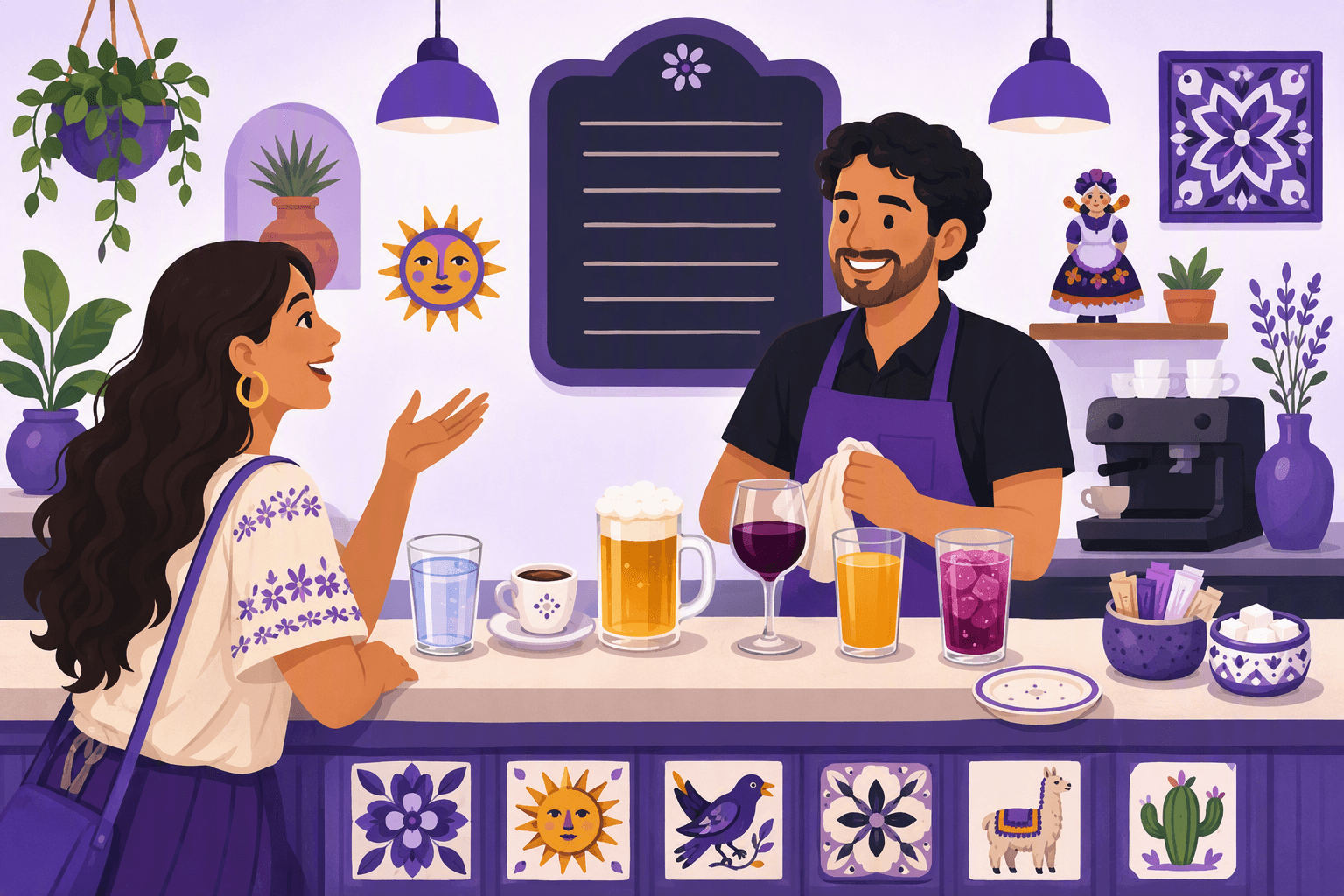
Essential Spanish drink words
The umbrella term bebida /beˈβiða/ means beverage or drink. You will see it on menus, supermarket signs, and restaurant sections, although in conversation people more often name what they want.
The Real Academia Española records both beber /beˈβeɾ/, “to drink,” and tomar /toˈmaɾ/, “to take or have,” as standard verbs. In much of the Spanish-speaking world, tomar algo /toˈmaɾ ˈalɣo/ is a very natural way to say “have a drink.”
Agua
Agua /ˈaɣwa/ means water. Although it is grammatically feminine, singular forms use el agua /el ˈaɣwa/ rather than la agua because two adjacent stressed a sounds are awkward in Spanish.
The adjective remains feminine: el agua fría /el ˈaɣwa ˈfɾia/, “cold water.” Ask for agua sin gas /ˈaɣwa sin ɣas/ when you want still water and agua con gas /ˈaɣwa kon ɣas/ when you want sparkling water.
In restaurants in Spain, bottled water is common and may cost extra. Agua del grifo /ˈaɣwa del ˈɣɾifo/, tap water, is increasingly available, but practices differ by city and restaurant.
Café
Café /kaˈfe/ is coffee, and coffee vocabulary is particularly useful in Spain. A straightforward espresso is often simply un café /uŋ kaˈfe/, although a menu may distinguish it as café solo /kaˈfe ˈsolo/.
A café con leche /kaˈfe kon ˈletʃe/ is coffee with milk. A cortado /koɾˈtaðo/ is espresso “cut” with a small amount of milk, while a descafeinado /deska.fe.iˈnaðo/ is decaffeinated coffee.
Coffee order customs vary more than many visitors expect. In Spain, a late-afternoon café con leche is entirely ordinary, while in Italy the equivalent order after lunch may stand out more. For practical food and drink etiquette, see our Spanish food vocabulary guide.
Té
Té /te/ means tea. The written accent matters because te /te/ without an accent is an object pronoun meaning “you.”
You may see té negro /te ˈneɣɾo/, black tea, té verde /te ˈbeɾðe/, green tea, and infusión /iŋfuˈsjon/, an herbal infusion. If you want milk, say té con leche /te kon ˈletʃe/.
Zumo
In Spain, zumo /ˈθumo/ is juice. Zumo de naranja /ˈθumo ðe naˈɾaŋxa/ means orange juice and is a standard breakfast item in cafés and hotels.
The same word is often pronounced /ˈsumo/ in regions with seseo, where the letters z and c before e or i sound like /s/. This is a pronunciation difference, not a different word.
Jugo
Across much of Latin America, jugo /ˈxuɣo/ is the usual word for juice. You may order jugo de mango /ˈxuɣo ðe ˈmaŋɡo/, mango juice, or jugo natural /ˈxuɣo natuˈɾal/, fresh juice.
In some countries, jugo can also refer to the liquid from cooked food, such as meat juices. Context makes the intended meaning clear.
🌍 Zumo or jugo?
Use zumo /ˈθumo/ or /ˈsumo/ in Spain and jugo /ˈxuɣo/ in most Latin American countries. Both are understood widely, so this is a regional preference, not a serious communication barrier.
Alcoholic drinks in Spanish
Alcohol vocabulary matters in restaurants, celebrations, and nightlife, but knowing the words does not mean you need to drink. Sin alcohol /sin alkoˈol/ means alcohol-free, and it is the key phrase for requesting a non-alcoholic version.
| English | Spanish | Pronunciation | Note |
|---|---|---|---|
| Beer | cerveza | behr-SEH-sah | Pronounced behr-SEH-sah in much of Spain, behr-SEH-sah approximates common Latin American speech too. |
| Draft beer | cerveza de barril | behr-SEH-sah deh bah-RREEL | Beer served from a tap. |
| Small draft beer | caña | KAHN-yah | Especially common in Spain. |
| Wine | vino | BEE-noh | A masculine noun. |
| Red wine | vino tinto | BEE-noh TEEN-toh | Tinto means red in wine contexts. |
| White wine | vino blanco | BEE-noh BLAHN-koh | Blanco means white. |
| Rosé wine | vino rosado | BEE-noh roh-SAH-doh | A common restaurant option. |
| Sparkling wine | vino espumoso | BEE-noh es-poo-MOH-soh | Includes cava and other sparkling wines. |
| Cocktail | cóctel | KOK-tehl | Also written coctel in some regions. |
| Liquor | licor | lee-KOR | Often sweet or served after a meal. |
| Rum | ron | rohn | Common in cocktails across the Caribbean and Latin America. |
| Tequila | tequila | teh-KEE-lah | A Mexican spirit with protected geographic origin. |
Cerveza
Cerveza /beɾˈθesa/ in much of Spain, or /beɾˈsesa/ in most of Latin America, means beer. In Spain, una caña /ˈuna ˈkaɲa/ usually means a small draft beer, while una cerveza may arrive in a bottle, can, or glass depending on the venue.
A jarra /ˈxara/ is a larger beer glass or mug, and una sin /ˈuna sin/ can be shorthand for a non-alcoholic beer in casual Spanish in Spain. Ask ¿Tiene cerveza sin alcohol? /ˈtjene beɾˈθesa sin alkoˈol/ if you want to be fully clear.
Vino
Vino /ˈbino/ means wine. The most useful choices are vino tinto /ˈbino ˈtinto/, red wine, vino blanco /ˈbino ˈblaŋko/, white wine, and vino rosado /ˈbino roˈsaðo/, rosé wine.
Spain is one of the world’s major wine-producing countries, with famous regions including Rioja, Ribera del Duero, Priorat, Rías Baixas, and Jerez. Wine is also central to food culture in Argentina, Chile, and parts of Mexico, though everyday habits and serving styles differ.
Cóctel
Cóctel /ˈkoktel/ means cocktail. The spelling coctel /kokˈtel/ is also accepted in many contexts, but the accented form is common in dictionaries and formal writing.
Names of cocktails travel widely, but ingredients do not always stay fixed. A mojito /moˈxito/, for example, may be sweeter, stronger, or served in a different size depending on the bar and country.
🌍 A shared drink is often a social pause
In Spain, meeting for tomar algo /toˈmaɾ ˈalɣo/ often means meeting to chat, with or without alcohol. The phrase can cover coffee, sparkling water, beer, wine, or a soft drink. Claude Fischler's work on food and social identity helps explain why eating and drinking habits communicate belonging as well as preference.
Drinks you will see on Spanish menus
Restaurant menus use several words that are easy to confuse. Refresco /reˈfɾesko/ is a soft drink, batido /baˈtiðo/ is a milkshake or blended drink, and granizado /gɾaniˈsaðo/ is an icy slush-style beverage.
Horchata /oɾˈtʃata/ has different regional meanings. In Valencia, Spain, it traditionally refers to a sweet chilled drink made from tiger nuts, called chufas /ˈtʃufas/. In Mexico, horchata is commonly rice-based and flavored with cinnamon.
Sangría /saŋˈɡɾia/ is a wine-based punch, often made with fruit. It is strongly associated with Spain abroad, but locals may also order tinto de verano /ˈtinto ðe beˈɾano/, literally “summer red,” a simpler mix of red wine and a lemon soda.
UNESCO’s recognition of the Mediterranean diet emphasizes shared meals, local ingredients, and social practices, not just a list of foods. That context is useful when you see drinks served alongside tapas, late lunches, and long conversations. Learn more useful ordering language in our guide to eating at a restaurant in Spanish.
Useful phrases for ordering drinks
A list of nouns helps, but complete sentences prevent awkward ordering. Spanish speakers generally appreciate a greeting, a clear request, and por favor /poɾ faˈβoɾ/.
| English | Spanish | Pronunciation | Note |
|---|---|---|---|
| I would like a coffee, please | Quisiera un café, por favor | kee-SYEH-rah oon kah-FEH por fah-BOR | Polite and useful in any Spanish-speaking country. |
| Can I have water? | ¿Me puede traer agua? | meh PWEH-deh trah-EHR AH-gwah | Polite restaurant request. |
| Still water, please | Agua sin gas, por favor | AH-gwah seen gahss por fah-BOR | The standard request for still water. |
| Sparkling water, please | Agua con gas, por favor | AH-gwah kohn gahss por fah-BOR | Useful at restaurants and cafés. |
| What do you recommend? | ¿Qué me recomienda? | keh meh reh-koh-MYEHN-dah | Use this when choosing wine, juice, or a local drink. |
| One beer, please | Una cerveza, por favor | OO-nah behr-SEH-sah por fah-BOR | A direct but polite order. |
| Do you have anything without alcohol? | ¿Tiene algo sin alcohol? | TYEH-neh AHL-goh seen ahl-koh-OHL | Works in bars and restaurants. |
| The bill, please | La cuenta, por favor | lah KWEHN-tah por fah-BOR | In Spain, ask when you are ready to leave. |
¿Qué me recomienda?
¿Qué me recomienda? /ke me rekomjenˈda/ means “What do you recommend?” It is useful when a menu lists unfamiliar local drinks, regional wines, or several kinds of coffee.
In a small café, the answer may be brief and practical. In a wine bar or restaurant, staff may ask follow-up questions about sweetness, price, or whether you want a glass, una copa /ˈuna ˈkopa/, or a bottle, una botella /ˈuna boˈteʎa/.
La cuenta
La cuenta /la ˈkwenta/ means the bill or check. In many Spanish-speaking countries, you ask for it rather than waiting for it to arrive automatically.
When you are finished, say La cuenta, por favor /la ˈkwenta poɾ faˈβoɾ/. In more casual settings, a raised hand and por favor may be enough, but the full phrase is always polite.
💡 Use tomar for a natural invitation
To suggest getting a drink, say ¿Tomamos algo? /toˈmamos ˈalɣo/. It means “Shall we get something to drink?” and does not imply alcohol. It could mean coffee after work, a juice, or a beer with friends.
Regional vocabulary worth knowing
Spanish drink vocabulary is unified enough for travel, but local terms add precision. In Mexico, agua fresca /ˈaɣwa ˈfɾeska/ is a sweetened fruit, flower, grain, or seed drink, such as hibiscus, tamarind, or horchata.
In Argentina and Uruguay, mate /ˈmate/ is a caffeinated infusion made from yerba mate and shared from a gourd through a metal straw. Sharing the same bombilla /bomˈbiʎa/ is part of the social ritual, though personal preferences and hygiene norms may affect how it is shared.
In Colombia, Venezuela, and elsewhere, a jugo /ˈxuɣo/ may be made en agua /en ˈaɣwa/, blended with water, or en leche /en ˈletʃe/, blended with milk. Asking which base is used is normal, especially with tropical fruit juices.
The Spanish language has a large common core, yet food and drink vocabulary reveals local history quickly. Francisco Moreno Fernández, in Variedades de la lengua española, examines how regional varieties develop shared standards alongside distinctive local usage. Treat regional words as useful additions, not errors to correct.
Learn drink vocabulary through real scenes
Memorize drink words in situations where people actually say them: a hurried coffee order, friends choosing a bottle of wine, a bartender explaining a local specialty, or a family pouring juice at breakfast. The visual setting helps you remember what the word refers to and when it sounds natural.
Start with five essentials: agua /ˈaɣwa/, café /kaˈfe/, zumo /ˈθumo/ or jugo /ˈxuɣo/, cerveza /beɾˈθesa/, and vino /ˈbino/. Then practice one polite order every day until Quisiera un café, por favor /kiˈsjeɾa uŋ kaˈfe poɾ faˈβoɾ/ feels automatic.
For more travel-ready vocabulary, continue with our Spanish travel phrases and Spanish food culture guide. When you can recognize drink orders in real movie and TV scenes, you begin hearing not only the words, but the pace, politeness, and regional character behind them.
Frequently Asked Questions
What is the most common word for drink in Spanish?
How do you ask for water in Spanish?
What is the difference between zumo and jugo in Spanish?
What does café con leche mean in Spain?
How do you order a beer in Spanish?
Sources & References
- Instituto Cervantes, El español: una lengua viva, 2024
- Real Academia Española, Diccionario de la lengua española, accessed 2026
- Fundación Española de la Nutrición, Guía de la alimentación saludable
- UNESCO, Mediterranean Diet, Intangible Cultural Heritage
- Claude Fischler, El (h)omnívoro, Anagrama
Start learning with Wordy
Watch real movie clips and build your vocabulary as you go. Free to download.


