Quick Answer
The fastest way to improve Korean pronunciation is to focus on syllable blocks, final consonants, consonant tension, vowel distinctions, and the sound changes that happen between words. Learn sounds in real phrases, not isolated letters, and prioritize being clear over copying a perfect native accent.
Korean pronunciation becomes much easier when you stop treating it as English written in a new alphabet. Learn to read each Hangul syllable block, keep Korean syllables evenly timed, distinguish the three main consonant types, and practice sound changes in complete phrases. You do not need a perfect Seoul accent to be understood, but accurate vowels, final consonants, and rhythm will make your Korean immediately clearer.
Korean, or 한국어 /hanɡuɡʌ/, is spoken by more than 80 million people worldwide, according to Ethnologue. It is the principal language of both South Korea and North Korea, as well as a major community language in China, Japan, the United States, and many other countries. That global reach means you will hear regional and generational differences, but the core pronunciation system is stable.
The practical goal is intelligibility: listeners should hear the word you intend, even when you speak slowly. Start by reading Hangul confidently, then use the tips below to turn individual letters into natural, connected speech.
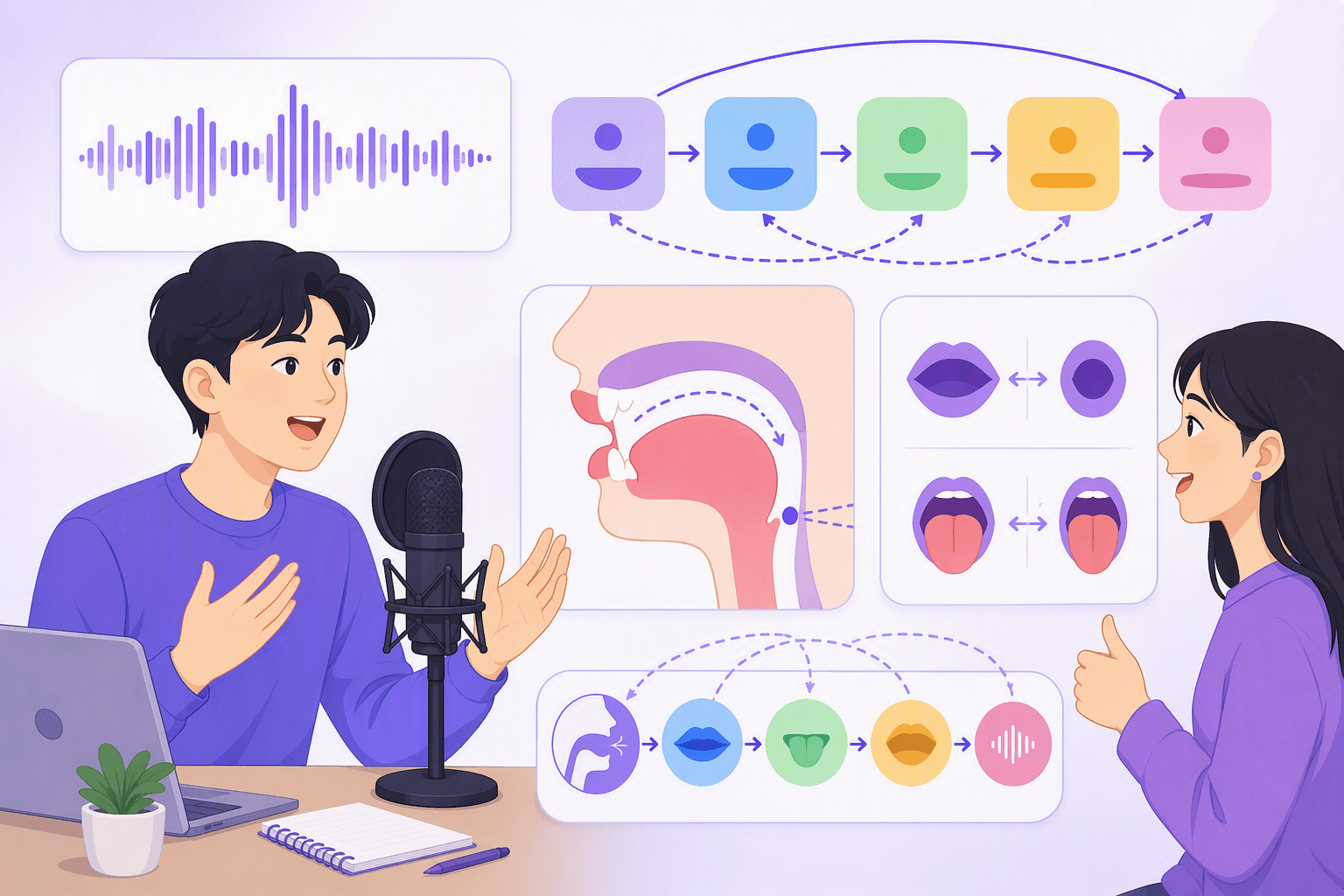
Start with syllable blocks, not romanization
Hangul /haŋɡɯl/ is one of the most systematic writing systems in the world. A Korean syllable is built in a compact block that contains at least one consonant and one vowel, such as 가 /ka/, 나 /na/, or 먹 /mʌk̚/.
Romanization can help briefly, but it has serious limits. The letters in 안녕하세요 /an.njʌŋ.ha.se.jo/ do not behave like the letters in an English-style spelling, and a romanized version cannot reliably show consonant tension, vowel quality, or linking.
The Korean language scholar Ho-min Sohn emphasizes that Korean sound patterns must be understood as a system, especially the relationship between spelling, syllable structure, and phonological rules. That is why reading the original script early is more useful than memorizing long romanized phrase lists.
Give every syllable its own beat
English rhythm compresses unstressed syllables. Korean generally does not. In a word such as 감사합니다 /kam.sa.ham.ni.da/, each syllable receives a clear beat.
Avoid rushing the middle into something like one blurred English word. Say it in four measured units: 감 /kam/, 사 /sa/, 합 /hap̚/, 니 /ni/, 다 /da/. In connected speech, the actual sound changes slightly, but the syllable timing remains perceptible.
💡 A simple rhythm drill
Clap once for each Hangul block as you repeat a phrase. For 감사합니다 /kam.sa.ham.ni.da/, use five even claps. This prevents the English habit of stressing one syllable heavily and swallowing the rest.
Learn the three Korean consonant families
One of the most important Korean pronunciation tips is learning that several consonants come in three versions. English speakers often hear them as minor variations, but Korean listeners use them to distinguish words.
The major contrast is between plain, aspirated, and tense consonants. For example, ㄱ can appear as a plain sound, ㅋ as an aspirated sound, and ㄲ as a tense sound.
| Type | Example letter | IPA | What to notice |
|---|---|---|---|
| Plain | ㄱ | /k~ɡ/ | Light, unvoiced at the beginning of a word |
| Aspirated | ㅋ | /kʰ/ | A noticeable puff of air |
| Tense | ㄲ | /k͈/ | Tight, crisp sound with no extra breath |
This same three-way contrast occurs with several other consonants:
| Plain | Aspirated | Tense |
|---|---|---|
| ㄷ /t~d/ | ㅌ /tʰ/ | ㄸ /t͈/ |
| ㅂ /p~b/ | ㅍ /pʰ/ | ㅃ /p͈/ |
| ㅈ /tɕ~dʑ/ | ㅊ /tɕʰ/ | ㅉ /tɕ͈/ |
| ㅅ /s/ | 없음 | ㅆ /s͈/ |
Test aspiration with paper
Hold a small piece of paper in front of your mouth. When you say ㅋ /kʰ/, ㅌ /tʰ/, ㅍ /pʰ/, or ㅊ /tɕʰ/, the paper should move from the burst of air.
Now compare 카 /kʰa/ with 까 /k͈a/. The tense ㄲ /k͈/ has a firmer onset but much less airflow. Do not add an English vowel before it. Korean ㄲ /k͈/ starts directly and cleanly.
Do not turn tense sounds into doubled English letters
Tense consonants are not simply longer versions of English consonants. In 빨리 /p͈al.li/, meaning quickly, the first sound is produced with a tightened vocal setup, not by saying an extra English “p.”
A useful beginner strategy is to make the tense consonant short, firm, and dry. Keep the following vowel immediate. With practice, your ear will begin to distinguish ㄱ /k~ɡ/, ㅋ /kʰ/, and ㄲ /k͈/ before you can explain the difference consciously.
Master batchim without adding a vowel
A consonant at the bottom of a Korean syllable block is called 받침 /patɕʰim/. It is often translated as a final consonant, but it does not work exactly like an English final consonant.
In English, speakers often release the end of a word strongly. In Korean, a final stop is usually unreleased. For example, the final ㄱ in 먹 /mʌk̚/ ends with the tongue or mouth in position, but there is no extra burst of air.
Korean final consonants reduce to a small set of audible categories:
| Written final consonant | Common final sound | Example |
|---|---|---|
| ㄱ, ㅋ, ㄲ | /k̚/ | 밖 /pak̚/ |
| ㄴ | /n/ | 산 /san/ |
| ㄷ, ㅅ, ㅈ, ㅊ, ㅌ, ㅎ | /t̚/ | 옷 /ot̚/ |
| ㄹ | /l/ | 물 /mul/ |
| ㅁ | /m/ | 밤 /pam/ |
| ㅂ, ㅍ | /p̚/ | 밥 /pap̚/ |
| ㅇ | /ŋ/ | 강 /kaŋ/ |
The National Institute of Korean Language describes these patterns in its standard pronunciation rules. The key fact for learners is that spelling may show many different final consonants, while pronunciation limits them to a smaller inventory.
Release only when a vowel follows
A final consonant can move forward when the next syllable begins with a vowel. For example, 한국어 /han.ɡu.ɡʌ/ is written with ㄱ /k~ɡ/ at the end of 국 /kuk̚/, but the following vowel allows that consonant to link into the next syllable.
This is why reading word by word can sound unnatural. Practice chunks instead: 한국어 /han.ɡu.ɡʌ/, 먹어요 /mʌ.ɡʌ.jo/, and 있어요 /i.s͈ʌ.jo/.
⚠️ Do not add an English-style release
For a word like 밥 /pap̚/, do not finish with a strong puff as if saying “puh.” Close your lips and stop. The final sound is brief, controlled, and often softer than English learners expect.
Expect sound changes between words
Korean spelling is consistent, but spoken Korean is connected. When sounds meet at syllable boundaries, they often influence each other. These are not random shortcuts: they are predictable pronunciation rules.
Jaehoon Yeon and Lucien Brown explain Korean phonology through these regular interactions between consonants, vowels, and grammatical endings. For learners, the solution is not to memorize every word twice. Learn high-frequency patterns, then notice them repeatedly in speech.
Nasal assimilation
When certain final consonants come before ㄴ /n/ or ㅁ /m/, they often become nasal.
For example, 한국말 /han.ɡuŋ.mal/ is commonly pronounced with /ŋ/ before ㅁ /m/. The final ㄱ /k̚/ in 국 /kuk̚/ changes toward the nasal place of articulation, producing a smoother transition.
Another common example is 감사합니다 /kam.sa.ham.ni.da/. The written final ㅂ /p̚/ in 합 /hap̚/ is heard as /m/ before ㄴ /n/, giving /ham.ni/ rather than /hap.ni/.
Lateral and nasal changes
The sequence ㄴ /n/ plus ㄹ /l/ often becomes a doubled lateral sound /lː/. In 신라 /sil.la/, the written ㄴ /n/ and ㄹ /l/ are pronounced closer to /l.l/.
Do not force a full English “n” followed by “r.” Korean ㄹ /ɾ~l/ is not English /ɹ/, and it changes depending on its position. Between vowels, it is usually a quick tap /ɾ/, while at the end of a syllable it is /l/.
Palatalization
A final ㄷ /t̚/ or ㅌ /tʰ/ can shift before 이 /i/ or related vowel sequences. This creates sounds closer to ㅈ /tɕ/ or ㅊ /tɕʰ/.
For example, 같이 /ka.tɕʰi/ is not pronounced by keeping a hard /t/ plus /i/. Native speech joins the sounds smoothly. This is a useful reminder that Korean is best practiced in complete words and phrases, not letter by letter.
Separate the vowels that English tends to merge
Korean has several vowel distinctions that English speakers may initially blur. The most useful pairs to train are ㅓ /ʌ/ versus ㅗ /o/, and ㅜ /u/ versus ㅡ /ɯ/.
The vowel ㅓ /ʌ/ in 어 /ʌ/ is not the vowel in English “oh.” Keep the tongue more central and the lips unrounded. The vowel ㅗ /o/ in 오 /o/ has rounded lips and a higher back position.
For ㅡ /ɯ/, flatten and relax your lips rather than rounding them. It is not identical to English “oo.” Compare:
| Korean vowel | IPA | Example |
|---|---|---|
| 어 | /ʌ/ | 언니 /ʌn.ni/ |
| 오 | /o/ | 오늘 /o.nɯl/ |
| 우 | /u/ | 우리 /u.ɾi/ |
| 으 | /ɯ/ | 음식 /ɯm.ɕik̚/ |
The distinction matters because words can become unclear when vowels collapse. Record yourself saying a minimal contrast, then compare with a reliable dictionary or native audio source.
The ㅐ and ㅔ reality
In contemporary Seoul speech, ㅐ /ɛ/ and ㅔ /e/ are often very close and may merge for many speakers. Do not spend hours trying to create a contrast that native speakers themselves may not maintain consistently.
Focus your effort on vowel pairs that clearly affect comprehension, particularly ㅓ /ʌ/ versus ㅗ /o/, ㅜ /u/ versus ㅡ /ɯ/, and short clean vowels within syllable blocks.
Use intonation for meaning, not dramatic stress
Korean has sentence intonation, but it does not use English-style word stress in the same way. If you heavily stress one syllable in a Korean word, the result can sound unnatural even if every consonant is correct.
Neutral statements usually fall at the end. Yes-or-no questions commonly rise. Compare a statement such as 괜찮아요 /kwɛn.tɕʰa.na.jo/ with a rising version when asking whether something is okay.
The familiar greeting 안녕하세요 /an.njʌŋ.ha.se.jo/ should sound like a smooth sequence rather than five sharply separated English syllables. The middle ㄴ /n/ and ㅕ /jʌ/ blend naturally, and the phrase remains polite without needing exaggerated volume.
For phrase-level practice, use our guide to saying hello in Korean. Learn each phrase with its social context, since pronunciation and politeness work together in Korean interaction.
🌍 Politeness affects how Korean sounds
Korean speech levels change endings, vocabulary, and the social tone of an interaction. A gentle, measured delivery is often more appropriate than an overly forceful one, especially with older people, customers, teachers, or new acquaintances. Clear pronunciation supports politeness because it shows attention to the listener.
Train with short clips and immediate repetition
Pronunciation improves through feedback, not through reading explanations alone. Use short audio segments, ideally one to four seconds long, and repeat them until you can match the rhythm, consonants, and vowel length.
This is especially effective for Korean because connected speech contains linking and assimilation that textbooks cannot fully represent. Watch a short scene, listen once without speaking, then imitate the line several times before checking the subtitles.
Use this four-step loop:
- Listen for the number of syllable blocks.
- Identify final consonants and the first sound of the next syllable.
- Repeat slowly with even timing.
- Repeat again at the speaker’s natural speed.
A drama or variety-show clip is useful because it also teaches emotional delivery. A warm, elongated 괜찮아 /kwɛn.tɕʰa.na/ can sound reassuring, while a short, flat version can sound impatient depending on context.
For useful everyday pronunciation targets, practice Korean goodbye phrases and compare polite endings with casual ones. Romantic phrases are another good listening exercise because emotion makes rhythm easier to notice, as in our guide to saying I love you in Korean.
A realistic 15-minute daily pronunciation routine
A short daily routine is more effective than one long session each week. Your mouth needs repeated exposure to unfamiliar movements, especially for tense consonants and unreleased finals.
Minutes 1 to 3: Read Hangul aloud
Read ten syllable blocks slowly. Include open syllables such as 가 /ka/ and closed syllables such as 각 /kak̚/. Keep your voice steady and avoid adding extra vowels.
Minutes 4 to 7: Contrast one sound pair
Choose one contrast: ㄱ /kɡ/ versus ㅋ /kʰ/, ㅂ /pb/ versus ㅃ /p͈/, or ㅓ /ʌ/ versus ㅗ /o/. Say a few words containing each sound, then record yourself.
Minutes 8 to 12: Shadow a short phrase
Choose one real line from audio. Copy not only the letters but the pace, linking, and emotional contour. Repetition is more valuable than moving through ten new phrases once.
Minutes 13 to 15: Review one difficult word
Pick a word you misheard or mispronounced. Write it in Hangul, mark the syllable blocks, identify its batchim /patɕʰim/, and listen again.
Avoid using harsh vocabulary as your first pronunciation material. If you encounter strong language in shows or games, learn its register before repeating it. Our guide to Korean swear words explains why a phrase’s social force matters as much as its literal meaning.
What clear Korean pronunciation really sounds like
Clear Korean is not about erasing your accent. It is about making sound contrasts audible, finishing syllables cleanly, and using the rhythm listeners expect. A learner with a foreign accent who distinguishes ㅋ /kʰ/ from ㄲ /k͈/ and handles 받침 /patɕʰim/ well will usually be easier to understand than someone who speaks quickly with blurred endings.
Build your pronunciation around Hangul /haŋɡɯl/, frequent phrases, and repeated listening. With daily practice, Korean sound changes stop feeling like exceptions and begin to feel like the natural flow of the language.
Frequently Asked Questions
What is the hardest part of Korean pronunciation for English speakers?
Do I need to learn Hangul before practicing Korean pronunciation?
How can I improve my Korean batchim pronunciation?
Why does Korean sound different from the way it is written?
Should I try to copy Korean pitch accent?
Sources & References
- National Institute of Korean Language, Standard Pronunciation Rules, accessed 2026
- King Sejong Institute Foundation, Korean Language Curriculum, accessed 2026
- Ethnologue, Korean, 27th edition, 2024
- Jaehoon Yeon and Lucien Brown, Korean: A Comprehensive Grammar, Routledge
- Ho-min Sohn, The Korean Language, Cambridge University Press
Start learning with Wordy
Watch real movie clips and build your vocabulary as you go. Free to download.