Quick Answer
Advanced Korean food vocabulary helps you read restaurant menus, understand cooking shows, order confidently, and recognize the cultural language around shared meals. Learn 35 useful Korean terms for ingredients, flavors, preparation methods, and dining etiquette.
Advanced Korean food vocabulary gives you the words behind a menu item, not just the name of a famous dish. Terms such as fermentation, broth, seasoning, grill cut, and shared side dish help you understand what you are ordering, follow Korean cooking content, and participate more naturally at the table. For the basics first, see our guide to Korean food culture and dining etiquette.
Korean is spoken by roughly 80 million people, mainly across South Korea and North Korea, with large communities elsewhere. Food language matters because meals are a major social setting: dishes are shared, side dishes are communal, and cooking vocabulary often carries family, regional, and seasonal associations.
The National Institute of Korean Language records standard meanings and usage for many of these terms, but food words also become vivid through real scenes: a family preparing dinner, coworkers grilling pork, or friends debating which stew to order. Korean cuisine scholar Michael J. Pettid, in Korean Cuisine: An Illustrated History, places these everyday foods in the longer history of agriculture, preservation, and social life on the peninsula.
| English | Korean | Pronunciation | Note |
|---|---|---|---|
| savory depth | 감칠맛 | gahm-cheel-maht | IPA /kam.tɕʰil.mat̚/. A rich, mouth-filling savory quality. |
| spicy | 매콤하다 | meh-kom-hah-dah | IPA /mɛ.kʰom.ha.da/. Pleasantly spicy, often less intense than 맵다. |
| sweet and salty | 단짠 | dahn-jjahn | IPA /tan.t͈ɕ͈an/. Informal blend describing sweet-salty flavor. |
| nutty | 고소하다 | goh-soh-hah-dah | IPA /ko.so.ha.da/. Used for sesame, beans, oils, and roasted flavors. |
| refreshing | 시원하다 | shee-won-hah-dah | IPA /ɕi.wʌn.ha.da/. Often describes cool, clean broth or a relieving flavor. |
| rich and oily | 느끼하다 | neu-kkee-hah-dah | IPA /nɯ.k͈i.ha.da/. Can be negative when food feels overly fatty. |
| bland | 싱겁다 | sheeng-geop-dah | IPA /ɕiŋ.kʌp̚.t͈a/. Not salty or strongly seasoned enough. |
| chewy | 쫄깃하다 | jjol-ggeet-hah-dah | IPA /t͈ɕ͈ol.ɡit̚.ha.da/. Describes a pleasantly springy texture. |
| crispy | 바삭하다 | bah-sahk-hah-dah | IPA /pa.sak̚.ha.da/. Used for fried food, pancakes, and toasted surfaces. |
| soft and tender | 부드럽다 | boo-deu-reop-dah | IPA /pu.dɯ.rʌp̚.t͈a/. Used for meat, tofu, bread, or texture. |
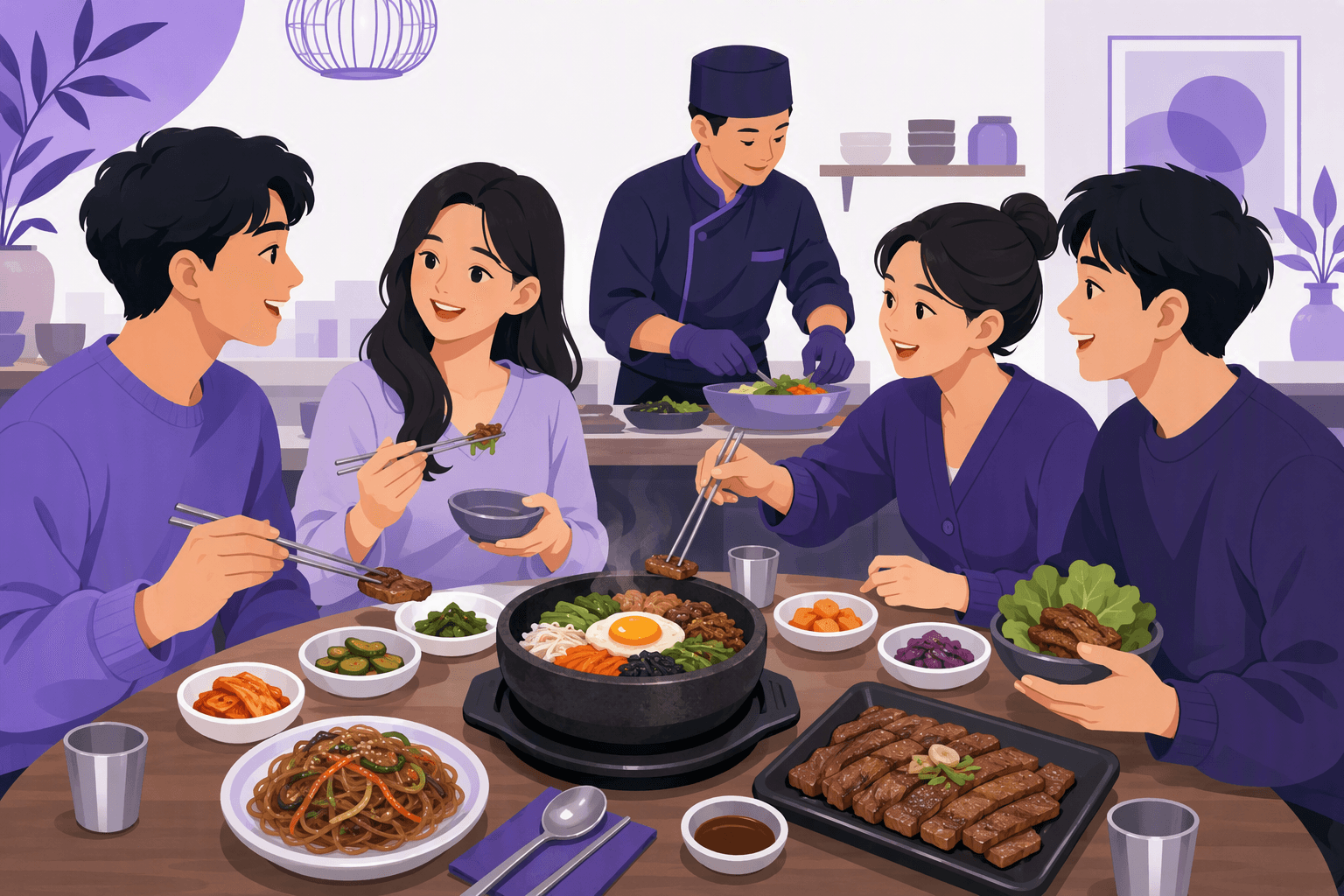
Flavor language that appears on menus and in reviews
Korean food descriptions often focus on texture as much as taste. A restaurant review might praise the 감칠맛 /kam.tɕʰil.mat̚/ of a broth, the 쫄깃하다 /t͈ɕ͈ol.ɡit̚.ha.da/ texture of noodles, or the 바삭하다 /pa.sak̚.ha.da/ crust of fried chicken.
감칠맛
감칠맛 /kam.tɕʰil.mat̚/ is close to savory depth or umami, but it is broader than a laboratory flavor category. It can describe the satisfying taste created by fermented soybean paste, dried anchovies, kelp, mushrooms, meat stock, or slow-cooked bones.
You may hear someone say 감칠맛이 나다 /kam.tɕʰil.ma.ɕi na.da/, meaning that food has that deeply savory quality. It is a compliment, especially for soup, stew, and seasoning.
시원하다
시원하다 /ɕi.wʌn.ha.da/ literally relates to feeling cool or refreshed, but it has a special culinary role. A hot bowl of bean sprout soup can be called 시원하다 because its clear, clean flavor feels relieving, particularly after heavy food or alcohol.
Do not translate it only as “cold.” A steaming soup can be 시원하다 /ɕi.wʌn.ha.da/ because the word describes the effect on the body and palate, not just temperature.
느끼하다
느끼하다 /nɯ.k͈i.ha.da/ describes food that feels too greasy, rich, or cloying. Fried meat, creamy sauces, or fatty pork may become 느끼하다 if there is no acidic, spicy, or fresh ingredient to balance them.
This helps explain why Korean meals frequently pair grilled meat with garlic, raw vegetables, kimchi, and sharp dipping sauces. The contrast is deliberate, not decorative.
Core ingredients and fermentation vocabulary
Fermented ingredients are central to Korean cooking. UNESCO recognizes 김장 /kim.dʑaŋ/, the seasonal practice of making and sharing kimchi in the Republic of Korea, as Intangible Cultural Heritage. Kimjang is a communal practice involving preparation, sharing, and seasonal knowledge, rather than simply a recipe.
| English | Korean | Pronunciation | Note |
|---|---|---|---|
| fermented soybean paste | 된장 | dwen-jahng | IPA /twen.dʑaŋ/. Earthy soybean paste used in soups, stews, and dipping sauces. |
| Korean chili paste | 고추장 | goh-choo-jahng | IPA /ko.tɕʰu.dʑaŋ/. Sweet, spicy fermented chili paste. |
| soy sauce | 간장 | gahn-jahng | IPA /kan.dʑaŋ/. A general word covering several Korean soy sauces. |
| red pepper flakes | 고춧가루 | goh-choot-gah-roo | IPA /ko.tɕʰut̚.k͈a.ɾu/. Dried red pepper powder, essential for kimchi and stews. |
| perilla oil | 들기름 | deul-gee-reum | IPA /tɯl.ɡi.rɯm/. Aromatic oil from perilla seeds. |
| sesame oil | 참기름 | chahm-gee-reum | IPA /tɕʰam.ɡi.rɯm/. Fragrant finishing oil made from toasted sesame. |
| fermented seafood seasoning | 젓갈 | jeot-gahl | IPA /tɕʌt̚.k͈al/. Salted and fermented seafood, often used in kimchi. |
| fermented vegetables | 김치 | gim-chee | IPA /kim.tɕʰi/. Kimchi is a category with many regional and seasonal types. |
| perilla leaf | 깻잎 | kkaet-leep | IPA /k͈ɛt̚.ip̚/. Strongly aromatic leaf used fresh, pickled, or wrapped around meat. |
| green onion | 대파 | deh-pah | IPA /tɛ.pʰa/. Large Korean green onion, common in broths and pancakes. |
된장
된장 /twen.dʑaŋ/ is fermented soybean paste with an earthy, salty flavor. It is the main seasoning in 된장찌개 /twen.dʑaŋ.t͈ɕi.ɡɛ/, a classic stew commonly made with tofu, zucchini, onion, mushrooms, and sometimes beef or clams.
It is not interchangeable with Japanese miso. The ingredients may overlap, but Korean 된장 /twen.dʑaŋ/ is often more pungent and rustic in flavor.
고추장
고추장 /ko.tɕʰu.dʑaŋ/ is a fermented red chili paste. It provides sweetness, heat, salt, and depth at once, which is why it appears in dishes such as 비빔밥 /pi.bim.p͈ap̚/, 떡볶이 /t͈ʌk̚.p͈o.k͈i/, and spicy marinades.
A dish containing 고추장 /ko.tɕʰu.dʑaŋ/ is not automatically extremely hot. Ask about spice level if needed, since recipes vary widely between households and restaurants.
젓갈
젓갈 /tɕʌt̚.k͈al/ refers to salted, fermented seafood. Types include tiny salted shrimp and fermented fish sauce-like products, which add intense savory character to kimchi and side dishes.
The flavor can seem strong at first, but it is usually a background seasoning rather than the main taste. Robert Ji-Song Ku, in Dubious Gastronomy, examines how Korean food gains meaning through migration, identity, and changing ideas of authenticity, and 젓갈 /tɕʌt̚.k͈al/ is a good example of an ingredient whose cultural value exceeds a simple translation.
💡 A useful menu clue
When you see 장 /dʑaŋ/ in a food word, it often points to a sauce, paste, or fermented seasoning. Common examples include 된장 /twen.dʑaŋ/, 고추장 /ko.tɕʰu.dʑaŋ/, and 간장 /kan.dʑaŋ/.
Cooking methods and restaurant menu words
Understanding preparation words makes Korean menus far easier to decode. A dish may be named after its ingredient plus a cooking method, so recognizing one final word can reveal how the whole dish will arrive.
| English | Korean | Pronunciation | Note |
|---|---|---|---|
| to grill or roast | 굽다 | goop-dah | IPA /kup̚.t͈a/. Used for meat, fish, vegetables, and baked items. |
| to stir-fry | 볶다 | bok-dah | IPA /pok̚.t͈a/. Seen in dishes such as 볶음밥, fried rice. |
| to braise in sauce | 조림 | joh-reem | IPA /tɕo.ɾim/. Food simmered until seasoned sauce is absorbed. |
| to steam | 찌다 | jjee-dah | IPA /t͈ɕ͈i.da/. Used for dumplings, eggs, and vegetables. |
| to boil or simmer | 끓이다 | kkeu-ree-dah | IPA /k͈ɯ.ɾi.da/. Used for soups, noodles, and stews. |
| seasoned vegetable side dish | 나물 | nah-mool | IPA /na.mul/. Usually blanched or cooked vegetables seasoned with oil and aromatics. |
| mixed rice dish | 비빔밥 | bee-beem-bahp | IPA /pi.bim.p͈ap̚/. Rice mixed with vegetables, sauce, and often egg or meat. |
| pancake or savory fritter | 전 | jeon | IPA /tɕʌn/. A broad category including seafood and kimchi pancakes. |
| clear soup | 국 | gook | IPA /kuk̚/. Usually lighter and less concentrated than a stew. |
| stew | 찌개 | jjee-geh | IPA /t͈ɕi.ɡɛ/. A substantial, strongly seasoned stew served hot. |
| hot pot soup | 전골 | jeon-gol | IPA /tɕʌn.ɡol/. Shared simmering dish often cooked at the table. |
| rice crust | 누룽지 | noo-roong-jee | IPA /nu.ɾuŋ.dʑi/. Toasted rice crust, eaten dry or simmered into a light soup. |
조림
조림 /tɕo.ɾim/ is braising or simmering an ingredient in a seasoned sauce until the flavor absorbs into it. You may see 갈치조림 /kal.tɕʰi.dʑo.ɾim/, braised cutlassfish, or 감자조림 /kam.dʑa.dʑo.ɾim/, braised potatoes.
The word signals a glossy, reduced sauce and a tender texture. It is a useful contrast with 볶다 /pok̚.t͈a/, stir-frying, which is usually quicker and drier.
전
전 /tɕʌn/ is often translated as pancake, but that can be misleading. Korean 전 /tɕʌn/ may be a thin battered slice of zucchini, a small fish fritter, a mung bean cake, or a large kimchi-and-seafood pancake.
At home, assortments of 전 /tɕʌn/ are especially associated with holiday meals and ancestral memorial rituals. The word is therefore both culinary and cultural.
전골
전골 /tɕʌn.ɡol/ is a shared hot pot cooked at the table or brought simmering in a wide pot. Unlike an individual 찌개 /t͈ɕi.ɡɛ/, it is designed for several people to eat together.
That shared format matches a central convention of Korean dining: dishes are commonly placed in the middle rather than ordered as strictly individual plates. Learn more useful shared-table phrases in our Korean restaurant guide.
Dining vocabulary for eating with confidence
The word 반찬 /pan.tɕʰan/ is one of the most useful words in Korean dining. It means a side dish, but the social practice behind it matters: several small dishes are typically shared across the table with rice, soup, and main dishes.
Rice is 밥 /pap̚/, and a full meal can also be called 밥 /pap̚/ in everyday speech. Asking whether someone has eaten, 밥 먹었어요? /pap̚ mʌ.ɡʌ.s͈ʌ.jo/, can function as a warm social check-in, not merely a question about calories.
반찬
반찬 /pan.tɕʰan/ covers far more than kimchi. It may include spinach 나물 /na.mul/, braised potatoes, fish cake, pickled radish, bean sprouts, acorn jelly, or grilled fish.
At many casual restaurants, refills are expected, but avoid reaching across others or taking the last portion without offering it. The Korean Food Promotion Institute emphasizes the shared structure of Korean meals, where rice, soup, and multiple side dishes form a balanced table rather than a single isolated entrée.
쌈
쌈 /s͈am/ means a wrap, usually made by placing rice, grilled meat, garlic, sauce, and other ingredients inside lettuce or perilla leaf. 쌈장 /s͈am.dʑaŋ/, a thick dipping paste, commonly goes inside.
A wrap is normally made as one bite. Trying to construct a very large 쌈 /s͈am/ can be impractical and may look awkward at a formal meal, even though friends will rarely mind.
🌍 Why grilled meat comes with so many extras
Korean barbecue is not just meat on a grill. Lettuce, perilla leaves, sliced garlic, kimchi, dipping sauce, rice, soup, and side dishes create balance between salty, fatty, spicy, fresh, and fermented flavors. The side dishes are part of the meal's structure, not optional garnish.
How to learn Korean food vocabulary from real scenes
Memorizing isolated dish names helps, but food vocabulary sticks faster when you hear it in context. Watch a Korean cooking show, restaurant scene, or family dinner with Korean subtitles and listen for repeated verbs such as 굽다 /kup̚.t͈a/, 볶다 /pok̚.t͈a/, and 끓이다 /k͈ɯ.ɾi.da/.
Pause whenever a character reacts to flavor. Are they saying 맛있다 /ma.ɕit̚.t͈a/, delicious, 맵다 /mɛp̚.t͈a/, spicy, or 싱겁다 /ɕiŋ.kʌp̚.t͈a/, bland? Food scenes give vocabulary an immediate visual anchor, which makes them ideal for a clip-based study routine.
Pair each new noun with an action and a sensory adjective. Instead of memorizing only 된장 /twen.dʑaŋ/, learn 된장찌개를 끓이다 /twen.dʑaŋ.t͈ɕi.ɡɛ.ɾɯl k͈ɯ.ɾi.da/, to cook soybean paste stew, and 구수하다 /ku.su.ha.da/, pleasantly earthy and savory.
Once food vocabulary feels familiar, practice the social language around it too. A natural greeting opens the interaction, so review how to say hello in Korean, and use a warm farewell after the meal with Korean goodbye phrases. Food language is most useful when it becomes part of a real exchange, not just a menu translation.
Frequently Asked Questions
What Korean food vocabulary should I learn before visiting Korea?
What does 반찬 mean in Korean food culture?
What is the difference between 국, 찌개, and 탕?
How do I ask for less spicy food in Korean?
Why is fermentation so important in Korean cuisine?
Sources & References
- National Institute of Korean Language, Standard Korean Language Dictionary, accessed 2026
- Korean Food Promotion Institute, Korean Food Information and Culinary Resources, accessed 2026
- UNESCO, Kimjang, Making and Sharing Kimchi in the Republic of Korea, accessed 2026
- Ethnologue, Korean, 27th edition, 2024
- Michael J. Pettid, Korean Cuisine: An Illustrated History, Reaktion Books
Start learning with Wordy
Watch real movie clips and build your vocabulary as you go. Free to download.